



NEB Grade 11 Physics Book: Curriculum, Structure, and Content Overview
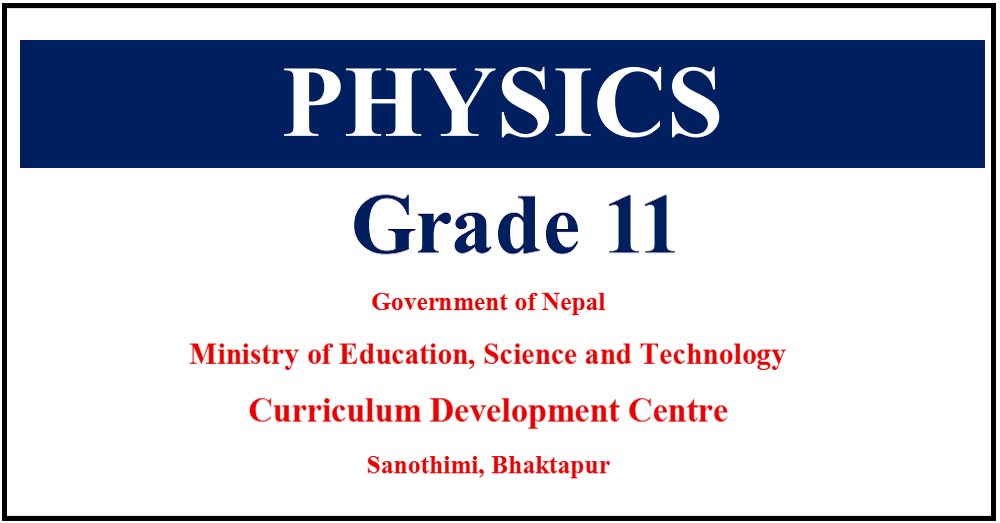
The NEB Grade 11 Physics Book is a core textbook for Class 11 science students in Nepal. The book is officially titled Physics Grade 11 and is published by the Government of Nepal, Ministry of Education & Sports, Curriculum Development Centre, Sanothimi, Bhaktapur.
This textbook is developed to support the aims of the Secondary Level Grade 11–12 Physics Curriculum and is aligned with the National Curriculum Framework for School Education, 2076. It introduces students to measurement, vectors, motion, force, work, energy, circular motion, gravitation, elasticity, heat, optics, electricity, nuclear physics, energy levels, and solids.
About the Grade 11 Physics Textbook
The Physics Grade 11 textbook presents Physics as the study of matter, energy, motion, force, and their interactions. It begins with physical quantities and measurement because Physics depends on observing, measuring, and explaining natural phenomena through numbers, units, laws, and mathematical relations.
The textbook was prepared and edited by an academic team that includes Mr. Arjun Sedai, Mr. Bagirath Neupane, Mr. Upendra Acharya, and Mr. Lav Dev Bhatta. The language editing was done by Mr. Ramesh Dhakal. The first edition of the textbook was published in 2024.
The preface explains that the book has been made activity-oriented and useful for learners. It is designed as a major classroom resource, while teachers are also encouraged to use additional materials according to classroom needs and curriculum goals.
NEB Grade 11 Physics Book Chapter List
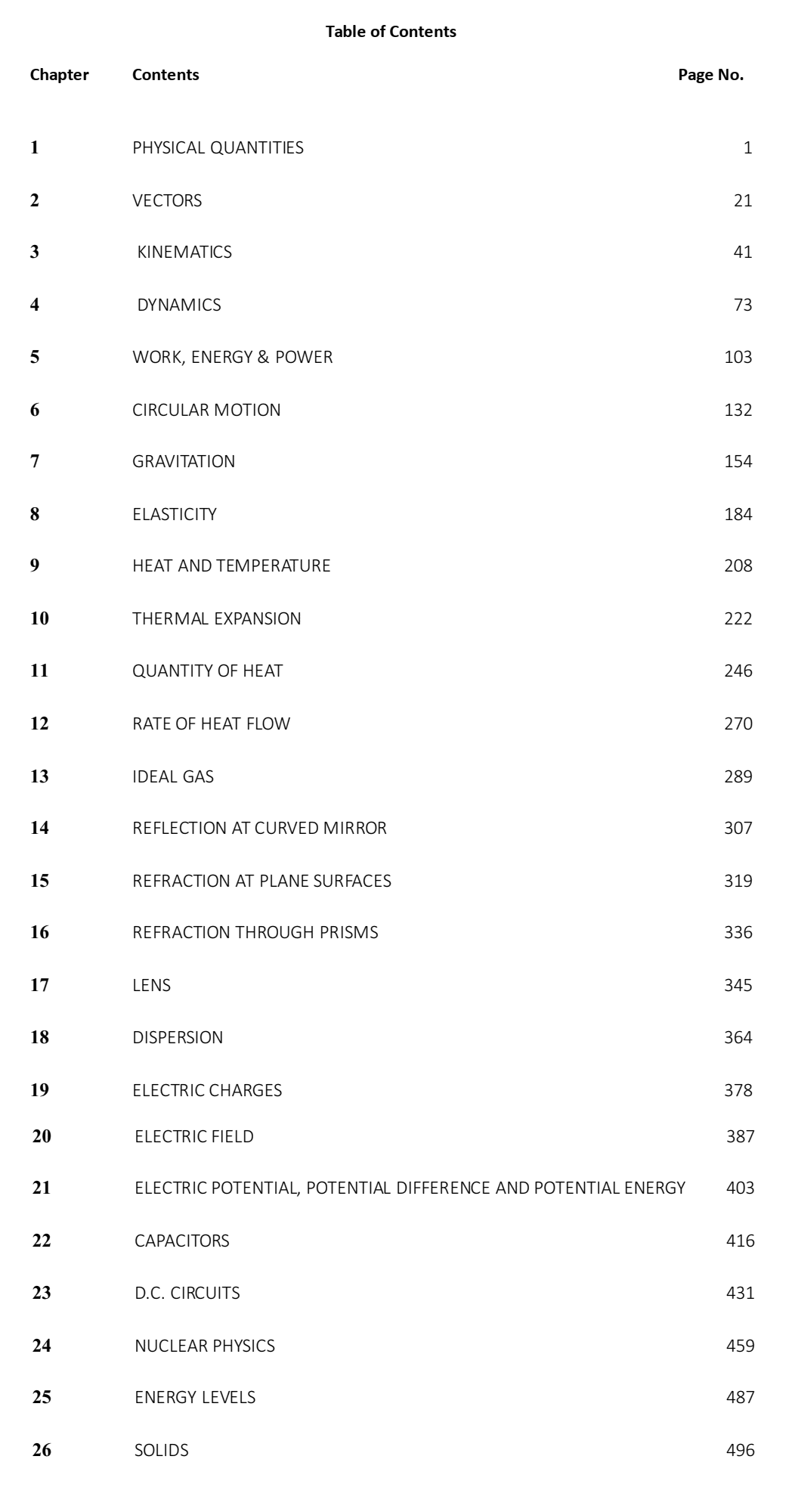
| Chapter No. | Chapter Name |
|---|---|
| 1 | Physical Quantities |
| 2 | Vectors |
| 3 | Kinematics |
| 4 | Dynamics |
| 5 | Work, Energy & Power |
| 6 | Circular Motion |
| 7 | Gravitation |
| 8 | Elasticity |
| 9 | Heat and Temperature |
| 10 | Thermal Expansion |
| 11 | Quantity of Heat |
| 12 | Rate of Heat Flow |
| 13 | Ideal Gas |
| 14 | Reflection at Curved Mirror |
| 15 | Refraction at Plane Surfaces |
| 16 | Refraction Through Prisms |
| 17 | Lens |
| 18 | Dispersion |
| 19 | Electric Charges |
| 20 | Electric Field |
| 21 | Electric Potential, Potential Difference and Potential Energy |
| 22 | Capacitors |
| 23 | D.C. Circuits |
| 24 | Nuclear Physics |
| 25 | Energy Levels |
| 26 | Solids |
Structure and Content of the Book
The Grade 11 Physics book contains 26 chapters. Its structure is practical because it first builds the language of Physics and then moves toward mechanics, heat, optics, electricity, and modern physics.
The first chapter, Physical Quantities, introduces measurement, units, precision, significant figures, dimensions, and dimensional analysis. This chapter is important because every major topic in Physics depends on measurable quantities. Students learn how to express physical quantities with numerical values and units, and how dimensional analysis can help check whether a physical equation is valid.
The second chapter, Vectors, explains the difference between scalar and vector quantities. It covers vector representation, types of vectors, vector addition, subtraction, resolution, rectangular components, scalar product, and vector product. This chapter is essential for understanding motion, force, torque, work, electric field, and other topics where both magnitude and direction matter.
The third chapter, Kinematics, deals with motion without discussing its cause. It explains distance, displacement, speed, velocity, acceleration, distance-time graphs, velocity-time graphs, relative velocity, equations of motion, motion under gravity, and projectile motion. The chapter includes graphs and numerical examples, making it one of the strongest foundations for mechanics.
The fourth chapter, Dynamics, studies motion by considering the force that causes it. It includes force, inertia, linear momentum, impulse, conservation of momentum, Newton’s laws of motion, applications of Newton’s laws, torque, equilibrium, friction, angle of friction, and angle of repose. The chapter connects Physics with daily-life examples such as walking, travelling in a bus, pushing objects, jumping, catching a ball, using a pulley, and standing in a lift.
The fifth chapter, Work, Energy & Power, explains mechanical work, kinetic energy, potential energy, conservation of energy, and power. This chapter helps students understand how force and displacement connect with energy transfer and practical mechanical systems.
The sixth chapter, Circular Motion, introduces motion along a circular path. Students study angular displacement, angular velocity, centripetal acceleration, centripetal force, and related applications. This chapter is useful for understanding rotating objects, circular tracks, planetary motion, and later topics in mechanics.
The seventh chapter, Gravitation, explains gravitational force and its effects. It includes Newton’s law of gravitation, acceleration due to gravity, gravitational field, gravitational potential, orbital motion, and related ideas. This chapter links classroom Physics with planetary motion, satellites, and the motion of bodies under gravity.
The eighth chapter, Elasticity, deals with the behavior of materials under force. It introduces stress, strain, elastic limit, Hooke’s law, modulus of elasticity, and practical uses of elastic properties.
Heat, Optics, Electricity, and Modern Physics
The thermal physics section begins with Heat and Temperature and continues through Thermal Expansion, Quantity of Heat, Rate of Heat Flow, and Ideal Gas. These chapters explain temperature measurement, expansion of solids and liquids, specific heat capacity, latent heat, conduction, convection, radiation, gas laws, and the behavior of ideal gases. This section helps students understand both everyday thermal effects and laboratory-based measurements.
The optics section includes Reflection at Curved Mirror, Refraction at Plane Surfaces, Refraction Through Prisms, Lens, and Dispersion. These chapters cover image formation, mirror formula, refraction, total internal reflection, prism deviation, lens formula, optical instruments, and the splitting of light into colours. Ray diagrams are especially important in this section because they support both understanding and exam writing.
The electricity section begins with Electric Charges and continues through Electric Field, Electric Potential, Potential Difference and Potential Energy, Capacitors, and D.C. Circuits. These chapters introduce charge, Coulomb’s law, electric field intensity, potential difference, electric potential energy, capacitance, current, resistance, Ohm’s law, and direct current circuit analysis.
The final chapters, Nuclear Physics, Energy Levels, and Solids, introduce students to modern and material-related areas of Physics. These chapters help students understand nuclear ideas, quantized energy states, and the physical properties of solids. They also prepare learners for Grade 12 Physics and further study in science and technology.
Learning Approach and Exercise Pattern
The textbook follows an activity-based learning style. Many chapters begin with real-life observations, short historical notes, diagrams, activities, or conceptual questions. For example, the first chapter connects Physics with natural phenomena such as rainfall, rainbow formation, evaporation, clouds, wind, and storms. The chapter on vectors uses familiar examples such as direction, flight, screw rotation, and locating places. The chapter on kinematics uses motion graphs, falling bodies, projectiles, and relative motion.
The book includes conceptual explanations, diagrams, worked examples, sample questions, test-yourself tasks, multiple-choice questions, short-answer questions, long-answer questions, project work, and numerical problems.
This structure is useful because Physics cannot be learned through memorization alone. Students need to understand concepts, apply formulas, interpret graphs, draw diagrams, and solve numerical problems step by step.
Why This Book Is Important for Grade 11 Students
The Class 11 Physics Book builds the foundation for Grade 12 Physics and higher studies in science, engineering, medicine, technology, aviation, environmental science, geoscience, and applied research.
The book starts with measurement and physical quantities, then develops mathematical and conceptual tools through vectors and kinematics. It then moves into dynamics, energy, circular motion, gravitation, elasticity, heat, optics, electricity, and modern physics. This gradual structure helps students move from basic observation to analytical reasoning.
For exam preparation, students should not depend only on guidebooks or short notes. They should read the textbook chapters, practise worked examples, solve exercises, revise formulas, and understand diagrams. Physics becomes clearer when students connect each formula with the physical situation behind it.
Students should give special attention to chapters that require numerical practice, especially Physical Quantities, Vectors, Kinematics, Dynamics, Work-Energy-Power, Circular Motion, Gravitation, Heat, Optics, Electricity, and D.C. Circuits. Graphs, ray diagrams, circuit diagrams, and derivations also need regular revision.
PDF Use and Responsible Access
The PDF version of the NEB Grade 11 Physics Book is useful for students who want to study from a mobile phone, tablet, laptop, or printed copy. It helps students revise chapters, check formulas, practise numerical questions, study diagrams, and access the textbook when the printed copy is not available.
The book should be used responsibly. The copyright page states that the publication belongs to the Curriculum Development Centre and that no part of it may be reproduced or transmitted in any form without written permission from the publisher, except photocopying for teacher training or other non-profit purposes.
Conclusion
The NEB Grade 11 Physics Book is a complete textbook for Class 11 science students in Nepal. It covers the core areas of Physics, including physical quantities, vectors, kinematics, dynamics, work, energy, power, circular motion, gravitation, elasticity, heat, optics, electricity, nuclear physics, energy levels, and solids.
The textbook is useful because it combines theory with diagrams, activities, worked examples, numerical problems, exercises, and project work. Students preparing for Grade 11 Physics should use it as a full learning resource, not only as an exam guide. Reading each chapter carefully, understanding the concepts, practising formulas, and solving numerical problems regularly will make Physics easier to study and more useful in higher-level science learning.




Comments 0
No comments yet. Be the first to start the conversation.