



NEB Grade 11 Chemistry Book PDF: Curriculum, Structure, and Content Overview
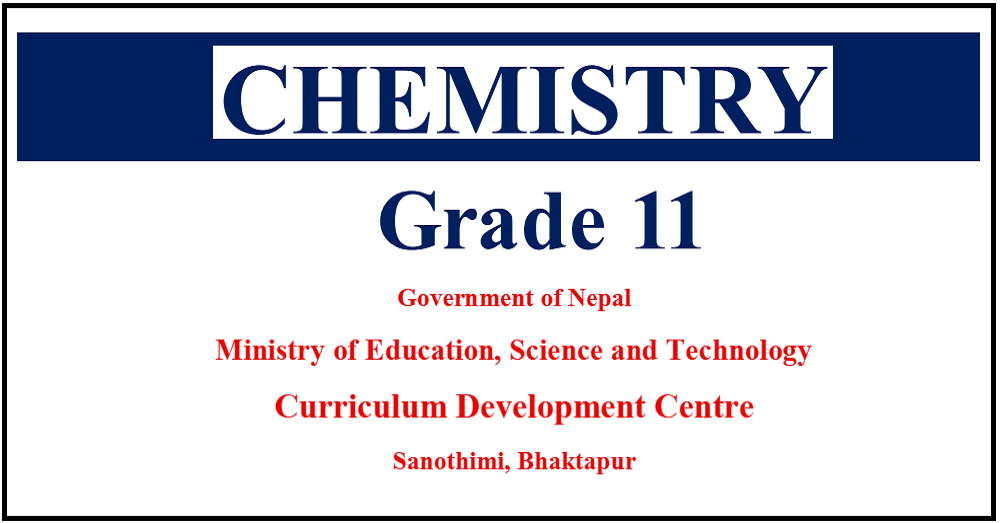
The NEB Grade 11 Chemistry Book is one of the main study resources for Class 11 science students in Nepal. The textbook is officially titled Chemistry Grade 11 and is published by the Government of Nepal, Ministry of Education and Sports, Curriculum Development Centre, Sanothimi, Bhaktapur.
The textbook is prepared for the Secondary Level Grade 11–12 Chemistry Curriculum and is aligned with the National Curriculum Framework for School Education, 2076. It introduces students to the basic language of chemistry, chemical calculations, atomic structure, periodic classification, bonding, equilibrium, inorganic chemistry, organic chemistry, applied chemistry, and modern chemical manufacturing.
Table of Content
- NEB Grade 11 Chemistry Book PDF: Curriculum, Structure, and Content Overview
- About the Grade 11 Chemistry Textbook
- NEB Grade 11 Chemistry Book Unit List
- Structure and Content of the Book
- Inorganic, Organic, and Applied Chemistry Coverage
- Learning Approach and Exercise Pattern
- Why This Book Is Important for Grade 11 Students
- PDF Use and Responsible Access
- Conclusion
- Download Book
About the Grade 11 Chemistry Textbook
The Chemistry Grade 11 textbook presents chemistry as the study of matter, its composition, structure, properties, and changes. The opening unit explains chemistry as the branch of science that studies matter and the way one substance changes into another. It also describes chemistry as a central science because it connects with biology, medicine, agriculture, food science, environmental science, materials science, forensic science, engineering, and technology.
The book was prepared by an academic team that includes Mr. Khem Raj Bhatta, Mr. Hari Prasad Regmi, Mr. Parmatma Mishra, and Mr. Lav Dev Bhatta. The language editing was done by Nabin Kumar Khadka. The textbook’s preface states that the book has been developed to support the aims of the secondary level chemistry curriculum and to make learning activity-oriented and useful for students.
The first edition of the textbook was published in 2024. It is designed as a major classroom resource, but it also encourages teachers to use additional learning materials where needed.
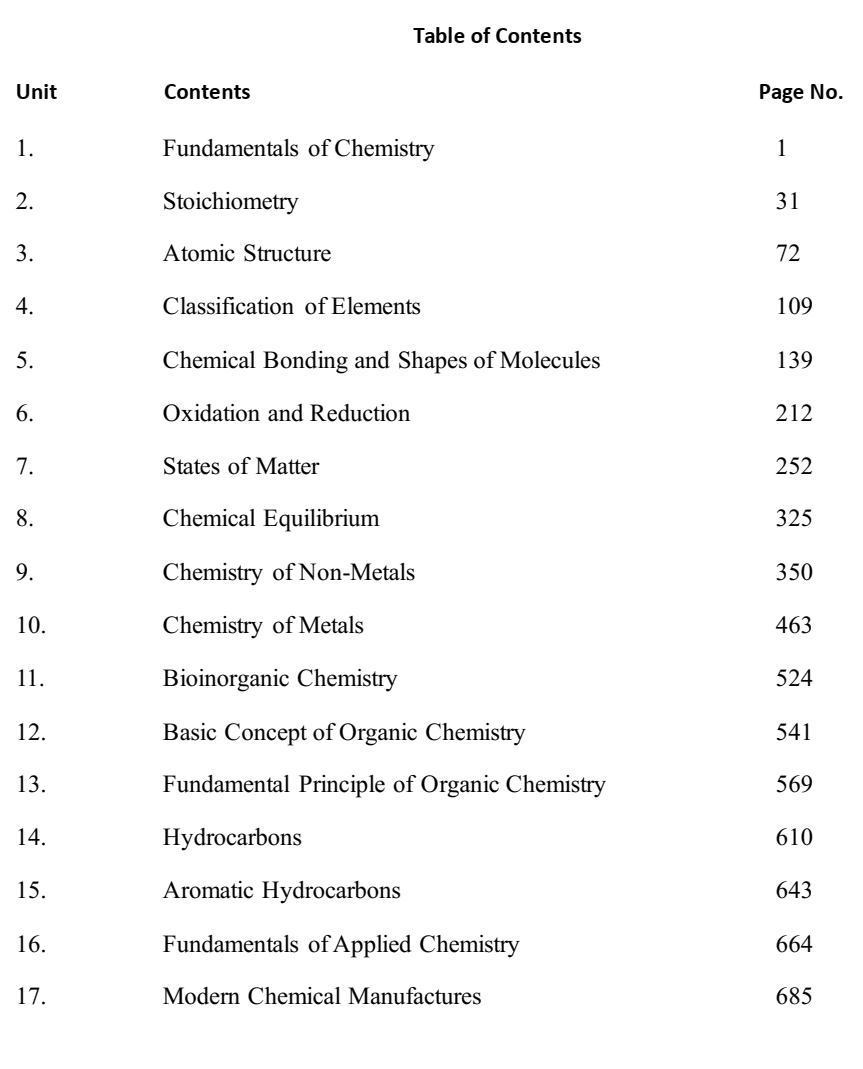
NEB Grade 11 Chemistry Book Unit List
| Unit No. | Unit Name |
|---|---|
| 1 | Fundamentals of Chemistry |
| 2 | Stoichiometry |
| 3 | Atomic Structure |
| 4 | Classification of Elements |
| 5 | Chemical Bonding and Shapes of Molecules |
| 6 | Oxidation and Reduction |
| 7 | States of Matter |
| 8 | Chemical Equilibrium |
| 9 | Chemistry of Non-Metals |
| 10 | Chemistry of Metals |
| 11 | Bioinorganic Chemistry |
| 12 | Basic Concept of Organic Chemistry |
| 13 | Fundamental Principle of Organic Chemistry |
| 14 | Hydrocarbons |
| 15 | Aromatic Hydrocarbons |
| 16 | Fundamentals of Applied Chemistry |
| 17 | Modern Chemical Manufactures |
Structure and Content of the Book
The Grade 11 Chemistry book contains 17 units. The sequence is practical because it begins with basic chemical ideas and gradually moves toward numerical chemistry, atomic theory, periodic trends, bonding, inorganic chemistry, organic chemistry, and industrial applications.
The first unit, Fundamentals of Chemistry, introduces the meaning, importance, and scope of chemistry. It explains matter, chemical change, branches of chemistry, atoms, molecules, ions, radicals, molecular formula, empirical formula, and percentage composition. This unit gives students the basic vocabulary needed for the rest of the course.
The second unit, Stoichiometry, is one of the most important numerical sections of the book. It covers Dalton’s atomic theory, laws of stoichiometry, Avogadro’s law, mole concept, molar mass, gas volume, limiting reactant, excess reactant, theoretical yield, experimental yield, percentage yield, and empirical and molecular formula calculations. Students preparing for exams need strong practice in this unit because many chemistry problems depend on mole-based calculation.
The third unit, Atomic Structure, explains how the idea of the atom developed from earlier atomic theories to the modern quantum model. It includes Rutherford’s atomic model, Bohr’s atomic model, hydrogen spectrum, de Broglie’s wave equation, Heisenberg’s uncertainty principle, probability concept, quantum numbers, orbitals, Pauli’s exclusion principle, Aufbau principle, Hund’s rule, and electronic configuration.
The fourth unit, Classification of Elements, focuses on the modern periodic table. It explains modern periodic law, periods, groups, blocks, metals, non-metals, metalloids, nuclear charge, effective nuclear charge, atomic radius, ionic radius, ionization energy, electronegativity, electron affinity, and metallic character. This unit helps students understand why elements show repeated trends in chemical and physical properties.
The fifth unit, Chemical Bonding and Shapes of Molecules, explains how atoms combine to form compounds. It helps students understand ionic bonding, covalent bonding, molecular shapes, and the relation between structure and properties. This unit is important because chemical bonding is the base for many later topics in inorganic and organic chemistry.
The sixth unit, Oxidation and Reduction, introduces redox reactions and oxidation number. Students learn how electron transfer, oxidizing agents, reducing agents, and redox equations are used to explain chemical change.
The seventh unit, States of Matter, deals with the physical behavior of gases, liquids, and solids. It connects particle-level explanation with observable properties such as pressure, volume, temperature, diffusion, and intermolecular forces.
The eighth unit, Chemical Equilibrium, explains reversible reactions and the condition in which forward and backward reactions occur at the same rate. This unit is useful for understanding reaction systems, industrial chemistry, and later physical chemistry topics.
Inorganic, Organic, and Applied Chemistry Coverage
The textbook gives strong attention to inorganic chemistry through Chemistry of Non-Metals, Chemistry of Metals, and Bioinorganic Chemistry. These units help students understand important elements, their compounds, reactions, preparation methods, uses, and biological significance.
The organic chemistry section begins with Basic Concept of Organic Chemistry and continues through Fundamental Principle of Organic Chemistry, Hydrocarbons, and Aromatic Hydrocarbons. These units introduce carbon compounds, functional groups, structures, reactions, alkanes, alkenes, alkynes, benzene, and related compounds. For students planning to study medicine, pharmacy, agriculture, biotechnology, or chemistry in higher education, this section is especially important.
The final two units, Fundamentals of Applied Chemistry and Modern Chemical Manufactures, connect chemistry with practical life and industry. They show how chemical knowledge is used in production, manufacturing, materials, and daily-use products. These units help students see chemistry not only as a subject for exams but also as a field connected with technology, health, environment, agriculture, and industry.
Learning Approach and Exercise Pattern
The book follows an activity-based style. Many units begin with activities, figures, diagrams, real-life examples, or questions for discussion. This helps students connect textbook ideas with familiar situations before moving into formal theory.
The textbook includes:
-
classroom activities
-
diagrams and figures
-
worked examples
-
“Test yourself” questions
-
multiple choice questions
-
short answer questions
-
long answer questions
-
project work
-
chemical equations and calculations
-
real-life applications of chemistry
This structure is useful because chemistry requires both conceptual understanding and regular practice. Students need to learn definitions, explain theories, solve numerical problems, balance chemical equations, interpret tables, and apply ideas to practical situations.
Why This Book Is Important for Grade 11 Students
The Class 11 Chemistry Book builds the foundation for Grade 12 Chemistry and higher studies in science-related fields. Students who want to study medicine, engineering, agriculture, pharmacy, laboratory technology, environmental science, food technology, biotechnology, or applied science need a strong base in Grade 11 chemistry.
The textbook starts from basic concepts such as matter, atoms, molecules, ions, and chemical formulae. It then develops more advanced areas such as stoichiometry, atomic structure, periodic properties, bonding, equilibrium, inorganic chemistry, organic chemistry, and applied chemistry. This gradual structure helps students move from simple chemical language to more analytical scientific thinking.
For exam preparation, students should not depend only on summaries or guidebooks. They should read each unit, practise the solved examples, complete the exercises, and revise the major formulas, definitions, reactions, and diagrams. Numerical units such as Stoichiometry, Atomic Structure, States of Matter, and Chemical Equilibrium need repeated practice.
PDF Use and Responsible Access
The PDF version of the NEB Grade 11 Chemistry Book is useful for students who want to study from a mobile phone, tablet, laptop, or printed copy. It helps students revise chapters, check exercises, practise numerical problems, and access the textbook when the printed book is not available.
The book should be used responsibly. The copyright page states that the publication belongs to the Curriculum Development Centre and that no part of the book may be reproduced or transmitted in any form without written permission from the publisher, except photocopying for teacher training or other non-profit purposes.
Conclusion
The NEB Grade 11 Chemistry Book PDF is a complete textbook for Class 11 science students in Nepal. It covers the major areas of chemistry, including fundamentals, stoichiometry, atomic structure, periodic classification, bonding, redox reactions, states of matter, equilibrium, inorganic chemistry, organic chemistry, applied chemistry, and modern chemical manufacturing.
The textbook is useful because it combines theory with activities, numerical practice, diagrams, project work, and real-life examples. Students preparing for Grade 11 Chemistry should use it as a full learning resource, not only as an exam guide. Reading each unit carefully, practising exercises, and understanding the concepts step by step will make Chemistry easier, clearer, and more practical.



Study purpose
Study purpose
for study
study purpose