



NEB Grade 12 English Book: Curriculum, Structure, and Content Overview
The NEB Grade 12 English textbook is published by the Government of Nepal, Ministry of Education and Sports, Curriculum Development Centre, Sanothimi, Bhaktapur. The book is titled English Grade 12 and lists its first edition as 2021 AD. According to the preface, the textbook was prepared in line with the National Curriculum Framework 2076 and the Secondary Level Curriculum 2076 for Grades 11 and 12. The curriculum direction behind the book is skill-oriented, life-skill-based, employment-driven and value-based education.
The textbook is designed as an integrated English course rather than a separate collection of grammar rules, reading passages or literary texts. Its main purpose is to develop students’ language ability through reading, vocabulary, writing, grammar, listening, speaking and project-based tasks. The preface clearly states that the book includes content for developing all four language skills, with contextual grammar and related vocabulary. This structure shows that grammar and vocabulary are not treated as isolated topics; they are connected with reading texts, classroom discussion, writing tasks and practical communication.
The book has two main sections: Language Development and Literature. The Language Development section contains 20 units based on contemporary local and global themes. These units are meant to build intensive reading skills and develop competence in grammar, vocabulary, speech and writing.
The Literature section is genre-based and includes short stories, poems, essays and one-act plays. It supports both intensive and extensive reading and encourages learners to interpret texts critically, respond creatively and understand cultural and social contexts.
Table of Content
- NEB Grade 12 English Book: Curriculum, Structure, and Content Overview
- Curriculum Orientation
- Section One: Language Development
- Section Two: Literature
- Overall Structure and Learning Value
- Conclusion
- Download Book
Curriculum Orientation
The curriculum behind the textbook gives importance to practical language use. Students are not only asked to read and answer questions; they are also asked to write e-mails, essays, news stories, press releases, autobiographies, letters, reviews, speeches, CVs, articles, reports, summaries and biographies. These tasks prepare students for academic, personal, public and professional communication.
The speaking section also has a clear functional purpose. Across the units, students practise expressing disappointment, arguing and defending a point, asking for and giving reasons, summarising, expressing certainty, expressing necessity, sharing feelings, comparing and contrasting, reporting, clarifying, reminding, presenting counter-arguments, speculating, criticising, expressing indifference, describing a process, making announcements, predicting, narrating past events, denying and debating. This range of functions makes the speaking component practical and classroom-friendly.
The listening component includes speeches, documentaries, interviews, lectures, news reports, radio reports and conversations. These activities expose students to different forms of spoken English. The project work tasks are also linked with communication and inquiry. Students interview others, develop stories, prepare reports, collect and present information, take part in oratory and debate, visit libraries or fields, use the internet and make oral presentations.
Section One: Language Development
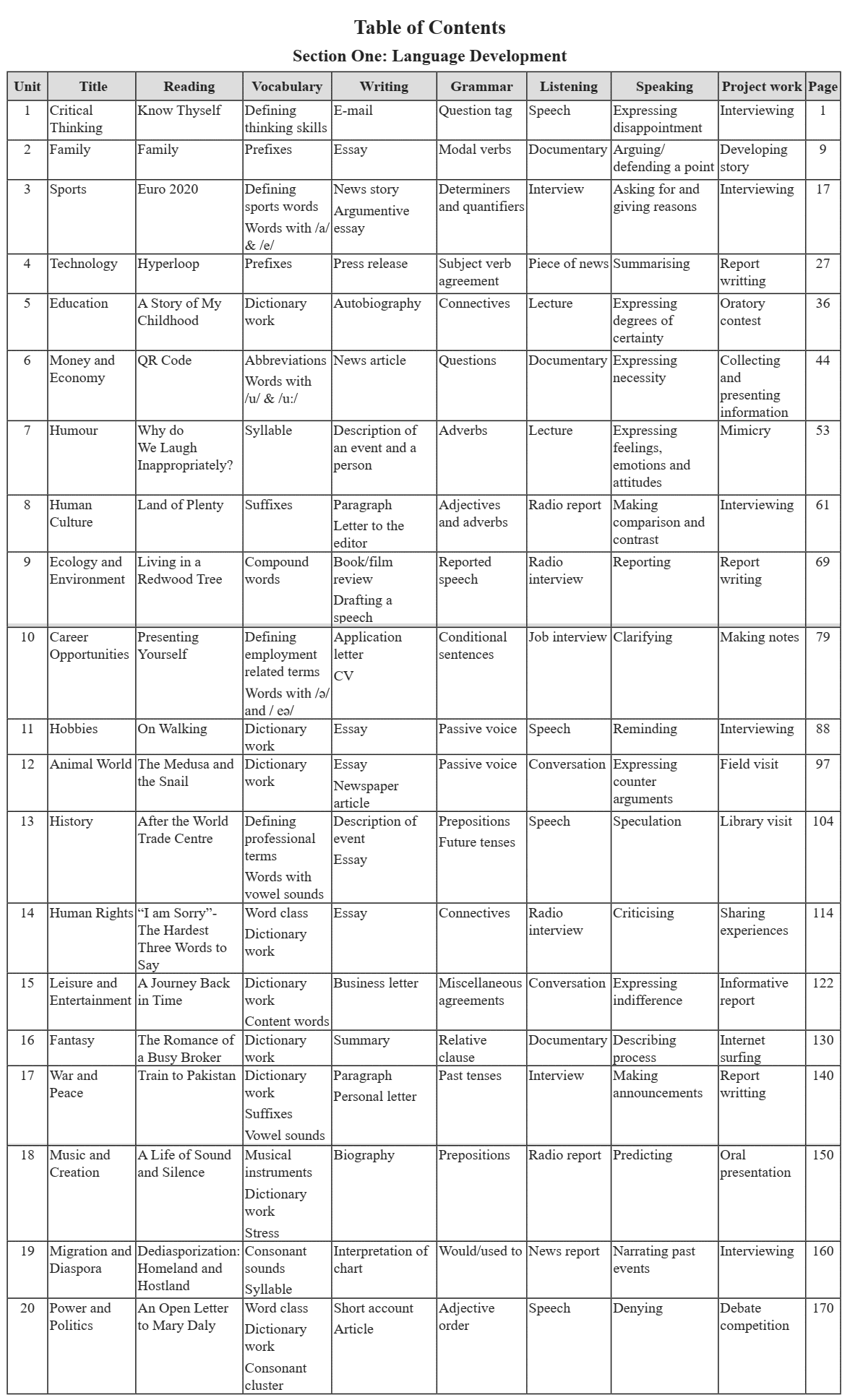
The Language Development section begins with Unit 1: Critical Thinking. The reading text is “Know Thyself.” The unit includes vocabulary related to thinking skills, e-mail writing, question tags, speech listening, expressing disappointment and interviewing. It introduces students to self-reflection and thoughtful communication at the start of the course.
| Unit No. | Unit Name |
|---|---|
| Unit 1 | Critical Thinking |
| Unit 2 | Family |
| Unit 3 | Sports |
| Unit 4 | Technology |
| Unit 5 | Education |
| Unit 6 | Money and Economy |
| Unit 7 | Humour |
| Unit 8 | Human Culture |
| Unit 9 | Ecology and Environment |
| Unit 10 | Career Opportunities |
| Unit 11 | Hobbies |
| Unit 12 | Animal World |
| Unit 13 | History |
| Unit 14 | Human Rights |
| Unit 15 | Leisure and Entertainment |
| Unit 16 | Fantasy |
| Unit 17 | War and Peace |
| Unit 18 | Music and Creation |
| Unit 19 | Migration and Diaspora |
| Unit 20 | Power and Politics |
Unit 2: Family uses the reading text “Family.” It includes prefixes, essay writing, modal verbs, documentary listening, arguing or defending a point and story development. The unit presents family as a social institution and connects reading with personal and social discussion.
Unit 3: Sports is based on “Euro 2020.” It includes sports-related vocabulary, vowel sounds, news story writing, argumentative essay writing, determiners and quantifiers, interview listening, asking for and giving reasons, and interviewing. The unit combines sports reporting with language practice.
Unit 4: Technology uses the text “Hyperloop.” It covers prefixes, press release writing, subject-verb agreement, news listening, summarising and report writing. The unit connects technological innovation with formal communication formats.
Unit 5: Education is based on “A Story of My Childhood.” It includes dictionary work, autobiography writing, connectives, lecture listening, expressing degrees of certainty and an oratory contest. The unit links personal experience with educational reflection.
Unit 6: Money and Economy uses “QR Code.” It covers abbreviations, vowel sounds, news article writing, questions, documentary listening, expressing necessity, and collecting and presenting information. This unit brings economic and digital literacy into language learning.
Unit 7: Humour is built around “Why do We Laugh Inappropriately?” It includes syllables, description of an event and a person, adverbs, lecture listening, expressing feelings, emotions and attitudes, and mimicry. The unit uses humour as a way to study social behaviour and expression.
Unit 8: Human Culture uses “Land of Plenty.” It covers suffixes, paragraph writing, letter to the editor, adjectives and adverbs, radio report listening, comparison and contrast, and interviewing. The unit helps students discuss cultural practices and social observations.
Unit 9: Ecology and Environment is based on “Living in a Redwood Tree.” It includes compound words, book or film review, speech drafting, reported speech, radio interview listening, reporting and report writing. The unit connects environmental issues with public expression and review writing.
Unit 10: Career Opportunities uses “Presenting Yourself.” It includes employment-related vocabulary, vowel sounds, application letter writing, CV writing, conditional sentences, job interview listening, clarifying and note-making. This is one of the most directly career-oriented units in the textbook.
Unit 11: Hobbies is based on “On Walking.” It includes dictionary work, essay writing, passive voice, speech listening, reminding and interviewing. The unit treats a personal activity as a subject for reflection and language practice.
Unit 12: Animal World uses “The Medusa and the Snail.” It includes dictionary work, essay writing, newspaper article writing, passive voice, conversation listening, expressing counter-arguments and a field visit. The unit combines scientific interest with argument and observation.
Unit 13: History is based on “After the World Trade Centre.” It includes professional terms, vowel sounds, description of an event, essay writing, prepositions, future tenses, speech listening, speculation and a library visit. The unit links historical events with interpretation and research habits.
Unit 14: Human Rights uses “‘I am Sorry’—The Hardest Three Words to Say.” It includes word class, dictionary work, essay writing, connectives, radio interview listening, criticising and sharing experiences. The unit encourages students to think about rights, responsibility and social behaviour.
Unit 15: Leisure and Entertainment is based on “A Journey Back in Time.” It includes dictionary work, content words, business letter writing, miscellaneous agreements, conversation listening, expressing indifference and informative report writing.
Unit 16: Fantasy uses “The Romance of a Busy Broker.” It includes dictionary work, summary writing, relative clauses, documentary listening, describing a process and internet surfing.
Unit 17: War and Peace is based on “Train to Pakistan.” It covers dictionary work, suffixes, vowel sounds, paragraph writing, personal letter writing, past tenses, interview listening, making announcements and report writing.
Unit 18: Music and Creation uses “A Life of Sound and Silence.” It includes musical instruments, dictionary work, stress, biography writing, prepositions, radio report listening, predicting and oral presentation.
Unit 19: Migration and Diaspora is based on “Dediasporization: Homeland and Hostland.” It includes consonant sounds, syllables, chart interpretation, would/used to, news report listening, narrating past events and interviewing.
Unit 20: Power and Politics closes the Language Development section with “An Open Letter to Mary Daly.” It includes word class, dictionary work, consonant clusters, short account writing, article writing, adjective order, speech listening, denying and debate competition.
Section Two: Literature
| Unit No. | Unit Name |
|---|---|
| Unit One | Short Stories |
| 1.1 | Neighbours — Tim Winton |
| 1.2 | A Respectable Woman — Kate Chopin |
| 1.3 | A Devoted Son — Anita Desai |
| 1.4 | The Treasure in the Forest — H. G. Wells |
| 1.5 | My Old Home — Lu Xun |
| 1.6 | The Half-closed Eyes of the Buddha and the Slowly Sinking Sun — Shankar Lamichhane |
| 1.7 | A Very Old Man with Enormous Wings — Gabriel Garcia Marquez |
| Unit Two | Poems |
| 2.1 | A Day — Emily Dickinson |
| 2.2 | Every Morning I Wake — Dylan Thomas |
| 2.3 | I Was My Own Route — Julia de Burgos |
| 2.4 | The Awakening Age — Ben Okri |
| 2.5 | Soft Storm — Abhi Subedi |
| Unit Three | Essays |
| 3.1 | On Libraries — Oliver Sacks |
| 3.2 | Marriage as a Social Institution — Stephen L. Nock |
| 3.3 | Knowledge and Wisdom — Bertrand Russell |
| 3.4 | Humility — Yuval Noah Harari |
| 3.5 | Human Rights and the Age of Inequality — Samuel Moyn |
| Unit Four | One-act Plays |
| 4.1 | A Matter of Husbands — Ferenc Molnar |
| 4.2 | Facing Death — August Strindberg |
| 4.3 | The Bull — Bhimnidhi Tiwari |
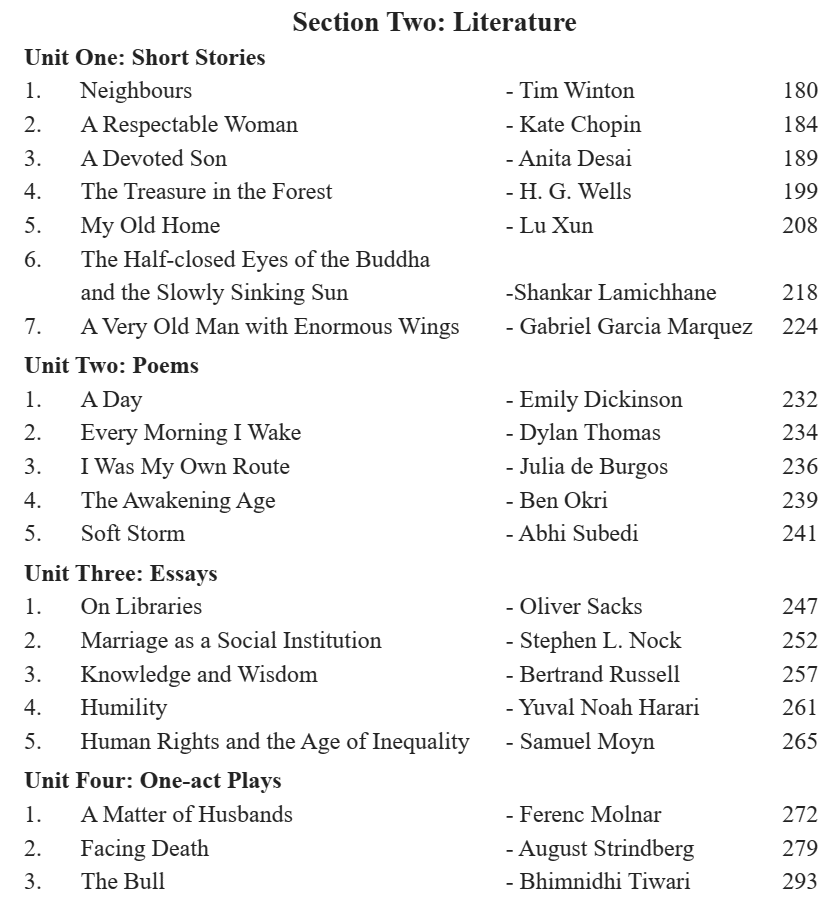
The Literature section is divided into four genre-based units: Short Stories, Poems, Essays and One-act Plays. This section gives students a structured introduction to literary reading. It also extends the reading experience beyond functional texts and helps students practise interpretation, discussion and creative response.
The Short Stories unit contains seven texts: “Neighbours” by Tim Winton, “A Respectable Woman” by Kate Chopin, “A Devoted Son” by Anita Desai, “The Treasure in the Forest” by H. G. Wells, “My Old Home” by Lu Xun, “The Half-closed Eyes of the Buddha and the Slowly Sinking Sun” by Shankar Lamichhane, and “A Very Old Man with Enormous Wings” by Gabriel Garcia Marquez. These stories expose learners to different settings, narrative styles and cultural backgrounds.
The Poems unit includes “A Day” by Emily Dickinson, “Every Morning I Wake” by Dylan Thomas, “I Was My Own Route” by Julia de Burgos, “The Awakening Age” by Ben Okri and “Soft Storm” by Abhi Subedi. The poems encourage close attention to imagery, voice, rhythm, personal feeling and social meaning.
The Essays unit contains “On Libraries” by Oliver Sacks, “Marriage as a Social Institution” by Stephen L. Nock, “Knowledge and Wisdom” by Bertrand Russell, “Humility” by Yuval Noah Harari and “Human Rights and the Age of Inequality” by Samuel Moyn. These essays support reading of argument, reflection and explanation.
The One-act Plays unit includes “A Matter of Husbands” by Ferenc Molnar, “Facing Death” by August Strindberg and “The Bull” by Bhimnidhi Tiwari. This part of the book introduces dramatic dialogue, conflict, character and performance-based reading.
Overall Structure and Learning Value
The Grade 12 English textbook has a broad but organized structure. The Language Development section moves from personal reflection to social issues, technology, economy, environment, career, history, human rights, migration and politics. The Literature section then deepens students’ reading experience through fiction, poetry, essays and drama.
A major strength of the book is the consistent unit pattern. Each language unit includes a reading text followed by vocabulary, comprehension, critical thinking, writing, grammar, listening, speaking and project work. This repeated structure helps students understand what they are expected to do in each lesson while still giving them different topics and tasks.
The book also balances accuracy and expression. Grammar lessons support sentence control, while writing and speaking tasks require students to use language for real purposes. Vocabulary work includes dictionary use, prefixes, suffixes, word class, sounds, stress and content words. Project work adds interaction, research and presentation.
Conclusion
The Grade 12 English textbook is a curriculum-based course designed to develop language skills, critical thinking, literary understanding and practical communication. It connects English learning with academic study, social awareness, workplace preparation and cultural interpretation. Its two-section structure allows students to practise English as both a functional language and a medium for literary and reflective reading.
Note:
All rights reserved with the Curriculum Development Centre; no part of this publication may be reproduced, transmitted in any other forms or by any means without the written permission of the publisher. However, this does not prohibit making photocopies of its pages for teacher training or other non-profit-making purposes.


Comments 0
No comments yet. Be the first to start the conversation.