



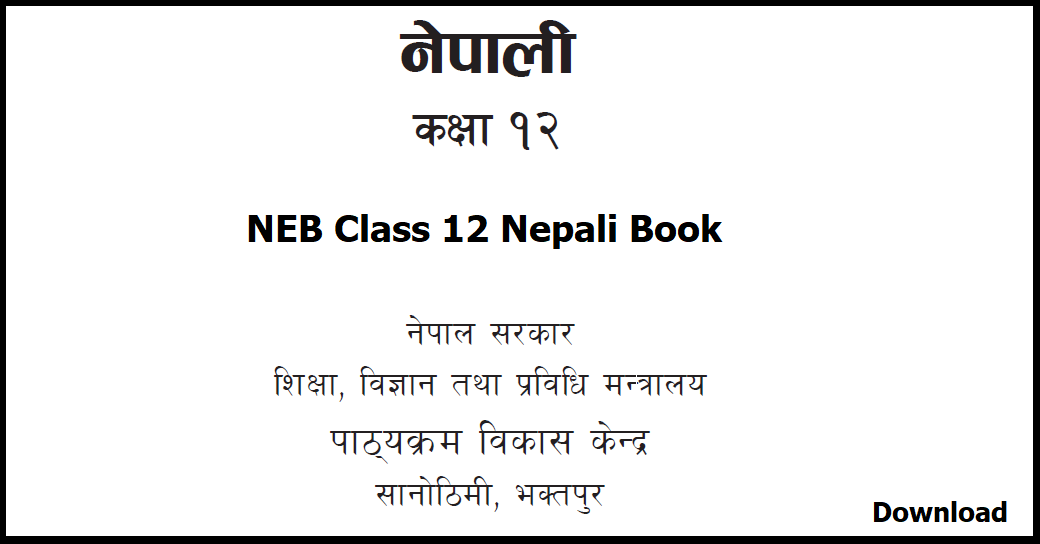
NEB Grade 12 Nepali Book PDF: Complete Textbook, Unit List, and Content Overview
The NEB Grade 12 Nepali Book is the compulsory Nepali textbook used by Class 12 students in Nepal. The book is titled नेपाली कक्षा १२ and is published by the Government of Nepal, Ministry of Education and Sports, Curriculum Development Centre, Sanothimi, Bhaktapur. It is prepared according to the Grade 12 Nepali curriculum and is designed to develop students’ reading, writing, grammar, interpretation, and practical communication skills.
This textbook is important not only for board exam preparation but also for improving students’ command of the Nepali language. It includes poetry, story, travel writing, practical writing, novel, biography, dialogue, essay, and reportage-style writing. Because of this variety, the book gives students exposure to both literary and functional use of Nepali.
Students searching for NEB Grade 12 Nepali Book PDF, Class 12 Nepali Book PDF, or Grade 12 Nepali textbook usually need three things: the official book, a clear unit list, and a short explanation of what the textbook contains. This overview is prepared for that purpose.
About the Grade 12 Nepali Textbook
The Grade 12 Nepali textbook presents Nepali as both a literary and practical subject. The book’s introductory section explains that education should connect learning with real life and help students develop knowledge, reasoning, moral conduct, social harmony, environmental awareness, national identity, and responsible citizenship.
The textbook was written by Dr. Dhan Prasad Subedi and Dr. Prem Chaulagain. It was developed by the Curriculum Development Centre with support from subject experts, editors, and language reviewers. The book also states that it has been prepared in line with the Grade 12 Nepali curriculum based on the National Curriculum Framework.
The content is arranged in a way that helps students move from reading and understanding to analysis, grammar practice, and independent writing. Each unit includes the main text followed by exercises, vocabulary work, comprehension questions, grammar tasks, and writing activities.
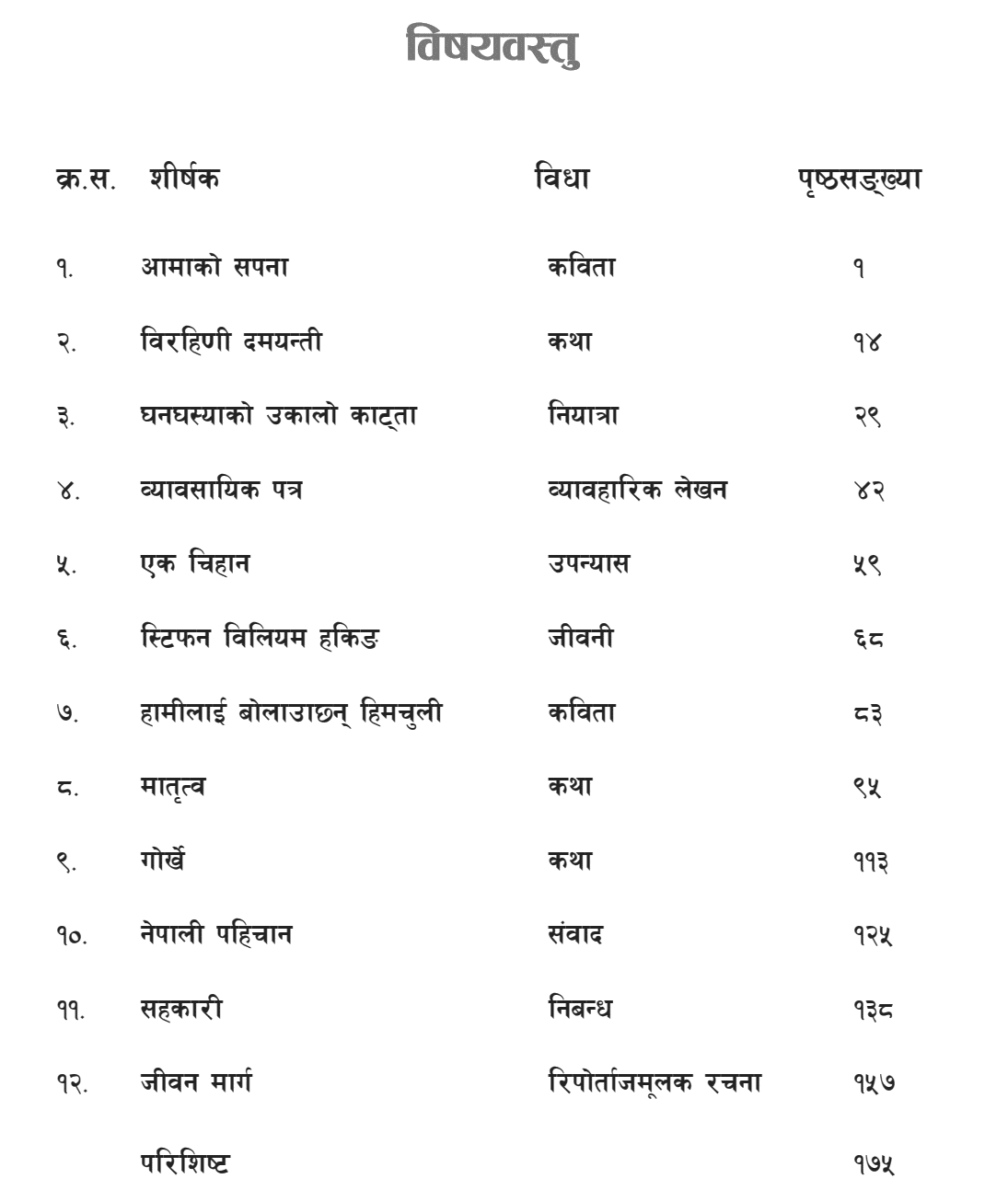
NEB Grade 12 Nepali Book Unit List
| Unit No. | Unit Name |
|---|---|
| 1 | आमाको सपना |
| 2 | बिरहिणी दमयन्ती |
| 3 | घनघस्याको उकालो काट्ता |
| 4 | व्यावसायिक पत्र |
| 5 | एक चिहान |
| 6 | स्टिफन विलियम हकिङ |
| 7 | हामीलाई बोलाउँछन् हिमचुली |
| 8 | मातृत्व |
| 9 | गोर्खे |
| 10 | नेपाली पहिचान |
| 11 | सहकारी |
| 12 | जीवन मार्ग |
Structure and Content of the Book
The book contains 12 main units and an appendix. Each unit represents a different form of Nepali language and literature. This makes the textbook useful for students who need to prepare for exams while also improving their general language ability.
The first unit, “आमाको सपना”, is a poem by Gopal Prasad Rimal. It introduces students to modern Nepali poetry through the voice of a mother, hope, and social imagination. The poem encourages students to think beyond literal meaning and understand emotion, symbolism, and national consciousness.
The second unit, “बिरहिणी दमयन्ती”, is a story. It presents a literary narrative connected with emotion, separation, memory, and character experience. This unit helps students understand descriptive language, storytelling, and emotional expression in Nepali prose.
The third unit, “घनघस्याको उकालो काट्ता”, is a travel-based text. It takes students into a journey setting and teaches them how travel writing records place, movement, people, landscape, and personal experience. This chapter is useful for learning descriptive writing and reflective observation.
The fourth unit, “व्यावसायिक पत्र”, focuses on practical writing. It teaches students how to write formal and business letters. This section is especially useful because students can apply it in exams as well as in real-life communication. It gives attention to format, subject, address, body, closing, and respectful expression.
The fifth unit, “एक चिहान”, belongs to the novel genre. It introduces students to extended fiction and helps them understand plot, character, conflict, setting, and social context. Through this unit, students learn how literature reflects society and human struggle.
The sixth unit, “स्टिफन विलियम हकिङ”, is a biography. It presents the life and contribution of Stephen William Hawking. This chapter connects language learning with science, curiosity, determination, and human achievement. It also helps students understand how a person’s life can be presented in an organized biographical form.
The seventh unit, “हामीलाई बोलाउँछन् हिमचुली”, is a poem. It uses the image of mountains to express inspiration, challenge, beauty, and aspiration. Since mountains are closely linked with Nepal’s identity, this poem also gives students a cultural and symbolic reading experience.
The eighth unit, “मातृत्व”, is a story based on motherhood and human feeling. It helps students understand family, care, sacrifice, affection, and emotional strength through narrative writing.
The ninth unit, “गोर्खे”, is also a story. It adds to the prose section of the book and helps students observe character, social background, dialogue, and narrative development. Students can use this unit to practise both summary writing and interpretation.
The tenth unit, “नेपाली पहिचान”, is written in dialogue form. This unit is important because it presents ideas through conversation. It helps students understand how speakers exchange views, ask questions, respond to each other, and discuss identity through spoken language.
The eleventh unit, “सहकारी”, is an essay. It introduces the idea of cooperative work and collective benefit. This unit is helpful for students learning how to present ideas clearly, organize arguments, and write explanatory paragraphs.
The final unit, “जीवन मार्ग”, is a reportage-style composition. It connects language with real situations, observation, factual presentation, and social experience. This unit helps students understand how information and human experience can be written in a readable and structured way.
Grammar and Exercise Pattern
The Grade 12 Nepali book does not treat grammar as a separate mechanical section only. Grammar is linked with the reading materials and exercises. Students are asked to practise word meaning, sentence structure, pronunciation, spelling, punctuation, transformation, and written expression.
The exercises usually move from simple understanding to deeper analysis. Students first work with vocabulary and comprehension, then answer interpretive questions, practise grammar, and complete writing tasks. This structure is useful for NEB exam preparation because students need to understand the lessons and express their answers clearly in Nepali.
The writing activities are also important. They encourage students to write formal letters, summaries, explanations, personal responses, analytical answers, and practical compositions. These tasks help students move beyond memorization and develop original writing skills.
Why This Book Is Important for Grade 12 Students
The Class 12 Nepali Book supports both academic and practical language learning. It prepares students for the Nepali subject in the board examination, but its value is not limited to exam marks. The book also helps students improve reading habit, vocabulary, grammar accuracy, cultural understanding, and written communication.
The inclusion of different genres makes the textbook balanced. Poetry helps students understand emotion and symbolism. Stories develop narrative understanding. Practical writing builds formal communication skills. Biography connects students with real life and achievement. Dialogue improves conversational understanding. Essay and reportage develop organized thinking and factual presentation.
For better preparation, students should read the original lessons carefully instead of depending only on short summaries. The textbook’s own exercises are important because they show the type of questions students may face and the kind of thinking expected from them.
NEB Grade 12 Nepali Book PDF Use
The PDF version of the NEB Grade 12 Nepali Book is useful for students who want to study from a mobile phone, laptop, tablet, or printed copy. It helps students revise chapters, check exercises, and access the textbook when the printed book is not available.
However, the book should be used responsibly. The copyright page states that commercial reproduction, modification, electronic storage, recording, or copying of the whole or partial content requires written permission from the Curriculum Development Centre. Students may use the PDF for study and reference, but websites should be careful while hosting or redistributing the file.
Conclusion
The NEB Grade 12 Nepali Book is a complete textbook for Class 12 Nepali students. It brings together literature, practical writing, biography, dialogue, essay, grammar, and reportage in one structured volume. From “आमाको सपना” to “जीवन मार्ग”, the book helps students improve Nepali language skills while also developing literary understanding, social awareness, and practical communication ability.
Students preparing for the NEB Grade 12 examination should study each unit carefully, practise the exercises, revise grammar, and write answers in their own words. The textbook is not only a source for exam preparation; it is also a useful resource for improving reading, writing, thinking, and expression in Nepali.


helloo