



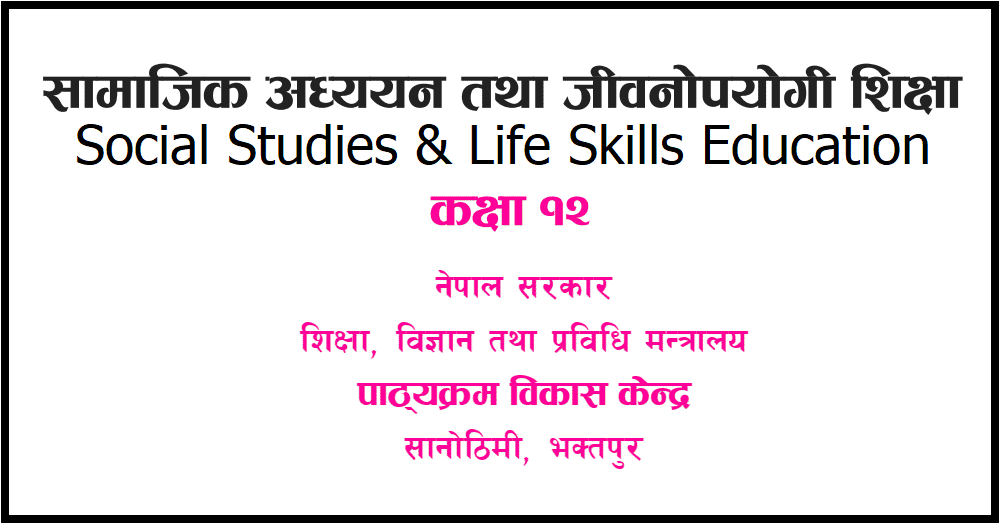
Grade 12 Social Studies and Life Skills Education Book PDF: Complete Unit List and Textbook Overview
The NEB Grade 12 Social Studies and Life Skills Education Book is the official textbook prepared for Class 12 students in Nepal. The book is titled सामाजिक अध्ययन तथा जीवनोपयोगी शिक्षा कक्षा १२ and is published by the Government of Nepal, Ministry of Education and Sports, Curriculum Development Centre, Sanothimi, Bhaktapur.
This textbook combines two closely connected areas of learning: social studies and life skills education. Social studies helps students understand society, history, geography, citizenship, economy, development, diversity, migration, and education. Life skills education helps students build practical abilities such as research skills, digital skills, critical thinking, creative thinking, empathy, self-awareness, emotional management, communication, and responsible decision-making.
For students searching for Grade 12 Social Studies and Life Skills Education Book PDF, Class 12 Social Studies Book PDF, or सामाजिक अध्ययन तथा जीवनोपयोगी शिक्षा कक्षा १२ PDF, this article provides a clear overview of the textbook, its unit structure, major learning areas, and study value.
Table of Content
- Grade 12 Social Studies and Life Skills Education Book PDF: Complete Unit List and Textbook Overview
- About the Grade 12 Social Studies and Life Skills Education Textbook
- Grade 12 Social Studies and Life Skills Education Unit List
- Structure and Content of the Book
- Learning Approach and Classroom Activities
- Why This Book Is Important for Grade 12 Students
- PDF Use and Responsible Access
- Conclusion
- Download Book
About the Grade 12 Social Studies and Life Skills Education Textbook
The textbook presents education as a way to connect classroom learning with real life. Its foreword explains that education should help students develop knowledge, reasoning ability, healthy habits, moral conduct, social harmony, environmental awareness, respect for national identity, and the ability to contribute to an inclusive society.
The book was written by Prof. Dr. Shambhu Prasad Khatiwada, Dr. Nirmalmani Adhikari, Mahendra Bista, and Shyam Prasad Pande. It was developed by the Curriculum Development Centre with support from subject experts, editors, language editors, layout designers, and art editors. The first edition is listed as B.S. 2078.
The book is not only a reading textbook. It is built around activities, discussions, exercises, project work, data collection, analysis, charts, tables, maps, case examples, and practical assignments. This structure makes it useful for board exam preparation as well as for understanding real social issues.
Grade 12 Social Studies and Life Skills Education Unit List
| Unit No. | Unit Name |
|---|---|
| 1 | सामाजिक तथा जीवनोपयोगी शिक्षाको अवधारणा |
| 2 | जीवनोपयोगी सिपका रूपमा डिजिटल सिपहरू तथा सामान्य अनुसन्धान सिपहरू |
| 3 | जीवनोपयोगी सिप |
| 4 | समाजको विकास र दर्शन |
| 5 | भूगोल र सामाजिक जीवन |
| 6 | नेपालको इतिहास |
| 7 | सामाजिक पहिचान र विविधता |
| 8 | संविधान र नागरिक सचेतना |
| 9 | सहरीकरण र बसाइँसराइ |
| 10 | अर्थतन्त्र र विकास |
| 11 | शिक्षा र सामाजिक विकास |
Structure and Content of the Book

The textbook contains 11 main units. The content begins with the concept of social studies and life skills education and then moves into research, digital skills, social philosophy, geography, history, identity, citizenship, urbanization, economy, and education. The sequence is practical because it first builds a foundation and then connects students with wider national and social issues.
The first unit, “सामाजिक तथा जीवनोपयोगी शिक्षाको अवधारणा,” explains the relationship between social studies and life skills education. It introduces social studies as an integrated study of human beings and their physical, social, political, cultural, and economic environment. It also explains how life skills education supports healthy living, personal development, social behavior, and responsible citizenship.
The second unit, “जीवनोपयोगी सिपका रूपमा डिजिटल सिपहरू तथा सामान्य अनुसन्धान सिपहरू,” is one of the most practical sections of the textbook. It covers research introduction, correlation and causation, study proposal structure, ethical use of others’ writing, problem formulation, research method selection, data collection, data analysis, Microsoft Excel, and presentation of verbal information. This unit is especially useful for students preparing project work and research-based assignments.
The third unit, “जीवनोपयोगी सिप,” focuses directly on life skills. It includes the historical background, classification, and practice of life skills. It also discusses critical thinking, creative thinking, empathy, self-awareness, and emotional management. These lessons help students understand themselves, communicate better, manage emotions, and respond to daily situations more thoughtfully.
The fourth unit, “समाजको विकास र दर्शन,” connects society with philosophy, values, and social change. It discusses social diversity in the modern world, development of social relationships, social interdependence, life philosophy, social values, the use of philosophy in daily life, community change, and social transformation.
The fifth unit, “भूगोल र सामाजिक जीवन,” is one of the broadest units in the book. It covers Nepal’s administrative provinces, demographic features, social and cultural conditions, economic features, inter-provincial relations, disasters in Nepal, causes and effects of disasters, disaster management mechanisms, information technology in geography, and the use of geographic information systems in social mapping.
The sixth unit, “नेपालको इतिहास,” gives students a structured view of Nepali history. It includes ancient Nepal, the Lichchhavi period, medieval political conditions, medieval economic, social, and cultural conditions, the rise and decline of small states, the modern period, state power after unification, and modern economy, law, culture, and art.
The seventh unit, “सामाजिक पहिचान र विविधता,” focuses on identity, inclusion, and equality. It covers class and social transformation, gender issues, gender inclusion, disability and inclusion, religious and regional identity, and the idea of an equitable society. This unit is important because it helps students understand social justice, representation, and respect for diversity.
The eighth unit, “संविधान र नागरिक सचेतना,” introduces students to governance and civic awareness. It includes government formation, the work, duties, and rights of government, citizen rights and duties, adolescent rights and duties, the civil code, right to information, ethics, and social accountability.
The ninth unit, “सहरीकरण र बसाइँसराइ,” deals with urbanization and migration. It explains the concept of urbanization, urbanization in Nepal, rural-urban relations, opportunities and challenges of urbanization, migration, migration trends, safe and dignified migration, and the effects of migration.
The tenth unit, “अर्थतन्त्र र विकास,” focuses on Nepal’s economy and development. It includes Nepal’s economy, foreign policy, Nepal-India and Nepal-China relations, international relations, foreign trade, foreign employment policy, economic growth, human development, sustainable development, the poverty cycle, and ways to address poverty.
The eleventh unit, “शिक्षा र सामाजिक विकास,” connects education with human resource development, access, inclusion, social and cultural change, community participation, and employment. This final unit helps students understand education as a driver of social development and livelihood opportunity.
Learning Approach and Classroom Activities
The textbook uses an activity-based learning style. Many lessons begin with a situation, dialogue, case, example, or classroom task. Students are then guided toward discussion, explanation, exercises, and project work. This method supports active learning instead of simple memorization.
The book gives special importance to project-based learning. Students are encouraged to observe communities, collect information, conduct interviews, prepare charts, use digital tools, analyze data, and present findings. This helps them connect textbook knowledge with local realities.
The research and digital skills section is particularly useful for Grade 12 students. It introduces data, sources, surveys, interviews, observation, questionnaires, Microsoft Excel, charts, graphs, tables, report writing, citation, and plagiarism awareness. These topics are directly useful for assignments, fieldwork, and academic writing.
Why This Book Is Important for Grade 12 Students
The Class 12 Social Studies and Life Skills Education Book is important because it connects academic knowledge with practical social understanding. Students learn about Nepal’s provinces, history, Constitution, citizenship, economy, migration, education, diversity, and development. At the same time, they practise skills that are useful beyond exams.
The book also strengthens civic awareness. It introduces students to rights and duties, government responsibilities, information rights, ethical conduct, social accountability, inclusion, and equality. These lessons help students understand their role as responsible citizens.
Another major strength of the textbook is its focus on practical life skills. Critical thinking, creative thinking, empathy, self-awareness, emotional management, research skills, and digital skills are useful in higher education, employment, social participation, and personal decision-making.
For examination preparation, students should study each unit carefully, understand the concepts, practise the exercises, and complete project work honestly. The textbook encourages students to observe society, ask questions, use evidence, and present their ideas clearly.
PDF Use and Responsible Access
The PDF version of the Grade 12 Social Studies and Life Skills Education Book is useful for students who want to study from a mobile phone, laptop, tablet, or printed copy. It helps learners access the textbook anywhere, revise chapters, check unit lists, and prepare for project work.
The book should be used responsibly. The copyright page states that all rights are reserved by the Curriculum Development Centre and that commercial reproduction, modification, recording, copying, or redistribution of the full or partial textbook requires written permission. Students may use the PDF for study and reference, but websites should be careful while hosting or redistributing the file.
Conclusion
The Grade 12 Social Studies and Life Skills Education Book is a complete textbook for Class 12 students in Nepal. It combines social knowledge with practical life skills and prepares students to understand society, citizenship, development, diversity, economy, history, geography, migration, and education.
From “सामाजिक तथा जीवनोपयोगी शिक्षाको अवधारणा” to “शिक्षा र सामाजिक विकास,” the textbook guides students through academic and real-life learning. It helps them build knowledge, research ability, ethical awareness, digital skills, civic understanding, and practical thinking.
Students preparing for Grade 12 should use this book as a full learning resource, not only as an exam guide. Reading the lessons, practising exercises, preparing project work, and understanding social issues in context will make the subject more useful and easier to remember.


Comments 0
No comments yet. Be the first to start the conversation.