



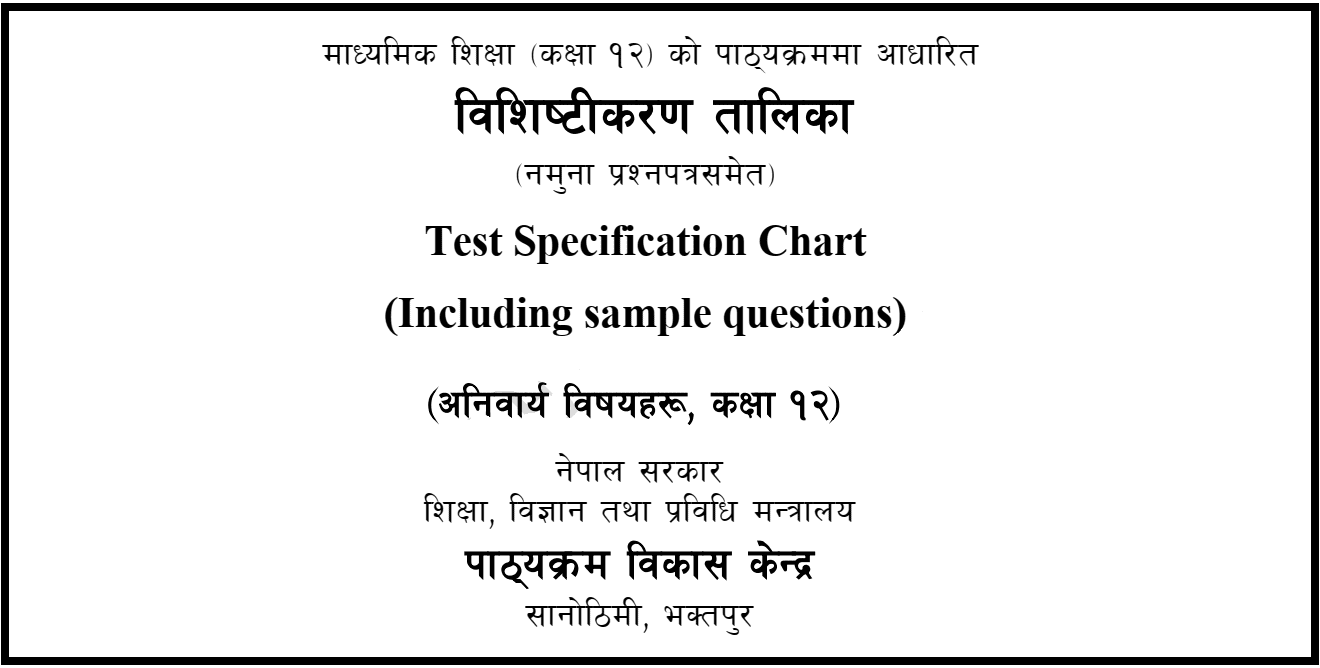
NEB Class 12 Specification Chart and Sample Questions of Compulsory Subjects
The NEB Class 12 Specification Chart and Sample Questions of Compulsory Subjects PDF is an important reference document for Grade 12 students, teachers, and question setters in Nepal. The document is officially titled Test Specification Chart (Including Sample Questions) and is based on the Secondary Education Class 12 curriculum.
It is published by the Government of Nepal, Ministry of Education and Sports, Curriculum Development Centre, Sanothimi, Bhaktapur. Students often search for this document as NEB Class 12 specification chart, Class 12 specification grid, Class 12 model questions with specification grid, or Grade 12 compulsory subjects sample questions.
This document is useful because it explains the question pattern, marks distribution, competency levels, and sample question structure for Class 12 compulsory subjects. It does not only provide model questions; it also shows how examination questions should be planned according to the curriculum.
Table of Content
- NEB Class 12 Specification Chart and Sample Questions of Compulsory Subjects
- About the Class 12 Specification Chart
- Subjects Included in the Document
- Purpose of the Specification Chart
- Compulsory Nepali Specification Chart
- Compulsory English Specification Chart
- Social Studies and Life Skills Education Specification Chart
- Mathematics Specification Chart
- Why This Document Is Important for Class 12 Students
- How Students Should Use This PDF
- PDF Use and Responsible Access
- Conclusion
- Donwnload
About the Class 12 Specification Chart
A specification chart is a structured plan used for preparing examination questions. It helps ensure that questions are not selected randomly. Instead, the question paper is prepared by considering the curriculum, learning outcomes, subject content, question types, marks, time, and competency levels.
The document explains that assessment should be objective, reliable, valid, and aligned with the curriculum. A specification chart supports this by guiding teachers and question setters on what to ask, how many questions to ask, how much mark weight to assign, and which learning levels to assess.
The first edition of this document was published in Poush 2078 BS. It includes specification charts and sample questions for Class 12 compulsory subjects.
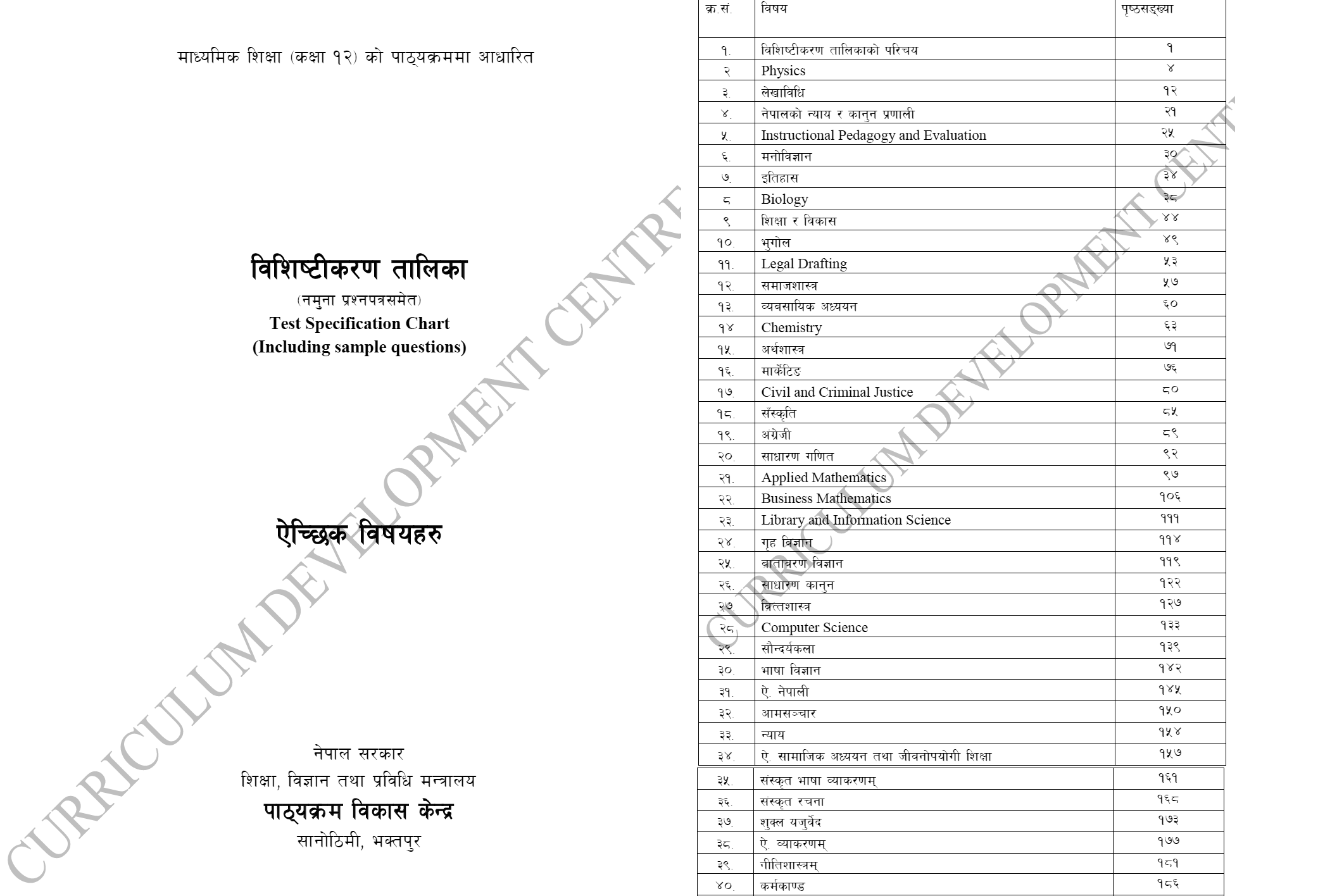
Subjects Included in the Document
| Section | Subject |
|---|---|
| 1 | Introduction to Test Specification Chart |
| 2 | Compulsory Nepali |
| 3 | Compulsory English |
| 4 | Social Studies and Life Skills Education |
| 5 | Mathematics |
The document covers Compulsory Nepali, Compulsory English, Social Studies and Life Skills Education, and Mathematics. Each subject section gives students and teachers a clearer idea of the exam structure and question format.
Purpose of the Specification Chart
The main purpose of the specification chart is to make examination preparation and question paper design more systematic. It helps identify:
-
the units or content areas to be covered
-
the number of questions to be asked
-
the type of questions to be included
-
the marks assigned to each section
-
the time needed for the exam
-
the competency level tested by each question
The document gives importance to different learning levels such as knowledge, understanding, application, practical skills, and higher ability. This means the examination is not designed only to test memorized answers. It also checks whether students can understand, apply, analyze, evaluate, and express ideas clearly.
Compulsory Nepali Specification Chart
The Compulsory Nepali [Nep. 002] section is prepared for Class 12 with full marks 75 and time 3 hours. The specification chart covers reading, writing, grammar, vocabulary, practical writing, literary comprehension, and essay writing.
The Nepali section includes areas such as letter structure, spelling, vocabulary, word class, word source, word formation, case and inflection, tense and voice, sentence transformation, reading comprehension, summary writing, practical writing, report writing, literary explanation, literary response, review-based answers, and essay writing.
This structure shows that the Nepali examination is not limited to textbook memorization. Students need to understand grammar, use language correctly, read passages carefully, write practical documents, respond to literary texts, and produce original written answers.
Compulsory English Specification Chart
The Compulsory English [Eng. 004] section is also designed for 75 marks and 3 hours. The specification chart divides the subject into three main areas.
| Area | Marks |
|---|---|
| Reading | 35 |
| Writing | 25 |
| Grammar and Vocabulary | 15 |
| Total | 75 |
The reading section includes an unseen prose text of about 500 words and text-based questions from the literature section. The unseen text may include reviews, news reports, articles, stories, letters, emails, essays, biographies, blogs, brochures, travel writing, or product guides.
The writing section includes three writing tasks. Students may be asked to write a paragraph, summary, news story, note, personal letter, job application, letter to the editor, business letter, email, CV, essay, travelogue, book or film review, biography, diary entry, communique, or press release.
The grammar and vocabulary section covers adjectives, adverbs, subject-verb agreement, prepositions, modal auxiliaries, tense and aspect, infinitives, gerunds, conjunctions, relative clauses, voice, reported speech, sound system, word formation, synonyms, antonyms, idioms, spelling, punctuation, dictionary use, and phrasal verbs.
Social Studies and Life Skills Education Specification Chart
The Social Studies and Life Skills Education [Sol. 005] section has full marks 75 and time 3 hours. The document provides a detailed question plan and marks distribution for this subject.
The competency weight is divided as follows:
| Competency Level | Weight |
|---|---|
| Knowledge | 20% |
| Understanding | 27% |
| Application and Skills | 28% |
| Higher Ability | 25% |
The question format includes 11 very short questions, 8 short questions, and 3 long questions.
| Question Type | Number of Questions | Marks per Question | Total Marks |
|---|---|---|---|
| Very short questions | 11 | 1 | 11 |
| Short questions | 8 | 5 | 40 |
| Long questions | 3 | 8 | 24 |
| Total | 22 | 75 |
This subject covers the concept of social and life skills education, digital skills, research skills, life skills, society and philosophy, geography and social life, history of Nepal, social identity and diversity, Constitution and civic awareness, urbanization and migration, economy and development, and education and social development.
The sample questions show that students should prepare for factual, analytical, practical, civic, social, and opinion-based answers.
Mathematics Specification Chart
The Mathematics [Mat. 008] section is prepared for Class 12 with full marks 75 and time 3 hours. The specification grid lists major content areas and competency levels.
The competency weight for Mathematics is:
| Competency Level | Marks |
|---|---|
| Knowledge | 12 |
| Understanding | 18 |
| Application | 30 |
| Higher Ability | 15 |
| Total | 75 |
The question format includes multiple choice questions, short answer questions, and long answer questions.
| Question Type | Number of Questions | Marks per Question | Total Marks |
|---|---|---|---|
| Multiple Choice Questions | 11 | 1 | 11 |
| Short Answer Questions | 8 | 5 | 40 |
| Long Answer Questions | 3 | 8 | 24 |
| Total | 22 | 75 |
The Mathematics specification grid covers Algebra, Trigonometry, Analytic Geometry, Vector, Statistics and Probability, Calculus, and Computational Methods or Mechanics. The sample question paper includes MCQs, short answer questions, and long problem-solving questions.
Students preparing for Mathematics should focus not only on formulas but also on application, proof, interpretation, and problem-solving.
Why This Document Is Important for Class 12 Students
The Class 12 Specification Chart and Sample Questions PDF is useful because it helps students understand the actual structure of the examination. Many students prepare only by reading textbooks or solving random model questions. That is not enough. The specification chart shows how marks are distributed and what type of learning is being tested.
For example, students preparing for Social Studies and Life Skills Education can see the balance between very short, short, and long questions. Mathematics students can understand the weight of MCQs, short questions, and long questions. English students can prepare separately for reading, writing, grammar, vocabulary, and literature. Nepali students can focus on grammar, practical writing, literary response, and essay writing according to the chart.
This document is also useful for teachers. It helps them prepare internal tests, guide students, plan revision classes, and design practice questions according to the official pattern.
How Students Should Use This PDF
Students should use the NEB Class 12 Specification Chart and Sample Questions PDF as an exam planning document. It should not be treated only as a model question collection.
A practical way to use it is:
-
Read the specification chart of your subject.
-
Note the marks distribution and question types.
-
Practise the sample questions given in the document.
-
Prepare similar questions from the textbook.
-
Give more time to sections with higher marks.
-
Practise writing answers within the expected time.
-
Revise grammar, writing, formulas, and analytical-answer formats separately.
This method helps students prepare more systematically for the Class 12 board examination.
PDF Use and Responsible Access
The PDF version is useful for students, teachers, schools, and exam preparation centers. It helps students understand the question pattern and helps teachers prepare practice papers.
However, the document should be used responsibly. The copyright page states that all rights are reserved by the Curriculum Development Centre and that commercial reproduction, modification, recording, copying, or redistribution without written permission is not allowed.
Students may use the PDF for study and reference, but websites should be careful while hosting or redistributing the full file.
Conclusion
The NEB Class 12 Specification Chart and Sample Questions of Compulsory Subjects PDF is a valuable exam preparation resource for Grade 12 students in Nepal. It explains the test specification chart, question pattern, marks distribution, competency levels, and sample questions for compulsory subjects.
The document covers Compulsory Nepali, Compulsory English, Social Studies and Life Skills Education, and Mathematics. It helps students understand what to study, how to practise, and how to manage preparation according to the official question pattern.
For effective preparation, students should study the textbook, practise sample questions, understand the specification grid, and revise according to marks weight and question type. This makes exam preparation more focused, balanced, and practical.
Donwnload
NEB Class 12 Specification Chart and Sample Questions of Compulsory Subjects.PDF

Comments 0
No comments yet. Be the first to start the conversation.