



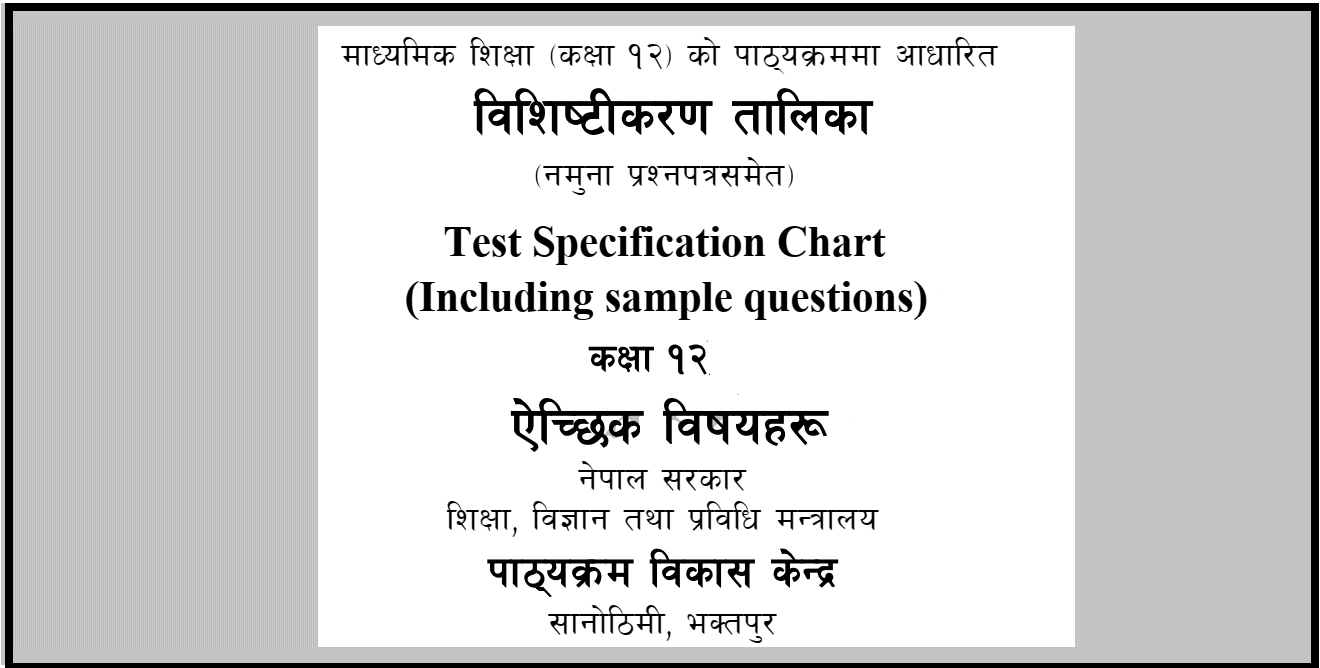
NEB Class 12 Optional Subjects Specification Chart and Sample Questions PDF
The NEB Class 12 Optional Subjects Specification Chart and Sample Questions PDF is an important exam preparation document for Grade 12 students in Nepal. The official document is titled Test Specification Chart (Including Sample Questions) for optional subjects and is based on the Secondary Education Class 12 curriculum.
It is published by the Government of Nepal, Ministry of Education and Sports, Curriculum Development Centre, Sanothimi, Bhaktapur. Students commonly search for this document as NEB Class 12 Optional Subjects Specification Chart, Class 12 Optional Subjects Sample Questions, Grade 12 Optional Subjects Model Questions, or Class 12 optional subject exam pattern.
This PDF helps students, teachers, and question setters understand the examination structure of optional subjects. It includes subject-wise specification charts, question formats, marks distribution, competency levels, and sample questions. For students preparing for the Class 12 board examination, this document is useful because it shows how questions are designed according to the curriculum.
Table of Content
- NEB Class 12 Optional Subjects Specification Chart and Sample Questions PDF
- About the Grade 12 Optional Subjects Specification Chart
- Subjects Included in the Optional Subjects Specification Chart
- What the Specification Chart Contains
- Common Question Pattern in Optional Subjects
- Science and Mathematics Subjects
- Management, Law, Education, and Humanities Subjects
- Why This PDF Is Important for Students
- How Students Should Use the Specification Chart
- PDF Use and Responsible Access
- Conclusion
- Download
About the Grade 12 Optional Subjects Specification Chart
A specification chart is a structured plan used for preparing examination questions. It helps ensure that the question paper is balanced, curriculum-based, and aligned with learning outcomes. Instead of preparing questions randomly, a specification chart shows which content areas should be covered, how many questions should be asked, how marks should be distributed, and which competency levels should be tested.
The document explains that curriculum implementation becomes more effective when assessment is systematic, valid, reliable, and objective. A test specification chart supports this process by guiding teachers and question setters to prepare examination papers according to the curriculum.
The first edition of this optional subjects specification chart was published in Magh 2078 BS. It was prepared for the external evaluation of Grade 12 optional subjects under the revised curriculum.
Subjects Included in the Optional Subjects Specification Chart
The PDF includes specification charts and sample questions for a wide range of Grade 12 optional subjects. The subjects listed in the document are:
| No. | Optional Subject |
|---|---|
| 1 | Introduction to Test Specification Chart |
| 2 | Physics |
| 3 | Accounting |
| 4 | Nepalese Legal System |
| 5 | Instructional Pedagogy and Evaluation |
| 6 | Psychology |
| 7 | History |
| 8 | Biology |
| 9 | Education and Development |
| 10 | Geography |
| 11 | Legal Drafting |
| 12 | Sociology |
| 13 | Business Studies |
| 14 | Chemistry |
| 15 | Economics |
| 16 | Marketing |
| 17 | Civil and Criminal Justice |
| 18 | Culture |
| 19 | English |
| 20 | General Mathematics |
| 21 | Applied Mathematics |
| 22 | Business Mathematics |
| 23 | Library and Information Science |
| 24 | Home Science |
| 25 | Environmental Science |
| 26 | General Law |
| 27 | Finance |
| 28 | Computer Science |
| 29 | Fine Arts |
| 30 | Linguistics |
| 31 | Optional Nepali |
| 32 | Mass Communication |
| 33 | Nyaya |
| 34 | Optional Social Studies and Life Skills Education |
| 35 | Sanskrit Language Grammar |
| 36 | Sanskrit Composition |
| 37 | Shukla Yajurveda |
| 38 | Optional Grammar |
| 39 | Ethics |
| 40 | Ritual Studies |
| 41 | Philosophy |
| 42 | Siddhanta Jyotish |
| 43 | Atharvaveda |
| 44 | Rigveda |
| 45 | Rural Development |
| 46 | Fashion Design |
| 47 | Health and Physical Education |
| 48 | Mass Communication |
| 49 | Population Education |
| 50 | Sports Science |
This wide subject coverage makes the document useful for students from Science, Management, Education, Humanities, Law, Sanskrit, and other study groups.
What the Specification Chart Contains
Each subject section generally includes a test specification chart and a model question paper. The specification chart shows the content areas, working hours, unit-wise marks, question types, and competency levels.
The main competency levels used in the document are:
-
knowledge or remembering
-
understanding or comprehension
-
application
-
higher ability
This means the examination is not designed only to test memorized facts. Students are also expected to understand concepts, apply knowledge, analyze situations, solve problems, justify answers, and present ideas clearly.
The sample questions included in the PDF help students understand the actual style of the examination. They show how very short, short, and long answer questions are asked. In science and mathematics subjects, the sample questions also include multiple-choice questions, numerical problems, diagrams, structured questions, and analytical problems.
Common Question Pattern in Optional Subjects
Many Grade 12 optional subjects follow a 75-mark written examination with a 3-hour time limit. In several subjects, the format includes:
| Question Type | Number of Questions | Marks |
|---|---|---|
| Very short answer questions | 11 | 11 |
| Short answer questions | 8 | 40 |
| Long answer questions | 3 | 24 |
| Total | 22 | 75 |
In science subjects such as Physics and Chemistry, the question paper commonly includes 11 multiple-choice questions, 8 short answer questions, and 3 long answer questions. Physics, Chemistry, and Mathematics use a clear structure for MCQ, short answer, and long answer sections. Biology has a slightly different structure because it is divided into Botany and Zoology sections.
Some optional subjects follow a different mark structure. For example, subjects such as Legal Drafting are shown with a 50-mark theoretical format and a 2-hour exam structure. This means students should check the chart for their own subject carefully instead of assuming that all optional subjects have the same question pattern.
Science and Mathematics Subjects
The Science and Mathematics sections are especially useful for students because they provide clear content-area weightage. Physics includes Mechanics, Heat and Thermodynamics, Wave and Optics, Electricity and Magnetism, and Modern Physics. Chemistry includes Physical Chemistry, Inorganic Chemistry, Organic Chemistry, and Applied Chemistry.
Biology is divided into Botany and Zoology and includes areas such as plant anatomy, plant physiology, embryology, genetics, biotechnology, applied biology, animal tissue, developmental biology, human biology, and population and health disorders.
Mathematics-related subjects such as General Mathematics, Applied Mathematics, and Business Mathematics include content-area charts, competency levels, and sample questions. These sections help students identify which areas carry more weight and what type of problem-solving skills are expected.
Management, Law, Education, and Humanities Subjects
The optional subjects specification chart is also important for students from Management, Law, Education, and Humanities streams. Accounting, Business Studies, Economics, Marketing, Finance, and Business Mathematics help students understand the structure of numerical, conceptual, and analytical questions.
Law-related subjects such as Nepalese Legal System, Legal Drafting, General Law, Civil and Criminal Justice, and Nyaya include question patterns that test legal concepts, interpretation, drafting ability, and analytical thinking.
Education-related subjects such as Instructional Pedagogy and Evaluation, Education and Development, and Optional Social Studies and Life Skills Education focus on teaching-learning processes, assessment, development, civic awareness, social issues, and practical application.
Humanities and social science subjects such as History, Geography, Sociology, Psychology, Culture, Linguistics, Population Education, Mass Communication, and Rural Development require students to prepare for explanation, comparison, review, analysis, and opinion-based answers.
Why This PDF Is Important for Students
The Class 12 Optional Subjects Specification Chart PDF helps students prepare more strategically. Many students study only the textbook or solve random model questions. That method is incomplete. A specification chart shows the official examination structure behind the question paper.
Students can use this document to understand:
-
which units are more important
-
how marks are distributed
-
how many questions are asked
-
which question types are used
-
whether the subject has MCQs, short answers, or long answers
-
which competencies are tested
-
how sample questions are structured
This is especially useful for optional subjects because each subject has its own nature. A Science subject may require numerical problem-solving and diagrams, while a Law or Humanities subject may require explanation, drafting, argument, review, or analysis.
How Students Should Use the Specification Chart
Students should use the PDF as an exam planning tool. First, they should open the chart for their own optional subject and check the full marks, exam time, question types, and unit-wise marks. Then they should compare the chart with their textbook chapters and prepare a study plan.
The sample questions should be used for practice, but students should not memorize only the model question paper. The sample questions are examples based on the curriculum. Similar questions may be asked from the same subject areas, but the exact questions can vary.
A practical preparation method is to study the textbook, check the specification chart, practise the sample questions, prepare similar questions from each unit, and revise according to marks weight.
PDF Use and Responsible Access
The PDF version of the NEB Class 12 Optional Subjects Specification Chart and Sample Questions is useful for students, teachers, schools, and exam preparation centers. It helps students understand the question format and helps teachers prepare practice papers according to the curriculum.
However, the document should be used responsibly. The copyright page states that the material belongs to the Curriculum Development Centre and that commercial reproduction, modification, recording, copying, or redistribution without written permission is not allowed.
Students may use the PDF for study and reference. Websites should be careful while hosting or redistributing the full file.
Conclusion
The NEB Class 12 Optional Subjects Specification Chart and Sample Questions PDF is a valuable document for Grade 12 exam preparation. It covers a wide range of optional subjects and explains how question papers are structured according to content areas, marks distribution, question types, and competency levels.
Students should use this PDF together with their textbooks. It helps them prepare in a focused way, understand the exam pattern, practise sample questions, and manage revision according to subject weightage. For teachers, it is equally useful for preparing internal exams, model questions, and revision plans aligned with the Class 12 curriculum.
Download
NEB Class 12 Optional Subjects Specification Chart and Sample Questions.PDF

Comments 0
No comments yet. Be the first to start the conversation.