



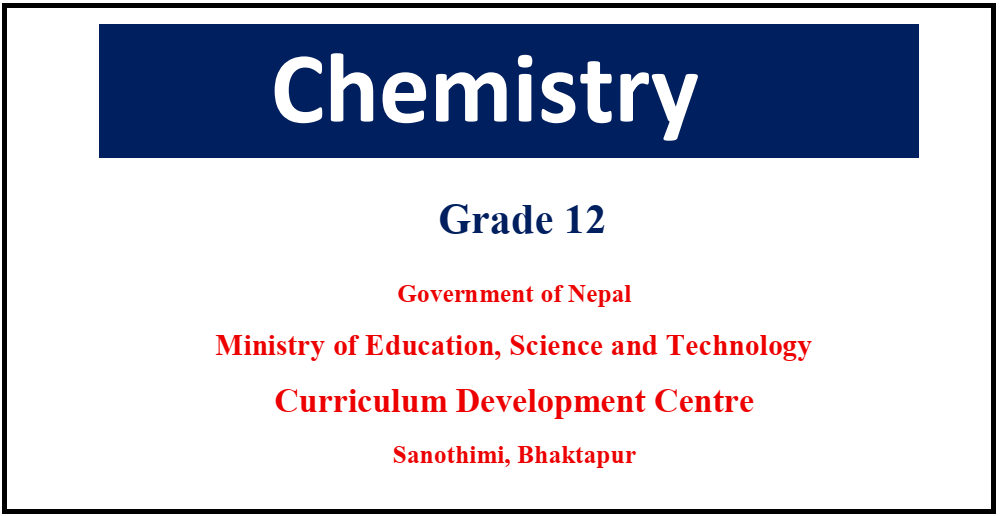
Chemistry Grade 12 Book: Curriculum, Structure, and Content Overview
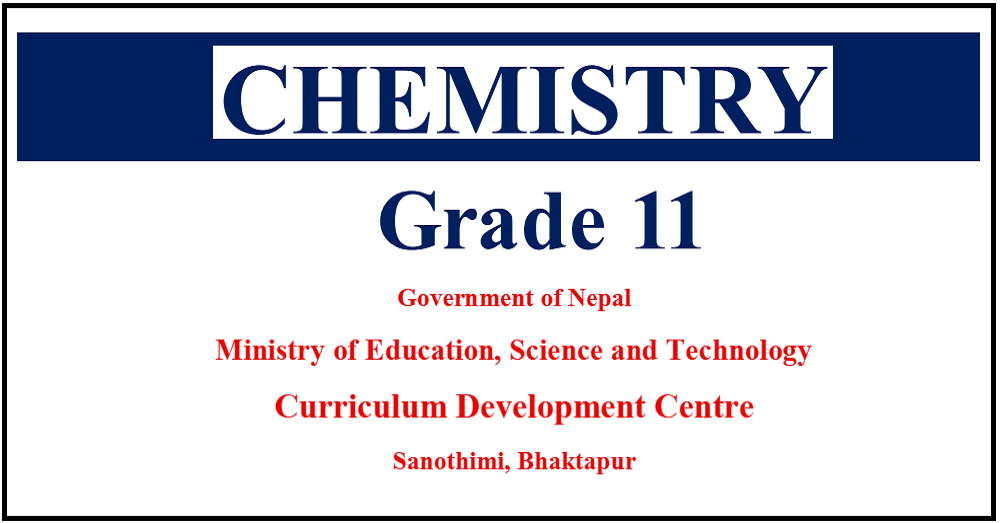
The Chemistry Grade 12 textbook is published by the Curriculum Development Centre, Government of Nepal, Ministry of Education and Sports. The publication page identifies it as the First Edition, 2025, with the Curriculum Development Centre, Sanothimi, Bhaktapur, as the publisher.
The book has been prepared in line with the National Curriculum Framework for School Education, 2076 and developed according to the Secondary Level Grade 11–12 Chemistry Curriculum, 2077.
Table of Content
- Chemistry Grade 12 Book: Curriculum, Structure, and Content Overview
- Curriculum Basis and Purpose
- Development and Contribution
- Structure of the Textbook
- Volumetric Analysis and Laboratory Measurement
- Ionic Equilibrium, Kinetics, and Thermodynamics
- Electrochemistry and Metallic Elements
- Organic Chemistry
- Chemistry in Daily Life and Industry
- Nuclear Chemistry and Applications of Radioactivity
- Learning Approach
- Conclusion
- Download Book
Curriculum Basis and Purpose
A curriculum provides the main direction for teaching and learning. It defines what students are expected to study and what teachers are expected to teach. A textbook helps carry that curriculum into the classroom by organizing the subject matter into lessons, activities, examples, exercises, and practical tasks.
The Chemistry Grade 12 textbook follows this role by presenting chemistry as both a theoretical and practical subject. It includes concepts, calculations, laboratory methods, industrial applications, organic reactions, and topics connected with everyday materials. The preface states that the textbook aims to provide relevant, practical, and useful knowledge while supporting the overall development of learners.
The book is also designed to be activity-oriented. It includes classroom tasks, observation-based questions, “Do yourself” sections, “Test yourself” questions, solved examples, project work, tables, diagrams, and exercises. These features help students move beyond memorization and encourage them to observe, measure, calculate, compare, and apply chemical ideas in practical situations.
The textbook can be used as a major classroom resource, but it is not presented as the only source of learning. Teachers are encouraged to adapt the contents and tasks according to learner needs and classroom contexts, and to use additional resources where necessary to support the curriculum.
Development and Contribution
The textbook was developed by a team consisting of Mr. Hari Prasad Regmi, Mr. Khem Raj Bhatta, Mr. Naresh Prashad Bhatta, Mr. Pramatma Mishra, and Mr. Lav Dev Bhatta.
The publication also acknowledges the contributions of Director General Mr. Yubaraj Paudel, Dr. Kamal Prasad Acharya, Mr. Umanath Lamsal, Mr. Keshar Bahadur Khulal, Mr. Heramba Raj Kandel, Ms. Mina Shrestha, Mr. Purushottam Ghimire, Asst. Prof. Dr. Deval Prasad Bhattarai, Asst. Prof. Dr. Bhoj Raj Poudel, and Asst. Prof. Dr. Bhanu Neupane.
These acknowledgements show that the textbook was prepared through the combined work of writers, curriculum officials, reviewers, and subject contributors involved in developing a curriculum-based science text.
Structure of the Textbook
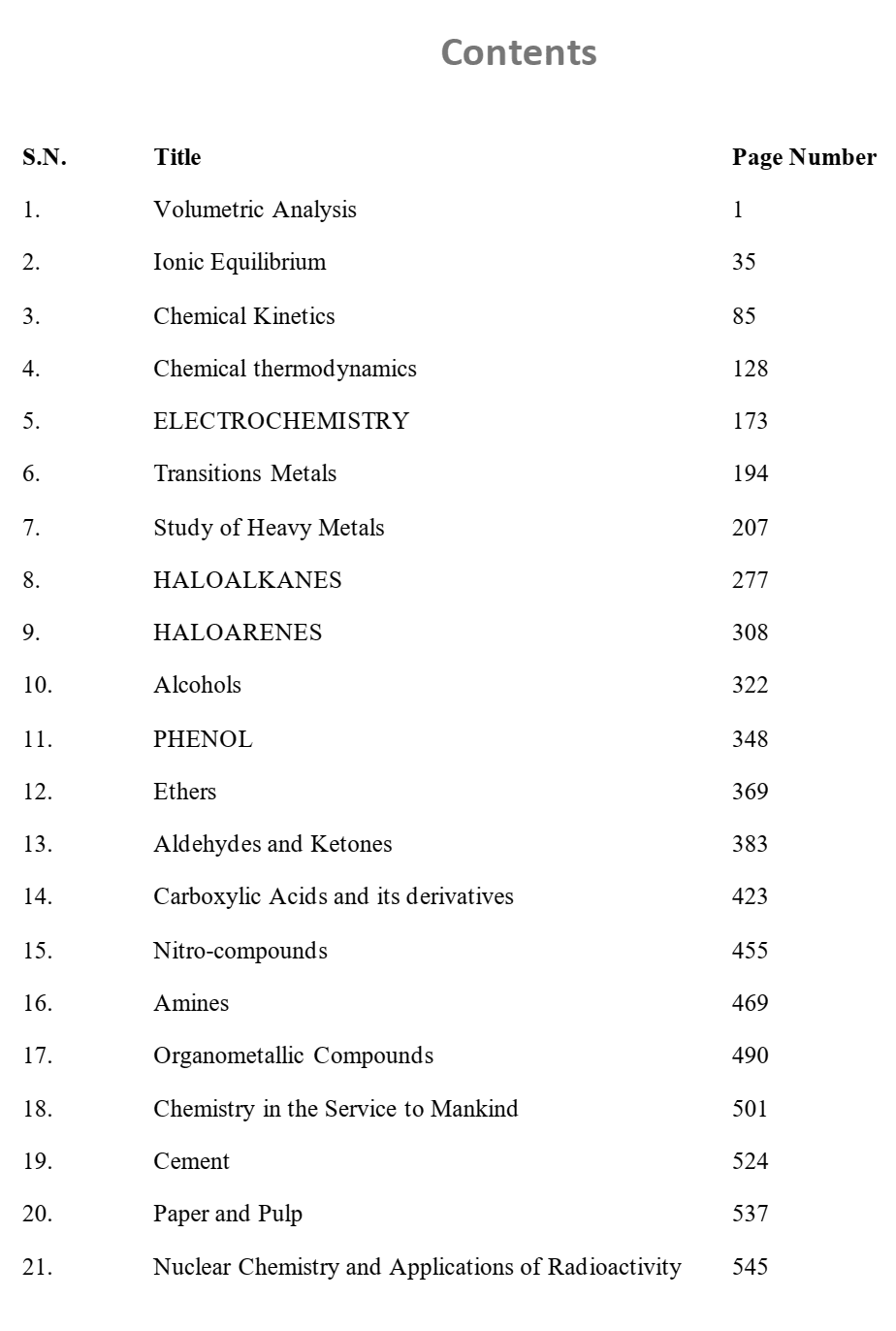
The textbook is organized into 21 units. Its structure begins with analytical chemistry and physical chemistry, moves into inorganic and organic chemistry, and ends with applied and nuclear chemistry. This order gives students a gradual path from laboratory measurement and chemical principles to reactions, materials, industries, and modern applications.
| S.N. | Unit |
|---|---|
| 1 | Volumetric Analysis |
| 2 | Ionic Equilibrium |
| 3 | Chemical Kinetics |
| 4 | Chemical Thermodynamics |
| 5 | Electrochemistry |
| 6 | Transition Metals |
| 7 | Study of Heavy Metals |
| 8 | Haloalkanes |
| 9 | Haloarenes |
| 10 | Alcohols |
| 11 | Phenol |
| 12 | Ethers |
| 13 | Aldehydes and Ketones |
| 14 | Carboxylic Acids and Their Derivatives |
| 15 | Nitro-compounds |
| 16 | Amines |
| 17 | Organometallic Compounds |
| 18 | Chemistry in the Service to Mankind |
| 19 | Cement |
| 20 | Paper and Pulp |
| 21 | Nuclear Chemistry and Applications of Radioactivity |
Volumetric Analysis and Laboratory Measurement
The first unit, Volumetric Analysis, introduces students to chemical analysis. It distinguishes between qualitative analysis, which identifies the nature of a substance, and quantitative analysis, which measures the amount of a substance present in a sample. The unit also explains gravimetric analysis and volumetric analysis as important methods of quantitative analysis.
A major focus of this unit is accurate measurement. Students are introduced to laboratory glassware such as burettes, pipettes, measuring cylinders, and volumetric flasks. The chapter explains that burettes and measuring cylinders are used to transfer desired volumes, while pipettes and volumetric flasks are used to transfer fixed volumes of liquid.
The unit also covers equivalent weight, the relationship between equivalent weight, atomic weight and valency, concentration of solutions, primary and secondary standard substances, the law of equivalence, dilution, and titration. These topics are central to quantitative chemistry because they help students calculate unknown concentrations and understand the logic behind laboratory analysis.
The chapter connects volumetric analysis with practical fields such as water quality testing, pharmaceutical analysis, food industry measurements, and environmental monitoring. This makes the topic useful not only for examination preparation but also for understanding how chemistry is used in testing and quality control.
Ionic Equilibrium, Kinetics, and Thermodynamics
The next group of units develops the physical chemistry foundation of the textbook. Ionic Equilibrium introduces students to chemical systems involving ions in solution. This unit supports later understanding of acids, bases, salts, indicators, titration behavior, and solution chemistry.
Chemical Kinetics focuses on the rate of chemical reactions. It helps students understand that chemical reactions do not all occur at the same speed. Some reactions are slow, while others are rapid. By studying reaction rate and related factors, students learn how chemists describe and control the speed of chemical change.
Chemical Thermodynamics deals with energy changes in chemical processes. This unit gives students a framework for understanding heat, work, energy transfer, and the conditions under which reactions or processes occur. Together, ionic equilibrium, kinetics, and thermodynamics help students build a stronger conceptual base for explaining chemical behavior.
Electrochemistry and Metallic Elements
The Electrochemistry unit connects chemical reactions with electrical energy. It introduces students to chemical changes involving electron transfer and helps them understand the relationship between redox processes and electricity. This topic is important because it links classroom chemistry with cells, batteries, electrolysis, and related technologies.
The textbook then moves into inorganic chemistry through Transition Metals and Study of Heavy Metals. Transition metals are important because of their variable properties and wide chemical behavior. The study of heavy metals gives students a closer look at selected metallic elements and their significance.
These units help students understand that chemistry is not limited to formulas and equations. It also explains the properties of elements, their reactions, their uses, and their role in materials and industry.
Organic Chemistry
A large part of the textbook is devoted to organic chemistry. The sequence begins with Haloalkanes and Haloarenes, which introduce halogen-containing organic compounds. These units help students study organic compounds in terms of structure, naming, properties, preparation, and reactions.
The textbook then covers oxygen-containing organic compounds through Alcohols, Phenol, Ethers, Aldehydes and Ketones, and Carboxylic Acids and Their Derivatives. This sequence is important because it allows students to study functional groups in an organized way. Each functional group gives organic compounds their characteristic chemical behavior, and studying them step by step helps students understand how structure affects reaction.
The later organic units include Nitro-compounds, Amines, and Organometallic Compounds. These chapters extend students’ understanding of organic chemistry into nitrogen-containing compounds and compounds involving metal-carbon bonds. The progression from halo compounds to alcohols, carbonyl compounds, acids, amines, and organometallic compounds gives the organic section a clear internal order.
Chemistry in Daily Life and Industry
The unit Chemistry in the Service to Mankind connects chemical knowledge with practical human needs. Its placement after the core organic units shows how chemistry contributes to useful materials and products. This section helps students see chemistry as a subject that affects health, agriculture, household materials, and daily life.
The industrial chemistry units, Cement and Paper and Pulp, continue this practical focus. Cement is linked with construction and infrastructure, while paper and pulp connect chemistry with materials made from fibrous sources. These chapters help students understand how chemical principles are used in manufacturing and how raw materials are converted into useful products.
By including these units, the textbook gives chemistry a wider social and industrial context. Students are not only studying reactions in isolation; they are also learning how chemical knowledge supports production, construction, communication, and material use.
Nuclear Chemistry and Applications of Radioactivity
The final unit, Nuclear Chemistry and Applications of Radioactivity, introduces chemistry related to nuclear changes and radioactive substances. This unit gives students exposure to an area of chemistry that differs from ordinary chemical reactions, as nuclear processes involve changes in the nucleus rather than only the rearrangement of electrons.
The inclusion of radioactivity and its applications gives the textbook a modern scientific dimension. It helps students understand that chemistry also contributes to fields involving energy, radiation, medical applications, industrial testing, and scientific research.
Learning Approach
The textbook uses a practical and student-centered learning approach. Many lessons begin with activities that ask students to observe figures, discuss questions, identify apparatus, compare situations, or complete tables. The first unit, for example, uses laboratory glassware, titration diagrams, concentration examples, and project work to connect theory with practice.
The book also includes solved examples and numerical problems. These are important in chemistry because students need to connect concepts with calculations. Topics such as equivalent weight, concentration, molarity, normality, dilution, and titration require both conceptual clarity and mathematical accuracy.
Project work further supports applied learning. Students are encouraged to investigate chemical ideas through practical tasks rather than only reading explanations. This helps make chemistry more active and connected to real observations.
Conclusion
The NEB Chemistry Grade 12 textbook provides a structured introduction to analytical chemistry, physical chemistry, inorganic chemistry, organic chemistry, industrial chemistry, and nuclear chemistry. It begins with measurement and analysis, develops core chemical principles, introduces metallic and organic compounds, and ends with applied and modern areas of chemistry.
Its main strength is its curriculum-based structure combined with laboratory relevance. Through activities, diagrams, solved examples, exercises, and project work, the textbook supports students in learning chemistry as a subject of observation, calculation, experimentation, and application. It gives Grade 12 students a broad foundation for understanding chemical processes, materials, reactions, industries, and the practical role of chemistry in daily life.
Note:
All rights reserved with the Curriculum Development Centre; no part of this publication may be reproduced, transmitted in any other forms or by any means without the written permission of the publisher. However, this does not prohibit making photocopies of its pages for teacher training or other non-profit-making purposes.


Comments 0
No comments yet. Be the first to start the conversation.