



Physics Grade 12 Book: Curriculum, Structure, and Content Overview
The Physics Grade 12 textbook, published by the Curriculum Development Centre, Government of Nepal, Ministry of Education and Sports, is designed as a major resource for teaching and learning physics at the secondary level. It has been prepared in line with the National Curriculum Framework for School Education, 2076 and developed according to the Secondary Level Grade 11–12 Physics Curriculum, 2077.
The curriculum serves as the central guide for identifying what is essential in teaching and learning. A textbook helps deliver the intent and content of the curriculum by presenting relevant, practical, and useful knowledge.
This textbook aims to support learners’ overall development by helping them build conceptual understanding, scientific reasoning, mathematical skills, practical knowledge, and problem-solving ability.
Table of Content
- Physics Grade 12 Book: Curriculum, Structure, and Content Overview
- Development and Contribution
- Topics Covered in the Textbook
- Mechanics and Oscillatory Motion
- Fluid Mechanics and Thermodynamics
- Waves, Sound, and Acoustics
- Optics and the Nature of Light
- Electricity, Magnetism, and Electromagnetic Induction
- Modern Physics and Electronics
- Recent Trends in Physics
- Conclusion
- Download Book
Development and Contribution
The textbook was developed by a team consisting of Mr. Bishnu Prasad Paudel, Mr. Bhagirath Neupane, Mr. Arjun Sedhai, Mr. Purna Shreshta, and Mr. Lav Dev Bhatta.
The publication also acknowledges the contributions of several individuals, including Director General Mr. Yubaraj Paudel, Dr. Kamal Prasad Acharya, Mr. Umanath Lamsal, Mr. Keshar Bahadur Khulal, Mr. Heramba Raj Kandel, Ms. Mina Shrestha, Mr. Purushottam Ghimire, Mr. Prakash Timsina, Mr. Deepak Kafle, Mr. Manoj Chaudhary, and Mr. Devendra Rimal Neupane.
The book has been prepared to make learning activity-oriented and engaging for students. While all lessons are considered important, teachers may adapt the content and classroom tasks according to learners’ needs and classroom contexts.
The textbook can be used as a major classroom resource, but it is not intended to be the only source of learning. Teachers are encouraged to use additional resources to support the curricular content. The Curriculum Development Centre also welcomes constructive feedback and suggestions for improving its publications.
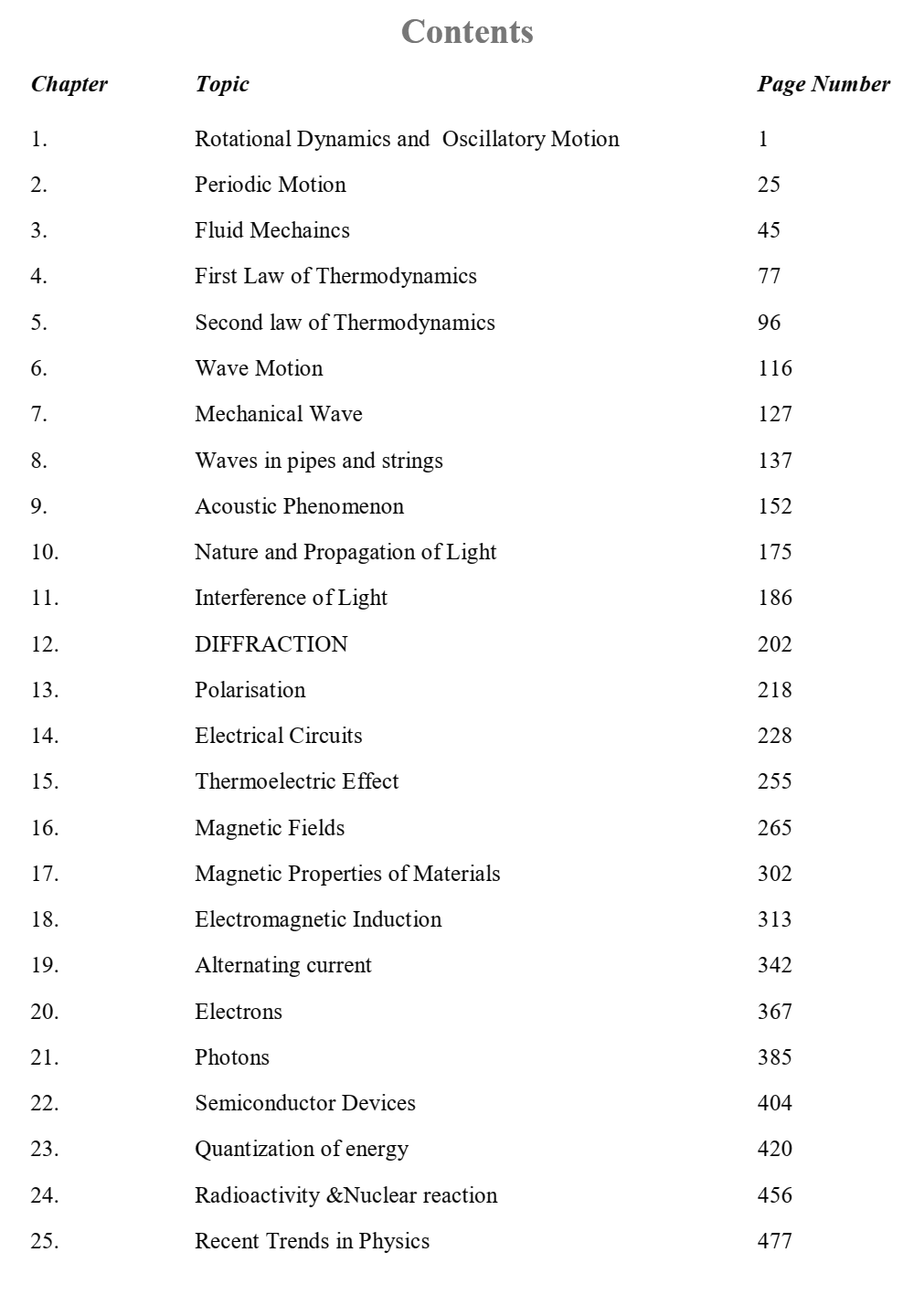
Topics Covered in the Textbook
| Chapter | Topic |
|---|---|
| 1 | Rotational Dynamics and Oscillatory Motion |
| 2 | Periodic Motion |
| 3 | Fluid Mechanics |
| 4 | First Law of Thermodynamics |
| 5 | Second Law of Thermodynamics |
| 6 | Wave Motion |
| 7 | Mechanical Wave |
| 8 | Waves in Pipes and Strings |
| 9 | Acoustic Phenomenon |
| 10 | Nature and Propagation of Light |
| 11 | Interference of Light |
| 12 | Diffraction |
| 13 | Polarisation |
| 14 | Electrical Circuits |
| 15 | Thermoelectric Effect |
| 16 | Magnetic Fields |
| 17 | Magnetic Properties of Materials |
| 18 | Electromagnetic Induction |
| 19 | Alternating Current |
| 20 | Electrons |
| 21 | Photons |
| 22 | Semiconductor Devices |
| 23 | Quantization of Energy |
| 24 | Radioactivity and Nuclear Reactions |
| 25 | Recent Trends in Physics |
Mechanics and Oscillatory Motion
The textbook begins with rotational dynamics and oscillatory motion. It explains rigid bodies, rotational kinematics, moment of inertia, radius of gyration, and conservation of angular momentum. These ideas are connected with real-world examples such as the spinning motion of an ice skater and the stability of a gyroscope.
The discussion then moves to periodic motion, with a focus on simple harmonic motion. Students study displacement, velocity, acceleration, spring-mass systems, and the simple pendulum. The text also notes the limitations of ideal physical models when applied to real situations.
Fluid Mechanics and Thermodynamics
The fluid mechanics section covers fluids at rest and in motion. It explains pressure in a fluid column, Pascal’s law, Archimedes’ principle, surface tension, capillarity, viscosity, Stokes’ law, Poiseuille’s formula, the equation of continuity, and Bernoulli’s equation. These principles are linked with practical applications such as airplane lift, helicopter flight, the Venturi effect, and medical devices.
Thermal physics is presented through the first and second laws of thermodynamics. The first law is explained as a form of energy conservation, along with open, closed, and isolated systems. The textbook also describes isothermal, adiabatic, isobaric, and isochoric processes, specific heat capacities, and Mayer’s relation.
The second law introduces the direction of natural processes and the limits of heat engines. It covers the Kelvin-Planck and Clausius statements, the Carnot engine, refrigerators, petrol and diesel engines, and entropy as a measure of disorder.
Waves, Sound, and Acoustics
The chapters on waves explain progressive and stationary waves, the principle of superposition, and the mathematical treatment of wave motion. Mechanical waves are studied in solids, liquids, and gases, including Newton’s formula for the speed of sound and Laplace’s correction.
The textbook also examines waves in pipes and strings. It explains harmonics, overtones, open and closed organ pipes, and transverse vibrations in stretched strings. The acoustics section connects wave physics with human hearing by explaining intensity, loudness, pitch, timbre, and the Doppler effect.
Optics and the Nature of Light
The optics section compares Newton’s corpuscular theory with Huygens’ wave theory. Huygens’ principle is used to explain the laws of reflection and refraction.
The textbook then covers interference, diffraction, and polarization. Young’s double-slit experiment is used to explain sustained interference, fringe width, and the conditions for constructive and destructive interference. Diffraction is discussed through single-slit patterns, diffraction gratings, and the resolving power of optical instruments. Polarization is used to show the transverse nature of light, with practical applications such as reducing glare through Polaroids.
Electricity, Magnetism, and Electromagnetic Induction
The electricity section moves beyond basic circuit concepts to Kirchhoff’s laws, the Wheatstone bridge, the meter bridge, and the potentiometer. It explains the use of a potentiometer for comparing electromotive forces and measuring internal resistance. The textbook also covers galvanometer conversion, Joule heating, superconductivity, and the Meissner effect.
The magnetism section begins with Oersted’s discovery and develops the subject through the Lorentz force, Biot-Savart law, and Ampere’s circuital law. These concepts are applied to magnetic fields around straight conductors, circular coils, solenoids, and toroids. The text also discusses the Hall effect, moving coil galvanometers, and the force between parallel current-carrying conductors.
Magnetic materials are classified as diamagnetic, paramagnetic, and ferromagnetic. The textbook explains magnetic domains, hysteresis, and the use of different magnetic materials in transformer cores and permanent magnets.
Electromagnetic induction is introduced through Faraday’s laws and Lenz’s law. The textbook explains induced electromotive force, eddy currents, self-induction, mutual induction, AC generators, and transformers. Alternating current is then studied through RMS values, phasor diagrams, resistive, inductive, capacitive, and LCR circuits, along with resonance, impedance, power factor, and wattless current.
Modern Physics and Electronics
Modern physics begins with the study of electrons. The textbook discusses Millikan’s oil drop experiment and J.J. Thomson’s experiment on the specific charge of the electron. The photon chapter introduces Planck’s quantum theory and Einstein’s photoelectric equation, including work function, threshold frequency, and stopping potential.
The semiconductor section connects physics with electronics. It explains p-n junctions, depletion layers, potential barriers, forward and reverse biasing, full-wave rectifiers, Zener diodes, voltage regulation, logic gates, and Boolean algebra.
The atomic physics chapters cover Bohr’s atomic model, stationary orbits, angular momentum, electron energy, hydrogen spectral series, de Broglie’s hypothesis, Heisenberg’s uncertainty principle, and X-ray production. The nuclear physics section introduces radioactivity, alpha, beta, and gamma radiation, radioactive decay, half-life, mean life, radiocarbon dating, and the Geiger-Muller tube.
Recent Trends in Physics
The final chapter connects physics with recent scientific developments. It introduces seismology, earthquake waves, and the 2015 Gorkha Earthquake as a case study. It also discusses gravitational waves, the Higgs boson, and nanotechnology, showing how physics continues to influence research in medicine, electronics, and materials science.
Conclusion
The NEB Physics Grade 12 textbook provides students with an organized introduction to major areas of physics. By combining physical laws, mathematical derivations, experiments, historical context, classroom activities, and practical applications, it supports a deeper understanding of the natural world and prepares students for further study in science and technology.
Note:
All rights reserved with the Curriculum Development Centre; no part of this publication may be reproduced, transmitted in any other forms or by any means without the written permission of the publisher. However, this does not prohibit making photocopies of its pages for teacher training or other non-profit-making purposes.





Comments 0
No comments yet. Be the first to start the conversation.