



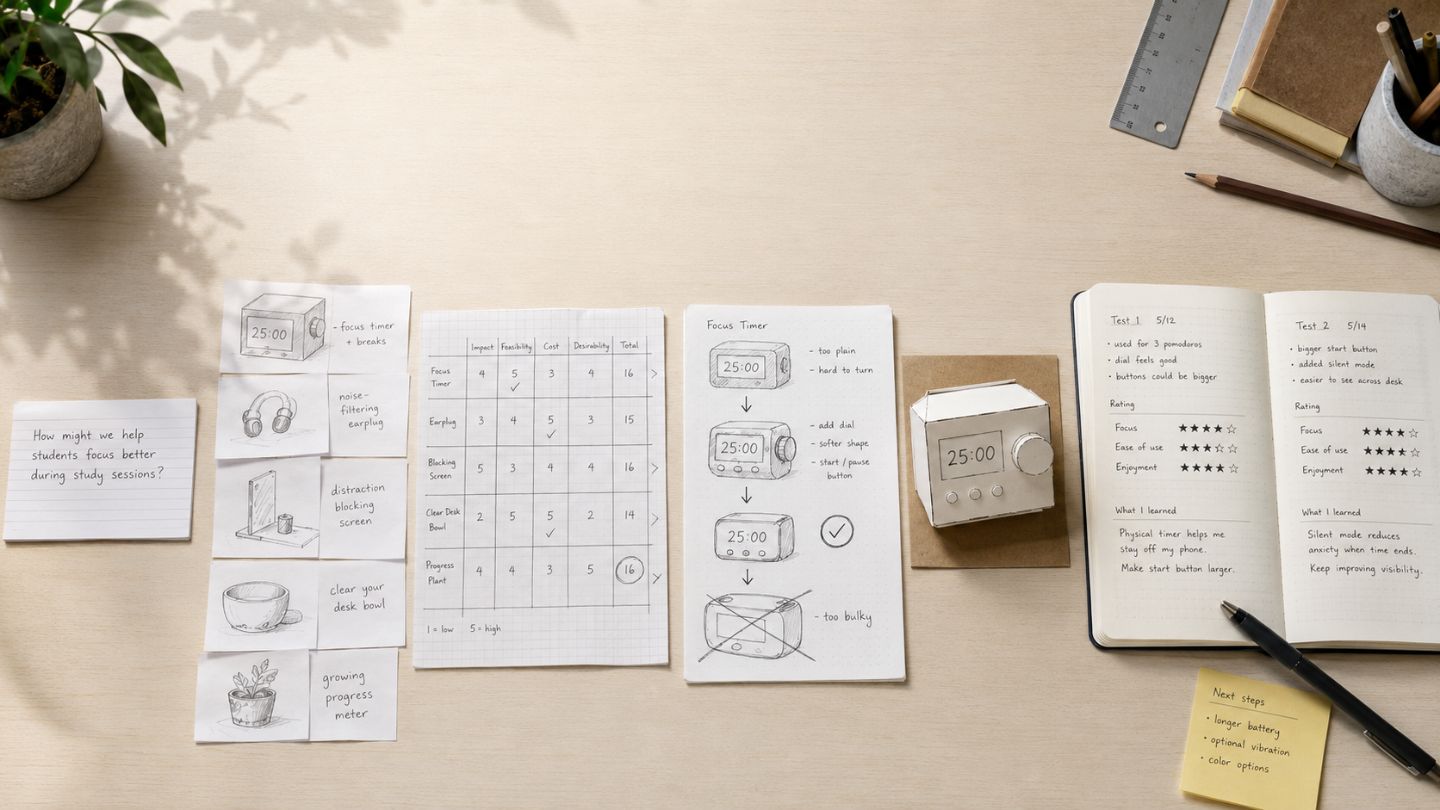
Creative thinking is easier to practise when it is treated as a process rather than a personality trait. A student planning an assignment, a teacher adapting a lesson, a professional preparing a proposal, or a family solving an everyday problem all need similar abilities: framing the challenge, producing varied options, evaluating them carefully, improving promising ideas, testing assumptions, and learning from the result.
Research supports a qualified answer to whether creativity can be developed. Training studies report a positive average effect, but the estimated benefit becomes smaller after adjustments for publication bias. Study quality also varies, and individual programmes sometimes produce uneven or null results. Idea generation and evaluation should therefore be practised as related but distinct parts of the process.
Answer Summary: Creative thinking can be developed through a repeatable process: frame the problem, generate varied options without judging them too early, evaluate ideas using separate criteria, improve promising components, test the riskiest assumption, and reflect on the result. Training can help on average, but improvement is not guaranteed. Progress is better judged against a personal baseline than through a fixed label such as “creative” or “uncreative.”
Table of Content
- What Creative Thinking Means
- Can Creative Thinking Be Learned?
- The Creative Thinking Loop
- Step 1: Frame the Challenge Clearly
- Step 2: Generate Varied Options
- Step 3: Evaluate Ideas Without Rejecting Novelty Too Early
- Step 4: Improve Promising Ideas
- Step 5: Prototype and Test with Limited Effort
- Step 6: Reflect and Repeat
- A 20-Minute Creative Thinking Routine
- One-Page Creative Thinking Practice Log
- How to Measure Improvement
- Worked Example: Improving a Weekly Meeting
- Common Mistakes and How to Correct Them
- Solo, Group, and AI-Assisted Practice
- Use the Loop on a Real Problem
Key Takeaways:
-
Creative thinking combines novelty with usefulness in context.
-
Generating ideas and evaluating them are connected but different tasks.
-
Variety matters more than producing minor versions of one idea.
-
Originality, usefulness, feasibility, assumptions, and learning value should be considered separately.
-
Rough ideas can often be strengthened by changing individual components.
-
Small tests expose weaknesses before substantial effort is committed.
-
Personal process records are more useful than fixed talent labels.
What Creative Thinking Means
Creative thinking can be described, for practical purposes, as producing ideas that are both novel and useful in a particular context.
Novel does not have to mean historically unprecedented. It may mean new to the person, group, assignment, organisation, or situation. Useful means that the idea addresses a relevant purpose, user, or constraint.
An unusual answer that ignores the problem is not automatically valuable. Similarly, a useful answer is not necessarily creative when it merely repeats an obvious solution.
Novelty and usefulness are common elements in creativity research, although definitions and measurement methods differ by field and task. The definition used here is therefore an operational one for practical problem-solving rather than the only accepted scientific definition.
Everyday creative thinking should also be distinguished from exceptional creative achievement. A person can improve how they generate and refine ideas without becoming a celebrated inventor, artist, or researcher. This guide concerns trainable thinking processes, not claims about extraordinary achievement.
Generation, Evaluation, and Improvement
Creative thinking includes more than brainstorming.
| Process | Main purpose | Guiding question | Common error |
|---|---|---|---|
| Generation or divergence | Expand the available options | What different directions are possible? | Producing minor variations of one idea |
| Evaluation or convergence | Compare and shortlist options | Which ideas fit the goal, evidence, and constraints? | Rejecting unfamiliar ideas too early |
| Improvement or elaboration | Strengthen promising components | What should be kept, changed, combined, or tested? | Accepting or rejecting the whole idea at once |
Divergent thinking expands possibilities. Convergent thinking narrows those options by applying criteria and constraints.
Idea evaluation is part of this narrowing process, but it is not merely a final yes-or-no decision. It may involve comparing assumptions, identifying uncertainty, and deciding which elements deserve further development.
Research comparing generation and evaluation tasks supports treating them as distinct but connected processes. Improvement in one does not necessarily produce equal improvement in the other.
Can Creative Thinking Be Learned?
Creativity training produces a positive average effect across the research literature, but the finding requires substantial qualification.
A 2024 Psychological Bulletin meta-analysis examined 169 studies covering 844 effect sizes across five decades. The unadjusted average effect was reported as 0.53 standard deviations. Four methods used to adjust for publication bias produced lower estimates between 0.29 and 0.32 standard deviations.
The authors also found substantial variation between studies and widespread methodological weaknesses. They cautioned that even the adjusted estimates might remain too high. The evidence therefore supports the statement that training can help on average, but not that every method works or that each learner will experience a predictable result.
Why Individual Studies Matter
A 2020 study examined a 10-hour cognitive training programme involving 51 undergraduate students at a university in the Netherlands. The researchers did not find significant training-related improvements in idea fluency, flexibility, or the measured idea-evaluation outcomes.
The small sample, programme design, selected tasks, and absence of a separate long-term untreated group limit how widely the result can be applied.
A separate 2021 study compared 120 university students: senior design students, first-year design students, and students from non-design subjects. Senior design students performed better on the divergent-thinking task than the other groups, but they scored lower than the non-design group on the convergent-thinking task.
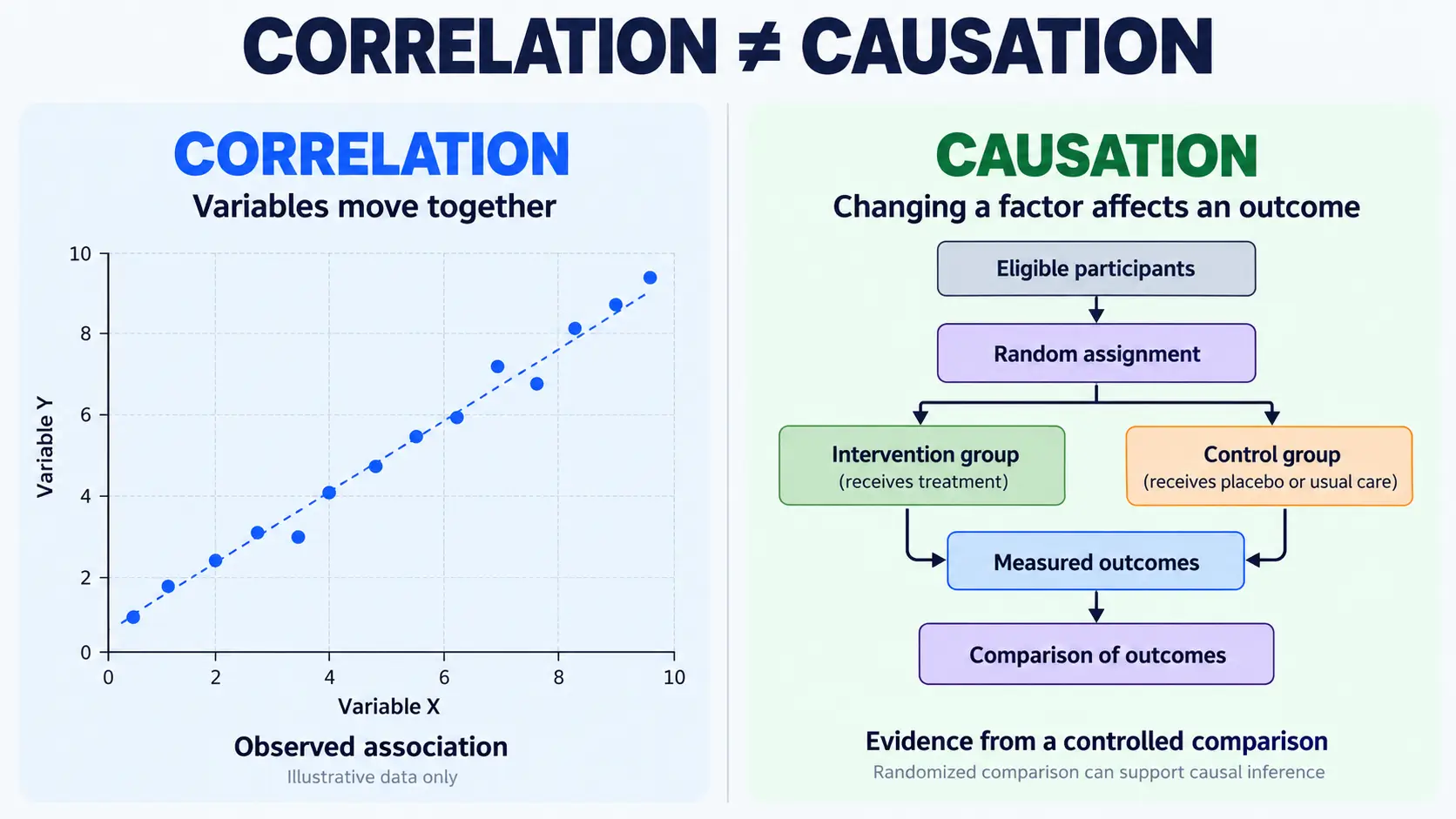
Because participants were not randomly assigned to several years of design training, the study cannot establish that training caused the differences.
What the Evidence Supports
| Evidence finding | Responsible interpretation |
|---|---|
| A meta-analysis found a positive average training effect | Structured training can help on average |
| Publication-bias adjustments reduced the estimated effect | Published positive findings may overstate effectiveness |
| Study quality and results varied substantially | No programme should be presented as universally effective |
| Some studies found null or uneven outcomes | Generation and evaluation may not improve together |
| Studies use different tasks and definitions | One task cannot measure creativity in every context |
For readers, learnable should mean that creative-thinking processes can be practised and may become more effective. It does not mean unlimited potential, equal outcomes, automatic transfer between domains, or a guaranteed timetable.
The Creative Thinking Loop
The Creative Thinking Loop has six stages:
Frame → Diverge → Score → Develop → Test → Reflect
The sequence is flexible. Testing may reveal that the original problem was framed poorly. Evaluation may show that more options are needed. Reflection may suggest a different generation method for the next attempt.
Design Council’s Double Diamond similarly uses divergence, convergence, small-scale testing, feedback, and iteration. It also presents the process as non-linear rather than as a fixed sequence. This framework supports the practical structure of the loop, but it is not experimental proof that one method improves creativity for every person or task.
Step 1: Frame the Challenge Clearly
A useful frame identifies:
-
the person or group affected;
-
the change being sought;
-
the evidence that would indicate improvement;
-
the constraints that genuinely matter.
A vague question such as “How can I make this better?” provides little direction. A highly restricted question can eliminate useful possibilities before idea generation begins.
Turn the issue into an open but bounded question.
Study example: How might I explain this scientific concept clearly in five minutes without relying only on text?
Work example: How might we reduce unproductive time in a weekly meeting while preserving necessary decisions and participation?
Everyday example: How might our household reduce forgotten tasks without requiring everyone to use the same application?
Before moving forward, check whether the frame describes a real problem rather than a preferred solution.
“How can we persuade everyone to use this app?” already assumes that an application is the answer. “How might we make task responsibilities visible?” allows several kinds of solution.
Step 2: Generate Varied Options
The purpose of divergence is not simply to produce a longer list. It is to generate ideas from meaningfully different categories.
Category Switching
Produce at least one option from several relevant categories.
For a study problem, the categories might include:
-
format;
-
timing;
-
environment;
-
feedback;
-
collaboration;
-
removal of unnecessary work.
For a meeting problem, they could include agenda design, participation, roles, scheduling, communication, or eliminating a step.
Assumption Reversal
Identify a rule that appears fixed and reverse it temporarily.
-
What if attendance were optional?
-
What if students explained the concept?
-
What if no screen could be used?
-
What if updates happened before the meeting?
The reversed idea does not need to be practical in its original form. Its purpose is to expose alternatives hidden by familiar assumptions.
Forced Connections
Connect the problem with an unrelated system, setting, or object.
A queue, restaurant menu, sports drill, library catalogue, voting process, or travel checklist may suggest a different structure. The connection is useful only when it produces a relevant change rather than a decorative comparison.
Constraint Changes
Add, remove, or alter one constraint.
Ask what the solution would look like with:
-
no additional money;
-
half the available time;
-
no new technology;
-
fewer people;
-
only existing materials;
-
a requirement that the first version be reversible.
Constraints can widen the search by preventing an immediate return to the usual answer.
Mind Mapping
Place the challenge at the centre and create branches for users, causes, constraints, categories, examples, and options.
Mind mapping is most useful when a problem contains several connected factors. It is less useful when the map becomes a collection of words that never leads to distinct options.
Collegenp’s Mind Mapping for Better Learning and Creativity provides a related method for association, clustering, and idea organisation.
Analogies
Ask how another setting handles a structurally similar problem.
For example:
-
How does a hospital hand over urgent information?
-
How does a sports team review performance?
-
How does a library help users find relevant material?
-
How does a kitchen coordinate several tasks under time pressure?
Use the analogy to identify a transferable principle rather than copying another setting without considering its context.
Delay Evaluation During the First Pass
Temporarily separating idea generation from judgment is a useful default. It gives unusual options time to appear before feasibility concerns narrow the set.
The separation does not need to be absolute. A dangerous, unethical, or clearly irrelevant idea should not be retained merely to protect originality. The purpose is to postpone routine criticism, not to ignore essential boundaries.
Step 3: Evaluate Ideas Without Rejecting Novelty Too Early
Evaluation is more useful when each criterion is considered separately.
An idea may be original but difficult to test. Another may be feasible but conventional. A third may be useful but depend on unsupported assumptions. Combining these qualities into one immediate impression can hide important differences.
Idea Evaluation Scorecard
| Criterion | Question | Simple scale |
|---|---|---|
| Relevance or usefulness | Does the idea address the user, goal, and context? | 1 = weak fit; 5 = strong fit |
| Originality | Is it meaningfully different from obvious options? | 1 = familiar; 5 = unusually distinct |
| Feasibility | Can a first version be attempted with available resources? | 1 = difficult now; 5 = readily testable |
| Assumptions or evidence | What must be true, and what is already known? | 1 = many unsupported assumptions; 5 = key assumptions supported |
| Learning value | Will a small test provide useful information? | 1 = little learning; 5 = high learning value |
The scorecard is a practical decision tool, not a validated psychological test. Its purpose is to support comparison and discussion.
The importance of each criterion depends on the task. A safety-sensitive decision may give greater weight to evidence and feasibility. An early concept exercise may place more weight on originality and learning value. Ethics and possible harm should be treated as screening conditions rather than optional points.
Use a Two-Pass Shortlist
In the first pass, remove ideas that clearly fail the goal, user need, ethical conditions, or unavoidable constraints.
In the second pass, select:
-
two or three promising options;
-
one wildcard that is unusual but worth developing.
Keeping a wildcard does not mean accepting it as the final answer. It provides time to identify whether an unfamiliar idea contains a useful component before it is rejected.
Step 4: Improve Promising Ideas
A rough idea should not always be accepted or rejected as a whole. It may contain one useful component and several weak ones.
Ask:
-
Which part directly addresses the problem?
-
Which assumption creates the greatest weakness?
-
Can two ideas be combined?
-
Can the first version be narrower?
-
Can an expensive or complicated feature be removed?
-
Can the idea be adapted for another user?
-
What would make it easier to test?
-
What must change for the idea to become useful?
Useful improvement actions include:
-
combining strengths from different ideas;
-
simplifying the first version;
-
adding missing detail;
-
removing a weak component;
-
changing an assumption;
-
narrowing the target situation;
-
reversing one element;
-
adding a helpful constraint.
A 2023 think-aloud study examined how experts worked while evaluating ideas. The researchers observed that experts often moved beyond a gatekeeping role by elaborating, transforming, or reframing idea components. The study concerned experts in a particular design context, so its findings should not be generalised to every task or learner.
Step 5: Prototype and Test with Limited Effort
A prototype is the smallest useful representation of an idea that can provide information.
Depending on the task, it might be:
-
a sketch;
-
a sample paragraph;
-
a short lesson segment;
-
a role-play;
-
a checklist;
-
a storyboard;
-
a paper interface;
-
a mock-up;
-
an interview prompt;
-
a limited trial.
Begin with the riskiest assumption:
What must be true for this idea to work, and how can I learn about that with the least effort?
For a new study method, test one session before planning an entire term. For a lesson activity, run a short version with one group. For a meeting process, try it for two meetings. For a household system, test it on one recurring task before applying it more widely.
A useful test should produce information rather than merely display effort. Record what happened, what failed, what was unexpected, and what the next version should change.
Design Council’s framework includes small-scale testing, rejection of unsuitable options, improvement, and repeated feedback.
Collegenp’s Productive Failure and the Creative Mind offers related reading on reflection after an unsuccessful attempt.
Step 6: Reflect and Repeat
Reflection turns one exercise into information that can improve the next attempt.
Record:
-
the original prompt;
-
the techniques used;
-
the number of options;
-
the categories represented;
-
the shortlisted ideas;
-
the reason for each score;
-
the assumption tested;
-
the result;
-
the next change.
The aim is not to prove that you possess a fixed level of creativity. It is to notice whether your process changes.
You may find that you:
-
frame problems more clearly;
-
move between categories more easily;
-
produce fewer near-duplicates;
-
preserve unusual options longer;
-
explain selection decisions more carefully;
-
improve components before rejecting ideas;
-
learn more from small tests.
A 20-Minute Creative Thinking Routine
This routine is a convenient practice template. It is not a scientifically established training dose or a promised timeline.
| Time | Activity | Output |
|---|---|---|
| 2 minutes | Frame the challenge | One open question with a user, goal, and constraint |
| 7 minutes | Generate varied options | Ideas from several categories |
| 4 minutes | Cluster the ideas | Groups based on approach, cause, user, or format |
| 4 minutes | Score and shortlist | Two or three options plus one wildcard |
| 3 minutes | Improve one option | A revised idea and one testable assumption |
Change the generation technique across sessions. One attempt might use assumption reversal, while another uses category switching, analogies, constraints, or a mind map.
Extend or adapt the routine when a problem requires research, consultation, ethical review, technical expertise, or input from affected people.
One-Page Creative Thinking Practice Log
A practice log makes progress easier to examine without turning one score into a personal identity.
| Field | What to record |
|---|---|
| Date and context | When and where the exercise took place |
| Challenge | The open question being addressed |
| User or audience | Who would be affected |
| Goal | The change or result being sought |
| Constraints | Time, resources, rules, safety, or other limits |
| Generation method | Reversal, analogy, mapping, category switching, or another method |
| Number of options | Total ideas produced |
| Categories represented | Distinct approaches rather than near-duplicates |
| Shortlisted ideas | Promising options and an optional wildcard |
| Score rationale | Why each rating was assigned |
| Selected idea | The option chosen for development |
| Main improvement | What was combined, removed, narrowed, or changed |
| Riskiest assumption | What most needs to be true |
| Small test | The least demanding way to investigate that assumption |
| Result | What happened |
| Learning | What the result clarified or changed |
| Next step | Repeat, revise, combine, pause, or reject |
The log may be kept in a notebook, document, or spreadsheet. The format matters less than recording decisions consistently enough to compare later attempts.
How to Measure Improvement
Progress should be compared with earlier attempts on similar tasks rather than with a universal talent score.
Track five indicators.
Fluency
How many relevant options did you produce?
A higher number is not automatically better, but repeatedly stopping after the first idea may leave too little choice.
Flexibility
How many distinct categories did the ideas represent?
Ten minor variations of one approach show less flexibility than six ideas drawn from different categories.
Relevance
How many ideas addressed the actual user, goal, and constraints?
An unusual option that ignores the problem should not receive credit simply for being different.
Iteration Quality
Did development make the selected idea clearer, narrower, easier to test, or better matched to its intended user?
This shifts attention from first ideas to improvement.
Test Learning
Did the prototype or trial reveal information that changed the next decision?
A test that challenges an assumption may provide more value than one that produces only vague approval.
Originality may also be noted relative to your previous work or to known options in the task. Avoid treating one score or task as proof of overall creative ability. Creativity research uses varied definitions, tasks, populations, and measures.
Worked Example: Improving a Weekly Meeting
The following is a simplified illustration, not a documented organisational case study.
Frame the Problem
Prompt: How might a team reduce unproductive time in a weekly meeting while preserving necessary decisions and participation, without adding new software?
Generate Options from Different Categories
-
Agenda: Put decisions first and routine updates last.
-
Participation: Begin with three minutes of silent written input.
-
Format: Share routine updates in advance and use live time for unresolved decisions.
-
Roles: Rotate a timekeeper and decision recorder.
-
Wildcard: Cancel the standing meeting and hold a short session only when an unresolved decision has been submitted.
Evaluate the Wildcard
The wildcard is unusual but incomplete. It assumes that team members will identify unresolved decisions in advance and that cancelling the regular meeting will not cause information gaps.
| Criterion | Score | Reason |
|---|---|---|
| Relevance | 4 | It directly targets unnecessary meeting time |
| Originality | 5 | It challenges the assumption that the meeting must always occur |
| Feasibility | 3 | It could be tried, but coordination rules are missing |
| Assumptions or evidence | 2 | It depends on timely submissions and accurate issue identification |
| Learning value | 5 | A short trial could expose delays or missed concerns |
The low assumption score identifies what needs development. It does not require immediate rejection.
Develop the Idea
Keep the principle of meeting only for unresolved decisions, then add operating conditions:
-
routine updates are submitted by an agreed deadline;
-
the decision owner marks items requiring discussion;
-
the meeting is cancelled when no item requires live discussion;
-
a short session is held when an unresolved item is submitted;
-
people unable to attend may provide a written position;
-
decisions and responsibilities are recorded in an agreed location.
Identify the Riskiest Assumption
Riskiest assumption: Team members will submit updates on time and correctly identify decisions requiring discussion.
Run a Small Test
Trial the process with one team for two weeks.
Record:
-
meeting time used;
-
decisions completed;
-
delayed items;
-
concerns that were missed;
-
late submissions;
-
participant feedback.
The test would not prove that the system works for every organisation. It would show whether the submission rule is realistic and what must change before a wider trial.
Common Mistakes and How to Correct Them
| Mistake | Why it weakens the process | Correction |
|---|---|---|
| Waiting for inspiration | Practice becomes dependent on an uncertain feeling | Begin with a prompt, category, analogy, or constraint |
| Judging during the first generation pass | Early criticism narrows the option set | Separate initial generation from scoring |
| Producing near-duplicates | Quantity rises without increasing real choice | Change categories, users, assumptions, or constraints |
| Treating more ideas as the complete goal | Count alone does not ensure relevance or improvement | Evaluate variety, usefulness, and learning |
| Chasing originality alone | An unusual idea may ignore the goal or create unnecessary risk | Judge originality separately from usefulness and feasibility |
| Polishing before testing | Effort is committed before the main uncertainty is examined | Build the smallest useful test |
| Allowing the loudest person to choose | Confidence may replace evidence | Use written criteria before discussion |
| Rejecting an idea because one part is weak | A valuable component may be lost | Keep strengths and change weaker components |
| Repeating one technique every time | Familiar methods may reproduce familiar patterns | Rotate reversal, analogy, mapping, constraints, and category switching |
| Treating one score as identity | Context-specific performance becomes an inaccurate label | Compare the process with personal baselines |
Solo, Group, and AI-Assisted Practice
Different settings support different parts of the process.
Working Alone
Solo work can provide space to record early ideas without immediate group reaction. It is useful for:
-
producing an independent first set of options;
-
noticing personal assumptions;
-
completing an initial scorecard;
-
reflecting on the reasoning behind a choice.
Its limitation is that one person may overlook users, consequences, constraints, or knowledge that others would notice.
Working with a Group
A practical group sequence is:
-
Frame the challenge together.
-
Let participants produce an initial set of options independently.
-
Share and cluster the ideas.
-
Combine or elaborate related options.
-
Score them using agreed criteria.
-
Preserve one wildcard for development.
-
Decide what to test.
Independent generation before discussion is a practice option, not proof that group brainstorming is always inferior.
Educators seeking a wider teaching context may refer to Collegenp’s Teach Critical, Creative, and Independent Thinking.
Using AI as an Optional Aid
AI tools can help produce:
-
additional categories;
-
counterexamples;
-
variations of an existing idea;
-
questions about assumptions;
-
alternative wording;
-
possible test scenarios.
The output still requires human evaluation. A machine-generated suggestion is not automatically original, accurate, ethical, feasible, or suitable for the intended user.
Use AI as an optional prompt or feedback aid rather than evidence that an idea is correct. When the goal is to practise independent generation, write your own initial options before requesting machine-generated alternatives.
Use the Loop on a Real Problem
Creative thinking becomes more manageable when it is treated as observable work: a question you frame, options you generate, criteria you apply, components you improve, assumptions you test, and lessons you record.
Research supports cautious confidence that creativity training can help on average. It also shows substantial variation, publication bias, methodological weaknesses, task differences, and limits on what can be concluded from any one programme or test.
Choose one current problem and complete one loop. Compare the process with your previous attempt rather than asking whether you have become a “creative person.” The more useful question is whether you now have a clearer way to generate, judge, improve, and test ideas.





Comments 0
No comments yet. Be the first to start the conversation.