



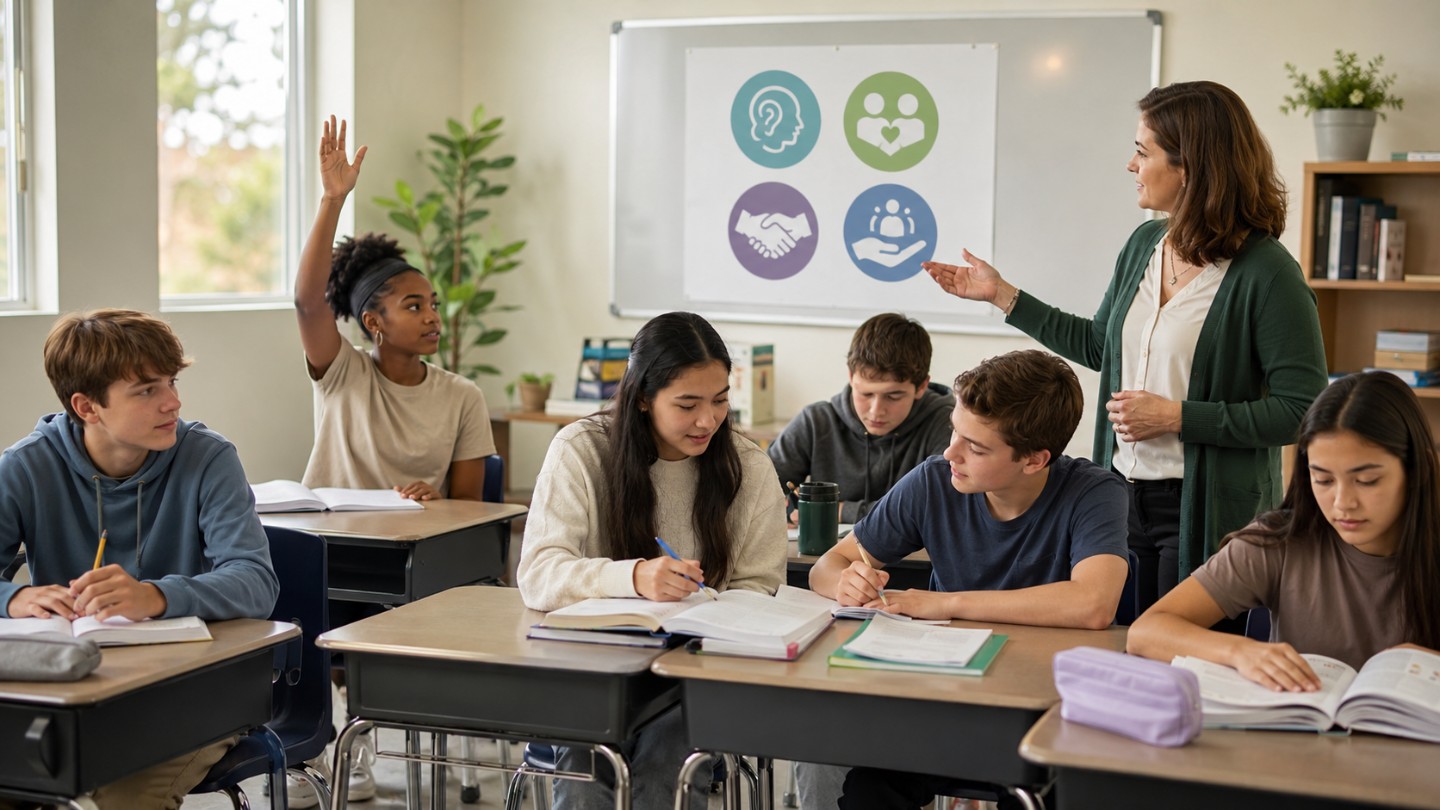
Student behaviors in the classroom are the observable actions students show while learning, listening, speaking, moving, working with classmates, using materials, and responding to expectations. These actions can support learning or interrupt it, but they should be described carefully and not used as permanent labels for students.
A useful way to understand classroom behavior is to ask three questions: What action did the teacher observe? How did it affect learning, safety, or relationships? What skill, routine, or support should come next?
Understood’s positive behavior strategies guide recommends planning, teaching, practicing, reinforcing, and re-teaching expected behaviors and classroom routines. The What Works Clearinghouse guide on reducing behavior problems in elementary classrooms recommends identifying the specific behavior and the conditions that prompt and reinforce it before selecting a response.
Answer Summary:
Student behaviors in the classroom are observable actions, not fixed student identities. Positive behaviors include listening, participation, cooperation, preparedness, respectful communication, persistence, and self-regulation. Negative behaviors include interruptions, off-task actions, refusal, teasing, peer conflict, device misuse, and repeated lateness. Teachers can respond by teaching expectations, reinforcing helpful actions, redirecting calmly, using logical consequences, documenting patterns, and involving school support when behavior continues or affects safety.
Table of Content
- What Are Student Behaviors?
- Positive Student Behaviors in the Classroom
- Negative Student Behaviors in the Classroom
- Positive vs Negative Student Behaviors
- Why Students May Show Negative Classroom Behaviors
- How Teachers Can Encourage Positive Student Behaviors
- How Teachers Can Respond to Negative Student Behaviors
- Classroom Behavior Checklist for Teachers
- Conclusion
Key Takeaways:
-
Student behavior means observable classroom action.
-
Positive behaviors can be taught, practiced, and reinforced.
-
Negative behaviors should be described without labeling the student.
-
Behavior may reflect unclear expectations, task difficulty, stress, peer issues, or weak routines.
-
Calm redirection works better when students already know the expected behavior.
-
Logical consequences should connect directly to the behavior.
-
Repeated, unsafe, or harmful behavior needs documentation and school support.
What Are Student Behaviors?
Student behaviors are visible classroom actions that a teacher can observe, describe, and respond to. Examples include raising a hand, listening during instructions, asking for help, interrupting, refusing a task, helping a peer, using a device, or moving around the room.
The word “observable” matters. “The student interrupted three times during group discussion” is clearer than “The student is rude.” The first sentence describes an action. The second sentence labels the student and gives the teacher less useful information.
The IRIS Center’s classroom behavior management module explains that effective classroom behavior management includes cultural influences on behavior, positive classroom climate, structured classrooms, and foundational practices. This means behavior support is part of daily teaching, not a separate task saved only for difficult moments.
For related teacher background, Collegenp’s article on why educational psychology is important for every teacher can help readers connect classroom behavior with learning, motivation, and student development.
Behavior vs Attitude vs Academic Performance
Behavior is what a student does. Attitude is an internal tendency, feeling, or belief that a teacher cannot fully see. Academic performance is evidence of learning, such as classwork, tests, projects, presentations, or oral responses.
These areas can affect one another, but they should not be treated as the same issue.
A student who looks away during a lesson may be distracted, confused, tired, anxious, or thinking. A student who scores poorly on a quiz may need academic support rather than behavior correction. A student who speaks sharply may need help with respectful language, conflict repair, or emotional regulation.
Teachers can reduce unfair assumptions by asking:
-
What action did I observe?
-
What expectation was met or missed?
-
What happened before and after the behavior?
-
What skill, routine, or support may help the student next?
This keeps the response focused on teaching and support rather than judgment.
Positive Student Behaviors in the Classroom
Positive student behaviors are actions that support learning, safety, cooperation, and respectful participation. These behaviors are teachable skills, not personality traits.
Positive behavior does not mean silent compliance. A student may show positive behavior by asking a relevant question, disagreeing respectfully, helping a classmate, correcting an error, requesting help, or using a calming strategy after frustration.
Examples of Positive Student Behaviors
Common positive student behaviors include:
-
Listening while the teacher or a classmate is speaking
-
Following classroom routines after they have been taught
-
Asking relevant questions
-
Participating respectfully in discussion
-
Bringing required materials
-
Starting work after directions are clear
-
Staying with a difficult task
-
Sharing responsibility during group work
-
Using respectful words during disagreement
-
Waiting for a turn to speak
-
Asking for help before giving up
-
Using technology for the assigned task
-
Caring for shared materials
-
Accepting feedback and trying again
-
Repairing harm after conflict
These behaviors become stronger when teachers model them, give students practice, and name the specific action they want repeated. Understood recommends setting observable expectations, teaching routines, using reminders, and reinforcing expected behavior throughout the school year.
How Positive Behaviors Support Learning
Positive behaviors help students focus, participate, receive feedback, and work with others. They also help teachers spend more time on instruction and less time correcting repeated interruptions.
CASEL’s social and emotional learning framework identifies five competence areas: self-awareness, self-management, social awareness, relationship skills, and responsible decision-making. In classroom language, these skills appear when students listen, take turns, manage frustration, solve peer problems, and make responsible choices during learning activities.
Teachers can make reinforcement more useful by naming the behavior clearly. Instead of saying, “Good job,” a teacher can say, “You waited until your classmate finished before adding your idea.” Specific feedback tells students which action supports learning.
For lesson ideas connected to participation and attention, Collegenp’s article on student engagement activities in the classroom may be a useful internal resource.
Negative Student Behaviors in the Classroom
Negative student behaviors are observable actions that interrupt learning, safety, respect, or classroom routines. They should be described as actions, not used as names for students.
A negative behavior may be minor, repeated, or serious. The response should match the behavior, the student’s age, the pattern, the classroom expectation, and the school’s policy.
Examples of Negative Student Behaviors
Common negative student behaviors include:
-
Interrupting the teacher or classmates
-
Talking during instructions
-
Leaving the seat during work time without permission
-
Refusing to begin a task
-
Arguing after a direction
-
Making disrespectful comments
-
Teasing or excluding classmates
-
Misusing shared materials
-
Using a phone or device for non-class activity
-
Copying another student’s work
-
Arriving late repeatedly
-
Avoiding group responsibilities
-
Making repeated distracting sounds
-
Ignoring agreed routines
-
Escalating peer conflict instead of seeking help
Some behaviors need immediate school support. Physical conflict, threats, bullying, harassment, discriminatory language, repeated targeted peer harm, or safety concerns should be handled according to school safeguarding, behavior, and family communication policies.
Why Teachers Should Avoid Labeling Students
Teachers should avoid labeling students because labels hide the specific behavior that needs support. “Off-task during independent writing” is clearer than “lazy.” “Refused to put the phone away after two reminders” is clearer than “defiant.”
The Victoria Department of Education’s positive classroom management strategies state that behavior is functional, behavior can be taught, and alternative replacement behaviors can meet students’ needs more appropriately. A teacher cannot teach a label. A teacher can teach a replacement action.
Positive vs Negative Student Behaviors
A side-by-side comparison helps teachers connect the observed behavior, classroom effect, and response. The same student may show positive and negative behaviors on the same day, so the purpose is guidance rather than judgment.
| Classroom area | Positive student behavior | Negative student behavior | Helpful teacher response |
|---|---|---|---|
| Listening | Waits while others speak | Talks over directions or peers | Re-teach the listening routine; use a cue |
| Participation | Adds relevant ideas | Calls out or dominates discussion | Use a turn-taking structure |
| Group work | Shares tasks and listens | Avoids role or argues repeatedly | Assign roles and check progress |
| Materials | Uses and returns supplies | Misuses or hides materials | Re-teach the routine; restore materials |
| Technology | Uses device for assigned work | Uses device for unrelated activity | Re-state the device rule; adjust access if needed |
| Conflict | Uses respectful words | Teases, excludes, or escalates | Separate, calm, repair, and document if repeated |
| Persistence | Tries a strategy before asking for help | Gives up, refuses, or leaves work | Reduce the first step; offer structured choice |
| Time | Arrives prepared and starts | Arrives late or delays work | Check the pattern; teach the entry routine |
Why Students May Show Negative Classroom Behaviors
Students may show negative behaviors for different reasons, including unclear expectations, task difficulty, peer pressure, attention, stress, boredom, unmet needs, or weak routines. A useful response starts with observation before judgment.
The What Works Clearinghouse recommends identifying both the specific behavior and the conditions that prompt and reinforce it. The same guide also recommends teaching and reinforcing new skills to increase appropriate behavior and preserve a positive classroom climate. (Institute of Education Sciences)
For example, a student who leaves the seat during writing may be avoiding a hard task, seeking peer attention, needing movement, or unsure how to begin. The response should depend on the pattern.
Teachers can look for:
-
When the behavior happens
-
What activity or transition came before it
-
Who was nearby
-
What the student gained or avoided
-
Whether the expectation had been taught
-
Whether the task was clear and accessible
-
Whether the student may need academic, social, emotional, or language support
Teachers do not need to diagnose students. They need to observe patterns, respond calmly, and involve school support when concerns continue.
How Teachers Can Encourage Positive Student Behaviors
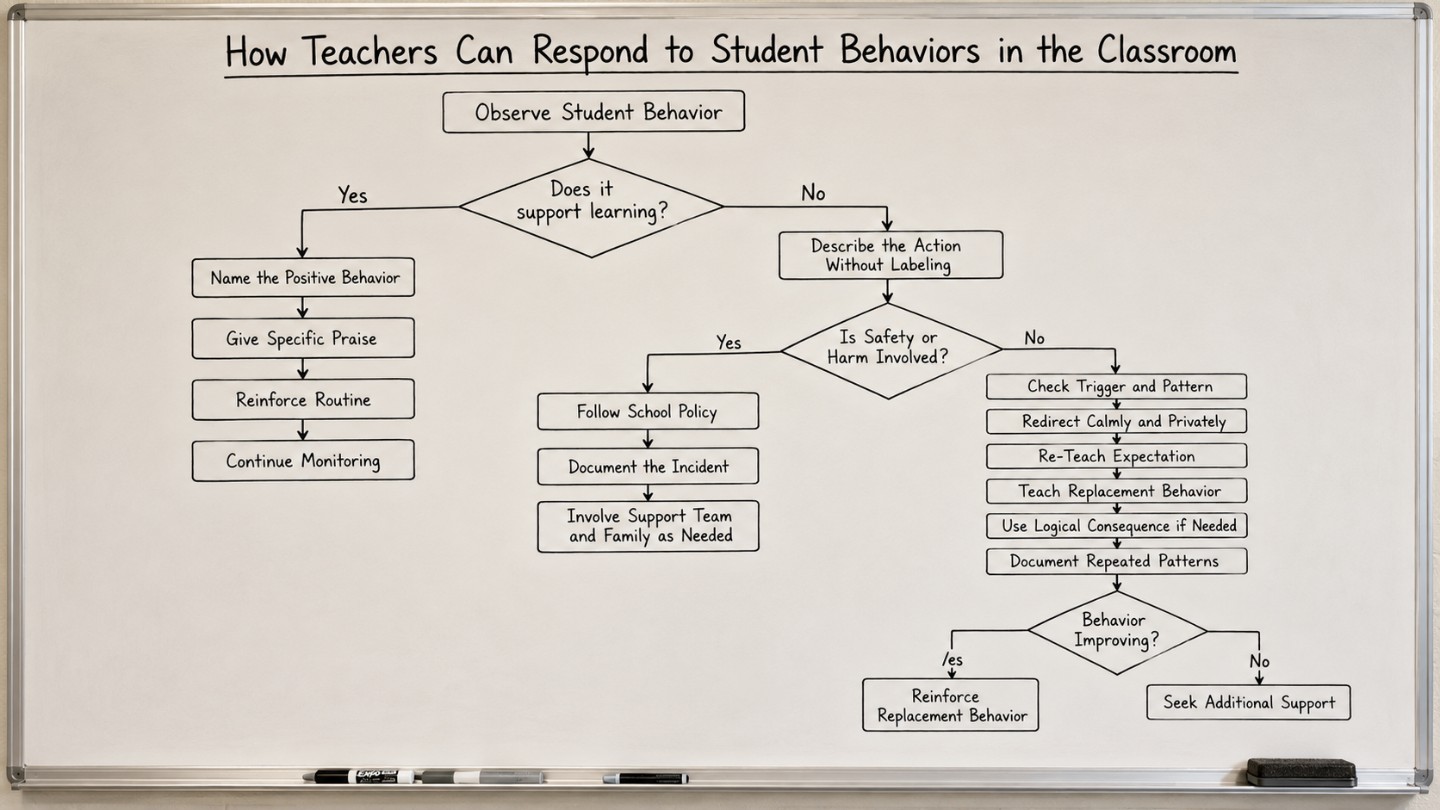
Teachers encourage positive student behaviors by making expectations visible, teaching routines, practicing them, and reinforcing specific actions. Students are more likely to meet expectations when they know what the expected behavior looks and sounds like.
Set Clear Expectations and Routines
Classroom expectations should be positive, concrete, and observable. Instead of “Don’t be noisy,” say, “Use a voice level that lets your group work.” Instead of “Don’t be careless with materials,” say, “Use materials for the task and return them to the tray.”
Useful expectation areas include:
-
Respectful communication
-
Preparedness
-
Safe movement
-
Participation
-
Responsible technology use
-
Care for materials
-
Help-seeking routines
The Education Endowment Foundation’s Improving Behaviour in Schools report is designed to support school leaders in primary and secondary schools when making decisions about behavior strategies. For school-wide context, Collegenp’s article on strategies for building a positive school culture can support related reading.
Use Specific Praise and Reinforcement
Specific praise works because it names the action the student should repeat.
Examples:
-
“You opened your notebook and started the warm-up.”
-
“You disagreed with the idea without insulting the person.”
-
“You asked for help before leaving the task.”
-
“Your group used quiet voices and stayed with the role cards.”
The Center on PBIS defines Positive Behavioral Interventions and Supports as an evidence-based, tiered framework for supporting students’ behavioral, academic, social, emotional, and mental health needs. In classroom practice, this means expected behavior should be defined, taught, acknowledged, and reviewed when students need more support.
Teach Replacement Behaviors
A replacement behavior is the action a student should use instead of the negative behavior. It should meet a similar need in a more appropriate way.
| Negative behavior | Replacement behavior to teach |
|---|---|
| Calling out | Raise a hand or use a discussion signal |
| Leaving the seat repeatedly | Request movement or use an agreed break routine |
| Refusing work | Start with the first small task or ask for help |
| Arguing after feedback | Ask one clarifying question, then try the correction |
| Teasing a peer | Use respectful disagreement or request help |
| Device misuse | Follow the assigned device task or put the device away |
Replacement behaviors should be taught before teachers expect students to use them consistently. If students only hear what not to do, they may still lack a workable next action.
For classroom technology expectations, Collegenp’s article on safe digital tools for modern classrooms can support related reading.
Build Student Voice and Relationships
Relationships do not replace expectations, but they can make expectations easier to teach and maintain. Students are more likely to accept correction when they believe adults are fair, calm, and consistent.
Useful teacher questions include:
-
What helps you start work?
-
Which part of group work is difficult?
-
What reminder helps you without embarrassing you?
-
What is a fair way to repair this problem?
-
What should you try first when the task feels hard?
These questions keep responsibility with the student while giving the teacher better information. For peer interaction and cooperation, Collegenp’s article on social skills every student needs in the classroom is a relevant internal resource.
How Teachers Can Respond to Negative Student Behaviors
Teachers can respond to negative behaviors by staying calm, naming the expected behavior, redirecting privately when appropriate, re-teaching routines, using logical consequences, and documenting repeated patterns. The purpose is to teach the next action and protect the learning environment.
Redirect Calmly and Privately
A calm redirection is brief, specific, and focused on what the student should do next.
Examples:
-
“Use the discussion signal before speaking.”
-
“Put the phone in your bag and return to question two.”
-
“Move back to your seat and start the first sentence.”
-
“Use respectful words. Try that again.”
-
“Pause and listen to the direction again.”
Private correction can reduce embarrassment and peer attention. A teacher may move closer, use a quiet voice, point to the routine, or give a nonverbal cue.
Use Logical Consequences
A logical consequence connects directly to the behavior and aims to teach, repair, or restore. The CDC’s behavior management guidance distinguishes logical consequences from punishment by explaining that logical consequences are linked to behavior and focus on corrective guidance and modeling.
| Behavior | Logical consequence |
|---|---|
| Misusing shared materials | Re-teach use; restore or organize materials |
| Using a device for unrelated activity | Put the device away under the classroom rule |
| Making a hurtful comment | Use repair language; adjust seating if needed |
| Avoiding a group role | Complete a smaller assigned role with check-in |
| Repeated calling out | Use a turn card or written response before speaking |
Logical consequences should be respectful, predictable, and connected to the classroom expectation. They should not embarrass students or turn correction into a public argument.
Track Patterns and Seek Support
Documentation helps teachers see whether behavior is occasional, repeated, situational, or escalating. It also helps school teams decide whether the student needs targeted support.
A simple behavior note may include:
-
Date and time
-
Activity or setting
-
Observable behavior
-
Teacher response
-
Student response
-
Possible trigger
-
Follow-up needed
Teachers should involve school support teams when behavior is repeated, unsafe, discriminatory, harmful to peers, or beyond ordinary classroom redirection. Family communication should follow school policy and focus on observable patterns, not blame.
Classroom Behavior Checklist for Teachers
A classroom behavior checklist helps teachers reflect on expectations, routines, reinforcement, and support. It should not be used to shame students or rank them publicly.
Positive behaviors to reinforce:
-
Listens during directions
-
Starts work after instructions
-
Uses respectful words
-
Waits for a turn
-
Brings materials
-
Cooperates in group tasks
-
Uses technology for assigned work
-
Asks for help appropriately
-
Persists after mistakes
-
Repairs conflict when guided
Negative behaviors to observe:
-
Interrupts repeatedly
-
Leaves task without permission
-
Refuses directions
-
Argues during correction
-
Teases or excludes peers
-
Misuses materials
-
Uses devices for unrelated activity
-
Arrives late repeatedly
-
Avoids group role
-
Makes repeated distracting sounds
Teacher response check:
-
Was the expectation taught?
-
Was the routine practiced?
-
Was the correction calm and specific?
-
Was the replacement behavior named?
-
Was the consequence logical?
-
Was the pattern documented?
-
Is school or family support needed?
Conclusion
Student behaviors in the classroom are best handled as observable actions that can be taught, practiced, redirected, and supported. Positive behaviors such as listening, participation, cooperation, preparedness, persistence, and respectful communication help create a stronger learning environment. Negative behaviors such as interruptions, refusal, teasing, off-task actions, peer conflict, and device misuse need calm, specific, and consistent responses.
The goal is not to label students. The goal is to understand behavior, teach expectations, reinforce helpful actions, respond fairly, and involve support when patterns continue or safety is affected.



Comments 0
No comments yet. Be the first to start the conversation.