



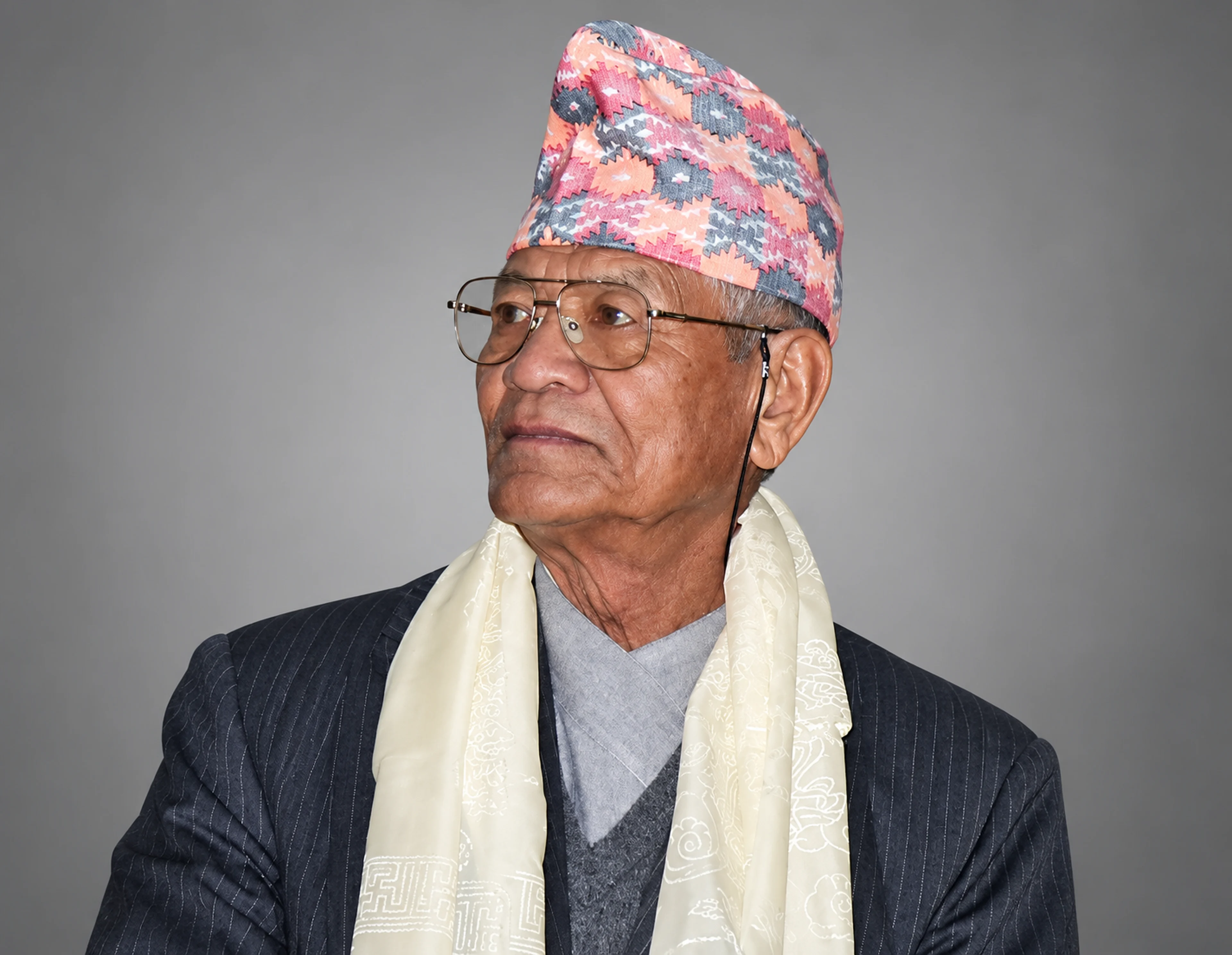
Bairagi Kainla (real name: Til Bikram Nembang) is an experimental poet of modern Nepali literature, a co-founder of the Tesro Aayam (Third Dimension) literary movement, a researcher of the Limbu language and Mundhum tradition, and a former Chancellor of the Nepal Academy.
In 1963, he helped launch the Tesro Aayam literary movement in Darjeeling, India, alongside Indra Bahadur Rai and Ishwar Ballav. The movement played an important role in introducing new discussions about the complexity of human life, objectivity, intellectual engagement, and experimental expression in Nepali literature.
Beyond poetry, Bairagi Kainla has devoted many years to studying the oral knowledge traditions, Mundhum, language, and culture of the Kirat Yakthung (Limbu) community. His contributions include collecting, transcribing, translating, editing, and publishing oral Mundhum texts.
In recognition of these contributions, the Madan Puraskar Guthi awarded him the Jagadamba Shree Award for 2075 BS.
Bairagi Kainla: Quick Facts
|
Particulars |
Details |
|---|---|
|
Real Name |
Til Bikram Nembang |
|
Literary Name |
Bairagi Kainla |
|
Date of Birth |
25 Shrawan 1996 BS (August 9, 1939) |
|
Birthplace |
Pauwa, Panchthar District, Nepal |
|
Father |
Khadga Bahadur Nembang |
|
Nationality |
Nepali |
|
Education |
Nepal and Darjeeling, India |
|
Main Areas of Work |
Nepali poetry, literary editing, Limbu language, culture, and Mundhum research |
|
Literary Movement |
Tesro Aayam (1963) |
|
Co-founders |
Indra Bahadur Rai and Ishwar Ballav |
|
Major Poetry Collections |
Bairagi Kainlaka Kavitaharu (2031 BS), Andha Manchheharu ra Hatti (2068 BS) |
|
Major Academic Position |
Chancellor of Nepal Academy (2066–2070 BS) |
|
Major Awards |
Sajha Award (2031 BS), Yugkavi Siddhicharan Award, Jagadamba Shree (2075 BS) |
Birth, Family Background, and Childhood
Bairagi Kainla was born on 25 Shrawan 1996 BS in Pauwa village of Panchthar District, Nepal. His birthplace lies in the former Pauwa Sartap area, now part of Phalgunanda Rural Municipality–3.
His father was Khadga Bahadur Nembang. Kainla grew up in a family connected to the social and cultural traditions of the Limbu community. Family members addressed him as "Kainla," a Nepali term commonly used for a child of a particular birth order. He later added "Bairagi" to this name and adopted it as his literary identity.
In a biographical article published in Shilapatra, Dharmendra Nembang discussed his family background, birthplace, and naming. According to that account, his name given during the traditional naming ceremony was Bajhanghang, while he used Til Bikram Nembang for his formal education.
Kainla spent his childhood in the rural surroundings of eastern Nepal. Limbu language, oral history, traditional knowledge, and cultural rituals formed an important part of social life in the region.
Within the Limbu community, traditional ritual specialists such as Phedangma, Samba, Yeba, and Yema have played roles in reciting and transmitting Mundhum across generations. Kainla later made the study and documentation of this oral knowledge tradition a major focus of his scholarly work.
Education and the Literary Setting of Darjeeling
Bairagi Kainla began his early education at home and in his local surroundings. He subsequently continued his studies through Ilam before moving to Darjeeling, India.
He studied science in Darjeeling. According to published biographical accounts, he completed the certificate level in science there.
His stay in Darjeeling was important to his literary development. At the time, Darjeeling was an active centre of Nepali language, literature, publications, and literary discussion.
In an interview with The Kathmandu Post on August 24, 2019, Kainla said he had travelled to Darjeeling for his studies in the 1950s and developed his reading habits and literary interests during his time there.
He mentioned being influenced by Nepali writers such as Laxmi Prasad Devkota, Balkrishna Sama, and Madhav Prasad Ghimire, as well as Rabindranath Tagore, Sarat Chandra Chattopadhyay, William Wordsworth, and T. S. Eliot.
While studying and participating in literary activities in Darjeeling, Kainla became acquainted with Indra Bahadur Rai and Ishwar Ballav. Their literary collaboration eventually provided the foundation for the Tesro Aayam movement.
Early Literary Career
Bairagi Kainla began writing during his student years. His early poems reflected themes of love, personal experience, and the influence of Romantic literary tendencies.
Over time, his literary outlook changed. Alongside expressions of personal emotion, he increasingly attempted to address social realities, human existence, and the complexities of modern life through poetry.
In Darjeeling, he also participated in publishing and editing literary magazines with other writers. His involvement with the magazine Phool-Paat-Patkar was among his notable early literary activities.
Literary discussions, reading, and editorial experience gave him opportunities to experiment with new ideas and writing styles. Against this background, he and his colleagues began searching for new methods of literary expression in Nepali literature.
The Tesro Aayam Literary Movement
Tesro Aayam (Third Dimension) was a literary movement that began in Darjeeling, India, in 1963 (2020 BS). Its principal founders were Bairagi Kainla, Indra Bahadur Rai, and Ishwar Ballav.
A literary magazine titled Tesro Aayam was published to present the movement's ideas and creative works. Bairagi Kainla provided editorial leadership for the magazine.
The movement attempted to portray people, objects, experiences, and different aspects of life through approaches that differed from conventional literary expression. It generated new discussions about experimental writing in Nepali poetry, fiction, and literary criticism.
Main Concepts of Tesro Aayam
The founders of Tesro Aayam argued that literature should not be limited to describing external events and emotions.
In their view, understanding human life required more than observing a person's external circumstances. Literature also needed to address inner experiences, psychological conditions, social relationships, history, and connections with time.
The main elements of this approach included:
-
Totality: Literature should attempt to represent different dimensions of a person or event rather than focusing on a single aspect.
-
Objectivity: Literary representation should give importance to the existence of objects or life situations and their different characteristics.
-
Intellectual Engagement: Literary works should incorporate ideas, reflection, and analysis alongside emotion and imagination.
-
Myths and Symbols: Cultural references, myths, symbols, and imagery can be used to communicate complex experiences and ideas.
-
Linguistic Experimentation: Literary meaning can be developed through unconventional language, sentence structures, and methods of expression.
Ideas associated with modern painting, psychology, and experimental developments in world literature also influenced Tesro Aayam writing.
However, the movement cannot be confined to a single fixed definition. Its founders themselves presented different perspectives on literary creation and interpretation.
Bairagi Kainla's Contribution to the Movement
Indra Bahadur Rai's contribution to Tesro Aayam was primarily associated with fiction and the development of literary theory. Ishwar Ballav and Bairagi Kainla advanced the movement's experimental approach through poetry.
Kainla's poems explore the complexities of modern life, human existence, social structures, and questions of freedom. His writing is characterised by intellectual expression, mythological references, and unconventional combinations of imagery.
His poem Mateko Manchheko Bhashan: Madhyarat Pachhiko Sadaksita (A Drunken Man's Speech: To the Street After Midnight) appeared in the first issue of Tesro Aayam. It is regarded as a representative example of his experimental poetic style.
An article by Parbat Portel and Samuel Chhetri, published in The Kathmandu Post on November 14, 2019, included observations from literary scholar Abhi Subedi and other critics. The article discussed the influence of Tesro Aayam on the language and creative structure of Nepali literature.
Tesro Aayam did not remain active as a single organised movement for an extended period. Its founders eventually pursued their respective literary and academic activities. Nevertheless, the literary discussions initiated by the movement have continued to attract attention in studies of modern Nepali literature.
Major Poetry Collections of Bairagi Kainla
Bairagi Kainla's two major original poetry collections are Bairagi Kainlaka Kavitaharu and Andha Manchheharu ra Hatti. A collected edition bringing together poems from different periods of his career was published later.
These publications provide an opportunity to examine his experimental poetic style, literary outlook, and changes in his writing over time.
Bairagi Kainlaka Kavitaharu (2031 BS)
Bairagi Kainlaka Kavitaharu (Poems of Bairagi Kainla) is a poetry collection published by Sajha Prakashan in 2031 BS.
It contains representative poems associated with his early writing and the Tesro Aayam movement. The collection reflects his linguistic experimentation, intellectually oriented poetry, and perspective on modern life.
He received the Sajha Award in 2031 BS for this work.
Andha Manchheharu ra Hatti (2068 BS)
Andha Manchheharu ra Hatti (Blind People and the Elephant) is his second poetry collection, published by Shangri-La Books in 2068 BS.
The collection includes some of his previously written poems alongside works composed during later periods.
In a 2019 interview with Nepal Magazine, Kainla explained that one reason for preparing his second collection was to preserve poems that had not appeared in his first book. He also mentioned that the collection included poems written during Nepal's People's Movement of 2062/63 BS.
Bairagi Kainlaka Sankalit Kavita (2076 BS)
In 2076 BS, Phoenix Books published Bairagi Kainlaka Sankalit Kavita (Collected Poems of Bairagi Kainla), edited by Rajan Mukarung.
The publication brought together poems from his two major poetry collections, along with early poems and several songs.
It made works written during different periods of his literary career available for study in a single volume.
Notable Poems of Bairagi Kainla
Modernist thought, awareness of human existence, social criticism, and experimental language are prominent characteristics of Bairagi Kainla's poetry.
Some of his notable poems and their principal themes are discussed below.
Mateko Manchheko Bhashan: Madhyarat Pachhiko Sadaksita
Mateko Manchheko Bhashan: Madhyarat Pachhiko Sadaksita is one of Bairagi Kainla's well-known poems.
It raises questions concerning modern society, social structures, individual freedom, and human existence.
Through the speech-like expression of a character, the poem portrays tensions between social structures and individual liberty. It uses satire, symbols, historical references, and intellectual reflection.
The poem can be studied in relation to the contradictions of modern society and the search for an independent individual existence.
Parvat
Parvat (Mountain) is another notable poem by Bairagi Kainla.
Rather than presenting a mountain merely as a natural feature, the poem treats it as a subject carrying symbolic meaning.
Imagery, intellectual references, and linguistic structure play important roles in constructing its meaning. The poem can be examined in connection with the experimental tendencies of Tesro Aayam writing.
Planchetko Table
Planchetko Table (The Planchette Table) is associated with Kainla's experimental approach to poetry.
The poem employs linguistic structures and symbols that differ from traditional descriptive writing. Understanding its meaning requires attention to the relationships between its imagery and intellectual references.
Ganga Nilo Bagchha
Ganga Nilo Bagchha (The Ganges Flows Blue) is another of his experimental poems.
It uses symbolic expression and intellectual references that differ from conventional narration. Studying the poem provides insight into Kainla's poetic language and creative experimentation.
Main Characteristics of His Poetic Style
Bairagi Kainla's poetry is particularly associated with intellectual reflection, symbolic expression, mythological references, questions concerning modern life, and experimentation with language.
His writing demonstrates methods of expression that differ from traditional descriptive styles. Individual poems often combine multiple images, ideas, and references to construct meaning.
However, complex symbols, references, and sentence structures can make some of his poems difficult for general readers to interpret.
For this reason, his poetry is frequently studied through the perspectives of literary theory, linguistic experimentation, and modernist thought.
Literary and Social Life After Returning to Nepal
Bairagi Kainla returned to Nepal after his studies in Darjeeling and the early phase of the Tesro Aayam movement.
His return marked a new period in his literary and social life. Alongside creative writing, he became involved in social activities and the study of the Limbu community's oral literature.
From the 2030s BS, he began placing particular emphasis on collecting and documenting Mundhum.
In an interview with Nepal Magazine, he stated that he had begun recording oral Mundhum texts around 2030 BS and became more actively involved in this field from 2031 BS.
Participation in Social and Civic Activities
In addition to literature and cultural research, Bairagi Kainla participated in social and civic activities.
He took part in activities supporting multiparty democracy in Nepal. During the People's Movement of 2062/63 BS, he was also involved in civic campaigns organised by writers, literary figures, and cultural workers.
In interviews, he stated that he had focused more on literary and cultural work than on active politics.
His public life can therefore be understood through several connected areas: literary creation, the study of language and culture, and civic participation.
Research on Kirat Mundhum, Limbu Language, and Culture
Bairagi Kainla's scholarly contributions extend beyond Nepali poetry. He has undertaken significant work in studying and documenting the oral knowledge traditions, Mundhum, language, and cultural literature of the Kirat Yakthung community.
His research has helped make orally transmitted materials available for study in written and translated forms.
What Is Mundhum?
Mundhum is a tradition associated with the oral knowledge, religious and cultural rituals, creation narratives, social beliefs, and philosophy of life of the Kirat Yakthung community.
It includes narratives concerning life-cycle rituals, nature, ancestors, community relationships, and cultural beliefs.
Traditionally, Mundhum specialists and ritual practitioners, including Phedangma, Samba, Yeba, and Yema, have recited and transmitted these traditions across generations.
Mundhum texts and rituals may vary according to community, location, and customary practice. Therefore, it would be inappropriate to understand Mundhum as a single book or one fixed collection of texts.
Collection and Documentation of Mundhum
Bairagi Kainla has worked on collecting, recording, transcribing, translating, and interpreting materials obtained from traditional Mundhum reciters.
Documenting oral texts requires attention to pronunciation, original vocabulary, cultural meanings, and the relationship between narratives and associated rituals.
His Mundhum-related publications use the Kirat Sirijanga script, Devanagari script, and Nepali translations.
These publications have also helped readers and researchers who do not know the Limbu language study Mundhum.
Historical Background of Mundhum Research
Research on Mundhum did not begin with Bairagi Kainla.
Earlier scholars, including Brian Hodgson and Iman Singh Chemjong, had collected and documented materials concerning Kirat history, language, and Mundhum.
Kainla's contribution lies in extending earlier research through the systematic collection, translation, editing, and publication of different Mundhum texts.
In an article titled Bairagi Kainla ra Mundhum, published in Shilapatra, Madhu Raj Kerung discussed Kainla's Mundhum-related publications, research sources, and different aspects of documenting oral texts.
Major Mundhum-Related Works of Bairagi Kainla
Bairagi Kainla has contributed to the collection, editing, transcription, and translation of several works related to Mundhum.
His major publications include the following:
|
Publication |
Publication Year (BS) |
|---|---|
|
Sappok Chomen: Limbu Jatiko Kokhpuja |
2049 |
|
Nahen Mundhum: Irshya ra Aankhidahiko Aakhyan ra Anushthan |
2051 |
|
Samsogha Mundhum: Pretatmako Aakhyan ra Anushthan |
2051 |
|
Sasik Mundhum: Moch Marne Aakhyan ra Anushthan |
2052 |
|
Tangsing Takma Mundhum: Aakhyan ra Anushthan |
2052 |
|
Chait Mundhum (Srishti Varnan) |
2060 |
|
Mujingnama Kheyongnama Mundhum |
2070 |
|
Lahadongna–Suhampheba Mundhum |
2070 |
|
Pajaiba Mundhum |
2070 |
|
Namsami–Kesami Mundhum |
2070 |
The titles and transliterations of these works vary somewhat across published references.
For example, the Madan Puraskar Pustakalaya catalogue includes a publication recorded as Taksing Takma Mundhum: Aakhyan ra Anushthan, with the publication year listed as 2052 BS.
Contributions to Limbu Language, Grammar, and Editing
In addition to Mundhum research, Bairagi Kainla has been involved in studying and editing Limbu language and literature.
His contributions include co-authoring work on Limbu grammar, editing a Limbu bibliography, and participating in publications concerning language and literature.
Other notable works associated with his activities include Kirat Jagaran Geet, Limbu Granthasuchi, Limbu Bhasha Tatha Sahitya Vichar Goshthi, and Mahaguru Phalgunandaka Upadeshharu Tatha Satyahangma Panthako Bhajanmala.
These activities have helped expand the availability of written materials and cultural research resources related to the Limbu language.
Bairagi Kainla's Role at Nepal Academy
Bairagi Kainla has served Nepal Academy as both a member and its Chancellor.
According to Nepal Academy's official records of former academic councils, he was a member of the Academic Council constituted in 2051 BS.
He was subsequently appointed Chancellor of the Academic Council constituted in 2066 BS. He served as Chancellor of Nepal Academy from 2066 to 2070 BS.
His institutional leadership at Nepal Academy and his research on Mundhum represent two important aspects of his academic career.
Awards and Honours Received by Bairagi Kainla
Bairagi Kainla has received various literary awards and honours for his contributions to Nepali poetry, literary thought, and research on Limbu language and Mundhum.
Sajha Award (2031 BS)
He received the Sajha Award in 2031 BS for his poetry collection Bairagi Kainlaka Kavitaharu.
The award was an important achievement in his literary career.
Yugkavi Siddhicharan Award
Bairagi Kainla was also honoured with the Yugkavi Siddhicharan Award for his contributions to Nepali poetry and literature.
Jagadamba Shree Award (2075 BS)
Bairagi Kainla was the recipient of the Jagadamba Shree Award for 2075 BS.
According to the official records of the Madan Puraskar Guthi, the award recognised his contributions to Nepali literature and scholarship through the study, research, and documentation of the Limbu language, Mundhum rituals, and culture.
The award for 2075 BS was presented to him at a ceremony held on 3 Asoj 2076 BS.
In addition, he has received the Harihar Shastri–Savitri Devi Literary Award, Ratna–Shobha–Shubhalakshmi Mundhum Award, and various other literary honours.
Bairagi Kainla's Contribution to Modern Nepali Literature
Bairagi Kainla's contribution to Nepali literature is primarily associated with modern experimental poetry and the Tesro Aayam movement.
He introduced intellectual reflection, new imagery, mythological references, and unconventional linguistic structures into his poetry. These approaches contributed to the exploration of possibilities beyond traditional poetic expression.
Two aspects are particularly relevant when evaluating the literary significance of his work.
First, the innovative styles and ideas found in his poems contributed to the development of modern Nepali poetry.
Second, his use of complex language, myths, and symbols can require readers to undertake additional study to understand the meaning of his work.
In this sense, the experimental nature of his poetry can be seen as both a source of its literary significance and a challenge for readers.
His poetic style also helped create opportunities for discussing new creative possibilities by questioning established methods of expression in Nepali literature.
Significance and Limitations of His Contributions to Mundhum Studies
The importance of Bairagi Kainla's Mundhum research lies in making oral traditions available in documented forms.
His research and publications have provided students, researchers, and other readers with materials for studying different Mundhum texts and aspects of Limbu language and culture.
However, documenting oral traditions in written form presents certain challenges.
Different communities or local traditions may recite different versions of the same narrative. Pronunciation, word meanings, ritual procedures, and cultural interpretations may also vary.
Therefore, it would be inappropriate to treat any single published Mundhum text as the only authoritative version for the entire Limbu community.
Studying Kainla's publications alongside their oral sources, local practices, and other research can provide a clearer understanding of the subject.
From this perspective, his contribution is better understood as advancing the study, documentation, and public availability of oral knowledge traditions rather than presenting a final or exclusive interpretation of Mundhum.
Literary and Academic Legacy of Bairagi Kainla
Two major areas of work stand out in Bairagi Kainla's literary and academic career.
The first is the development of experimental writing, intellectual reflection, and new methods of expression in modern Nepali poetry. The Tesro Aayam movement and his poems represent this aspect of his career.
The second is the study and documentation of Limbu language, culture, and Mundhum. His Mundhum-related publications represent this area of his academic work.
Both fields demonstrate his engagement with language and expression.
In poetry, he explored new meanings and methods of literary expression. In Mundhum research, he attempted to present orally preserved cultural knowledge in forms suitable for study.
His publications remain important references for understanding modern Nepali poetry and the oral literary traditions of the Kirat Yakthung community.
Conclusion
Bairagi Kainla is an experimental poet of modern Nepali literature and a researcher of Limbu language and Mundhum.
Through the Tesro Aayam movement, he contributed to developing new poetic perspectives and methods of expression in Nepali literature. His poetry prominently features questions concerning modern life, intellectual reflection, and symbolic expression.
He has also contributed to preserving the Limbu community's oral knowledge traditions through collection, transcription, translation, and editing, making these traditions available in written records.
Studying his life and works is useful not only for understanding the history of modern Nepali poetry but also for learning about Nepal's mother tongues, cultural diversity, and oral knowledge traditions.
Sources and References
-
Madan Puraskar Guthi — Bairagi Kainla: Profile and Jagadamba Shree Award Records
-
Nepal Academy — Records of Former Academic Councils
-
The Kathmandu Post — How Tesro Aayam Shaped Nepali Literature (2019)
-
The Kathmandu Post — Realism Taught Me How to Express Myself (2019)
-
Shilapatra — 86 Lageka Bairagi Kainla, Dharmendra Nembang (2081 BS)
-
Shilapatra — Bairagi Kainla ra Mundhum, Madhu Raj Kerung (2081 BS)
-
Nepal Magazine — Mero Kura Sarkarle Sunena, Afnai Samudayale Pani Bujhena (2019)
-
Madan Puraskar Pustakalaya — Taksing Takma Mundhum: Aakhyan ra Anushthan, Book Catalogue
-
Gorkhapatra Online — Bairagi Kainlalai Nagarik Abhinandan Garine






Comments 0
No comments yet. Be the first to start the conversation.