



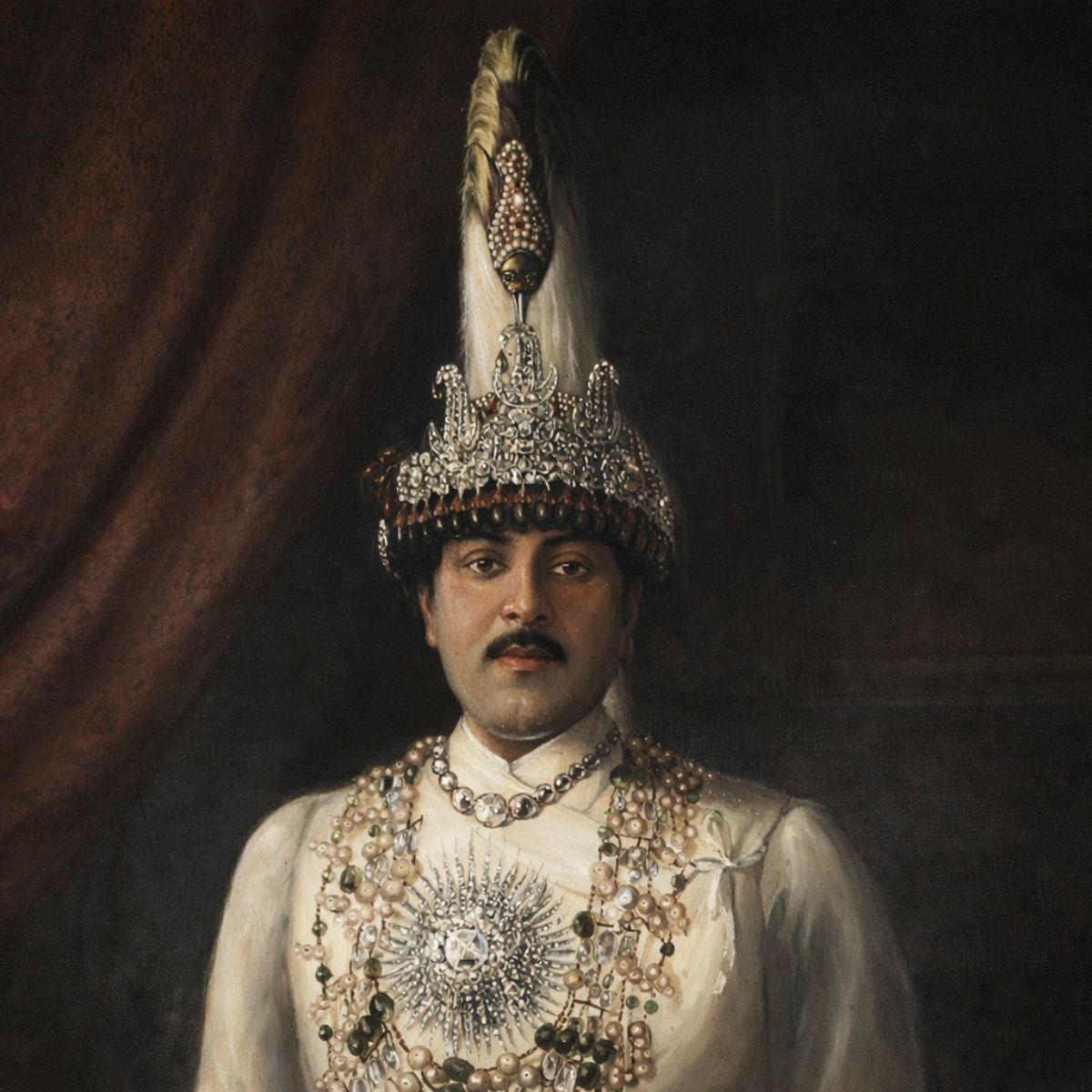
Tribhuvan Bir Bikram Shah
Brief Introduction
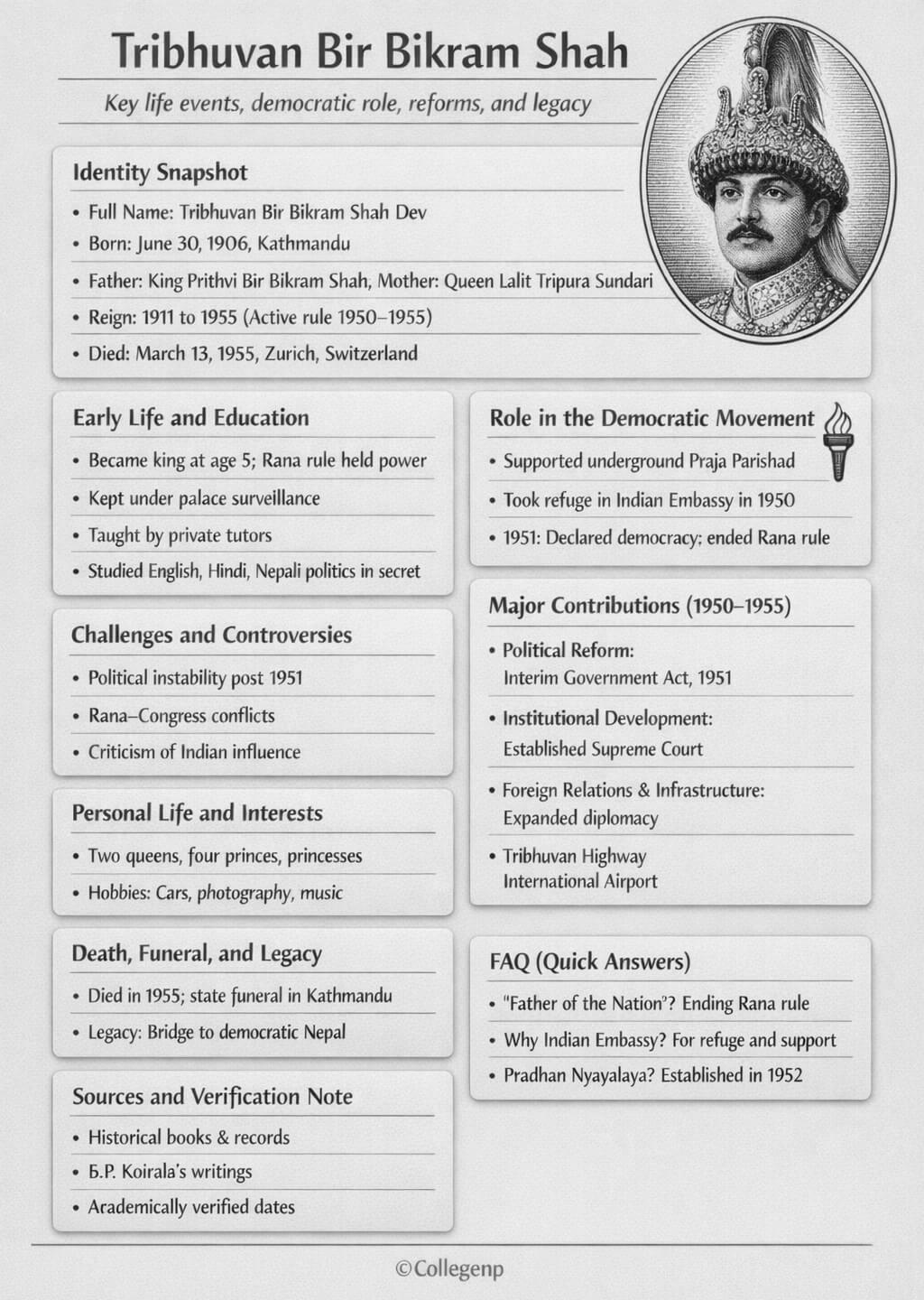
Tribhuvan Bir Bikram Shah was the eighth Shah dynasty king of Nepal. He is honored as the “Father of the Nation” and the “Father of Democracy” for his decisive role in the historic movement of BS 2007, which ended the 104-year Rana oligarchic rule and established democracy in Nepal.
His reign is regarded as important for bringing Nepal into a modern era and for initiating constitutional processes.
Identity
Full Name: Tribhuvan Bir Bikram Shah Dev (In Nepali: त्रिभुवन वीर विक्रम शाह)
Date of Birth: June 30, 1906 (BS 1963 Asar 17)
Place of Birth: Indrachowk (Hanuman Dhoka Palace complex), Kathmandu
Father: Prithvi Bir Bikram Shah
Mother: Lalit Tripura Sundari Devi
Position/Titles: King of Nepal, Father of the Nation, Father of Democracy
Reign:
-
Accession to the throne: BS 1968 (1911), at age 5, through BS 2011 (1955)
-
Active rule: BS 2007 to BS 2011 (after the attainment of democracy)
Date of Death: March 13, 1955 (BS 2011 Falgun 30)
Place of Death: Zurich, Switzerland
Key Contributions: Ending the 104-year Rana rule and formally declaring democracy; establishing institutions such as the Supreme Court and the Public Service Commission.
Table of Content
- Tribhuvan Bir Bikram Shah
- Early Life and Background
- Education and Formation
- Role in the Democratic Movement
- Major Contributions
- Challenges and Controversies
- Personal Life
- Death and Funeral
- Legacy and Historical Significance
- Frequently Asked Questions (FAQ)
- Source and Verification Note
Early Life and Background
King Tribhuvan was born on BS 1963 Asar 17 (June 30, 1906) in the then royal palace in Indrachowk, Kathmandu. His father was King Prithvi Bir Bikram Shah, and his mother was Queen Lalit Tripura Sundari.
After his father’s untimely death, he ascended the throne in BS 1968 (1911) at the age of five. Although he became king, Nepal at that time remained under the autocratic rule of Rana prime ministers.
The Rana rulers kept the monarch limited to a purely ceremonial role, described as an “ornamental” figure and like a “deity in a cage.” He was kept under strict surveillance within the palace walls and was barred from direct contact with the public.
Education and Formation
The Rana rulers adopted a strategy to keep King Tribhuvan deprived of formal higher education and political knowledge. His education took place inside the palace through private tutors.
Despite restrictions on external contact, he developed an interest in political awareness and world affairs from adolescence. With the help of trusted palace aides, he secretly read newspapers and magazines, listened to the radio, and stayed informed about Nepal’s difficult political situation.
He prepared himself through self-study, especially in English, Hindi, and Nepali literature and contemporary politics.
Role in the Democratic Movement
The most significant aspect of King Tribhuvan’s life was his struggle against the Rana regime. After the formation of the underground anti-Rana organization Nepal Praja Parishad in BS 1997 (1940), he secretly provided moral and financial support to the campaign.
He held covert meetings with Praja Parishad leaders such as Tankaprasad Acharya and Dasharath Chand, among others.
Key historical developments
-
Praja Parishad crackdown (BS 1997): The Ranas exposed the Praja Parishad. Four martyrs—Shukraraj Shastri, Dharma Bhakta Mathema, Gangalal Shrestha, and Dasharath Chand—were sentenced to death. A plot was also formed to depose King Tribhuvan, but the Ranas backed down due to Indian and British pressure and fear of a military revolt.
-
Shelter at the Indian Embassy: On BS 2007 Kartik 21 (November 6, 1950), King Tribhuvan, along with his family (excluding his younger grandson Gyanendra), reached the Embassy of India, Kathmandu seeking refuge, using “going on a hunting trip” as a pretext.
-
Departure to Delhi and the agreement: After the royal family reached New Delhi, an armed revolution intensified in Nepal under the leadership of the Nepali Congress. With India’s mediation, a tripartite “Delhi Accord” was reached between the King, the Ranas, and the Nepali Congress.
-
Declaration of democracy: On BS 2007 Falgun 7 (February 18, 1951), King Tribhuvan returned to Nepal and formally declared democracy, ending the 104-year Rana rule.
Major Contributions
King Tribhuvan’s short period of active rule (BS 2007–2011) focused on laying the foundation for Nepal’s modernization and democratization.
Political reforms
-
Interim constitution: He issued “Nepal Interim Government Act, 2007 BS” (Nepal Antarim Shasan Vidhan, 2007; Interim Government of Nepal Act, 1951). It laid the foundation for fundamental rights and the rule of law.
-
Concept of a Constituent Assembly: He made a historic declaration that the country would be governed through a constitution written by representatives elected by the people (though this was realized only later, in BS 2072).
Institutional development
-
Judicial independence: In BS 2009, he established the “Pradhan Nyayalaya” (the precursor to the Supreme Court of Nepal), initiating the practice of an independent judiciary.
-
Public Service Commission: He established the Public Service Commission (Nepal) to select civil servants based on merit.
Expansion of foreign relations
He broadened Nepal’s diplomatic relations, which had remained limited during the Rana period. During his reign, efforts were made to expand ties beyond India and Britain to countries such as the United States and France.
Formal efforts toward membership in the United Nations began during his time (membership was achieved in BS 2012, after his death).
Infrastructure and social reforms
-
Radio Nepal: The formal establishment of “Democracy Radio” (later known as Radio Nepal) in BS 2007.
-
Tribhuvan Highway: Initiation of the construction of the Tribhuvan Highway (with Indian support).
-
Tribhuvan Airport: Development of Tribhuvan International Airport for civil aviation.
Challenges and Controversies
King Tribhuvan’s reign remained transitional and unstable.
-
Political instability: After the attainment of democracy, repeated cabinet changes occurred due to disputes and internal conflict among political parties. The failure of the Rana–Congress coalition government and disputes involving leaders such as Matrika Prasad Koirala prevented the consolidation of political stability.
-
Indian influence: Some historians and political analysts criticize that Nepal’s internal affairs saw increased Indian influence after the Delhi Accord and in subsequent years. Controversy also arose over the presence of Indian advisors in cabinet meetings.
-
Health problems: Due to long-term illness, he could not provide active leadership in the final phase of his reign.
Personal Life
King Tribhuvan’s personal life unfolded within a blend of strict palace discipline, restrictions, and luxury. Although kept under Rana surveillance like a “caged parrot,” his lifestyle and interests were notably modern and technology-oriented.
Marriage and children
His marriage took place in childhood. According to the traditions and political compulsions of that time, he married two sisters simultaneously in BS 1975 Falgun (at age 13).
-
Senior Queen: Kanti Rajya Laxmi Devi Shah
-
Junior Queen: Ishwari Rajya Laxmi Devi Shah
These marriages were arranged by the Rana rulers as a planned strategy to keep the king away from the influence of “A-Class” Ranas and to weaken his position.
Children (as stated):
Sons:
-
Crown Prince: Mahendra Bir Bikram Shah (from the senior queen; born BS 1977) — later became King Mahendra.
-
Prince: Himalaya Bir Bikram Shah (from the junior queen).
-
Prince: Basundhara Bir Bikram Shah (from the junior queen).
Daughters:
His daughters were married into various Indian royal families. The principal princesses listed are Trailokya Rajya Laxmi, Nalini Rajya Laxmi, Bijaya Rajya Laxmi, and Bharati Rajya Laxmi.
Interests, temperament, and modern outlook
He was not only a traditional monarch; by temperament he was an explorer and an admirer of modernity. Even within palace confinement, his interests connected him to the outside world.
-
Automobiles and mechanics: He was deeply fond of driving cars that had been carried into the Kathmandu Valley even before roads existed. His interest extended beyond appearance to engines and mechanics, and he took special pleasure in repairing broken vehicles himself.
-
Photography and cinema: He was a skilled photographer. His rare photographs provide glimpses of Kathmandu and palace life of that era. He arranged for film screenings inside the palace, which helped him learn about Western society and ideas of freedom.
-
Music and instruments: He appreciated Western classical music and jazz, and he could play instruments such as the guitar and piano.
-
Information and radio: During World War II, the Rana rulers imposed strict censorship to block external news, but he had his own radio set. He secretly listened to BBC and All India Radio. The radio informed him about the Allied victory and democratic waves, which encouraged him to stand against Rana rule.
Death and Funeral
Within a few years of the arrival of democracy in Nepal, King Tribhuvan’s health began to deteriorate. He suffered from a serious heart ailment for a long time, and later faced kidney-related complications.
Treatment and passing
In the winter of BS 2011 (1954/55), as his condition became extremely critical, he was taken to Europe for further treatment. After staying for some time in Nice, he was admitted to the Cantonal Hospital (Kantonsspital) in Zurich, Switzerland.
To ensure governance in Nepal during his absence, he appointed Crown Prince Mahendra as an “authorized royal representative” before leaving the country. Despite doctors’ continuous efforts, his heart stopped functioning. He died on March 13, 1955 (BS 2011 Falgun 30) at the age of 48 in Zurich hospital.
Mourning and funeral
News of his death brought deep mourning across Nepal. His body was brought back to Nepal by special aircraft. On BS 2011 Chaitra 4, he was cremated in Kathmandu with state honors.
His last rites were performed at Pashupati Aryaghat, where thousands of people, foreign diplomats, and leaders paid their respects. After his death, Crown Prince Mahendra ascended the throne.
Legacy and Historical Significance
King Tribhuvan is regarded as a watershed figure in Nepal’s history. His reign served as a bridge between a medieval feudal order and a modern democratic Nepal.
The Democrat King
His greatest and enduring legacy is that he “risked the throne and stood with the people.” In world history, it is rare for a king to align with the public against autocratic power or aristocratic dominance. He demonstrated moral courage by refusing to allow the execution of Praja Parishad revolutionaries.
The unfulfilled dream: Constituent Assembly
Another major legacy is his “royal declaration of BS 2007,” in which he accepted that Nepal’s governance and constitution would henceforth be made by an assembly of representatives elected by the people (a Constituent Assembly). Although this dream was not fulfilled during his lifetime and for the next 60 years, Nepal’s Constitution of 2015 (BS 2072) is presented as the delayed implementation of that historic vision.
Modern infrastructure and institutional memory
His name is closely linked to the foundation of Nepal’s modernization. Institutions named in his honor continue to function as national lifelines.
-
Tribhuvan University: Established in BS 2016 as Nepal’s first and oldest university. It was founded in his memory through initiatives led by the queen mothers.
-
Tribhuvan Highway: Nepal’s first modern highway connecting Kathmandu with the Tarai and India, opening Kathmandu Valley’s previously closed economy.
-
Tribhuvan International Airport: The initial development of Gaucharan ground into a modern airport, connecting Nepal to international aviation.
-
Tribhuvan Army Club and the Tribhuvan Challenge Shield: He had deep interest in sports, especially football, and these institutions have continued that legacy.
A critical view of the legacy
Historians also point to another dimension of his legacy. One view holds that democracy arrived through the Delhi Accord, but the accord also opened the way for increased geopolitical influence in Nepal, particularly from India. However, there is no dispute that his principal objective was liberation from Rana rule.
Frequently Asked Questions (FAQ)
Why is King Tribhuvan called the “Father of the Nation”?
He is regarded as the “Father of the Nation” because of his decisive role in ending the 104-year autocratic Rana regime, establishing democracy, and helping empower the people through that political transition.
Why did King Tribhuvan take refuge in the Indian Embassy?
He went to the Indian Embassy to give the armed revolution against the Rana rulers a decisive turning point, to ensure the safety of himself and his family, and to secure international support. This event undermined the Rana regime’s legitimacy at the international level.
When was the Supreme Court (Pradhan Nyayalaya) first established in Nepal?
The Pradhan Nyayalaya was established in BS 2009 during King Tribhuvan’s time.
Source and Verification Note
This biography is based on the following reliable sources:
-
Nepal's Political Darpan by Grishma Bahadur Devkota (academic history work)
-
Archives of the Royal Nepali Embassy archives and Nepal Gazette (official records and gazettes)
-
Historical books related to the history of the Shah dynasty
-
B.P. Koirala autobiography and contemporary political documents
Note: The dates and events mentioned here are academically established facts. Minor publicly disputed details have been presented based on the most widely accepted sources.





Comments 0
No comments yet. Be the first to start the conversation.