



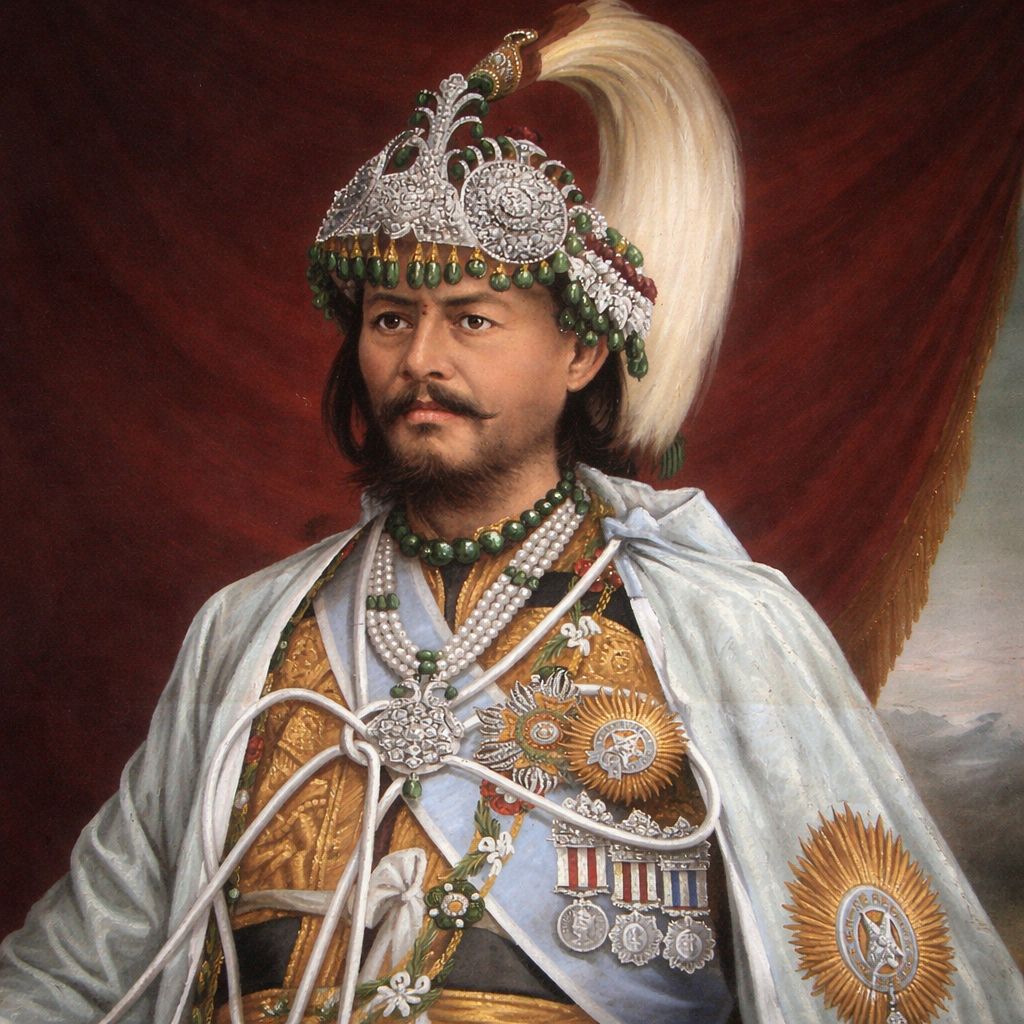
Jung Bahadur Rana: Biography of the Founder of the Rana Regime
-
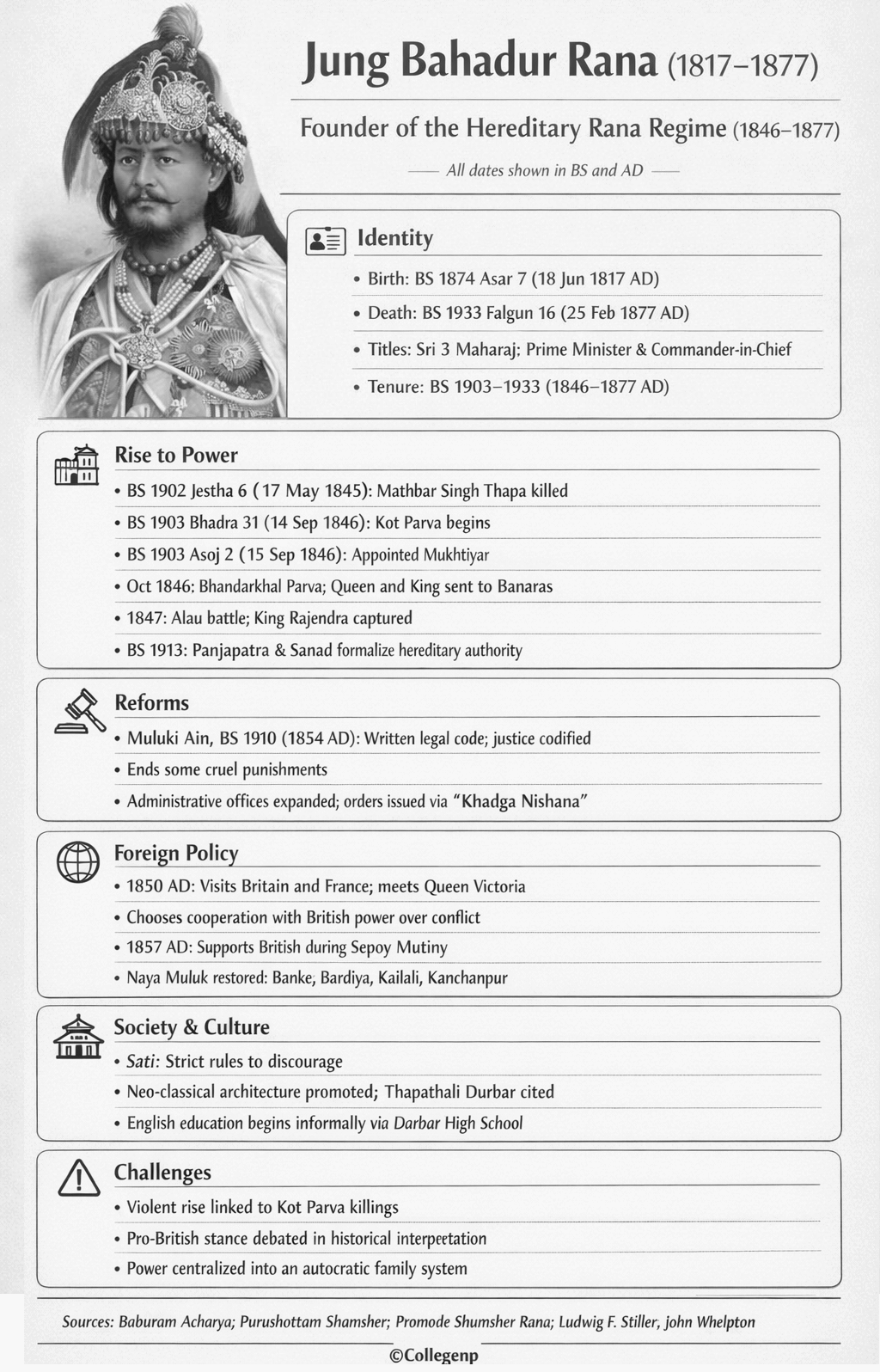
Full Name: Jung Bahadur Rana (birth name: Bir Narsingh Kunwar)
-
Position/Title: Sri 3 Maharaj (Maharaja), Prime Minister and Commander-in-Chief
-
Date of Birth: BS 1874 Asar 7 (18 June 1817 AD)
-
Date of Death: BS 1933 Falgun 16 (25 February 1877 AD)
-
Tenure: BS 1903 to 1933 (1846–1877 AD)
-
Known For: Founder of the 104-year Rana regime, social reformer, diplomat, and astute administrator
Introduction
Jung Bahadur Rana is presented as one of the most powerful and influential prime ministers in Nepal’s history. He laid the foundation of the hereditary Rana regime that lasted for 104 years.
He is described as a ruler who curtailed the monarch’s authority and centralized executive power in himself and his family. His role is portrayed as significant in shaping Nepal’s legal system, administrative structure, and foreign policy.
He is also described as known for courage, high ambition, and political shrewdness.
Early Life, Lineage, and Background of Rise
Jung Bahadur Rana’s early life and family background are presented not only as personal history, but also as a reflection of the era’s court politics and power struggles.
His rise is linked to the bravery of his ancestors during the expansion of the Gorkha state, along with their access and influence within the palace.
Ancestry and Family Legacy
His lineage is described as closely connected to the kings of Gorkha. His great-grandfather Ram Krishna Kunwar is presented as a leading military commander in the “Unification Campaign” under Prithvi Narayan Shah.
Ram Krishna is also credited with contributing to the construction of the “52 Jhyale Durbar,” and with earning the Shah kings’ confidence through bravery in warfare.
Jung Bahadur’s grandfather Ranjit Kunwar and father Bal Narsingh Kunwar are described as respected figures in military and administrative spheres. Bal Narsingh served as a bodyguard of King Rana Bahadur Shah.
In 1806 AD (BS 1863), when Sher Bahadur Shah killed King Rana Bahadur Shah, Bal Narsingh immediately struck down and killed Sher Bahadur. For this act, he received the title of Kaji (a high-ranking official) and extensive birta land grants.
Because of this legacy, his birthplace is stated as either Balkot, Kathmandu, or—according to some sources—a grand residence at Thapathali.
Mother’s Influence and the Thapa Connection
His mother Ganesh Kumari is presented as having a major role in his path to power. She is described as the niece of Bhimsen Thapa, the powerful Mukhtiyar (Prime Minister-equivalent) of the time, and the daughter of Nayan Singh Thapa.
Nayan Singh Thapa is described as a warrior who died in the Battle of Kagada. In this way, Jung Bahadur is presented as inheriting both the bravery of the Kunwars and the political craft of the Thapas.
His childhood name was Bir Narsingh. His maternal uncle Mathbar Singh Thapa is described as giving him the name “Jung Bahadur,” noting the child’s forceful temperament and fearless conduct from an early age. This name later became his public identity, and after adopting the “Rana” title it became the basis of a ruling dynasty.
Education and Early Military Training
Formal schooling is described as limited in that era. However, as the son of an elite family, he is presented as gaining military and diplomatic knowledge within the court environment.
He is described as practicing horse riding, handling weapons, and strategic skills from a young age. He is also presented as learning early aspects of legal order and state administration through close association with his father and maternal relatives.
He is stated as having acquired knowledge of Sanskrit and some Persian, used in court discourse at the time.
Crisis and Survival Period
In BS 1894 (1837 AD), a major political shock is described as striking his family. Due to conspiracies by the Pande group, Bhimsen Thapa lost power.
Following this downfall, Bal Narsingh Kunwar and the family were stripped of office, and their property was confiscated (sarvaswaharan). At around the age of 20, Jung Bahadur is described as leaving for Banaras (Varanasi, British India) in a form of exile to survive the crisis.
While in Banaras, he is described as learning two major lessons:
-
Observation of British power: He closely observed British India’s modern military and administrative strength, which later encouraged him to maintain friendly relations with the British.
-
The harsh art of survival: In financial hardship, he engaged in activities such as gambling and attempts at trading weapons. Accounts also mention heavy gambling losses and further debt.
Return to Kathmandu and Tests of Courage
After returning to Kathmandu with little, he is described as working at times as an informant and at times in lower-level military roles. It is also stated that he went to the Tarai forests to capture and sell wild elephants as a means of livelihood, described as extremely dangerous.
Several legends are cited about his physical agility and fearlessness, including:
-
Jumping from Dharahara: It is said he jumped from the tall tower to impress Crown Prince Surendra or on the prince’s order. Some describe this as exaggerated, including claims that he jumped “with an umbrella” and survived.
-
Jumping with a horse from the Trishuli embankment: Such daring conduct is described as making him a favored figure in King Surendra’s eyes.
After BS 1897, Queen Rajyalakshmi’s influence is described as rising. As her power grew, Jung Bahadur gradually re-entered the army, first obtaining the rank of Captain and later the post of Kaji.
Using his father’s administrative legacy, his maternal network, and personal political skill, he is described as securing his place in inner court politics. This early period of hardship and struggle is presented as shaping him into an opportunistic and fearless leader, contributing to his later resolve to seize power through the Kot Parva.
Rise to Power and Decisive Events
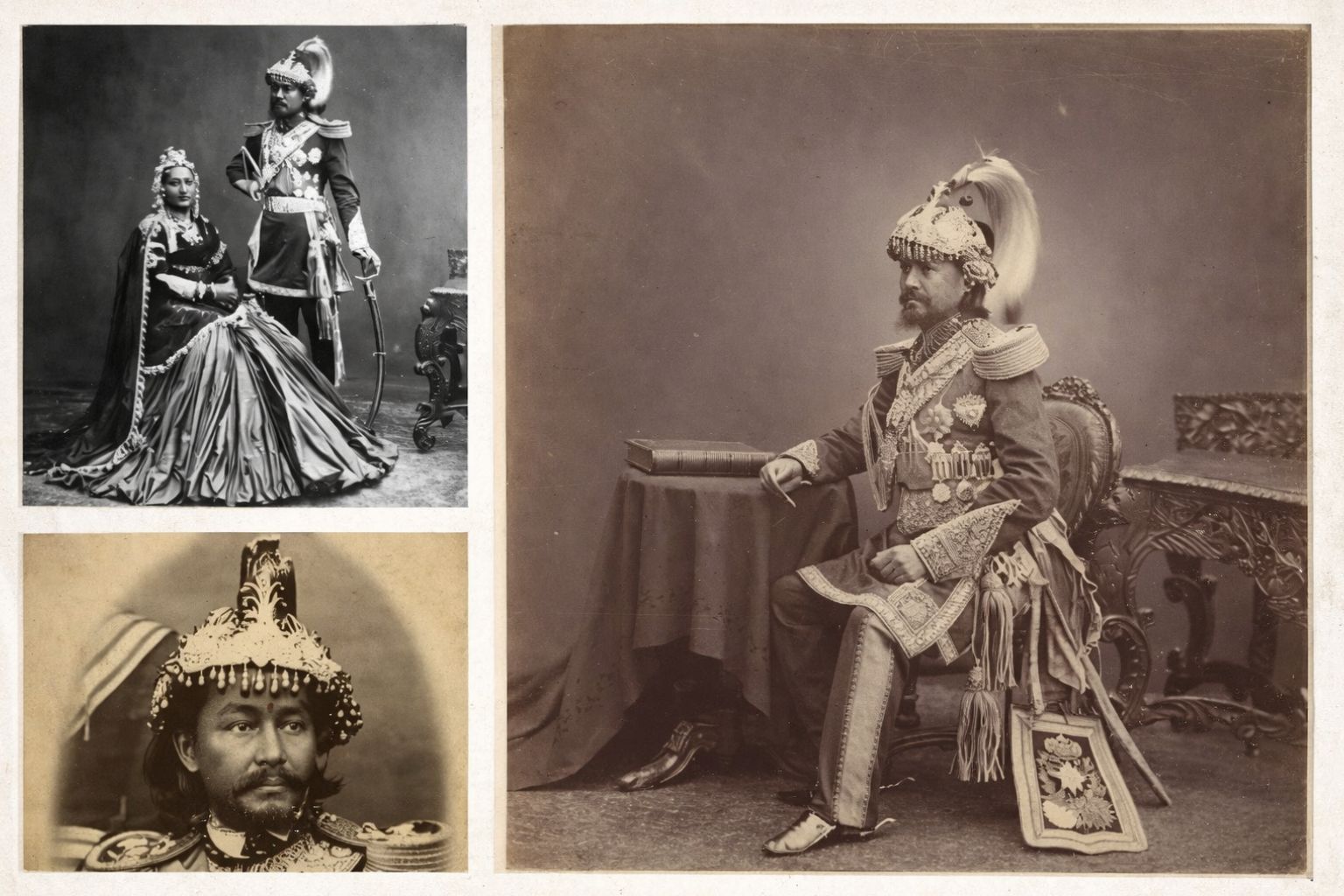
His rise is presented not as coincidence, but as the outcome of distrust, repeated killings, and extreme political instability within the Nepali court.
After Bhimsen Thapa’s fall in 1837 AD, politics is described as being trapped in rivalry among the Pande, Thapa, and Chautariya factions. King Rajendra Shah’s indecisive nature and Queen Rajyalakshmi’s ambition to place her son (Rabindra Bikram) on the throne are presented as conditions that enabled Jung Bahadur to become a decisive actor.
Assassination of Mathbar Singh Thapa (1845 AD)
A major early step toward power is described as the killing of his maternal uncle Mathbar Singh Thapa.
On BS 1902 Jestha 6 (17 May 1845), at midnight, Jung Bahadur is described as summoning Mathbar Singh to the palace and shooting him, acting under the order and conspiracy of King Rajendra and Queen Rajyalakshmi.
-
Cause: Mathbar Singh is described as having antagonized multiple court factions and refusing to support the queen’s ambition to make her son king.
-
Outcome: This event is presented as establishing Jung Bahadur as a “fearsome yet trusted” palace warrior. In return, he is described as further strengthening his military influence and reinforcing his Kaji position. It is also stated that after Mathbar’s death he adopted a posture of regret and acted strategically to secure his brothers’ future.
Kot Parva: The Final Weapon for Seizing Power (1846 AD)
After Mathbar Singh’s death, a coalition ministry is described as forming with Fateh Jung Shah as prime minister, while real influence is attributed to Gagan Singh Bhandari, described as Queen Rajyalakshmi’s lover.
On BS 1903 Bhadra 31 (14 September 1846), Gagan Singh is described as being mysteriously killed while performing worship at his residence.
The queen, described as distraught, ordered nobles to assemble without weapons at the Kot (armoury) near Hanuman Dhoka Palace to identify and punish the killer.
-
Strategy: Jung Bahadur arrived at the Kot with six brothers and more than 1,200 loyal armed guards.
-
Massacre: Amid arguments and suspicion, after Abhiman Singh Rana was killed, widespread slaughter began in the Kot courtyard. Jung Bahadur’s forces are described as killing Prime Minister Fateh Jung Shah, Dalbhanjan Pande, Khadga Bikram Shah, and approximately 31–40 senior courtiers, along with dozens of soldiers.
-
Legitimacy: The next day, Asoj 2 (15 September), the queen appointed Jung Bahadur as Mukhtiyar, meaning Prime Minister and Commander-in-Chief. This event is presented as initiating autocracy under a single ruler.
Bhandarkhal Parva: Removal of the Queen (October 1846)
After the Kot Parva, Queen Rajyalakshmi is described as believing Jung Bahadur would become her instrument and help place her son Rabindra on the throne. Jung Bahadur is described as insisting on protecting Crown Prince Surendra’s rights.
The queen then planned to assassinate Jung Bahadur in what is described as the Bhandarkhal Parva.
-
Exposure of the plot: With support from the Basnyats, a banquet was planned in the Bhandarkhal garden to kill him. Court scholar Vijay Raj Pandit is described as warning Jung Bahadur in advance.
-
Outcome: Jung Bahadur arrived with troops and eliminated opponents including Biradhwaj Basnyat. He then removed the queen from power and decided on exile. The queen and King Rajendra were sent toward Banaras, while Surendra was made “Naib.”
The Battle of Alau (1847 AD)
From exile in Banaras, King Rajendra is described as preparing forces in India to remove Jung Bahadur and regain power.
In BS 1904 Shrawan (1847 AD), he arrived with troops near Birgunj at a place called Alau.
-
Clash: Jung Bahadur dispatched government forces under Bam Bahadur and Sanak Singh. In the brief fighting at Alau, King Rajendra’s forces are described as being badly defeated.
-
Result: King Rajendra was captured, brought to Kathmandu, and placed under house arrest in the Bhaktapur palace. After this, Surendra’s coronation is described as being formally arranged.
Panjapatra and Sanad (Delegation of Sovereign Powers)
In BS 1913, King Surendra granted Jung Bahadur the title “Sri 3 Maharaj” (Maharaja of Kaski and Lamjung) and issued a royal sanad (decree).
This authority document is described as establishing that:
-
The post of prime minister would be hereditary for Jung Bahadur and his descendants.
-
They would hold the power to wage war and conclude treaties.
-
The king’s power would be limited, transferring practical governance into the hands of the Rana family.
This is presented as the formal beginning and legal foundation of the Rana regime in Nepal.
These events are presented as showing that Jung Bahadur established the basis of his 30-year one-man rule through military force, court intelligence gathering, and harsh measures including the physical elimination of opponents.
Major Contributions and Reforms
During his 30-year rule, Jung Bahadur is described as implementing reforms with long-term impact in administration, law, and social policy.
Legal and Administrative Reform
-
Muluki Ain, BS 1910 (1854 AD): This is presented as his most significant contribution. Influenced by Britain’s legal system, he issued a written legal code incorporating Nepal’s religion, culture, and traditions.
The code is described as ending cruel punishments such as angbhang (dismemberment) and codifying the justice system.
-
Kausal Adda and Khadga Nishana: He is described as organizing administrative decision-making through various offices and establishing the practice of issuing orders using the “Khadga Nishana” (the prime minister’s seal).
Foreign Policy and Diplomacy
-
Visit to Europe (1850 AD): He is described as the first serving prime minister from South Asia to travel overseas to Britain and France, and as meeting Queen Victoria.
This visit is presented as helping Nepal gain recognition internationally as a sovereign and independent state.
-
Balanced foreign policy: He is described as adopting friendship and cooperation with British power rather than war (appeasement policy), credited with helping Nepal avoid becoming a British colony.
-
Recovery of lost territory (Naya Muluk): During the 1857 Sepoy Mutiny in India, he provided military assistance to the British.
In return, Britain restored Banke, Bardiya, Kailali, and Kanchanpur—territories lost under the Sugauli Treaty—back to Nepal.
Social and Cultural Reform
-
Restrictions on sati: He did not fully abolish sati, but he introduced strict rules to discourage the practice.
-
Modern architecture: After returning from Europe, he introduced neo-classical architecture in Nepal. Thapathali Durbar is cited as an example.
-
English education: By establishing Darbar High School to educate his sons and nephews, he is credited with an informal beginning of English education in Nepal.
Titles and Succession: Transformation from Kunwar to Rana
His rule is presented not only as political control, but also as a transformation of a noble family into a ruling house.
To secure legitimacy and protect power across generations, he adopted decisions described as bold and controversial.
Adoption of the Rana Surname (1849 AD)
In BS 1905 (1849 AD), he replaced his ancestral surname “Kunwar” and began using “Rana.”
He asserted a connection to the Rajput royal lineage of Chittorgarh in India. To formalize this claim, he obtained a royal seal (lal mohar) from King Surendra granting him and his brothers the right to use the Rana title.
The main purpose of this change is described as elevating his status above older and established noble families in Kathmandu, including the Pande, Thapa, and Basnyat houses.
Title of Sri 3 Maharaj and Ownership of Kaski–Lamjung
In BS 1913, he staged a resignation from the post of prime minister and appointed his brother Bam Bahadur as prime minister.
In exchange, he obtained the title “Sri 3 Maharaj (Maharaja)” from King Surendra.
Through this title, he received personal ownership (private fiefdom) over Kaski and Lamjung. After this, Nepal is described as operating with “Sri 5 Maharajadhiraj” (the king) as a nominal ruler and “Sri 3 Maharaj” (the Rana) as the real executive authority.
Agnatic Roll of Succession
To reduce conflict within the Rana family, he created a defined roll of succession for the transfer of office.
Under this rule, the post of prime minister would not pass from father to son. Instead, it would pass to the eldest living brother in the family (agnatic succession).
He created a priority list among seven brothers so that they would serve as prime minister in turn, and only after that would his eldest son Jagat Jung’s turn come. It is also stated that this rule later fueled severe power struggles and killings among brothers and nephews within the Rana elite in subsequent decades.
Challenges and Controversies
His rule is presented as both influential and heavily criticized. Historians are described as analyzing his leadership from both “dark” and “bright” aspects.
Violent Rise to Power
His authority is described as rooted in the Kot Parva, viewed as a brutal massacre. The killing of nearly 40 senior courtiers and more than 400 soldiers in a single night is presented as a dark day in Nepal’s history.
Because of a policy of physically eliminating rivals, he is characterized as an autocratic and harsh ruler.
Strong Pro-British Orientation
During the 1857 uprising in India, he sent Nepali troops to support the British. Some interpret this as strategic action in Nepal’s national interest, while others accuse him of betraying a neighboring struggle for independence in South Asia.
Centralization of Authority
He reduced the king to a figurehead (“a parrot in a cage”) and implemented one-family autocratic rule by curtailing the people’s basic rights.
He is also described as initiating the practice of treating the state treasury like a family fund.
Later Life and Death
His life is presented as dramatic, and his end is described as unexpected, with additional claims appearing in literature and oral accounts.
Final Journey and Health
In the winter of BS 1933 (1877 AD), at the age of 59, he went hunting in the Tarai near Patharghatta (near Rautahat). Hunting is described as his greatest hobby.
During the journey he became seriously ill with fever and dysentery.
Death (25 February 1877)
On BS 1933 Falgun 16, he died on the bank of the Bagmati River. Official records are stated as describing the death as natural, resulting from illness.
The text also mentions additional claims found in Nepali literature and oral accounts:
-
White tiger narrative: In Diamond Shumsher Rana’s historical novel Seto Bagh, he is portrayed as being frightened by a mysterious white tiger, with his health deteriorating after that fear.
-
Suspicion of conspiracy: Some suspect he was slowly poisoned by relatives, but no conclusive evidence is reported.
Sati Practice and Funeral Aftermath
Through the Muluki Ain, he had placed multiple restrictions on sati. After his death, three of his queens—Hiranyagarbha Kumari, Suvarna Kumari, and Ram Kumari—committed sati.
His cremation was conducted with national honors, and his position was transferred to Ranodip Singh.
Although his death ended an active era of “Jung” Rana rule, the Rana system he established continued for a further 73 years.
Legacy and Historical Significance
He is presented as a controversial yet unavoidable figure in Nepal’s history.
-
Political stability: By ending prolonged instability and near-civil-war conditions, he established strong central governance.
-
Protection of sovereignty: While many South Asian states were being absorbed into the British Empire, his diplomacy is presented as a major factor in protecting Nepal’s sovereignty.
-
Seeds of modernization: The concept of a legal state, the beginning of English education, and the arrival of the printing press (Giddhe Press) are associated with his era.
According to historian Baburam Acharya: “Jung Bahadur protected Nepal from the claws of British imperialism and maintained an independent existence.” The text also states that his hereditary family rule pushed Nepal’s democratic development back by centuries.
Frequently Asked Questions
1. Who was Jung Bahadur Rana?
He was Nepal’s first Rana prime minister, the founder of the 104-year Rana regime, and is presented as a key historical figure linked to safeguarding national sovereignty.
2. Why is Jung Bahadur Rana famous?
He is known for coming to power through the Kot Parva, issuing Nepal’s first written legal code (Muluki Ain), being the first prime minister to visit Europe, and regaining the Naya Muluk territories (Banke, Bardiya, Kailali, and Kanchanpur).
3. Why did Jung Bahadur support Britain?
He considered it wiser to maintain friendship with a powerful British force rather than provoke conflict, and he supported Britain during the 1857 revolt, after which Nepal regained territory.
4. What was his real name?
His birth name was Bir Narsingh Kunwar. “Jung Bahadur” was the name given by his maternal uncle Mathbar Singh Thapa.
Sources and Verification Note
This biography cites the following sources:
-
Acharya, Baburam. “Nepalko Sankshipta Brittanta” (A Brief Account of Nepal)
-
Shamsher, Purushottam. “Sri 3 Haruko Tathya Brittanta”
-
Rana, Pramode Shumsher. “Rana Intrigues”
-
Stiller, Ludwig F. “The Silent Cry: The People of Nepal, 1816–39”
-
Whelpton, John. “Jang Bahadur in Europe”
Note: Historical dates have been presented in both Bikram Sambat and Anno Domini, converted to align with official records. Controversial topics prioritize established historians’ interpretations.







Comments 0
No comments yet. Be the first to start the conversation.