




Gagan Thapa: Detailed Biography
Gagan Kumar Thapa (Gagan Thapa) is described as an influential figure in contemporary politics in Nepal, the president of Nepali Congress, and a former Minister for Health and Population. He rose to national politics through the student movement and the 2062/63 (B.S.) People’s Movement, and is known for policy debates, parliamentary activism, and a reform agenda in the health sector.
He is stated to have been selected for the party’s top leadership through a special convention in January 2026, and is presented as the Nepali Congress’s proposed prime ministerial candidate for the House of Representatives election on 5 March 2026 (B.S. 2082 Falgun 21).
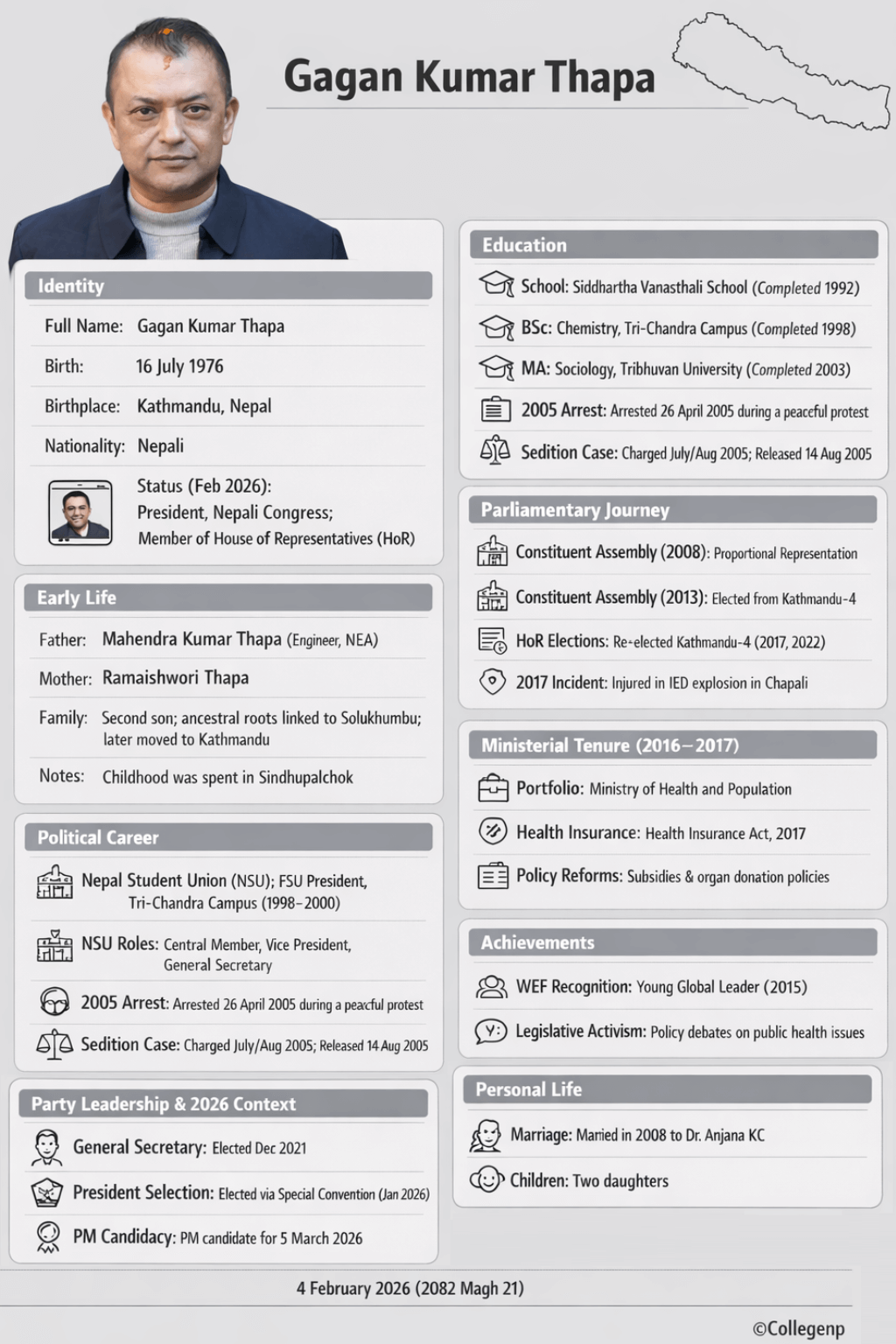
Identity
-
Full Name: Gagan Kumar Thapa (गगन थापा / गगन कुमार थापा)
-
Date of Birth: Although public records show some variation, official and detailed profiles mention 16 July 1976 (AD) (some outlets also list 19 July 1976).
-
Place of Birth: Kathmandu
-
Nationality: Nepali
-
Current Major Political Status (February 2026): President, Nepali Congress
-
Primary Affiliation: Member of the House of Representatives (HoR)
Early Life, Background, and Education
Gagan Thapa was born in Kathmandu. His father, Mahendra Kumar Thapa, worked as an engineer at the Nepal Electricity Authority, and his mother is Ramaishwori Thapa. He is the second son in the family. His ancestral roots are linked to Solukhumbu District, from where the family later moved to Kathmandu. Some public sources also state that he spent part of his childhood in Sindhupalchok District.
Education
Public profiles and news reports indicate that his formal education was centered in Kathmandu:
-
School Level: Completed school education from Siddhartha Vanasthali School in 1992.
-
Bachelor’s Degree: Completed a BSc in Chemistry from Tri-Chandra Campus in 1998.
-
Master’s Degree: Completed an MA in Sociology from Tribhuvan University in 2003.
Political Career and Movements
A) Student Politics
Gagan Thapa’s political rise is described as having taken place through the Nepal Student Union (NSU). While active in the Free Student Union (FSU) at Tri-Chandra Campus, he was elected FSU President of the same campus from 1998 to 2000. Within the student organization, he served as a central member (1998–2002) and vice president (2000–2002), and then held the role of central general secretary from 2002 to 2004.
B) Sedition Charge and Movements
During protests against royal rule around 2005, Thapa emerged as a prominent republican youth leader. According to Amnesty International, he was arrested on 26 April 2005 during a peaceful demonstration. In July/August of the same year, he was prosecuted under charges against the state, described as “sedition.” On 14 August 2005, the Special Court released him, but organizations including the International Commission of Jurists (ICJ) raised serious questions in the context of human rights and freedom of expression regarding those charges.
C) Parliamentary Journey and Election History
Thapa is described as having consistently maintained influence in parliamentary politics:
-
First Constituent Assembly (2008): Member through the proportional representation list (Member of the Constituent Assembly).
-
Second Constituent Assembly (2013): Elected directly from Kathmandu-4. During this period, he played a leading role in the Agriculture and Water Resources Committee.
-
House of Representatives Elections (2017 and 2022): Re-elected consecutively from Kathmandu-4. During the 2017 election campaign, he was injured in an IED explosion in the Chapali area.
Ministerial Tenure and Executive Role
Gagan Thapa led the Ministry of Health and Population (MoHP) from 2016 to 2017. As minister, some of his work is described as notable:
-
Health Insurance: He advanced the concept of Universal Health Coverage by giving policy priority to Nepal’s Health Insurance Act, 2017.
-
Policy Reforms: He initiated efforts to expand the state’s role and subsidies for treatment of serious conditions such as heart disease, kidney disease, and cancer. The ministry also worked to simplify regulations linked to organ donation and transplantation.
Party Leadership and the 2026 Special Convention
He was elected as the party’s general secretary through the 14th general convention of Nepali Congress (December 2021). While in that role, he promoted policy preparation for governance and a narrative of governance reform through “Project Government.”
Selection as President and the 2026 Election Context
In January 2026, intense power struggles and organizational disputes arose within Nepali Congress. During the same period, some leaders including Thapa were reportedly subjected to disciplinary action by the party’s official leadership. However, through a Special Convention called by the Thapa–Sharma group, he was elected party president. Public records state that around 16–17 January 2026, the Election Commission of Nepal (ECN) recognized Thapa’s committee as official.
For the election on 5 March 2026 (B.S. 2082 Falgun 21), Nepali Congress has declared him the party’s candidate for prime minister. In that election, he is described as contesting from Sarlahi-4 in Madhesh Province instead of Kathmandu, which political analysts have framed as his “strategic gamble.”
Achievements and Recognition
-
Young Global Leader (YGL): The World Economic Forum (WEF) listed Gagan Thapa as a “Young Global Leader” in 2015.
-
Legislative Activism: He is described as having energized policy debate in parliament through practices such as “resolution motions” and “motions of urgent public importance.” One example cited is a motion registered in parliament on public health security during the COVID-19 pandemic.
Controversies and Challenges
-
Allegations of Subsidy Misuse: In the past, he was publicly accused of misusing a government subsidy in an agricultural (goat farming) project. However, clarifications from official bodies explained procedural aspects of the subsidy disbursement process.
-
Deepfake Video Claim (2025): In 2025, fact-checking by TechPana stated that a video associated with him, described as “chasing away goats,” was a fake video (deepfake) created using Artificial Intelligence (AI).
-
Internal Party Conflict: In early 2026, attempts by the party establishment faction to impose disciplinary action and suspension reportedly placed him in political crisis, but he emerged stronger following the special convention and the Election Commission’s recognition.
Personal Life
Gagan Thapa married Anjana KC in 2008. Anjana KC is the daughter of Nepali Congress leader Arjun Narasingh KC. They have two daughters.
Legacy and Historical Significance
Gagan Thapa is portrayed as a key advocate of “fact-based arguing” in Nepal’s parliamentary politics and as a leading voice for generational change in traditional politics. Reforms associated with the health insurance law are presented as having long-term impact on the public health system. His 2026 election strategy after reaching party leadership and his prime ministerial candidacy are described as factors that will shape both the future direction of Nepali Congress and the trajectory of his personal political standing.
Frequently Asked Questions (FAQ)
1) Why is Gagan Thapa famous?
He is known for an influential speaking style, initiating health insurance programs as health minister, and establishing debate on youth leadership within Nepali Congress.
2) From which constituencies has he won elections?
He won elections from Kathmandu-4 in 2013, 2017, and 2022. In the 2026 election, he is a candidate from Sarlahi-4.
3) How did he become party president in 2026?
Amid internal conflict, he was selected as president through a special convention held in January 2026, which the Election Commission also officially recognized.
4) What were the sedition charges against him?
During royal rule, he was prosecuted in 2005 for an offense against the state for raising republican slogans, and he was later acquitted.
Sources and Verification
This biography is based on the following official and reliable sources:
-
Election Commission of Nepal: Records on political party registration, conventions, and election results.
-
Amnesty International: Reports on the 2005 arrest and human rights context.
-
Parliamentary Records (Parlnet.org/Secretariat): Details of members of parliament and educational background.
-
The Kathmandu Post: Biographical profiles and political developments (including the 2017 Chapali incident and later election updates).
-
TechPana Fact-Check: Examination of the AI-generated video (November 2025).
-
Ministry of Health and Population: Ministerial work, policy documents, and official records.
4 February 2026 (B.S. 2082 Magh 21)





Comments 0
No comments yet. Be the first to start the conversation.