



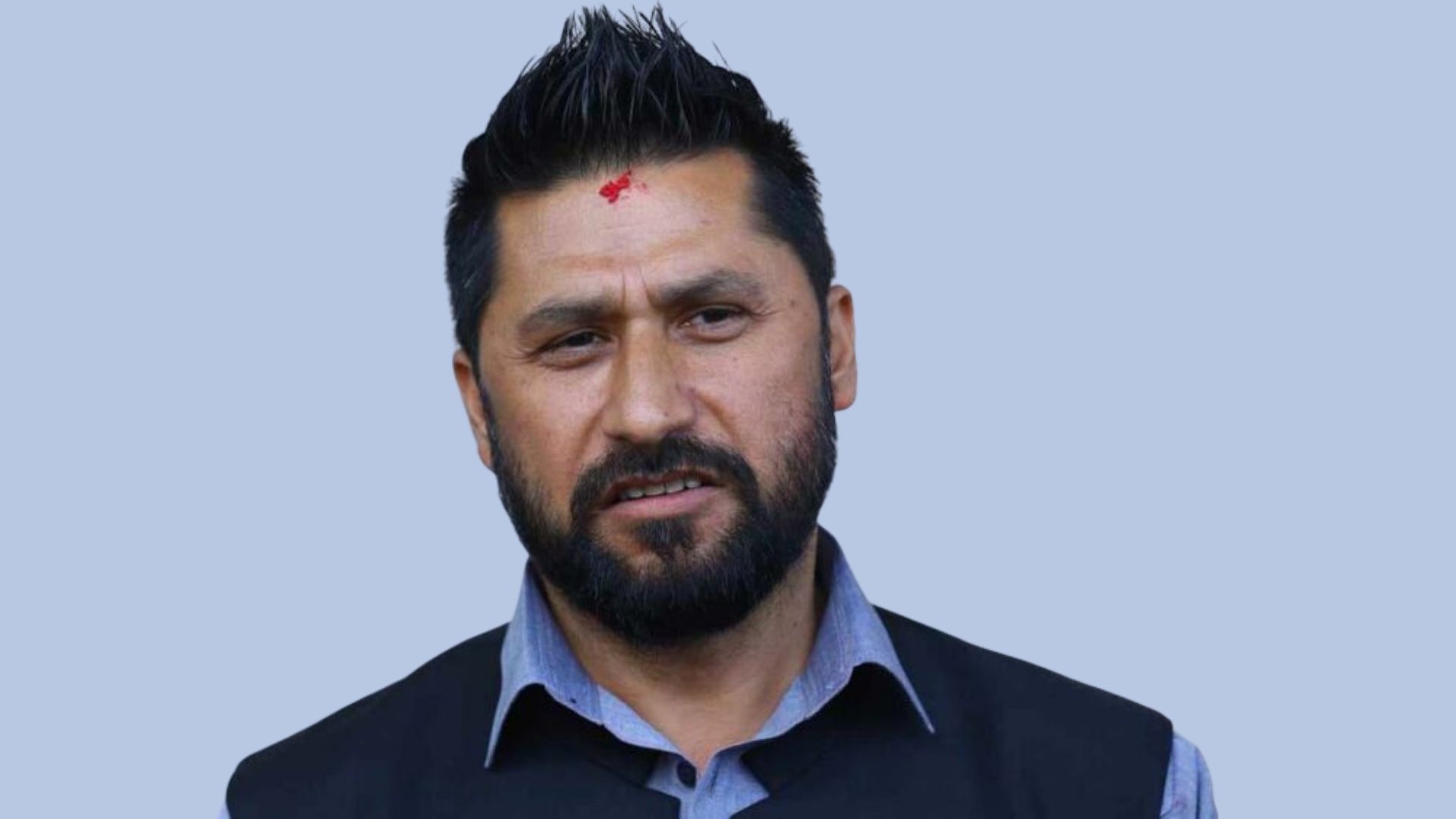
Rabi Lamichhane Biography
Rabi Lamichhane is a prominent Nepali media professional, politician, and the chairperson of the Rastriya Swatantra Party (RSP). He gained popularity through aggressive, public-focused television programming and entered full-time politics in 2022.
He has also served as Nepal’s Deputy Prime Minister and Home Minister. At a time of growing public frustration with traditional political parties, his political journey is often analyzed as the rise of an “alternative political force.”
Personal Details
-
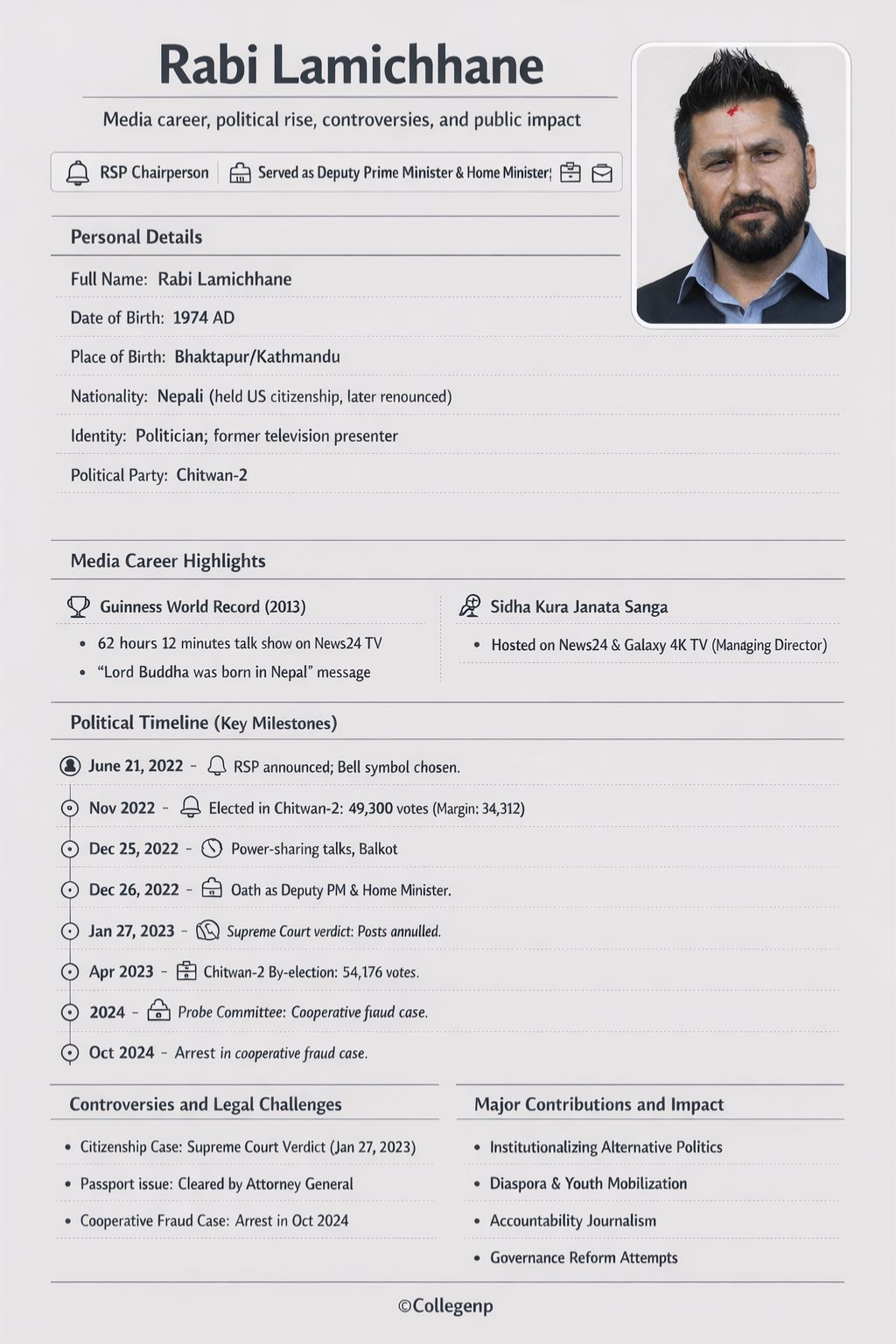
Full Name: Rabi Lamichhane (रवि लामिछाने)
-
Date of Birth: 1974 AD (approx. BS 2031 Bhadra/Ashoj)
-
Place of Birth: Bhaktapur
-
Nationality: Nepali (he reportedly held US citizenship for a period and later renounced it)
-
Identity: Politician, former television presenter
-
Political Party: Rastriya Swatantra Party (RSP)
-
Constituency: Chitwan-2 (Chitwan-2)
Early Life and Education
Details of Rabi Lamichhane’s childhood and formal school-level records are not fully clear in the public domain. He grew up in an average middle-class family. While it is stated that he studied at college level in Kathmandu, there have been disputes and debates regarding verified details of his academic degree and institution.
In the early 2000s, he went to the United States (USA) in search of employment and opportunities. He spent a long period there (about 12–13 years). In interviews, he has stated that while in the US he worked as a manager in businesses such as gas stations and Subway.
Media Career
Rabi Lamichhane’s public recognition is primarily rooted in his media work. His media journey has two main phases.
Guinness World Record
In 2013, with the objective of spreading the message “Lord Buddha was born in Nepal” worldwide, Lamichhane hosted a marathon talk show (Longest Talk Show). Through News24 Television, he ran a 62-hour and 12-minute program and set a world record. This event brought him wide public attention for the first time.
‘Sidha Kura Janata Sanga’
After returning to Nepal, he hosted a program titled Sidha Kura Janata Sanga on News24 Television. The style of this program was different from traditional journalism and was directly “action-oriented,” including:
-
Rescue of workers stranded abroad
-
Direct intervention against delays in government offices
-
An aggressive anti-corruption presentation
This program established him as a “Leader of the masses.” Later, he played a leading role in establishing Galaxy 4K TV, became its Managing Director, and ran the Sidha Kura program from there.
Political Career
Rabi Lamichhane’s political rise is considered an unprecedented phenomenon in Nepal’s contemporary history. After running what is described as an “undeclared campaign” against daily public hardships, corruption, and administrative delays through television for a long time, he decided in 2022 to convert his popular public image and “celebrity status” into institutional politics.
This was not merely a career change; it was a strategic move to “capitalize” on public dissatisfaction with the working style of traditional parties established over decades.
Formation of RSP
By early 2022, the victory of independent candidates in local elections in Kathmandu and other cities (the rise of figures such as Balen Shah and Harka Sampang) had already signaled a “paradigm shift” in Nepali politics. Building on this context, Rabi Lamichhane resigned from his role as a television presenter and announced a full-time political journey.
-
Announcement and strategy (June 21, 2022; BS 2079 Ashadh 7): On June 21, 2022 (BS 2079 Ashadh 7), he organized a special program at the National Assembly Hall in Kathmandu and announced the Rastriya Swatantra Party (RSP). He argued that instead of contesting alone as an independent, an organized force was needed “to intervene in parliamentary arithmetic and to form a government.”
-
Psychology of the election symbol: His party chose the election symbol “Bell.” This symbol had a major psychological impact—interpreted as “waking up sleeping leaders” or as an “alarm bell against corruption.” In a short time, the symbol became a “brand” among Nepali voters, particularly youth and the urban middle class.
-
Practice of primary elections: Lamichhane announced that his party would select candidates through “primary elections” among party members, described as a completely new experiment in Nepal’s democratic practice.
The 2022 Parliamentary Election
Less than five months after the party’s formation, Rabi Lamichhane and his party entered the general election held in November 2022 (BS 2079 Mangsir). The Chitwan Constituency No. 2, where he contested, became a national focal point.
-
Historic win and figures: The constituency included “heavyweight” candidates such as Nepali Congress’s incumbent Minister of State Umesh Shrestha and CPN-UML constitutional expert and former MP Krishna Bhakta Pokharel. Lamichhane, however, broke through traditional vote-bank patterns and secured 49,300 votes.
-
Record margin: He defeated his nearest rival (the Nepali Congress candidate) by a margin of 34,312 votes. In Nepal’s parliamentary history, defeating “heavyweights” by such a wide margin with such short political preparation was described as a rare record.
-
Reasons for victory: According to deeper political analysis, the “No Not Again” campaign, maximum use of social media, and “lobbying” by Nepalis abroad (Migrant Workers) within their families played decisive roles.
Emergence as the 4th Largest Force
It was not only Lamichhane’s individual win; under his leadership, the RSP also delivered a surprising result under proportional representation (Proportional Representation).
-
RSP received around 1.13 million proportional votes (11.3%) nationwide.
-
The party won 7 seats under the direct system and 13 seats under proportional representation, totaling 20 MPs, establishing itself as the 4th largest force in Parliament (4th Largest Force).
-
This result elevated Lamichhane’s presence in government formation and dissolution dynamics to the status of a “kingmaker” (Kingmaker).
Entry into Government: Deputy Prime Minister and Home Minister
Although he campaigned on slogans such as “clearing out old parties” and “always staying in opposition,” parliamentary arithmetic brought him to the center of power politics.
-
Decisive negotiations (BS 2079 Poush 10; December 25, 2022): After the election, no party secured a clear majority, resulting in a “hung parliament”. Amid intense bargaining, on BS 2079 Poush 10 (December 25, 2022), at a decisive meeting at UML Chair KP Sharma Oli’s residence in Balkot, Lamichhane’s support went to CPN (Maoist Centre) Chair Pushpa Kamal Dahal “Prachanda.”
-
Appointment and oath (December 26, 2022; BS 2079 Poush 11): Under this agreement, on December 26, 2022 (BS 2079 Poush 11), Lamichhane took the oath as Nepal’s Deputy Prime Minister and Home Minister.
-
Conflict of interest debate: His appointment as Home Minister was not without controversy. Investigations and court proceedings regarding citizenship and passport matters were pending against him. Civil society and legal experts strongly criticized what they called a “conflict of interest,” arguing that a person under investigation effectively leading the institution (Nepal Police) responsible for investigations constituted a conflict. However, due to political bargaining power, he succeeded in obtaining the post.
Brief but Notable Tenure
His first tenure lasted only 32 days (until a decision in the citizenship dispute), but during this period he attempted several “populist” and strict measures:
-
Calling back hundreds of security personnel assigned to VVIP protection and developing standards
-
Preparing to allow nighttime businesses (Thamel, Durbar Marg) to operate 24 hours
-
Directing the closure of illegal crusher industries
Although these decisions sent a positive message to the general public, before reaching the implementation stage, a Supreme Court decision (Magh 13, 2079) nullified his position.
This phase is described as a period in his life where he moved from being a “street hero” to a “ruler in government,” and then, due to a court order, descended again to the status of an “anational.” This political “roller coaster” is presented as the most study-worthy aspect of his political career.
Controversies, Cases, and Ups and Downs
Rabi Lamichhane’s political life has quickly become surrounded by multiple legal entanglements and controversies.
-
Citizenship issue: While he was Home Minister, a case was filed at the Supreme Court challenging the legality of his citizenship.
-
Verdict: On January 27, 2023, the Constitutional Bench of the Supreme Court ruled that after renouncing US citizenship, he had not completed the process to re-acquire Nepali citizenship.
-
Outcome: His MP position, party chair position, and ministerial post were annulled.
-
-
By-election comeback: After the court verdict, he formally re-acquired citizenship from the District Administration Office. Then:
-
April 2023 (BS 2080 Baisakh): In the Chitwan-2 by-election, he was re-elected with an even larger vote count (54,176 votes), which was presented as confirmation that his public support remained intact.
-
-
Passport controversy: An investigation was conducted regarding his holding a Nepali passport while he was a US citizen. However, he was cleared after the Office of the Attorney General decided not to pursue the case.
-
Cooperative fraud case: This is described as the most serious and complex turn in his career.
-
Allegation: While serving as Managing Director of “Gorkha Media Network,” which operated Galaxy 4K TV, he was accused of bringing in and misusing crores of rupees illegally from various cooperatives (such as Supreme and Suryadarshan).
-
Parliamentary probe: In 2024, a Parliamentary Special Probe Committee stated that while he was not found guilty of misappropriating cooperative funds, he appeared involved in the fund-spending process and recommended “legal action.”
-
Arrest: Based on this report and police investigation, in October 2024 (BS 2081 Kartik), he was arrested with assistance from Nepal Police’s Central Investigation Bureau (CIB). Investigations and court processes on charges including cooperative fraud and organized crime were continuing through 2024–25.
-
Major Contributions and Impact
Rabi Lamichhane’s public persona is described as having created a “disruption” (Disruption) in Nepal’s media sector and political landscape.
His contribution is presented as analyzable not only through traditional definitions, but also through changes he brought to social psychology and governance.
Institutionalizing Alternative Politics
Lamichhane is described as having played a catalyst role in weakening the dominance of the “tri-polar” politics established after BS 2046 (Nepali Congress, CPN-UML, and CPN (Maoist Centre)).
-
Issue over ideology: Instead of traditional left-wing or right-wing ideology, he prioritized “service delivery” and good governance as core agendas. His concept—“Country over party, and the citizen’s stove over ideology”—offered a new option to voters tired of ideological political conflict.
-
Organizational innovation: Expanding RSP nationwide in a short time after Election Commission registration and establishing it as the fourth force in Parliament is presented as a new “model” for transforming “independent” waves into an institutional political power, paving the way for a new generation seeking to enter politics.
Mobilization of Diaspora and Youth
Lamichhane is described as having successfully connected the psychology of young voters and Nepalis working abroad (Migrant Workers) to politics.
-
Social media as a political tool: He is described as possibly the first effective Nepali leader to use platforms such as Facebook Live and TikTok as political power. He made Nepali diaspora —said to be around 4 million in the Gulf, Malaysia, and other countries—the main commanders of his campaign. Their calls to families urging “one vote for the bell” were presented as a distinct experiment (Remote Campaigning) in Nepal’s electoral history.
-
Transforming frustration into energy: He is described as having helped build “optimism” among youth compelled to go abroad due to disappointment with the traditional system, promoting the belief that “change is possible within the country,” which contributed to increased qualitative participation in voting in urban and youth areas in the BS 2079 election.
Accountability Journalism Through Media
His biggest contribution is described as reducing the distance between the public and the state through television.
-
Action-oriented journalism: Through Sidha Kura Janata Sanga, he did not only report, but practiced direct problem-solving. He personally visited institutions such as ministries, police offices, and the Department of Foreign Employment to lead victim rescue efforts and push for legal accountability. This is presented as establishing a new style that made state organs more accountable.
-
Investigative and probing work: It is stated that many “sting operations” against corruption and brokerage created psychological fear from lower-level employees up to those involved in policy-level corruption. This style is described as later being followed as a standard practice by many journalists and digital content creators.
Meritocracy in Parliament
Under his leadership, he is described as bringing experts, professionals, and highly educated youth—who were hesitant to enter politics—into Parliament.
-
Merit-based representation: By helping individuals such as Sumana Shrestha (management consultant), Dr. Toshima Karki (surgeon), and Shishir Khanal (education sector expert) enter Parliament through direct and proportional routes, he is described as challenging the narrative that only those who have been imprisoned or only done politics can become leaders.
-
Effective parliamentary role: It is analyzed that study-based arguments (Data-driven Debate) presented by him and his party’s MPs in parliamentary committees and in Parliament added a new, scholarly energy to Nepal’s parliamentary practice.
Innovative Democratic Practices
To strengthen internal party democracy and promote transparency in state governance, he advanced several new ideas:
-
Primary elections: He applied an internal democratic system for candidate selection that no traditional party in Nepal had practiced.
-
Recall election and candidate search: His advocacy around public selection of candidates and the idea that citizens should be able to recall representatives for non-performance supported debates on empowering citizens.
Attempts at Security and Governance Reform as Home Minister
During his tenure as Home Minister, some efforts toward systemic reform are described as having signaled positive impact in good governance:
-
Reduction of special security: He sought to end the arbitrary practice of assigning excessive security personnel in the name of VVIP/VIP protection and to set an example of good governance in home administration.
-
Improving service delivery: He prioritized policy directives and direct monitoring to make passport and national ID distribution from District Administration Offices easier.
While Lamichhane’s impact is presented as debatable from both positive and negative perspectives, the text states that there is no doubt he taught Nepali society to question the state and established the idea that a “new and capable generation” should enter the political mainstream. It states that the foundation he laid will shape what Nepali politics looks like in the coming decade.
Conclusion and Legacy
Rabi Lamichhane is described as a “game changer” personality in Nepali politics. He inspired hope for immediate change among a disappointed public and received an unprecedented vote count.
However, his political future and historical evaluation will depend on the final outcomes (Final Court Verdicts) of legal tests, including the cooperative case.
Critics accuse him of indulging in “populism” and violating due process, while supporters consider him a courageous leader who breaks the “syndicate” of old parties.
Verification and Sources
This biography was prepared based on leading national dailies of Nepal (Kantipur, Annapurna Post, Naya Patrika), publicly available Supreme Court verdicts, records of the Election Commission of Nepal, and public reports of parliamentary probe committees.



Comments 0
No comments yet. Be the first to start the conversation.