




Bishweshwar Prasad Koirala (B. P. Koirala) Biography
Introduction
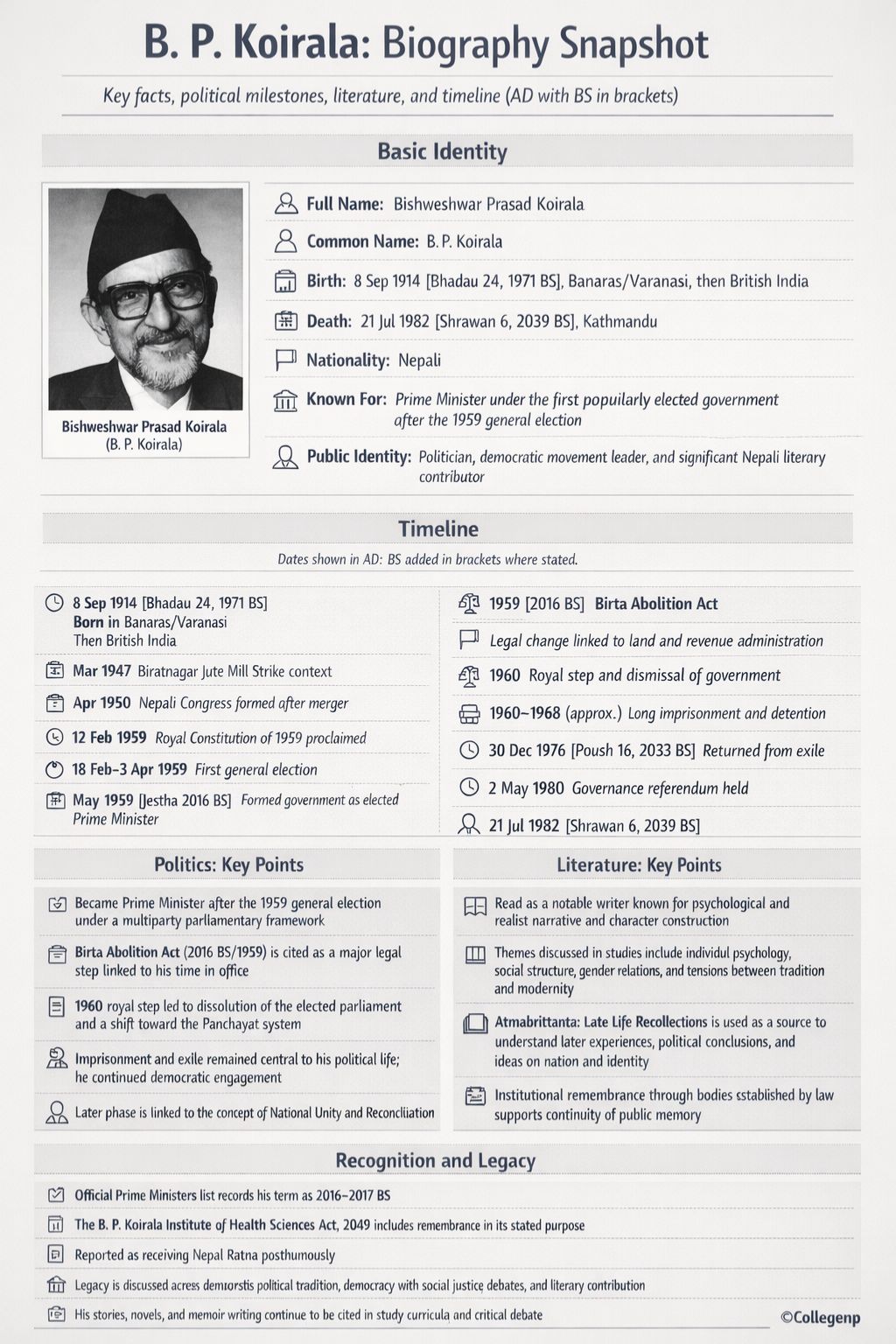
Bishweshwar Prasad Koirala (Bishweshwar Prasad Koirala, B. P. Koirala) was a Nepali politician, a leader of the democratic movement, and a significant contributor to Nepali literature.
He is recognized in history as the person who became Prime Minister of Nepal under the first popularly elected government. His life is closely linked to political struggle, imprisonment and exile, and sustained literary work.
Basic Identity
Full Name: Bishweshwar Prasad Koirala - (विश्वेश्वरप्रसाद कोइराला)
Common Name: B. P. Koirala (बी.पी. कोइराला)
Birth: 8 September 1914 (Bhadau 24, 1971 BS), Banaras, Varanasi, then British India
Death: 21 July 1982 (Shrawan 6, 2039 BS), Kathmandu
Nationality: Nepali
Main Fields: Politics (democracy and multiparty practice), Literature (novel, short story, essay and memoir)
Factual introduction: After the 1959 general election (2016 BS), Koirala became Prime Minister; after the royal step in 1960, he remained active in both democratic politics and literature while living through imprisonment and exile.
Early Life and Family Background
Although B. P. Koirala was born outside Nepal (in Banaras, Varanasi, India), his family identity and political and social concerns were connected to Nepal.
Biographical sources note that his family experienced migration and exile to India due to the political and social circumstances of Nepal during the Rana period.
Publicly available facts about his family background are limited. The Koirala family is considered one of the influential families in Nepal’s modern political history, but it is not appropriate in biography writing to add more private details than necessary. For this reason, only facts directly connected to public and political life are prioritized here.
Education, Ideological Formation, and Early Activism
Reliable biographies and autobiographical materials mention that B. P. Koirala studied in Banaras and later remained connected with academic institutions in India during higher studies.
Various studies and analyses discuss the influence of 20th-century South Asian political debates on his ideological formation, including the independence movement, civil rights, representative governance, and social justice.
Importantly, public records and documentary sources also indicate that he participated in activities connected to the Indian freedom struggle. This involvement appears to have supported his strategic understanding and organizational focus toward making political change possible in Nepal.
Timeline
-
8 September 1914 (Bhadau 24, 1971 BS) - Birth of Bishweshwar Prasad Koirala (Bishweshwar Prasad Koirala, B. P. Koirala) in Banaras, Varanasi, then British India.
-
March 1947 - Activities connected to labor and political movement in the context of the Biratnagar Jute Mill Strike, regarded as one of the early turning points in Nepal’s organized labor movement.
-
April 1950 - Formation of the Nepali Congress after a merger. Some sources show 9 April 1950, while others show 10 April 1950. Both state the same point about the formation of “Nepali Congress after the merger.”
-
12 February 1959 - Proclamation of the Royal Constitution of 1959 by King Mahendra.
-
18 February to 3 April 1959 - First general election. Sources mention that the Nepali Congress won a majority (74/109) in the House of Representatives.
-
May 1959 (Jestha 2016 BS) - Period of forming the government and assuming office as the elected Prime Minister. The official list notes his term as 2016 to 2017 BS.
-
1959 (2016 BS) - Birta Abolition Act, 1959, one of the legal reforms connected to land and revenue administration.
-
1960 - Constitutional timeline references a step by King Mahendra that dismissed Prime Minister Koirala’s government and moved toward emergency and constitutional suspension, marking the turn toward the Panchayat system.
-
1960 to 1968 (approx.) - Long imprisonment and detention. Some sources mention “about eight years.”
-
30 December 1976 (Poush 16, 2033 BS) - Return to Nepal from exile. Sources state that after landing at Tribhuvan Airport, he was immediately taken into custody and detained.
-
29 April to 17 May 1977 - Period mentioned as the time a case and hearings proceeded in a Special Court.
-
23 May 1979 - Reference to the announcement of a National Referendum.
-
2 May 1980 - Referendum on the system of governance held. Sources mention that the result went to the Panchayat side with a slim majority.
-
21 July 1982 (Shrawan 6, 2039 BS) - Death in Kathmandu.
Organized Politics and the Movement Against Rana Rule
Background of Political Organization Building in Nepal
The political struggle against the Rana regime accelerated party-based organizational development in Nepal. Academic and historical studies mention movements, organizations, and cross-border political activities between India and Nepal during this period.
B. P. Koirala appears as one of the key leaders in this stream. Various reference materials describe his involvement in movement strategy, organizational expansion, and mobilizing public support.
The 1950 to 1951 Change and Debates on Interim Governance
The political change in Nepal around 1950 to 1951 and the governance arrangements that followed (transitional governments, power-sharing, and the path toward constitution and elections) made B. P. Koirala’s public role more visible.
Contemporary documentary correspondence and archives also show diplomatic and political complexities involving parties, the palace, and India. These archives contain indications of political decisions, strategy, and signals of tension and coordination in the regional context of that time.
The 1959 Constitution and the Journey to the General Election
Nepal’s first general election took place in 1959. It is considered an early experiment in multiparty parliamentary practice. The election process was linked to the Constitution of 1959, which is noted as providing the framework for government formation through the House of Representatives.
A widely cited fact about the election result is that the Nepali Congress (Nepali Congress, NC) gained a majority and B. P. Koirala became Prime Minister. The Government of Nepal’s official list of Prime Ministers also records his term as 2016 to 2017 BS.
Prime Ministerial Term (1959 to 1960): Governance Practice, Policy Debate, and Limits
B. P. Koirala’s prime ministerial term was short. During that period, efforts to apply Nepal’s representative system in practice appear to have begun, including cabinet functioning, policy debate in parliament, and the institutional practice of administrative decision-making.
Land Ownership Structure and the End of the Birta System
Among the most concretely cited policy and legal steps linked to his time as Prime Minister is the legal change related to the Birta system. The Birta Abolition Act, 2016 BS (1959) appears to have provided provisions toward legally ending the Birta arrangement, and academic references also mention its publication and Nepal Gazette date.
Some studies interpret this change in relation to the restructuring of land and revenue, ownership structure, and state-society relations. However, research places different emphasis on its impact, limitations, and long-term outcomes due to practical implementation issues, later laws and policies, and structural continuities.
Democratic Governance Versus Tension Over Royal Authority
Although the Constitution of 1959 provided the framework for parliamentary practice, political history analyses often raise the issue of tension in practice regarding the role of the monarchy. Some studies indicate that this structural and political tension ultimately moved toward the obstruction of parliamentary process in 1960.
The 1960 Royal Step, Imprisonment, and Exile
After the step taken by King Mahendra in 1960, the elected parliament was dissolved, and it is widely accepted that many political leaders, including B. P. Koirala, were imprisoned or went into exile.
Studies describe this event as a turning point marking a breakdown of Nepal’s early democratic practice, analyzing institutional weakness, balance of power, and the nature of political competition as part of the background.
The period of imprisonment and exile was important for B. P. Koirala in two senses.
First, politically, it involved rethinking democratic party strategy, national unity, and governance structure.
Second, literarily, it involved the continuity of creative writing and memoir writing.
The Policy of National Unity and Reconciliation and Return to Nepal
In the later phase of B. P. Koirala’s political life, the concept of National Unity and Reconciliation is used as a key explanatory frame. Its core argument is generally presented as a strategic position that does not proceed only through complete confrontation with the monarchy and state structure, but continues democratic struggle on the basis of national interest.
Public memorial materials related to his birth and death also note national reconciliation as one of the central formulas of his political thinking.
Literary Contribution: Another Public Identity Beyond Politics
B. P. Koirala was not only a politician. He is also read in Nepali literature as a notable author known for psychological and realist narrative and character construction. There is also a strong tradition of evaluating his literary works separately from his political biography.
Main Themes in His Writing
Literary studies discuss themes in his stories and novels such as individual psychology, social structure, gender relations, tensions between tradition and modernity, and questions of personal freedom.
Autobiography and Memoir Writing
His memoir and autobiographical material Atmabrittanta: Late Life Recollections is used in studies as a source for understanding later life experiences, political conclusions, and thinking related to nation and identity.
Achievements and Recognition
Historical and Institutional Recognition
The Government of Nepal’s official list of Prime Ministers includes B. P. Koirala as Prime Minister for 2016 to 2017 BS.
Some institutions have been established in his name with legal provisions for remembrance. For example, the preamble of The B. P. Koirala Institute of Health Sciences Act, 2049 states the purpose of remembrance.
State-Level Civil Honor
Established media have published news that B. P. Koirala was awarded Nepal Ratna posthumously.
Challenges, Criticism, and Debated Discussions
Major controversies and debates connected to B. P. Koirala’s political life generally focus on these areas.
-
Interpretation of the balance of power and constitutional practice between the elected government of 1959 to 1960 and the monarchy.
-
How to classify and interpret the royal step of 1960, with differing views among political historians and analysts.
-
Differing interpretations of the National Unity and Reconciliation strategy as either a realistic strategy or a compromise-oriented political line depending on time and context.
Rather than imposing a single conclusion, it is appropriate to read these debates by keeping at the center the facts, sequence of events, and outcomes shown by reliable studies and archives.
Personal Life
For biography writing, it is appropriate to keep minimal facts related to public life rather than detailed private information. According to widely mentioned public facts, limited information is available in public sources about his family and children.
News materials related to the death of his wife, Sushila Koirala, clearly mention her as “the wife of B. P. Koirala,” which provides minimal confirmation regarding the marital relationship.
Final Years and Death
Reliable public memorial materials state that B. P. Koirala died on 21 July 1982 (Shrawan 6, 2039 BS) in Kathmandu.
Established media repeatedly show that memorial programs are held every year in various political and social circles after his death.
Long-Term Legacy and Historical Significance
A basis is found to view B. P. Koirala’s long-term impact mainly at three levels.
First, the democratic political tradition. As the Prime Minister formed through the first general election, his experience became a foundational reference point in Nepal’s multiparty history.
Second, political thought combining democracy and social justice. Literature is available that studies his political thinking by linking democracy with debates on social justice and socialist inclination.
Third, literary contribution. His stories, novels, and memoir writing continue to be cited in Nepali literary study curricula and critical debate.
Institutional remembrance through bodies established by law, such as the health sciences institute in his name, also provides evidence of the continuation of public memory at the state and institutional level.
FAQ
Who is this person
Bishweshwar Prasad Koirala (B. P. Koirala) is a Nepali politician and writer who became Prime Minister after the first general election in 1959.
Why is he considered important
His importance is mainly connected to the early experience of democratic governance as the first elected Prime Minister, his continued role in democratic struggle after 1960, and his notable contribution to Nepali literature.
What are his major contributions
In politics, leading the government after the general election, democratic party politics, and the strategic line connected to the concept of National Unity and Reconciliation.
In law and policy, the legal change connected to the Birta Abolition Act, 2016 BS (1959).
In literature, examples of psychological and realist writing in Nepali literature through stories, novels, and autobiography.
What is his long-term legacy
His legacy is linked to the historical reference of multiparty democracy, debate on democracy centered on social justice, and the continued presence of his literary works in study curricula. Institutional remembrance through institutions established in his name by law also sustains public memory.
Sources and Verification Notes
-
Office of the Prime Minister and Council of Ministers (OPMCM), Prime Ministers list showing B. P. Koirala for 2016 to 2017 BS.
-
Ratopati profile and biography materials mentioning his prime ministerial term (with AD dates) and introduction.
-
MyRepublica memorial materials stating birth on 8 September 1914 (Bhadau 24, 1971 BS) and death on 21 July 1982 (Shrawan 6, 2039 BS).
-
Nehru Archive, documentary correspondence related to the 1950 to 1951 period indicating Nepal, India, and party leadership political context.
-
ConstitutionNet, The Constitution of the Kingdom of Nepal, 1959 (PDF), constitutional framework and parliamentary system context.
-
Summary facts on the 1959 general election result (109 seats, NC 74 seats, election period).
-
Cambridge Core (PDF), historical context of Rana-era politics, protest, and the development of party movements.
-
The Economic Journal of Nepal (PDF), mentions Birta Abolition Act (2016 BS, 1959) with Nepal Gazette date context.
-
The Rising Nepal, memorial material including birth and death (BS) and national reconciliation.
-
European Journal of Political Science Studies (PDF), analysis on Nepal’s democratic breakdown of 1960.
-
Pahar.in (PDF), Atmabrittanta: Late Life Recollections (book and memoir source).
-
NepJOL (PDF), studies related to Atmabrittanta and meanings of nation and political cultural interpretation.
-
Nepal Law Commission, The B. P. Koirala Institute of Health Sciences Act, 2049, legal basis of institutional remembrance.
-
Setopati and The Himalayan Times, news on Nepal Ratna awarded posthumously.
-
The Himalayan Times, news material mentioning Sushila Koirala as the wife of B. P. Koirala (minimal public confirmation of personal life).






Comments 0
No comments yet. Be the first to start the conversation.