




Ganesh Man Singh Biography
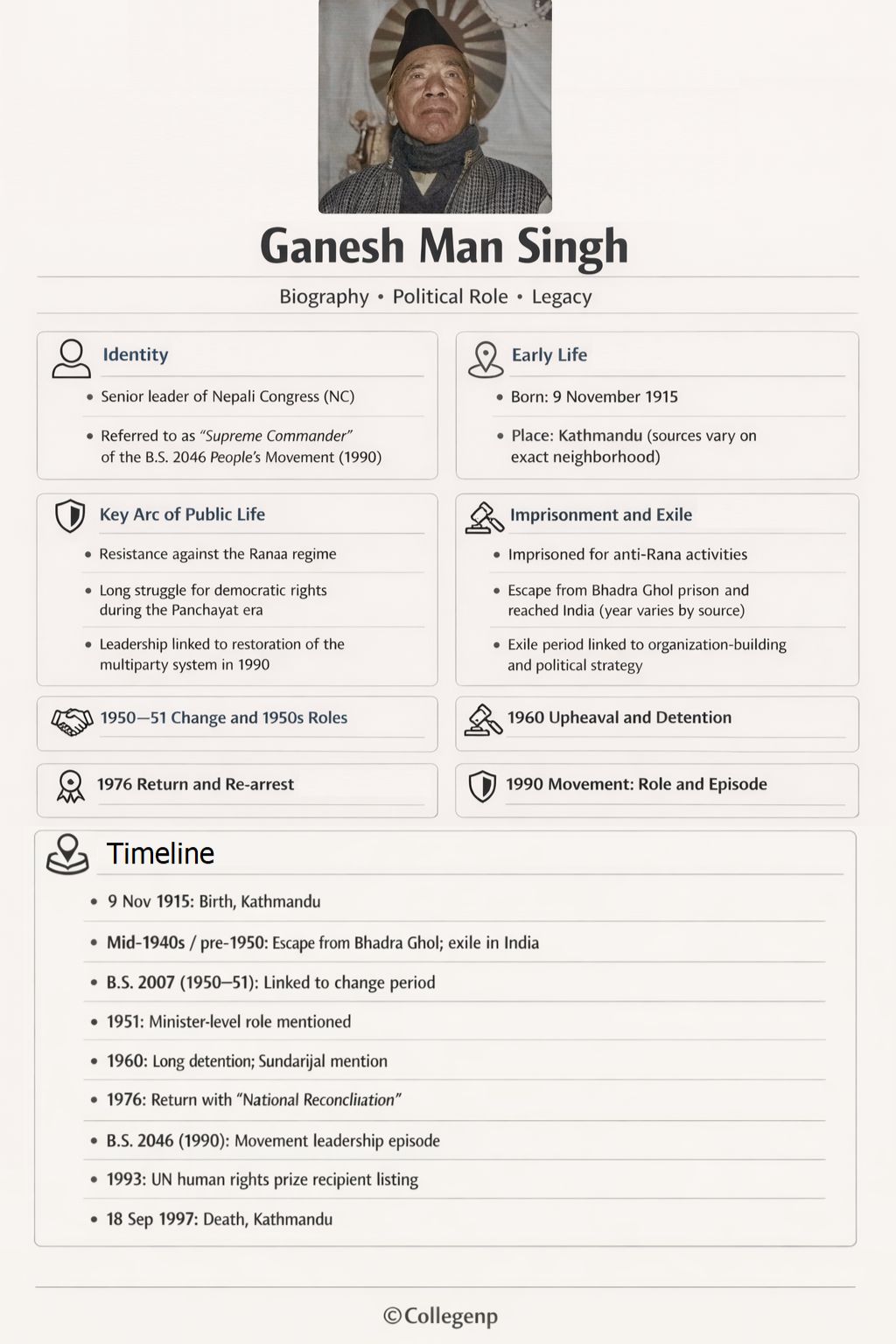
Ganesh Man Singh was a political figure closely associated over the long term with Nepal’s democratic movements. The central arc of his public life relates to resistance against the Rana regime, continued struggle for democratic rights during repression in the Panchayat era, and leadership associated with the B.S. 2046 People’s Movement (1990).
Introduction and Identity
In Nepali political history, Ganesh Man Singh is often described as a senior leader of the Nepali Congress (Nepali Congress—NC) and as the “Supreme Commander” of the B.S. 2046 People’s Movement (1990).
His political identity is mainly associated with these aspects:
-
Underground/struggle-oriented activity against the Rana regime, and the resulting experience of imprisonment and exile.
-
Roles in government and party-organization during the democratic transition of 1950–60.
-
Long detention/imprisonment after 1960 during the Panchayat system, and the reorganization of opposition politics.
-
Movement leadership that led to the restoration of the multiparty system in 1990.
Early Life: Birthplace and Family Background
Available reputable biographical/archival materials state that he was born on 9 November 1915 in Kathmandu. Although his birthplace is connected to an older city area within the Kathmandu Valley, sources differ on the exact neighborhood/place; however, sources largely align on the broader geographic identification “Kathmandu.”
Details about his early family/childhood (for example: school/college, year, educational certificates) appear in some sources, but not all such details are consistently confirmed by public archives in a uniform format and with the same level of reliability. Therefore, priority is given here to points that are publicly supported by multiple sources and are historically central.
Education and Ideological Formation
Information about Ganesh Man Singh’s formal education can vary by source. However, his ideological formation and political maturity appear primarily connected to repression under the Rana regime, organized resistance against it, imprisonment and exile, and political networks developed while in India.
Some biographical materials also mention that during exile/underground life he used the alias “Krishna Bahadur Pradhan.”
Entry into Public Life: Organized Activities Against the Rana Regime
Available archival materials note his connection with active groups/struggle-oriented political currents against the Rana regime. In particular, references appear to political activities related to “Praja Parishad (Praja Parishad).”
The main significance of this phase:
-
Efforts to sustain resistant political networks even when parties/organizations were banned.
-
Building political commitment by accepting personal risk (imprisonment, surveillance, exile).
Imprisonment, Escape from Bhadra Ghol, and Exile
Biographical/historical writing mentions that Ganesh Man Singh was imprisoned due to activities against the Rana regime, and that he escaped from Bhadra Ghol prison in Kathmandu and reached India. Sources may differ on the exact year of the escape (some mention the mid-1940s, some place it as a pre-1950 episode), but the core point repeated across multiple sources is “escape from Bhadra Ghol and, after reaching India, exile/organization.”
During exile, it is stated that he expanded relationships with Nepali political leadership and played an active role in organization-building and political strategy.
B.S. 2007 (1950–51) Change and Political Roles in the 1950s
Connection with the 1950–51 movement/change
Ganesh Man Singh is mentioned as one of the Nepali political leaders associated with the 1950–51 change. This phase is understood as a decisive political turning point toward ending the Rana regime in Nepal.
Roles in government (1950s)
According to available biographical archives, he is said to have held minister-level responsibilities in the transitional government/cabinet around 1951 (for example: a ministry related to industry and commerce; some biographical sources also mention other ministerial roles).
In the late 1950s, sources also mention that he maintained leadership links with movement-driven pressure in support of multiparty elections/democratic processes.
Political Upheaval of 1960 and Long Detention/Imprisonment
After King Mahendra overturned the political system in 1960, Ganesh Man Singh is said to have been detained/imprisoned for a long time. Biographical archives state that he was held for about eight years without a case/in a pending status, and that he was kept at locations including the Sundarijal Military Detention Camp (Sundarijal Military Detention Camp).
The historical meaning of this phase:
-
A symbolic center for the continuity of opposition politics during repression in the Panchayat era.
-
A leadership position that kept the demand for democratic rights and representative governance alive over a long period.
Exile, National Reconciliation, and Political Reactivation After 1976
Available international human-rights-related materials and biographical sources mention that around 1976 Ganesh Man Singh returned to Nepal along with B. P. Koirala (B. P. Koirala) in connection with the policy of “National Reconciliation,” and that he was then again arrested/detained.
Although various sources mention his role in movements during the Panchayat system, demands for a multiparty system, and political debates related to a referendum (referendum), priority is given here to the main point clearly supported by multiple sources: his continuous connection with the democratic movement throughout the Panchayat period.
The B.S. 2046 (1990) People’s Movement: Leadership and Outcomes
References to the role of “Supreme Commander”
In various memoir writings, news archives, and biographical materials, Ganesh Man Singh is referred to as the “Supreme Commander” of the 1990 People’s Movement.
According to available biographical sources, he is described as emphasizing strategic coordination of the movement, a unified direction between parties and the movement, and building a basis for cooperation among different political forces.
Episode of declining the proposal to become Prime Minister
News archives mention that after the People’s Movement succeeded, then King Birendra urged Ganesh Man Singh to become Prime Minister, and that he did not accept the post and instead put forward Krishna Prasad Bhattarai (Krishna Prasad Bhattarai).
Some writings interpret this episode as “moral leadership” or “prioritizing the movement over office,” but the factual point recorded is his decisive influence in the post-movement government-formation process and his choice to remain outside a direct executive post.
Human Rights and International Recognition
United Nations human rights award (1993)
Ganesh Man Singh is listed among the recipients of the United Nations Prize in the Field of Human Rights in 1993.
Other international honors mentioned in UN records
A United Nations official meeting record (General Assembly meeting record) also presents him in connection with the promotion of human rights and fundamental freedoms, and mentions that in 1990 he received the United States Peace Run Prize and the U Thant Peace Award.
The long-term significance of this archival mention:
-
An official archival basis showing Nepal’s political struggle linked to global human-rights discourse.
-
Documentary grounds connecting an individual’s contribution not only to “internal political movements” but also to the promotion of “fundamental rights.”
Writing and Documentary Contributions
Mentions of some of Ganesh Man Singh’s published works/writings appear in library catalogs and public lists. The Madan Puraskar Pustakalaya (Madan Puraskar Pustakalaya—MPP) catalog shows entries under his name (for example: a publication entry titled “Satya Ke ?”).
The MPP catalog also mentions autobiographical works published under the title “Mero Kathaka Panaaharu.”
Private Life
The name publicly mentioned regarding his married life is “Mangala Devi Singh (Mangala Devi Singh),” which also appears as a distinct identity in public history/memoir materials.
Available biographical sources also record that he had children, and mention the number of children (two sons and three daughters).
Final Years, Death, and Public Remembrance
Available biographical archives state that Ganesh Man Singh died on 18 September 1997 in Kathmandu.
News archives show that memorial programs are held in various places on occasions such as his memorial day/birth anniversary.
Major Contributions
1) Connection with organized resistance against the Rana regime
What was done: Connection with active political currents against the Rana regime; imprisonment; and after escaping from Bhadra Ghol prison, expansion of organization/networks in exile.
Why it matters: Sustaining organization under a repressive system was a foundation for democratic transition.
Impact: His role became linked to the leadership networks and strategic continuity toward the 1950–51 change.
2) Government/institutional roles in the democratic transition of the 1950s
What was done: Mentioned minister-level responsibility in the transitional government around 1951; leadership connection with movement-driven pressure linked to demands for democratic processes.
Why it matters: During the transition from movement to governance institutions, development of governance experience and institutional practice among democratic leadership.
Impact: Helped form a basis for historical comparison after the 1960 upheaval between “democratic practice” and a “control-oriented turn.”
3) Long resistance amid Panchayat-era repression (detention/imprisonment)
What was done: Mention of being held for about eight years without a case/in a pending status after 1960; continued connection with the democratic movement thereafter.
Why it matters: Continuity that kept opposition politics and the civic-rights agenda alive during a long period of repression.
Impact: Contributed to the stability and legitimacy of opposition leadership in the long political process leading to the 1990 movement.
4) Leadership associated with the B.S. 2046 (1990) People’s Movement
What was done: Role associated with top-level coordination and leadership of the movement; public references as “Supreme Commander”; episode of declining the proposal to become Prime Minister and proposing another leader’s name.
Why it matters: A decisive turning point for the restoration of the multiparty system and the expansion of civic/political rights.
Impact: Direct influence on leadership decisions and the direction of government formation in the early phase of the post-movement governance transition.
5) International archival recognition of human-rights-related contributions
What was done: Name listed among recipients of the United Nations human rights prize in 1993; other peace/award mentions in UN records.
Why it matters: An official archival basis linking Nepal’s democratic struggle with international recognition of human rights.
Impact: A documented legacy that records his role in Nepali political history in international archives.
Challenges, Criticism, or Controversy
Among the most clearly documented challenges in Ganesh Man Singh’s life are long imprisonment/detention, exile, and conditions of political restriction.
Although some writings interpret his decision not to take a direct executive post after the movement, at the factual level the main recorded point is the episode of declining the Prime Minister proposal and proposing another leader’s name.
Legacy and Historical Significance
On an evidence-based basis, his long-term legacy can be understood at these levels:
-
Continuous advocacy for democratic rights from resistance against the Rana regime through the Panchayat era (including imprisonment/exile).
-
Historical leadership associated with the 1990 change and its transitional decision-impact.
-
International archival recognition as a recipient of a United Nations human rights prize.
Brief Timeline
-
9 November 1915: Birth, Kathmandu.
-
Mid-1940s / pre-1950: Escape from Bhadra Ghol prison and exile in India (sources differ on the year).
-
B.S. 2007 (1950–51): Role associated with the change toward ending the Rana regime.
-
1951: Mention of a minister-level role in the transitional government/cabinet.
-
1960: Long detention/imprisonment after the political upheaval; mention related to Sundarijal detention camp.
-
1976: Return to Nepal in the context of “National Reconciliation,” and subsequent arrest/repression mentioned.
-
B.S. 2046 (1990): Leadership associated with the People’s Movement; reference as “Supreme Commander”; episode of declining the Prime Minister proposal.
-
1993: One of the recipients of the United Nations human rights prize.
-
18 September 1997: Death, Kathmandu.
FAQ
Who is Ganesh Man Singh?
Ganesh Man Singh is a Nepali democratic movement leader, referred to as the “Supreme Commander” of the B.S. 2046 (1990) People’s Movement.
Why is Ganesh Man Singh considered important?
He is considered important due to continuous struggle for democratic rights from resistance against the Rana regime through repression in the Panchayat era, his leadership associated with the 1990 movement, and international archival recognition as a 1993 United Nations human rights prize recipient.
What are his major contributions?
Major contributions mentioned include connection with organized resistance against the Rana regime, expansion of organization in exile after escaping from Bhadra Ghol prison, roles in government/politics during the democratic transition of the 1950s, continuity of opposition politics amid long detention/imprisonment after 1960, and leadership associated with the 1990 People’s Movement.
What is his long-term legacy?
His main long-term legacy is a long struggle for democratic rights and fundamental freedoms, leadership associated with the 1990 change, and recognition recorded in international archives as a recipient of a United Nations human rights prize.
Sources and Verification Note
This biography is based on reputable biographical/archival writing, human-rights institution records, official lists/records of the United Nations/OHCHR, and established news publications. Where sources differ on details such as birthplace, only the broader confirmed fact “Kathmandu” is presented as certain, and conclusions about specific neighborhood/house details are not presented unless uniformly confirmed by multiple sources.




Comments 0
No comments yet. Be the first to start the conversation.