



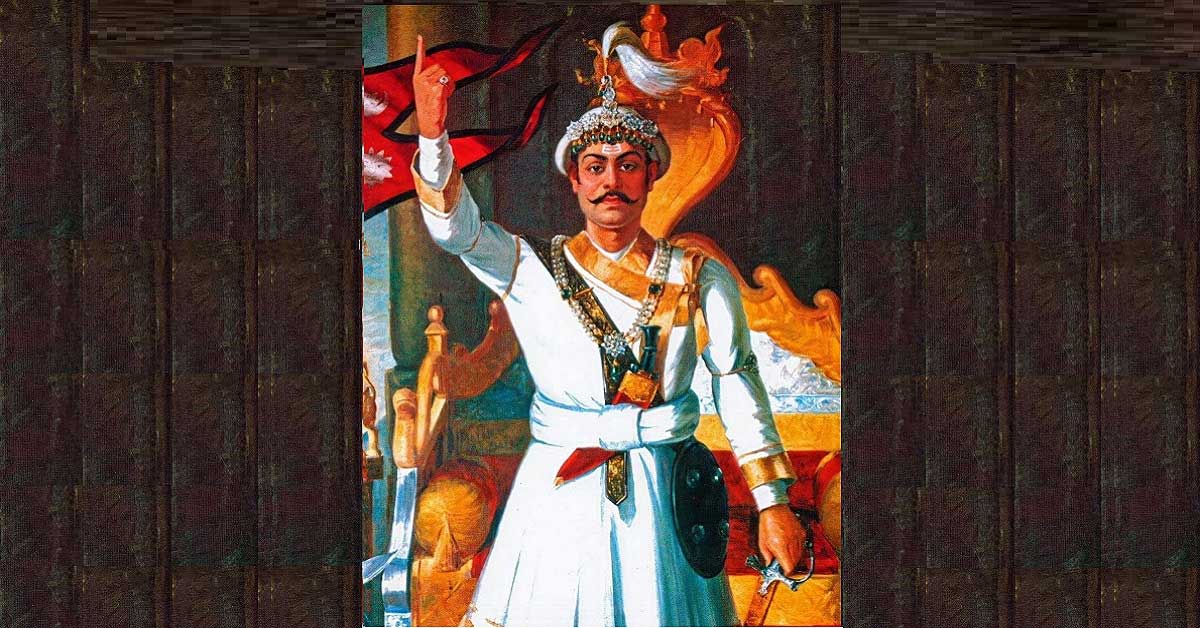
Prithvi Narayan Shah: Biography
Introduction
Full name: Prithvi Narayan Shah (in Nepali: पृथ्वी नारायण शाह)
Titles: Badamaharajadhiraj (Great King of Kings), Nation Builder
Nationality: Nepali
Key contribution: Unification of Modern Nepal
Reign: 1743 to 1775 AD (as King of Gorkha and later as King of the Kingdom of Nepal)
Prithvi Narayan Shah was a Shah dynasty ruler who led the political and military consolidation of many small principalities into a unified Nepal. He is widely described in Nepali historical writing as a strategic leader whose statecraft combined warfare, diplomacy, and economic pressure.

Early life and background
Birth: 27 Poush 1779 BS (11 January 1723 AD)
Birthplace: Gorkha Palace
He was the eldest son of Narabhupal Shah and Kaushalyavati Devi. His lineage is commonly described as connected to the Sisodia Rajputs, believed to have moved from Rajasthan into the western hills. He was the ninth-generation king in the Shah line of the Gorkha Kingdom, founded by King Dravya Shah.
At the time, the territory of present-day Nepal was divided among more than 50 small states, including the Baise and Chaubise principalities, the Malla kingdoms of the Kathmandu Valley, and the Sen states in the east. Gorkha was a comparatively small and economically weaker hill kingdom, frequently in conflict with neighboring polities. This fragmented political landscape is presented as a key context shaping his aim to build a unified state.
Education and formation
Following royal court practice, he received formal training in Sanskrit, political science, diplomacy, and religious texts. He was also trained in martial skills, including horsemanship, archery, and swordsmanship.
His early influences are described as including Chandra Prabhavati, who is credited with providing practical exposure to governance and political judgment. Court scholars and advisors, including Bhanu Aryal and Kulananda Dhakal, are also cited as sources of guidance and learning.
As crown prince, he travelled to Makwanpur and to Varanasi. During the Varanasi visit, he observed the rising influence of the East India Company and examined their modern weapons. This experience is described as strengthening his understanding of firearms and military modernization, later treated as significant in the unification campaign.
Accession and early setbacks
After his father’s death, he became King of Gorkha at the age of 20 on 25 Chaitra 1799 BS (1743 AD). Soon after taking the throne, he began an expansion campaign aimed at unifying surrounding states.
His early attempt to capture Nuwakot—a strategic location near the Kathmandu Valley—ended in defeat, attributed in the narrative to insufficient preparation and haste. This setback is presented as a turning point that reinforced the need for planning, resources, and modern weapons rather than courage alone.
Reforms, preparation, and first major victory
Following the initial defeat, his preparation is described through several measures:
-
Mobilizing resources through public support (often linked to the episode of Bise Nagarchi).
-
Arranging modern guns and gunpowder through travel and procurement.
-
Strengthening troop morale by granting “Marwat” (land, facilities, and provisions).
-
Improving diplomatic relations with neighboring states.
In 1801 BS (1744 AD), he attacked Nuwakot again and secured victory. This success is presented as a foundational step in the broader unification process.
Unification campaign
After the Nuwakot victory, his expansion proceeded in stages, with sustained pressure on key routes and centers of power.
Strategy: economic blockade and control of entry points
A key approach described is prolonged economic blockade of the Kathmandu Valley kingdoms (Kantipur, Patan, and Bhadgaun), rather than immediate decisive battle. The strategy focused on controlling major access routes into the Valley, including Makwanpur, Nuwakot, and Naldum.
Makwanpur and weapons capture
In 1819 BS (1762 AD), Makwanpur was captured, limiting the Valley’s southern access. The same conflict is described as including the defeat of forces associated with Mir Qasim, resulting in the capture of a large stock of weapons.
Kirtipur and Valley conquest
After three attempts, Kirtipur was captured in 1822 BS (1766 AD). The conquest of the Valley is described as follows:
-
In 1825 BS (1768 AD), Kantipur (Kathmandu) was taken on the day of Indra Jatra.
-
Soon after, Patan (Lalitpur) was conquered.
-
In 1826 BS (1769 AD), Bhadgaun (Bhaktapur) was conquered, bringing the entire Valley under Gorkha control.
Following the Valley conquest, the narrative describes further expansion eastward, incorporating the states of Majh Kirat and Pallo Kirat into Nepal.
Governance and Divyopadesh
The advice attributed to him in his final days is compiled as Divyopadesh. Its themes are commonly summarized as foreign policy caution, economic self-reliance, and social cohesion.
Foreign policy: Nepal is described as “a yam between two boulders,” recommending balanced relations with China in the north and the British power in the south. A defensive posture is emphasized: do not initiate aggression, but resist if attacked.
Economic policy: The text advocates self-reliance, including producing and using domestic cloth, and restricting foreign luxury goods and certain external commercial influences.
Social policy: Nepal is described as a shared garden of four varnas and thirty-six jatis, presented as a statement supporting social harmony within diversity.
Achievements and recognition
His achievements are commonly listed under state formation, military organization, and external resistance:
-
Unification of dispersed states into a sovereign Nepal.
-
Development of a more permanent military organization, including early forms of a company-style structure (often illustrated with units such as Shreenath Gan and Kalibox Gan).
-
Resistance to an East India Company force in the 1767 AD Battle of Sindhuli, described as preventing deeper external military intrusion; the force is associated with Captain Kinloch.
-
His birth anniversary (Poush 27) is observed as National Unity Day or Prithvi Jayanti in Nepal.
Challenges, criticism, and controversies
Historical writing also records debate around aspects of the campaign and its human impact.
Kirtipur incident: One of the most contested claims relates to allegations of bodily mutilation after Kirtipur’s conquest (commonly described as cutting of noses and ears). Capuchin missionaries and some foreign accounts describe severe cruelty. Some Nepali historians argue the accounts are exaggerated or symbolic in nature. The source tradition is not presented as fully unanimous or conclusively settled.
Economic blockade and hardship: The prolonged blockade strategy is criticized for causing sustained hardship for civilians during the Valley campaign.
Cultural policy: While some claims suggest cultural suppression in conquered areas, the narrative also records actions interpreted as continuity—such as visiting the Kumari after conquering Kantipur and maintaining certain Malla-era practices.
Personal life
First marriage: He married Indra Kumari, daughter of Hemkarna Sen, in 1794 BS. The relationship is described as politically tense, and she did not come to Gorkha.
Second marriage: He married Narendra Rajya Lakshmi, daughter of Abhimani Singh of Kashi (India).
Children: His sons were Pratap Singh Shah and Bahadur Shah. After his death, Pratap Singh Shah became king, and Bahadur Shah later served as regent and is described as extending expansion toward western Nepal.
Later life and death
During the continuing campaign and state-building work, he fell ill.
Death: He died at the age of 52 on 1 Maghe 1831 BS (11 January 1775 AD) at Devighat, Nuwakot. The counsel attributed to him in this final period was later compiled as Divyopadesh. After his death, Pratap Singh Shah ascended the throne.
Legacy and historical significance
His lasting legacy is most often framed as the survival and consolidation of Nepal as an independent political entity.
-
National identity and independence: In the period of expanding British power in South Asia, Nepal’s continued independence is commonly linked to the strategic choices made during and after unification.
-
Governance and diplomacy: The centralized governance model and foreign policy principles attributed to him are frequently referenced in later discussions of Nepal’s statecraft and strategic position.
-
Public image and debate: Many Nepalis regard him as a nation builder. Political debate over the meaning of unification and public commemoration has varied across different periods, including arguments that frame unification as state consolidation versus territorial expansion.
Frequently asked questions
Who was Prithvi Narayan Shah?
He was a Shah dynasty king and the principal figure associated with the unification of modern Nepal through the incorporation of many small states into one political entity.
Why is he considered a visionary king?
Because the unification campaign combined military action with blockade strategy and diplomacy, and because Divyopadesh is treated as an attempt to anticipate external risks and guide state policy.
When did he die?
He died on 1 Maghe 1831 BS (11 January 1775 AD) at Devighat, Nuwakot.
What does “a yam between two boulders” mean?
It is a metaphor used to describe Nepal’s geopolitical sensitivity between powerful neighbors—China to the north and the southern plains influenced by larger external powers.
Official and Historical sources
-
Divyopadesh (edited editions by Baburam Acharya and Yogi Naraharinath)
-
A Short History of Nepal by Baburam Acharya (Historian Laureate)
-
Research works by Ludwig F. Stiller, including The Rise of the House of Gorkha
-
Government archives and historical documents of the Department of Archaeology, Nepal






Comments 0
No comments yet. Be the first to start the conversation.