The Master of Education (M.Ed.) at Baneshwor Campus, Shantinagar, New Baneshwor, Kathmandu, Nepal, is a master’s level education program affiliated with Tribhuvan University. The program is designed for students with a Bachelor of Education or Post-Graduate Diploma in Education who want to study education, pedagogy, research, specialization-based teaching, educational planning, and professional practice.
Baneshwor Multiple Campus offers the program within a public, non-profit academic setting with classroom learning, internal assessment, library access, research facilities, study rooms, and student support services.
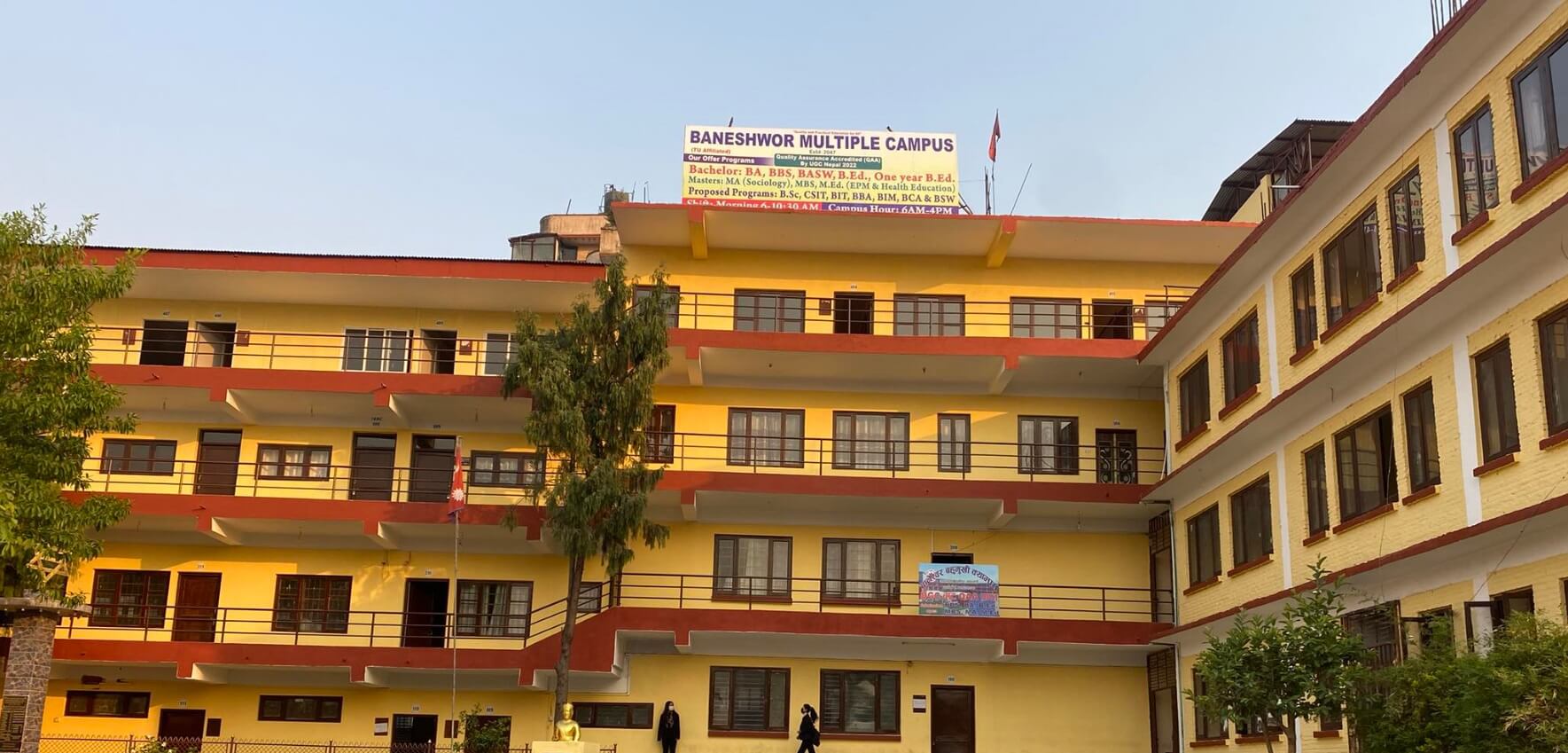
Course: Master of Education (M.Ed.)
College: Baneshwor Multiple Campus
Also known as: Baneshwor Campus
Location: Shantinagar, New Baneshwor, Kathmandu, Nepal
Affiliation: Tribhuvan University
Faculty: Faculty of Education
Level: Master’s level
Duration: 24 months
Study structure: Four semesters
Total credit hours: 69 credit hours
Maximum completion period: 5 years
Eligibility: B.Ed. or Post-Graduate Diploma in Education from Tribhuvan University or a recognized university, with subject-specific requirements for specialization areas
Admission basis: Entrance examination based on educational aptitude and specialization subject knowledge
Contact: +977-1-4620310, +977-1-4620332
The M.Ed. program focuses on advanced study in education, pedagogy, educational research, specialization-based learning, and professional practice. It is structured for students preparing for roles connected with teaching, teacher training, educational planning, educational administration, supervision, research, and education-related professional work.
The program includes core education courses, specialization courses, teaching practice or practicum, and thesis writing. Students study one specialization area based on their previous academic background and the subject requirements of the Faculty of Education.
The M.Ed. program has a normal duration of 24 months. It is divided into four semesters and carries 69 credit hours. The maximum duration for completing the program requirements is 5 years.
The academic structure includes:
21 credit hours of core professional courses
39 credit hours of specialization courses
3 credit hours of teaching practice or practicum
6 credit hours of thesis writing
The first, second, and third semesters each carry 18 credit hours. The fourth semester carries 15 credit hours, including teaching practice or practicum and thesis writing.
The M.Ed. program includes seven core education courses that students from all specialization areas must study.
Ed. 511: Foundations of Education
Ed. 513: Advanced Educational Psychology
Ed. 521: Curriculum Practices
Ed. 522: Education and Development
Ed. 532: Research Methodology in Education
Ed. 533: Measurement and Evaluation in Education
Ed. 545: Contemporary Educational Issues
The fourth semester also includes Teaching Practice, Practicum in Educational Planning and Management, or Practicum in Special Needs Education, depending on the student’s specialization area. Thesis writing is also placed in the fourth semester.
The M.Ed. program includes specialization areas under the Faculty of Education. Specialization areas include:
Biology Education
Chemistry Education
Curriculum and Evaluation
Economics Education
Education Planning and Management
English Education
Geography Education
Health Education
History Education
ICT Education
Math Education
Nepali Education
Physical Education
Physics Education
Political Science Education
Population Education
Special Need Education
Each student studies one specialization area based on the subject studied at the Bachelor of Education level or the related subject-specific requirement.
Applicants must have completed B.Ed. or a Post-Graduate Diploma in Education from Tribhuvan University or a recognized university. Students must also meet the subject-specific entry requirements for the specialization area they choose.
Some specialization areas accept candidates with B.A., B.Sc., or related bachelor’s degree backgrounds along with one-year B.Ed., depending on the subject requirement. ICT Education, Special Needs Education, Curriculum and Evaluation, Education Planning and Management, Economics Education, Population Education, Geography Education, Political Science Education, and History Education have separate subject-background requirements.
Admission to the M.Ed. program is based on the entrance examination. Applicants must submit the application with personal information and previous academic records as prescribed by the Faculty of Education.
Student selection is based on marks obtained in the entrance examination. The examination covers educational aptitude and knowledge related to the specialization subject area.
M.Ed. students complete a six-week Teaching Practice in schools or campuses toward the end of the fourth semester. Students of Educational Planning and Management and Special Needs Education complete a practicum in selected schools.
The thesis writing course has two parts. Part A supports academic writing, proposal preparation, research assignment, data collection tools, and proposal presentation. Part B requires students to write a master’s thesis under the supervision of an assigned faculty member.
Students present and defend thesis findings before the Department Research Committee in the presence of a subject expert. Thesis evaluation includes internal and external components.
The evaluation system includes internal evaluation and external evaluation. Internal evaluation carries 40 percent, and external evaluation carries 60 percent of the total weightage unless stated differently in the course content. Students must pass both internal and external evaluations separately.
Internal evaluation includes:
Attendance
Participation in learning activities
First assignment
Second assignment or assessment
Final assessment or exam
External evaluation is conducted through the semester-end final written examination by the Examination Section, Office of the Dean, Faculty of Education. The external examination includes objective questions, short-answer questions, and long-answer questions.
The grading system is based on a four-point scale. The passing grade for an individual paper in the semester-end examination is B minus or GPA 2.7. To pass the semester examination, students must secure at least Grade B or CGPA 3.0.
Baneshwor Multiple Campus follows a teaching approach that includes classroom learning, practical orientation, internal exams, class tests, assessment, and feedback. The campus gives attention to discipline, academic planning, practical teaching, student participation, and research-oriented learning.
For M.Ed. students, this academic environment supports study in education, pedagogy, research methodology, measurement and evaluation, specialization-based learning, teaching practice, practicum, and thesis work.
Baneshwor Multiple Campus provides facilities that support postgraduate learning and campus life. Available facilities include classrooms, a library with more than 8000 books, a research hall, an e-server, study rooms, sports spaces, a canteen, drinking water, toilets, and parking.
The campus also provides scholarship and fee-waiver opportunities for selected students based on academic performance and student background. These include support linked with academic merit, remote-area background, and students from fourteen earthquake-affected districts.
M.Ed. graduates may pursue education-related academic and professional pathways connected with teaching, teacher training, educational planning, educational administration, supervision, curriculum work, educational research, and specialization-based education practice.
The thesis, teaching practice, practicum, and research methodology components also support research-oriented academic work in education and related fields.
College Name: Baneshwor Multiple Campus
Location: Shantinagar, New Baneshwor, Kathmandu, Nepal
Phone: +977-1-4620310, +977-1-4620332
Email: bmc@baneshworcampus.edu.np
Additional Email: info@baneshworcampus.edu.np
Website: https://baneshworcampus.edu.np
The Master of Education (M.Ed.) is a master’s level program affiliated with Tribhuvan University. It focuses on education, pedagogy, research, specialization-based study, teaching practice, practicum, and thesis writing.
The M.Ed. program is offered at Baneshwor Multiple Campus, Shantinagar, New Baneshwor, Kathmandu, Nepal.
The M.Ed. program has a normal duration of 24 months and is divided into four semesters. The maximum completion period is 5 years.
The M.Ed. program carries 69 credit hours. It includes core courses, specialization courses, teaching practice or practicum, and thesis writing.
Applicants with B.Ed. or Post-Graduate Diploma in Education from Tribhuvan University or a recognized university can apply. They must also meet the subject-specific requirements for the selected specialization area.
Yes. Admission is based on an entrance examination covering educational aptitude and specialization subject knowledge.
Yes. M.Ed. students complete a six-week Teaching Practice toward the end of the fourth semester. Students in Educational Planning and Management and Special Needs Education complete a practicum.
The evaluation system includes 40 percent internal evaluation and 60 percent external evaluation. Students must pass internal and external evaluations separately.
Baneshwor Multiple Campus provides classrooms, a library with more than 8000 books, a research hall, an e-server, study rooms, sports spaces, a canteen, drinking water, toilets, and parking.