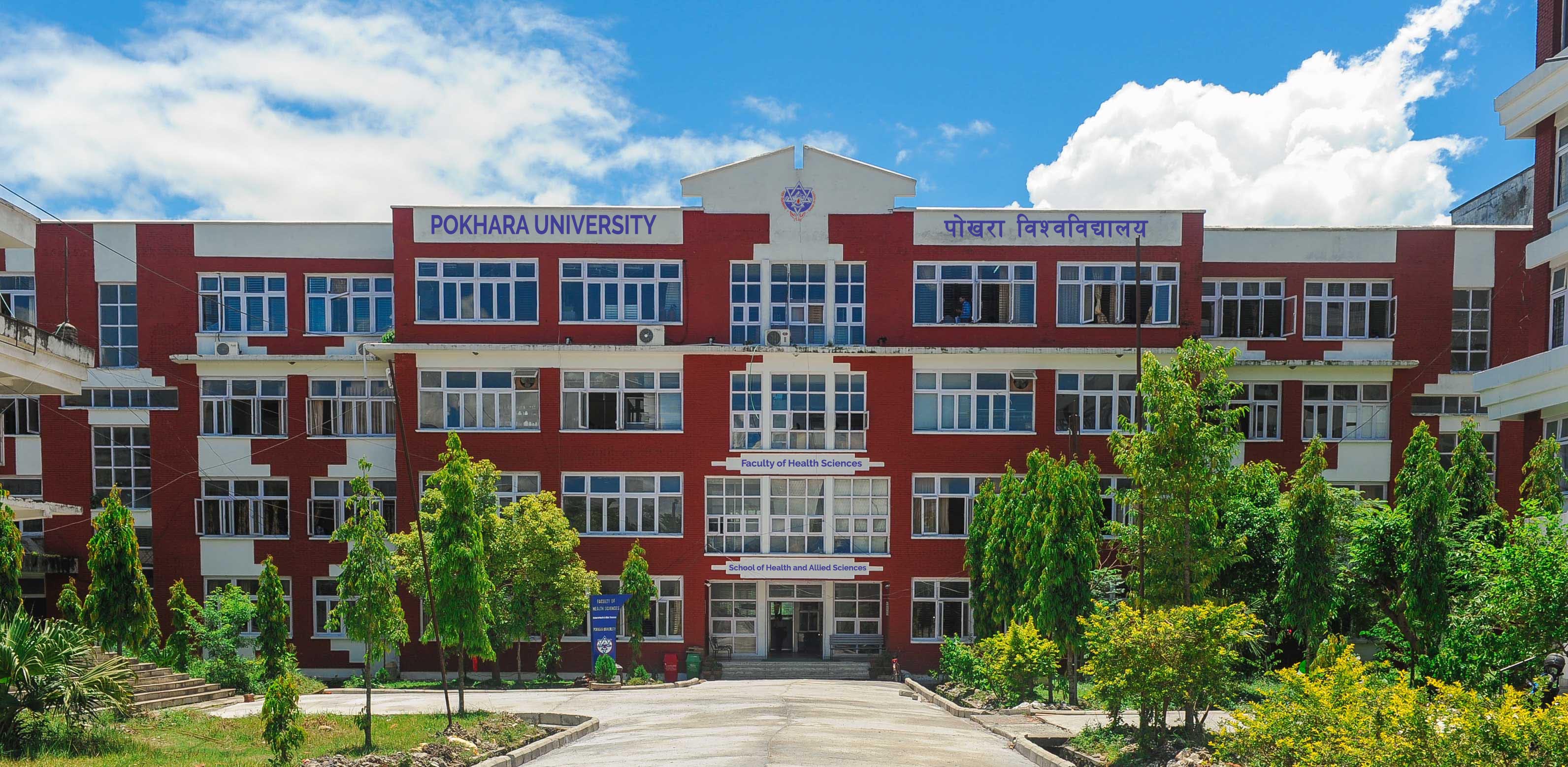
Master of Pharmacy (M.Pharm), academically presented as Master of Pharmaceutical Sciences, is a two-year postgraduate pharmacy program offered by the Pokhara University School of Health and Allied Sciences under Pokhara University. The School is located at Dhungepatan, Pokhara-30, Kaski.
The program is organized across four semesters and offers advanced study in Natural Products Chemistry, Pharmaceutics, and Clinical Pharmacy. Each pathway combines postgraduate coursework with laboratory, field, clinical, industrial, or research components suited to its academic focus. Research continues through the program and concludes with a nine-credit thesis in the fourth semester.
| Particular | Details |
|---|---|
| Course | Master of Pharmacy / Master of Pharmaceutical Sciences (M.Pharm) |
| Level | Postgraduate |
| University | Pokhara University |
| Institution | School of Health and Allied Sciences |
| Location | Dhungepatan, Pokhara-30, Kaski |
| Duration | 2 years |
| Academic Structure | 4 semesters |
| Credit Structure | 60 credits in each specialization |
| Listed Seat Allocation | 10 seats |
| Entrance | MECEE-PG |
| Entry Qualification | B.Pharm or equivalent |
| Professional Requirement | Registration with the respective professional council |
| Specializations | Natural Products Chemistry, Pharmaceutics, Clinical Pharmacy |
| Final Semester | 9-credit thesis |
The seat allocation is subject to determination by the Medical Education Commission and may change from one admission cycle to another.
Pokhara University's postgraduate pharmaceutical sciences program has three distinct areas of study:
M.Pharm in Natural Products Chemistry
M.Pharm in Pharmaceutics
M.Pharm in Clinical Pharmacy
The three pathways share an emphasis on research but differ considerably in their technical and professional focus. Natural Products Chemistry concentrates on natural drug discovery, bioactive compounds, phytochemical analysis, herbal pharmacology, and spectroscopy. Pharmaceutics concentrates on formulation, drug-delivery systems, pharmaceutical unit operations, packaging, and industrial work. Clinical Pharmacy concentrates on therapeutics, clinical pharmacokinetics, hospital and community pharmacy, pharmacovigilance, clerkship, and patient-related pharmaceutical practice.
Applicants must hold a B.Pharm degree or an equivalent qualification.
Candidates must also be registered with the respective professional council of their country. For applicants in Nepal, this professional context is connected with the Nepal Pharmacy Council.
Students progressing from the Bachelor of Pharmacy (B.Pharm) therefore enter M.Pharm as postgraduate pharmacy students who already have an undergraduate pharmacy qualification.
Admission to the master's-level health-professional program follows the prevailing rules of the Medical Education Commission (MEC), Nepal.
M.Pharm applicants follow the MECEE-PG admission system. Selection is governed by the entrance, merit, seat-allocation, and admission procedures applicable to the academic cycle.
The process includes:
Meeting the B.Pharm or equivalent academic requirement
Holding the required professional council registration
Appearing in MECEE-PG
Qualifying through the MEC merit system
Securing admission within the seats assigned for the intake
Completing Pokhara University and SHAS admission formalities
Seat allocation, scholarships, fees, entrance procedures, and admission schedules are subject to MEC decisions for the relevant academic year.
Natural Products Chemistry follows a 60-credit structure over four semesters.
The first semester covers Instrumental Analysis, Regulatory Affairs and Quality Assurance, Research Methodology and Applied Statistics, Natural Drug Discovery, and Medicinal Chemistry. Practical work includes Instrumental Analysis and Phytochemical Analysis laboratories, along with a pharmaceutical seminar and the first stage of pharmaceutical research.
Semester II moves into Drug Design and Formulation, Bioactive Natural Compounds, Herbal Pharmacology and Toxicology, electives, laboratory work, and Pharmaceutical Research II.
Semester III includes Applied Spectroscopy, another elective, Pharmaceutical Market Assessment, spectral analysis of natural drugs, and Pharmaceutical Research III.
The fourth semester consists of a nine-credit thesis.
Elective options include subjects such as:
Pharmaceutical Biotechnology
Molecular Pharmaceutics
Cosmeceuticals and Nutraceuticals
Pharmaceutical Management and Marketing
Pharmaceutical Packaging Technology
Complementary and Alternative Medicine
This pathway gives research a defined role from the beginning of the course. The research topic is approved at the start of the first semester, followed by progress reporting during the program and thesis work in the final semester.
The Pharmaceutics pathway is also a 60-credit, four-semester research program.
Semester I includes Instrumental Analysis, Regulatory Affairs and Quality Assurance, Research Methodology and Applied Statistics, Biopharmaceutics and Pharmacokinetics, and Pharmaceutical Unit Operations.
Laboratory work covers Instrumental Analysis and Biopharmaceutics and Pharmacokinetics. A pharmaceutical seminar and Pharmaceutical Research I are also included.
Semester II focuses more directly on formulation and delivery through:
Drug Design and Formulation
Modern Drug Delivery System
Pharmaceutical Packaging Technology
Two elective courses
Drug Design and Formulation laboratory
Drug Delivery System laboratory
Pharmaceutical Research II
Semester III includes an elective, Pharmaceutical Market Assessment, an Industrial Internship, a Molecular Pharmaceutics laboratory, and Pharmaceutical Research III.
Semester IV is devoted to the nine-credit thesis.
The industrial internship distinguishes this pathway from the Natural Products Chemistry structure by placing a formal industrial component within the third semester.
Clinical Pharmacy follows the same two-year, four-semester framework but has a different academic pattern, with greater emphasis on therapeutics, clinical pharmacy services, clerkship, pharmacovigilance, and community practice.
Semester I contains Instrumental Analysis, Regulatory Affairs and Quality Assurance, Research Methodology and Applied Statistics, Biopharmaceutics and Pharmacokinetics, and Applied Therapeutics I. Laboratory, seminar, and research courses are also included.
Semester II covers:
Applied Therapeutics II
Clinical Pharmacokinetics
Clinical Skills for Pharmacists
Hospital and Community Pharmacy
Clinical Clerkship I
Clinical Pharmacokinetics laboratory
Clinical Skills laboratory
Pharmaceutical Research II
Semester III develops the clinical component further through Pharmacoeconomics and Health System Pharmacy, Pharmacoepidemiology and Clinical Research, Drug Information and Pharmacovigilance, Clinical Clerkship II, Community Field Practice, a Case Study laboratory, and Pharmaceutical Research III.
The fourth semester consists of a nine-credit thesis. The complete Clinical Pharmacy pathway carries 60 credits.
Research is not confined to the final semester. All three M.Pharm pathways contain research work before the thesis stage.
Natural Products Chemistry and Pharmaceutics include Pharmaceutical Research I, II, and III before the nine-credit thesis. Clinical Pharmacy also includes research components throughout its first three semesters before thesis work.
For Natural Products Chemistry and Pharmaceutics, the research topic is approved at the beginning of the first semester and research progress is reported according to the departmental schedule.
The degree-award requirements also include a research dissemination component. Students must meet the applicable requirement through publication or approval for publication of a paper in a relevant peer-reviewed scientific journal, or through presentation of a paper at a national or international symposium. This requirement is stated for the M.Pharm pathways.
For the 2025 fee structure, Master Pharmacy carried the following amount:
| Fee Component | Amount |
|---|---|
| M.Pharm Program Fee | NPR 519,660 |
| Security Deposit | NPR 10,000 refundable |
| FSU Fee | NPR 1,000 |
The security deposit and FSU fee are separate from the program fee.
Medical education fees remain subject to MEC decisions. A fee applicable to one admission cycle should not automatically be treated as the amount for a later intake.
The practical component differs according to specialization.
Natural Products Chemistry includes laboratories in instrumental analysis, phytochemical analysis, formulation, bioassay, and spectral analysis of natural drugs.
Pharmaceutics includes laboratory work in instrumental analysis, biopharmaceutics and pharmacokinetics, drug design and formulation, drug-delivery systems, and molecular pharmaceutics. It also includes an industrial internship and pharmaceutical market assessment.
Clinical Pharmacy combines laboratory work with clinical clerkships, community field practice, case study activities, hospital and community pharmacy, drug information, and pharmacovigilance.
Students study within the broader SHAS academic setting, which includes pharmaceutical laboratories, Pokhara University's central library, electronic resources, computers, and high-speed internet.
M.Pharm graduates may explore work in areas connected with their specialization and prior professional preparation.
The pharmaceutical sciences program identifies settings such as:
Pharmaceutical industries
Hospitals
Academic institutions
Drug dispensing establishments
Government drug administration
Drug research laboratories
Health research institutes
Natural medicine research institutes
NGOs and INGOs
Natural Products Chemistry has a stronger academic connection with natural drug and medicinal-product research. Pharmaceutics connects more directly with formulation, manufacturing, drug delivery, and pharmaceutical industry work. Clinical Pharmacy is structured more closely around hospitals, pharmaceutical care, therapeutics, medication-related services, and clinical research.
These are possible professional settings rather than guaranteed employment outcomes. Career progression depends on specialization, professional registration, research experience, individual competence, vacancies, and organizational requirements.
M.Pharm is intended for pharmacy graduates who want postgraduate study beyond the general B.Pharm curriculum.
The choice of pathway is particularly important. Students interested in medicinal plants, natural compounds, phytochemistry, and natural-drug research may find Natural Products Chemistry more aligned with their academic direction. Those interested in formulation, drug delivery, manufacturing, packaging, and pharmaceutical production can consider Pharmaceutics.
Clinical Pharmacy is structured for students interested in therapeutics, pharmacokinetics, hospital and community pharmacy, pharmacovigilance, clinical research, and pharmacy services associated with patient care.
Across all three areas, students should be prepared for a substantial research commitment because the curriculum includes research from the early semesters and finishes with a thesis.
M.Pharm is a two-year postgraduate program organized across four semesters.
Applicants must hold a B.Pharm degree or equivalent and must be registered with the respective professional council of their country.
Master-level admission follows the MECEE-PG system under the prevailing Medical Education Commission rules.
The postgraduate pharmaceutical sciences program includes Natural Products Chemistry, Pharmaceutics, and Clinical Pharmacy.
Each specialization has a 60-credit curriculum over four semesters.
Yes. Semester IV contains a nine-credit thesis in all three specialization structures.
Yes. M.Pharm in Pharmaceutics includes a three-credit Industrial Internship in Semester III.
Yes. Its curriculum includes Clinical Clerkship I and II, Community Field Practice, clinical skills laboratory work, case studies, and hospital and community pharmacy.
The 2025 program fee was NPR 519,660. A refundable security deposit of NPR 10,000 and an FSU fee of NPR 1,000 were listed separately.