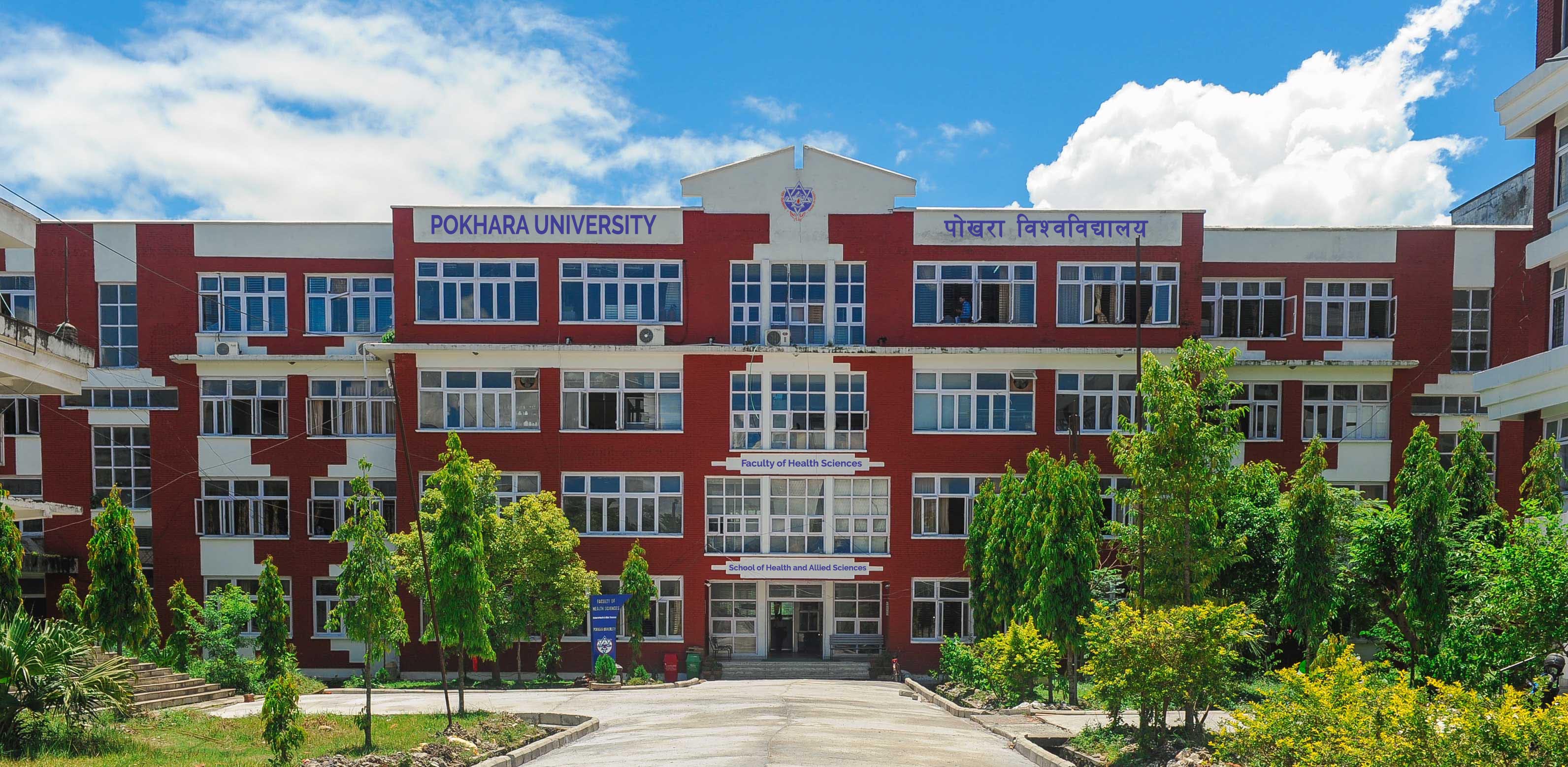
Bachelor of Public Health (BPH) is a four-year undergraduate health-science program offered by the Pokhara University School of Health and Allied Sciences under Pokhara University. The School is located at Dhungepatan, Pokhara-30, Kaski.
The program is organized across eight semesters and carries 145 credits. Its curriculum moves from biological and basic health sciences into epidemiology, disease prevention, nutrition, reproductive health, environmental and occupational health, public health management, health promotion, statistics, health economics, research, community diagnosis, monitoring and evaluation, public health law, and dissertation work.
Field practice is built into several stages of the course. Students complete integrated concurrent field practice, residential community and district-level field activities, health seminars, and a public health dissertation.
| Particular | Details |
|---|---|
| Course | Bachelor of Public Health (BPH) |
| Level | Undergraduate |
| University | Pokhara University |
| Institution | School of Health and Allied Sciences |
| Location | Dhungepatan, Pokhara-30, Kaski |
| Duration | 4 years |
| Academic Structure | 8 semesters |
| Total Credits | 145 |
| Current Seat Allocation | 40 seats |
| Entrance | MECEE-BL |
| Admission Authority | Medical Education Commission (MEC), Nepal |
| Listed Fee | NPR 777,000 |
| Major Components | Theory, practical work, field practice, research, dissertation |
The seat figure and fee are tied to the applicable Medical Education Commission framework and may be revised for a later admission cycle.
BPH is centered on population health rather than one clinical profession or laboratory discipline. The course examines how health problems develop within communities, how diseases can be prevented, how health programs are planned and managed, and how evidence can be used to understand public health needs.
The early curriculum gives students a grounding in anatomy and physiology, biochemistry, microbiology and immunology, environmental science, first aid, nutrition, parasitology and entomology, pharmacology, and toxicology.
The program then moves more directly into public health. Students study communicable and non-communicable diseases, environmental health, public health nutrition, reproductive health, demography, epidemiology, maternal and child health, occupational health, health behavior, sociology, health promotion, health education, health systems, statistics, economics, research, and management.
This structure links biological understanding with the social, environmental, managerial, and research dimensions of health.
Admission to BPH requires candidates to qualify for the Common Entrance Examination of Bachelor Level in Health Professional Education conducted by the Medical Education Commission.
Applicants may be eligible through the following academic routes:
10+2 Science with Physics, Chemistry, and Biology, with at least 50% aggregate marks or GPA 2.4 or equivalent.
A certificate-level qualification such as A-Level with an equivalent academic percentage under its grading system.
Diploma in Pharmacy with at least 50%, together with registration in the Nepal Pharmacy Council.
Candidates must pass the MEC bachelor-level entrance examination and be successful and recommended through the applicable admission system.
BPH admission follows the bachelor-level medical education system administered by the Medical Education Commission.
The process includes:
Meeting the prescribed academic eligibility
Appearing for MECEE-BL
Qualifying through the national entrance examination
Selection according to merit and available seats
Completing the required institutional admission formalities
The School's admission process uses merit order within the defined number of seats.
The current BPH intake is 40 seats. Seat allocation, scholarship provisions, admission procedures, fee arrangements, and related requirements are subject to the MEC rules and calendar applicable to each admission cycle.
The course carries 145 credits over eight semesters. Rather than concentrating field experience at the end, the curriculum introduces practical and community-based work during the middle and later stages of study.
| Academic Stage | Main Areas | Credits |
|---|---|---|
| Semester I | Public Health I, Anatomy and Physiology, Biochemistry, Microbiology and Immunology, Professional English, practical courses | 19 |
| Semester II | Environmental Science, First Aid, Nutritional Science, Parasitology and Entomology, Pharmacy, Pharmacology and Toxicology, practical courses | 20 |
| Semester III | Communicable Diseases, Environmental Health, Non-communicable Diseases, Public Health Nutrition, Reproductive Health and Demography, Field Practice I | 20 |
| Semester IV | Basic Epidemiology, Public Health II, Maternal, Child and Elderly Health, Occupational Health and Safety, Public Health Behavior and Anthropology, Field Practice II | 20 |
| Later Management Stage | Public Health Management, Epidemiological Methods, Health Promotion and Education, Sociology and Social Psychology, Public Health Statistics, Field Practice | 20 |
| Community Health Stage | Community Health Diagnosis, Health Education Communication, Health System Management, Health Finance and Economics, Public Health Statistics, Residential Field Practice | 18 |
| Advanced Management and Research Stage | Human Resources for Health, Research Methodology and Software Applications, Monitoring and Evaluation, Health System Management, Residential District Field Practice | 15 |
| Semester VIII | Disaster Management, Public Health Law and Acts, Journal Club/Health Seminar, Public Health Dissertation | 13 |
The final curriculum total is 145 credits.
The first year gives students a scientific foundation before the course moves deeper into population and community health.
Semester I introduces Public Health alongside Anatomy and Physiology, Biochemistry, Microbiology and Immunology, and Professional English. Several subjects include laboratory or practical components.
Semester II adds Environmental Science, First Aid, Nutritional Science, Parasitology and Entomology, and Pharmacy, Pharmacology and Toxicology. Practical courses continue alongside the theoretical subjects.
These subjects give students background knowledge that later supports work in disease prevention, environmental health, epidemiology, nutrition, and community assessment.
From Semester III, the curriculum becomes more directly focused on public health problems and population-based interventions.
Students study communicable diseases and non-communicable diseases alongside environmental health, public health nutrition, reproductive health, and demography.
Basic Epidemiology follows, together with maternal, child and elderly health, occupational health and safety, and public health behavior and anthropology.
This stage also introduces Integrated Concurrent Field Practice. Field Practice I and II each carry five credits, making practical community exposure a substantial part of the academic workload rather than a minor addition to classroom study.
The later curriculum connects epidemiological knowledge with program management and health communication.
Students encounter:
Basic Public Health Management
Epidemiological Methods and Management
Health Promotion and Education
Public Health Sociology and Social Psychology
Public Health Statistics
Health Education Communication
Health System Management in Nepal
Health Finance and Health Economics Including Entrepreneurship
These areas extend the program beyond disease knowledge. Students examine how health services are organized, how health programs are communicated, how resources are managed, and how statistical information can be used in public health work.
Field education is a recurring feature of the BPH curriculum.
The course includes three stages of Integrated Concurrent Field Practice and later moves into residential field activities.
Residential Field Practice in Community Health Diagnosis accompanies study in community health diagnosis and program implementation strategies. Another residential field component covers Comprehensive District Health Management.
These practical courses place community assessment and health-service management within the formal curriculum. Students therefore work with field-based public health activities before reaching the dissertation stage.
Research becomes progressively more prominent during the later part of BPH.
Public Health Statistics I and II provide quantitative study, while Health Research Methodology and Software Applications introduces a more direct research component.
Students also study Health Monitoring and Evaluation, linking research and information with the assessment of health programs.
The final semester includes a six-credit Public Health Dissertation. Journal Club/Health Seminar is included alongside the dissertation, Disaster Management, and Public Health Law and Acts.
The dissertation gives students a defined research component at the end of the four-year course.
The current MEC fee listed for BPH is:
| Fee Component | Amount |
|---|---|
| BPH Program Fee | NPR 777,000 |
| Security Deposit | NPR 10,000 refundable |
| FSU Fee | NPR 1,000 |
The security deposit and FSU fee are listed separately from the program fee.
Fees remain subject to the prevailing MEC fee structure and Pokhara University requirements. An amount applicable to one admission cycle should not automatically be treated as the fee for a later intake.
Scholarship arrangements for BPH operate within the prevailing MEC admission framework.
The current program intake is 40 seats. MEC rules govern seat determination, scholarship provisions, merit-based admission, fees, and related procedures for the applicable academic year.
Because seat distribution and scholarship arrangements can be revised, applicants should use the provisions attached to their own MECEE-BL admission cycle.
The BPH program identifies a range of sectors in which public health graduates may explore employment or professional opportunities.
These include:
Government offices and civil service
NGOs, INGOs, and HMOs
UN agencies
Multilateral and bilateral organizations
Health research organizations
Academic institutions
Consultancy work
These are possible work settings rather than guaranteed employment outcomes. Recruitment depends on the requirements of individual organizations, available positions, professional requirements, academic performance, skills, experience, and competitive selection.
Pokhara University also offers Master of Public Health through SHAS.
The MPH program has specializations in Public Health Service Management and Health Promotion and Education. BPH is among the qualifications accepted for MPH admission, subject to the applicable professional registration and MEC entrance requirements.
This provides a postgraduate academic route for graduates who want to continue into advanced study in public health.
BPH may be relevant for students interested in health at the community and population level rather than concentrating only on individual clinical treatment.
The curriculum requires engagement with biological sciences, disease patterns, environmental health, nutrition, epidemiology, statistics, health communication, social sciences, management, economics, fieldwork, and research.
Students should also consider the practical character of the course. Field practice begins before the final year and develops into residential community and district-level work, followed by research methodology and dissertation work.
Bachelor of Public Health is a four-year program organized across eight semesters.
The BPH curriculum carries a total of 145 credits.
The current listed intake is 40 seats. Seat numbers are subject to MEC determination and may vary between admission cycles.
Applicants must pass the bachelor-level Common Entrance Examination in Health Professional Education conducted through MEC, commonly referred to as MECEE-BL.
Applicants may qualify through 10+2 Science with Physics, Chemistry, and Biology and at least 50% aggregate marks or GPA 2.4 or equivalent. Equivalent certificate-level qualifications and the specified Diploma in Pharmacy route are also included.
The listed BPH program fee is NPR 777,000. A refundable NPR 10,000 security deposit and NPR 1,000 FSU fee are listed separately.
Yes. The curriculum includes Integrated Concurrent Field Practice as well as residential field practice in community health diagnosis and comprehensive district health management.
Yes. Students study research methodology and software applications and complete a six-credit Public Health Dissertation in the final semester.