



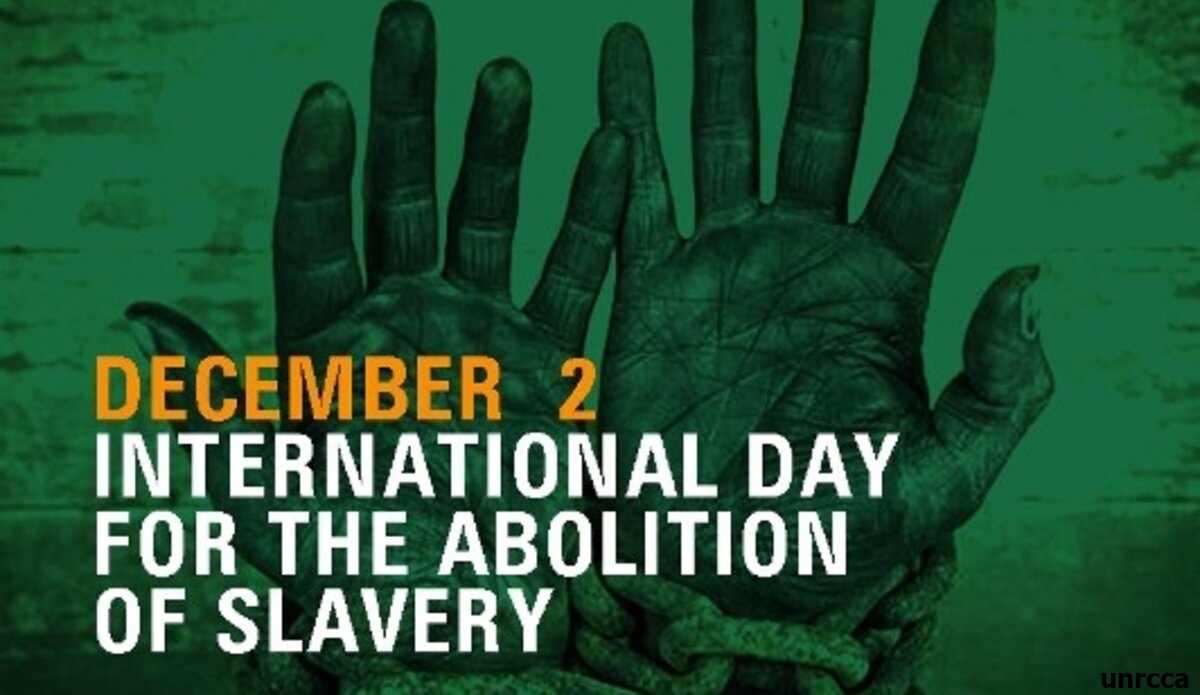
Ending Modern Slavery and the Relevance of International Abolition Day
Human civilization has reached the scientific and technological heights of the 21st century. We are dreaming of settling on Mars and competing to bring the world into our hands through Artificial Intelligence (AI). Yet, in the dark corners of this so-called “civilized” society, a cruel truth remains hidden – slavery.
This word may sound like something from the pages of history, but today it is still the daily reality of 50 million people.
Every year on 2 December, the International Day for the Abolition of Slavery is observed. It is not just a symbolic or formal day; it is a clear call to action against serious violations of human rights worldwide.
Historical Background: Why 2 December?
On 2 December 1949, the United Nations adopted the “Convention for the Suppression of the Traffic in Persons and of the Exploitation of the Prostitution of Others.” In memory of this historic date, the International Day for the Abolition of Slavery began to be observed.
Its main objective is not only to eliminate traditional slavery (where human beings were bought and sold as property) but also to uproot contemporary or modern forms of slavery from their roots.
Modern Slavery: Invisible Chains
When many of us hear the word “slave,” we immediately picture people bound in iron chains. Today, however, the chains of slavery are not made of iron. They are made of debt, fear, threats, confiscated documents, and psychological control.
According to the 2022 joint report “Global Estimates of Modern Slavery” by the International Labour Organization (ILO), Walk Free, and the International Organization for Migration (IOM):
-
Worldwide, 50 million people are forced to live in situations of modern slavery.
-
Among them, 27.6 million people are in forced labor.
-
22 million people are trapped in forced marriage.
-
In the last five years, this number has not decreased; it has increased by 10 million. This figure indicates the failure of our policy-making and implementation.
Forms of Modern Slavery
From the perspective of subject experts, modern slavery can be broadly classified into the following main areas:
-
Forced Labor: This is widespread in private sectors such as agriculture, construction, the garment industry, and fishing. Even when workers want to leave, they cannot do so because of debt or threats.
-
Child Labor and Child Soldiers: Forcing young children to work in mines or to carry weapons in conflicts is among the most extreme forms of slavery.
-
Human Trafficking: People are lured with promises of good jobs and taken abroad. Their passports are then seized and they are forced to live a hellish life.
-
Hereditary Slavery: In Nepal’s context, practices such as Haliya or Kamaiya have been legally abolished, yet their remnants still exist.
-
Sexual Exploitation: Women and children are forced into prostitution and sexually exploitative work.
Nepal’s Context: Legal Freedom but Practical Bondage
Article 29 of the Constitution of Nepal guarantees the “Right against Exploitation.” Nepal has legally abolished Kamaiya (2000), Haliya (2008), and Kamalari practices.
However, has slavery really ended? Research says “no.”
1. The Trap of Foreign Employment (Modern Indentured Servitude)
Every day, thousands of young people from Nepal leave for foreign employment. Most of them go to Gulf countries and Malaysia. Many manpower agencies charge recruitment fees higher than the legal limit. As a result, workers fall into heavy debt even before they depart.
When they reach the destination country, employers often confiscate their passports, assign them work different from what was agreed in the contract, and withhold salaries. Because they must repay their debt, they are forced to endure this exploitation. International labor experts call this “debt bondage,” which is a major form of modern slavery.
2. Brick Kilns and the Informal Sector
In Nepal’s brick kilns, many Indian and Nepali laborers take an “advance” payment (peshki). That advance itself becomes the chain that binds them. They are not allowed to leave until the work season ends.
Similarly, the condition of adolescent girls working in entertainment sectors such as dohori evenings and dance bars is very close to sexual slavery.
3. Dowry and Child Marriage
Child marriage and forced marriage are still widespread in Nepal. Forcing a person into marriage against their will and making them do continuous domestic labor is also a form of slavery.
Root Causes of the Problem
We have seen the problem. Now, as experts, we must examine its causes. Poverty alone is not the reason.
-
Structural Discrimination: When caste-based untouchability and marginalized communities (such as Musahar, Dom, Chamar) are kept outside the state’s mainstream, they become easy targets for exploitation.
-
Impunity: Traffickers and intermediaries involved in human trafficking frequently escape punishment because of political protection.
-
Consumer Ignorance: We look for cheap goods. But we do not ask which worker in which country shed blood and sweat to make that cheap shirt or pair of shoes, or whether they were paid a fair wage.
-
Weak Migration Policy: The “free visa, free ticket” policy exists on paper, but when it is not implemented in practice, workers fall into debt.
Practical Measures for Solutions (The Roadmap to Solution)
Slavery cannot be ended by slogans alone. To end it, tripartite collaboration is needed between the government, the private sector, and civil society.
1. Government’s Role: Not Just Laws, Implementation
Nepal already has the “Human Trafficking and Transportation (Control) Act, 2064 (2007).” The present need is for data-based monitoring.
-
Certification: Labour audits must be enforced strictly. Brick kilns and carpet industries should receive tax exemptions or government facilities only after providing proof that they do not use child labor.
-
Rehabilitation: A genuine rehabilitation package for freed Kamaiya and Haliya must be introduced. This should include not only land but also skills-based training and access to markets.
2. Responsibility of the Private Sector (Supply Chain Transparency)
This is one of the most important dimensions. Large companies must make their supply chains transparent.
-
Employers and manpower companies in Nepal should adopt “ethical recruitment,” that is, an employer-pays model in which workers do not have to pay recruitment fees.
3. Role of Communities and Civil Society
-
Awareness: Community-level vigilance groups should be formed. If someone from the village is going abroad with an unfamiliar agent, or if a suspicious marriage is taking place, such groups should be able to intervene and stop it.
-
Psychosocial Counselling: Survivors of slavery should not be viewed with contempt. Society should create an environment for their dignified reintegration.
4. Use of Technology
By using blockchain and mobile applications, systems should be created through which workers can directly submit complaints to the concerned authorities. A strong tracking system for people going for foreign employment is necessary.
Conclusion: The Real Meaning of Freedom
While observing the International Day for the Abolition of Slavery, we must understand that slavery is not merely a subject of history; it is a cruel reality of the present.
As long as a child from a Musahar settlement in Siraha is forced to carry bricks instead of going to school, as long as a Nepali youth sweating in Malaysia cannot keep their passport with themselves, and as long as a girl is married off in exchange for a debt, we are not truly free.
Nelson Mandela said, “To be free is not merely to cast off one's chains, but to live in a way that respects and enhances the freedom of others.” (To be free means not only to throw away one’s own chains, but also to live in a way that respects and promotes the freedom of others.)
Therefore, on this day, let us resolve: we will not accept slavery, we will not use products that promote slavery, and we will not remain silent in the struggle against modern slavery. Protecting human dignity is the first condition of a civilized society.

.png)

Comments 0
No comments yet. Be the first to start the conversation.