



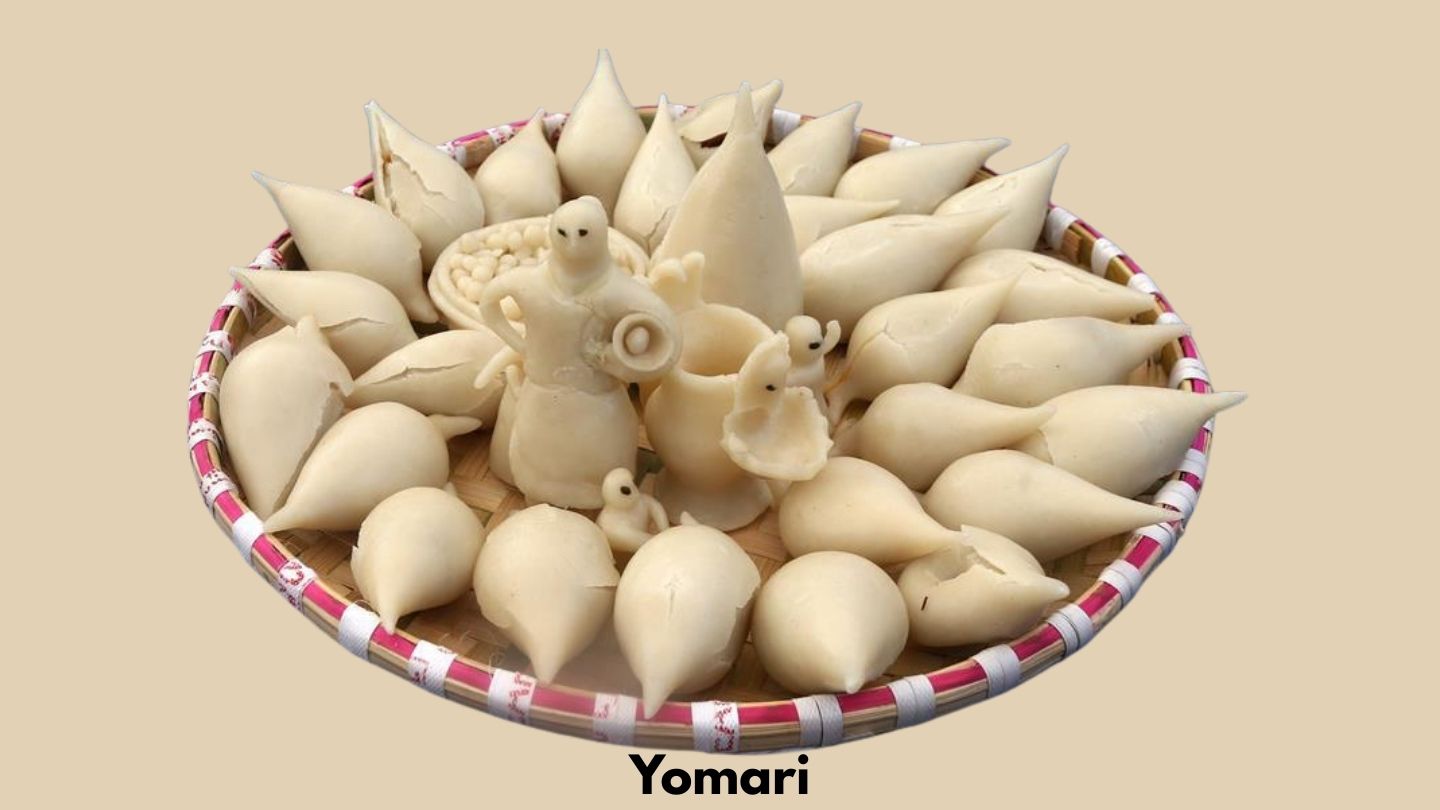
Yomari, Newa Folk Art and Intangible Heritage
As Yomari (literally “the favourite bread”), a sweet delicacy tied to the cultural identity of the Newa community, is also connected with Newa folk art, emphasis has been placed on its transmission to future generations.
At a workshop on “Newa Folk Art (Yomari Punhi)” jointly organised on Sunday by the Nepal Academy of Fine Arts and Kathmandu Metropolitan City, participating cultural and art experts said that, because the history of Newa folk art is linked with Yomari, it needs to be promoted.
Suresh Suras Shrestha, Head of the Culture Division at the Ministry of Culture, Tourism and Civil Aviation, said that Yomari, which is listed as an intangible cultural heritage, is not only a food item but also carries artistic pride. He stated that it is necessary for the new generation to understand the importance of Newa folk art embedded in Yomari.
He informed that Nepal ratified the 2003 UNESCO Convention for the Safeguarding of the Intangible Cultural Heritage in 2010. In line with that convention, the Ministry of Culture this year formulated the “Intangible Cultural Heritage (Listing and Management) Procedure, 2081” and, for the first time, opened applications for listing intangible cultural heritage for its protection.
Division Head Shrestha said that, according to the notice, 105 applications were received from across the country and, following due process as per the procedure, only the Yomari of the Newa community succeeded in being listed. He emphasised that various intangible cultural heritages like Yomari are present but hidden in Nepal and must be preserved.
Chancellor of the Academy, Naradmani Hartamchhali, said that this Newa folk art workshop has raised issues of identity and artistic awakening, and that participants have clarified Newa folk art through imagery.
Associate Professor Dr Rajanlal Joshi of the Central Department of Nepal Bhasa at Tribhuvan University presented a paper on historical and religious facts related to Yomari and on Newa folk art. He clarified the origin of Yomari, its classical and cultural purposes, its deification and its relation with seasonal knowledge.
He said that, according to the Buddhist text “Ratnamala Avadan,” when Kubera went in the guise of a supplicant to test the generosity of Suchandra, a Brahmin from Panchal country (Panauti), Suchandra’s wife prepared Yomari and served it to him. Pleased, Kubera revealed his true form.
According to him, Kubera then gave “bimiro” and instructed them to place Yomari along with images of Lakshmi, Ganesh and Kubera in the grain store and perform worship. It is said that, when worship was done in that manner, the “bimiro” turned into gold. To this day, farmers continue the practice of placing Yomari together with deities in the storehouse and worshipping after bringing in the rice harvest.
He said, “There are many folk tales associated with Yomari, and in the Newa community there is a tradition of eating Yomari made with molasses (chaku), sesame and khuwa on Yomari Punhi (Mangsir full moon). There is a tradition of sending Yomari to a daughter’s home in the first year after her marriage, as well as on birthdays, ‘janku’ and other special occasions. Likewise, during the annual homage to deities and monasteries, and in the procession in which a coconut is dropped from the chariot of Red Matsyendranath in Thatitol, Lalitpur, it is customary to shower Yomari like a rain of flowers when the chariot reaches Janabaha. In such offerings to deities, only unbroken rice (akshata) is placed inside the Yomari. Depending on the festival and occasion, women and girls of the household prepare artistic Yomari by varying the method, size and shape.”
Artist and programme coordinator Manara Prajapati commented on the paper. Member-Secretary of the Academy, Devendra Kumar Kafle “Thumkeli,” said that it is now necessary to preserve, promote and transmit to future generations Yomari and other folk arts that carry the identity of the Newa community.
Head of the Architecture and Folk Art Department of the Academy, Pradeep Adhikari, said that the programme was organised with the objective of preserving and transmitting folk art and culture. Suman Maharjan served as trainer for the Newa folk art and Yomari “Dyahmari” workshop programme. Artist Samjhana Rajbhandari also shared her experiences related to Yomari art.
The Government of Nepal has listed Yomari, a delicacy linked to the cultural identity of the Newa community, and the festival Yomari Punhi as intangible heritage in the national inventory.
On 2082 Shrawan 23, through a ministerial-level decision and based on a proposal from the Newar community in Lalitpur, the Government of Nepal listed Yomari and the festival “Yomari (Punhi)” as a traditional delicacy and festival of the Newar community in the National List of Intangible Cultural Heritage.

.png)

Comments 0
No comments yet. Be the first to start the conversation.