



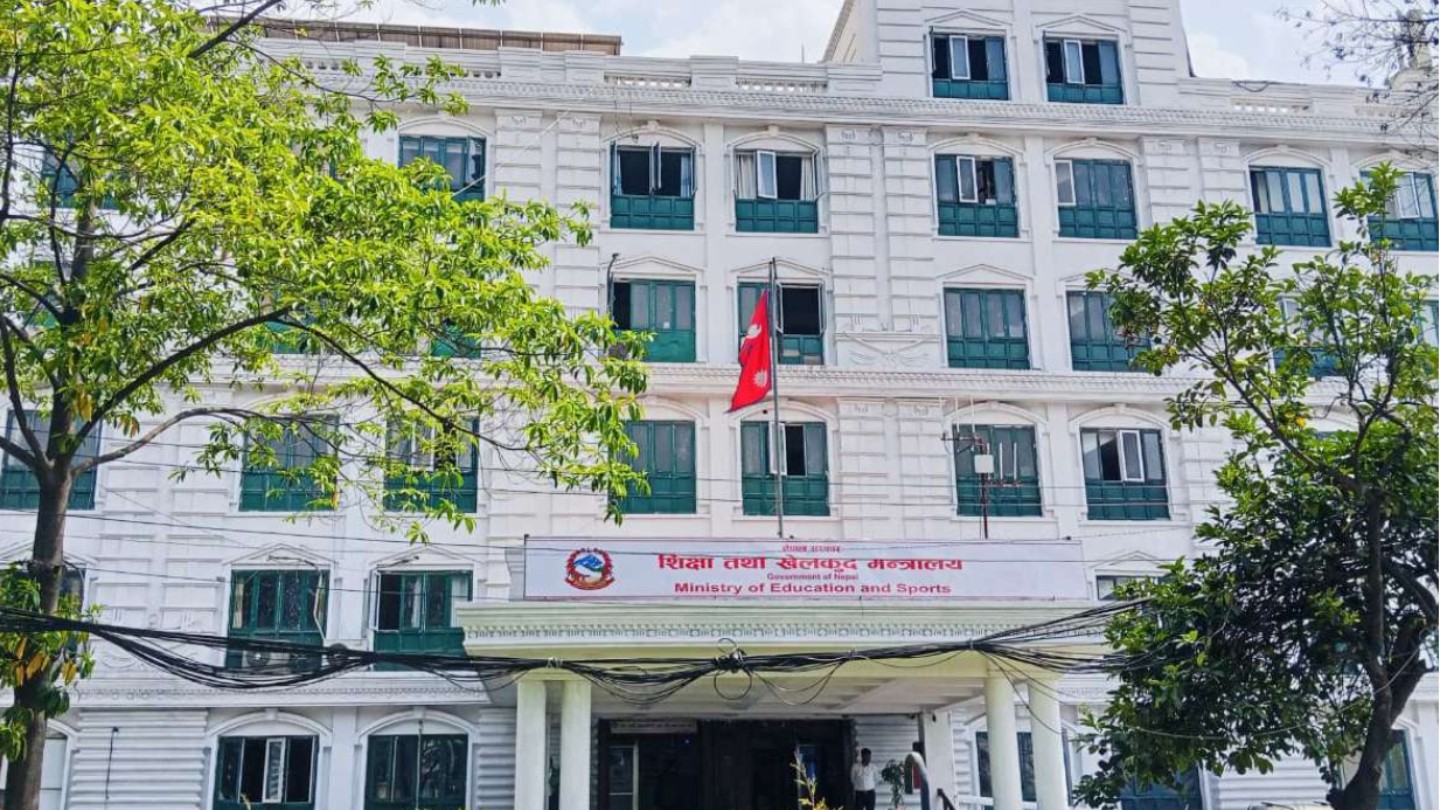
Education Ministry Progress Report Made Public: Focus on Examination System, University and Administrative Reform
Since the formation of the current government, the Ministry of Education and Sports has stated that significant progress has been made in improving the examination system, bringing governance reform in universities, expanding digital services, and making service delivery effective. Since Education and Sports Minister Sasmit Pokharel assumed responsibility of the ministry on Chait 12, the ministry has moved various reform works forward as a priority.
According to ministry spokesperson Shivakumar Sapkota, all these programs will enhance good governance in the education sector, make service delivery effective, ensure quality education, and make educational institutions more accountable.
According to the ministry’s progress report, which includes two sets of details, the main works mentioned are as follows:
Improvement in Examination System and Result Publication
-
Results of the Secondary Education Examination (SEE), Class 12, and university-level examinations have started being published faster than in the past.
-
From the coming year, arrangements have been made to publish SEE results within one month of completion of the examination, Class 12 results within 40 days, and university results within 65 days.
-
According to the government’s “100-point action plan” on governance reform, universities and the Council for Technical Education and Vocational Training (CTEVT) will publish examination results within two months of completion of the examination. In addition, arrangements have been made to publish bachelor’s and master’s level results according to the academic calendar.
University Reform and Action Against Misuse of Leave
-
The campaign to end party-based interference in universities has been intensified. Preparations are underway to avoid providing university buildings or land to student organizations and to remove party-based signs.
-
Work on preparing guidelines to implement the “Student Council” and “Voice of Student” systems has reached the final stage.
-
So far, the academic calendar has been implemented in nine universities.
-
After most office-bearers appointed through political appointments were relieved of their posts, acting arrangements have been made for daily administration. The selection of new office-bearers through a fair and competitive process has reached the final stage. According to the details received, interviews and presentations for the selection of vice-chancellors of eight universities have started from Saturday.
-
Revenue recovery: Of the approximately Rs. 2 billion to be recovered from around 400 professors of Tribhuvan University who went on study leave but did not return within the prescribed period, around Rs. 500 million has been recovered as revenue so far.
Digital Services, NOC and Administrative Reform
-
To make the foreign study permit (NOC) distribution system effective, it has been linked through API with the data systems of Tribhuvan University and Kathmandu University. Preparations for interoperability with the National Identity Number (NIN) system have been completed, while NOC and academic certificate certification services have also been provided on holidays.
-
In the last three months, NOCs have been provided to 40,413 people, and academic certificates of 12,210 people have been certified. Monitoring has been carried out of educational institutions operating in affiliation with 56 foreign universities.
-
All 212 complaints received through Hello Sarkar have been resolved. A help desk has been established for complaint management.
-
Preparations for an e-pension card system for teachers, business process re-engineering (BPR) of service delivery, digital signature certification, and expansion of the GIOMS system have been taken forward.
-
Listing and implementation of reports of various commissions have been started.
School Education and Learning Assessment
-
For students up to Class 5, the traditional internal examination has been removed and an alternative assessment system that reduces psychological pressure has been implemented.
-
A provision has been implemented to admit children who do not have birth registration certificates to school on the basis of details certified by the local level.
-
Preparations have been made to issue the necessary procedure through the University Grants Commission to arrange that citizenship will not be mandatory for students to study up to the bachelor’s level.
-
Implementation of the regulation on collaborative academic degree programs has been taken forward.
-
The final draft of the National Quality Standard for School Education has been prepared.
-
The policy guideline on national assessment has reached the final stage and an assessment framework has been prepared to make the learning achievement tests of Classes 3, 5, 8, and 10 improvement-oriented.
-
Equivalence has been provided to a total of 1,632 people, including 629 from Class 10 and 1,003 from Class 12.
Research, Budget and Targeted Programs
-
The ministry has published “Educational Information 2083.” A comprehensive review and policy analysis of research conducted by the ministry and its subordinate bodies has been completed.
-
Reports of 560 undergraduate-level and six postgraduate-level students who returned after completing studies on scholarship have been received and sent to the concerned bodies.
-
The medium-term expenditure framework report has been sent to the National Planning Commission, while the budget ceiling received from the Ministry of Finance has been communicated to the concerned bodies.
-
An agreement has been signed between the Medical Education Commission and the Policy Research Institute to study the commission’s scope of work, scholarship management, fee determination, and work operation system, and the research has started.
-
Targeted program for those affected by the Gen Z movement: To operate employment, skill development, psychosocial counseling, and rehabilitation programs in the government, public, and private sectors for families and citizens affected by the Gen Z movement, a program targeting more than 76 beneficiaries has been started through CTEVT with an action plan.
