The Master of Business Administration (MBA – Evening) at Rajdhani Model College (RMC), Old Baneshwor, Kathmandu, is a graduate management program affiliated with Pokhara University. The evening-shift MBA runs for 24 months across six trimesters and requires 60 credit hours.
It is structured for graduates from different academic disciplines, including students who want to combine postgraduate management study with employment. The curriculum covers accounting, economics, finance, operations, marketing, organizational behavior, research, information systems, entrepreneurship, strategy, concentration courses, electives, capstone work, and internship.
| Particular | Details |
|---|---|
| Course: | Master of Business Administration (MBA) |
| College: | Rajdhani Model College |
| Shift: | Evening |
| Affiliation: | Pokhara University |
| Level: | Graduate |
| Duration: | 24 months |
| Academic Structure: | 6 trimesters |
| Total Credits: | 60 |
| Eligibility: | Minimum 3-year bachelor's degree or equivalent in any discipline with 45% or CGPA 2.0 |
| Admission Test: | Pokhara University Centralized Management Admission Test (PUCMAT) |
| Internship: | 6 credits in Trimester VI |
| Location: | Devkota Marga, Pipalbot, Old Baneshwor, Kathmandu |
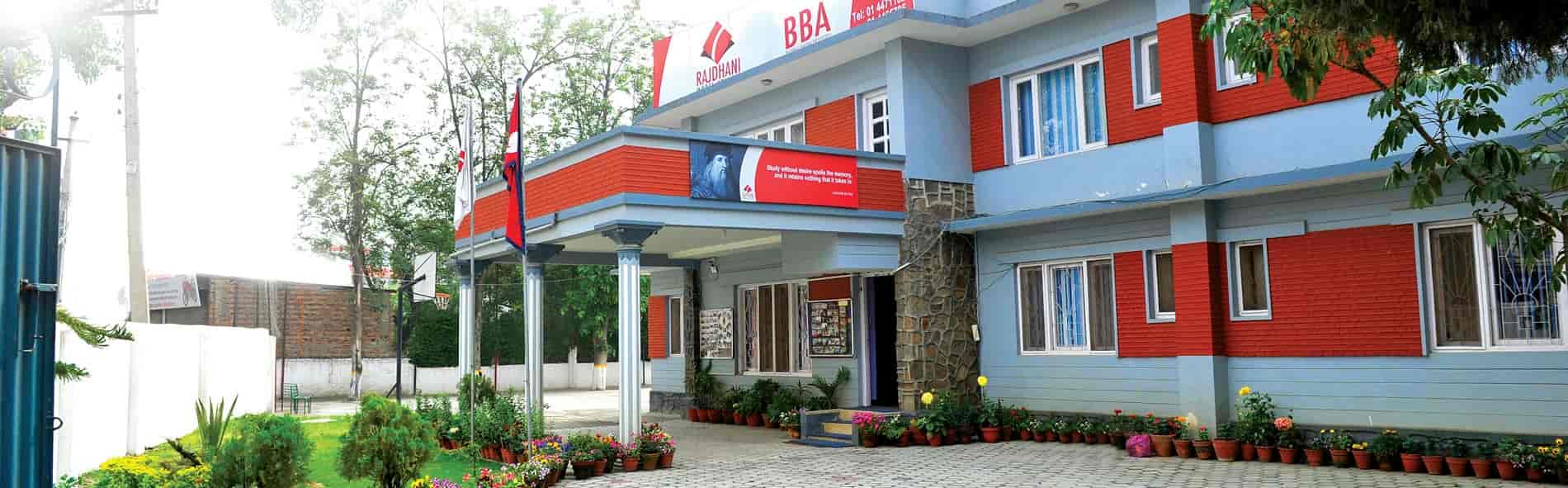
RMC offers the MBA in an evening shift. The arrangement is intended for students who want to undertake graduate management education while continuing employment, and it also accommodates fresh graduates who prefer to combine work and study. Students completing the program receive the Master of Business Administration degree from Pokhara University.
The program follows the same academic framework as the Pokhara University MBA. Each trimester normally runs for 12 weeks excluding examinations, and the minimum period for completing the six-trimester program is 24 months.
The 60-credit curriculum combines analytical study, core management subjects, specialization, electives, experiential work, and internship.
| Curriculum Component | Credits |
|---|---|
| Foundation and Analytical Courses | 16 |
| Management Core and Functional Courses | 20 |
| Concentration Courses | 8 |
| Elective Courses | 4 |
| Capstone Project and Experiential Learning / Graduate Thesis | 6 |
| Internship | 6 |
| Total: | 60 |
Students complete 25 courses, including concentration, elective, and practicum components. The curriculum also gives students a choice between an industry-oriented pathway and a research pathway during the capstone stage.
The early trimesters establish a broad management base through accounting, quantitative analysis, economics, organizational behavior, human resource management, finance, operations, marketing, research, information systems, communication, entrepreneurship, leadership, governance, ethics, and strategy.
Trimester I includes Accounting for Managerial Decisions, Statistics for Managers, Managerial Economics, Organizational Behavior and Human Resource Management, and a related practicum.
Trimester II moves into Financial Management, Quantitative Methods for Decision Making, Macroeconomics and Global Economy, Operations and Supply Chain Management, Marketing Management, and Digital Marketing Practicum.
Trimester III includes Methods for Business Research and Consultancy, Entrepreneurship and Innovation, Management Information System, Managerial Communication, Leadership, Governance and Ethics, and practicum courses connected with information systems and entrepreneurship.
By Trimester IV, students move into Business Environment and Strategy together with concentration and elective courses. The final two trimesters focus more heavily on specialization, capstone work, and internship.
MBA students select four concentration courses totaling eight credits from one concentration area. Pokhara University's MBA curriculum provides five concentration areas:
Finance
Marketing
Human Resource Management
Information Technology and Business Analytics
Entrepreneurship and Innovation
The Finance concentration includes areas such as corporate finance, investment management, international financial management, financial derivatives and risk management, behavioral finance, financial planning, valuation, and insurance.
Marketing options extend into service marketing, marketing research and analytics, consumer behavior, integrated marketing communications, international marketing, brand management, digital and social media marketing, and sales and distribution management.
Human Resource Management includes talent acquisition and development, compensation management, leadership and negotiation, employee relations, performance management, international human resource management, labor relations, and employer brand management.
Information Technology and Business Analytics covers areas including electronic commerce, digital economy, data mining and business analytics, information security for business, business intelligence, data analytics, data visualization, and related technology applications.
Entrepreneurship and Innovation includes subjects connected with innovation, business growth, family business, corporate entrepreneurship, new business models, electronic commerce, and technology entrepreneurship.
The MBA gives students two routes for the six-credit capstone component in Trimester V.
Students following the industry pathway complete either:
Consulting Project – 3 credits, or
New Venture Creation – 3 credits
They also complete Doing Business in Nepal for another three credits.
The Consulting Project requires students to work with an applied business issue over a minimum period of three months. It involves identifying and examining an organizational problem or opportunity and preparing recommendations through an integrated management project.
Students choosing the research pathway complete a six-credit Graduate Thesis in an approved area of management.
The thesis includes an integrative research report, seminar presentation, and viva-voce examination. The research report carries 75 percent of the evaluation weight, while the viva carries 25 percent.
Trimester VI contains a six-credit internship. Students are required to complete three months of satisfactory work experience with an approved employer under the supervision of both a faculty supervisor and a workplace supervisor.
Internship requirements include:
Completing specified learning objectives
Maintaining a weekly work and learning journal
Completing the required final paper
Preparing an internship report
Presenting the internship work at a final session
The host organization's confidential assessment accounts for 40 percent of the internship evaluation, while presentation of the Internship Project Report accounts for 60 percent.
Applicants must have completed at least 15 years of formal education, consisting of 12 years of schooling followed by a bachelor's degree of at least three years.
A minimum CGPA of 2.0 or 45 percent at bachelor's level is required. Graduates from any academic discipline may apply.
RMC also accepts students who have successfully completed or expect to complete a minimum three-year bachelor's degree or equivalent in any discipline with at least 45 percent or CGPA 2.0.
Applicants for the MBA Evening program must appear in the Pokhara University Centralized Management Admission Test (PUCMAT).
Candidates who successfully complete PUCMAT are invited for an interview at RMC, after which the final admission result is published.
The university's MBA admission framework also requires:
Completed and signed MBA application form
Official transcripts from academic institutions attended
Properly attested photocopies of academic certificates
Final selection considers admission-test performance, interview performance, and previous academic records.
The MBA uses classroom discussions, presentations, group work, case analysis, guest lectures, simulations, project work, and online instruction as part of its teaching structure. Practicum courses are also included within areas such as organizational behavior, management information systems, entrepreneurship, and digital marketing.
Pokhara University follows a four-point letter-grade system for the MBA. A minimum grade of C, equivalent to a 2.0 grade point, represents a pass in an individual course. Evaluation includes both university-managed and college-managed academic components, depending on the course.
The MBA Evening program may suit graduates who want broader postgraduate study in management while keeping an evening academic schedule.
Its curriculum brings together finance, marketing, organizational behavior, human resources, operations, research, economics, strategy, information systems, leadership, entrepreneurship, and analytical study. Students can then focus part of the degree through a concentration and choose between industry-based capstone work and a research thesis.
The structure may be particularly relevant to working students because RMC schedules the program in the evening. Fresh graduates can also enter the program if they meet the academic and admission requirements.
The MBA Evening program runs for 24 months and is divided into six trimesters.
Students must complete 60 credit hours covering foundation and analytical courses, management courses, concentration subjects, electives, capstone work, and internship.
Applicants need a minimum three-year bachelor's degree or equivalent in any discipline with at least 45 percent or CGPA 2.0. Pokhara University's framework requires a minimum of 15 years of formal education.
Yes. Applicants to RMC's MBA Evening program must appear in the Pokhara University Centralized Management Admission Test (PUCMAT). Successful candidates are invited for an interview at the college.
Yes. Rajdhani Model College offers the MBA in an evening shift. The schedule is intended to accommodate students who want to combine employment with graduate study.
The concentration areas are Finance, Marketing, Human Resource Management, Information Technology and Business Analytics, and Entrepreneurship and Innovation. Students complete four concentration courses totaling eight credits.
Yes. Trimester VI includes a six-credit internship requiring three months of work experience with an approved employer.
Yes. Students can select an industry pathway involving applied project work or a research pathway consisting of a six-credit Graduate Thesis.