The Bachelor of Science in Nursing (BSc Nursing) at Shree College of Technology, Chitwan, formerly Shree Medical and Technical College, is a four-year bachelor-level nursing program affiliated with Purbanchal University.
The program combines nursing science with basic health sciences, hospital nursing, community health, midwifery, psychiatric nursing, research, education, and management. Practical and clinical learning runs throughout the curriculum, moving from nursing foundations and community practice into medical-surgical nursing, maternal and child health, leadership, research, and advanced clinical areas.
| Particular | Details |
|---|---|
| Course | Bachelor of Science in Nursing (BSc Nursing/BSN) |
| Level | Bachelor |
| Duration | 4 academic years |
| College | Shree College of Technology |
| Former Name | Shree Medical and Technical College |
| Affiliation | Purbanchal University |
| Location | Bharatpur, Chitwan |
| Admission Entrance | MECEE-BL |
| Professional Council | Nepal Nursing Council |
| Academic Format | Yearly structure with theory and practical learning |
The BSc Nursing curriculum prepares students for professional nursing responsibilities across clinical, community, educational, administrative, and research settings.
Its academic focus includes preventive, promotive, curative, and rehabilitative nursing care. Students also study nursing process, primary health care, reproductive health, communication, epidemiology, research, management, and teaching-learning methods.
Hospital nursing, midwifery, family and reproductive health, and community health nursing form major parts of the four-year academic structure.
Eligibility: Applicants may qualify through the following academic routes:
10+2 Science or equivalent with Physics, Chemistry, and Biology, securing at least 50% aggregate marks or GPA 2.4.
Health Science Proficiency Certificate Level/Diploma in the specified health-science disciplines containing Physics, Chemistry, and Biology, with Grade 12 Science equivalence from the National Examination Board, at least 50% aggregate in the diploma and equivalence examination, and registration with the relevant professional council.
An equivalent percentage in certificate-level programs such as A-Level under a different grading system.
Admission eligibility is applied according to the prevailing rules for the relevant Medical Education Commission admission cycle.
Admission to BSc Nursing is based on MECEE-BL under the Medical Education Commission (MEC), Nepal.
The entrance format included with the course information consists of:
200 single-best-response multiple-choice questions
200 full marks
Four options for each question
3-hour examination duration
Recall, understanding, and application ratio of 30:50:20
The examination areas include Zoology, Botany, Chemistry, Physics, and Mental Agility Test components.
Admission follows the prevailing MEC rules, guidelines, code of conduct, merit and matching procedures, scholarship provisions, seat-allocation system, fee structure, and official admission calendar. Seats and examination arrangements may be revised between admission cycles according to MEC decisions.
The first year develops the basic scientific and nursing foundation required for later clinical study.
Subjects include:
Anatomy and Physiology
Biochemistry
Microbiology/Parasitology
Pathophysiology
Pharmacology
Nutrition and Dietetics
Foundation of Nursing
Community Health Nursing-I
Theory and practical components are incorporated across the first-year curriculum, including foundation nursing, community health, nutrition, and basic health sciences.
The second year moves further into hospital nursing, mental health, community care, and care of older adults.
Students study:
Nursing Concept and Theories
Medical-Surgical Nursing-I
Medical-Surgical Nursing-II
Psychiatric Nursing
Community Health Nursing-II
Medical Sociology/Anthropology
Geriatric Nursing
The third year concentrates strongly on child health, maternal nursing, reproductive health, and community practice.
Subjects include:
Pediatric Nursing
Midwifery-I
Midwifery-II
Midwifery-III
Community Health Nursing-III
Basic Epidemiology
Gynaecology Nursing
Most of the major nursing subjects in this year include practical components alongside theory.
The final year shifts toward professional responsibility, research, teaching, management, and advanced medical-surgical nursing.
Students study:
Research and Biostatistics in Nursing
Educational Science
Leadership and Management
Medical-Surgical Nursing-III
Advanced Medical-Surgical Nursing includes cardiopulmonary, oncology, nephrology, and neurology areas. The fourth-year structure also contains substantial practical study in research, nursing education, management, and advanced clinical nursing.
Clinical and practical education is integrated throughout the four academic years rather than being treated as a separate final-stage activity.
The curriculum uses classroom teaching together with demonstration, simulation in skill laboratories, observation, field and clinical practice, assignments, project work, group presentations, self-directed learning, and problem-based learning.
The yearly operational structure assigns dedicated periods to nursing practice, including Foundation of Nursing, Community Health Nursing, Medical-Surgical Nursing, Psychiatric Nursing, Geriatric Nursing, Pediatric Nursing, Midwifery, Gynaecology Nursing, research, educational science, leadership and management, and advanced medical-surgical practice.
Theory subjects use both internal and final assessment.
Internal theory assessment: 20%
Final theory assessment: 80%
Internal practical evaluation: 50%
Final practical evaluation: 50%
Practical assessment may include project work, performance evaluation, case studies, client teaching, student teaching, reports, procedure logbooks, nursing care plans, procedure evaluation, OSPE/OSCE or simulation, and viva examinations.
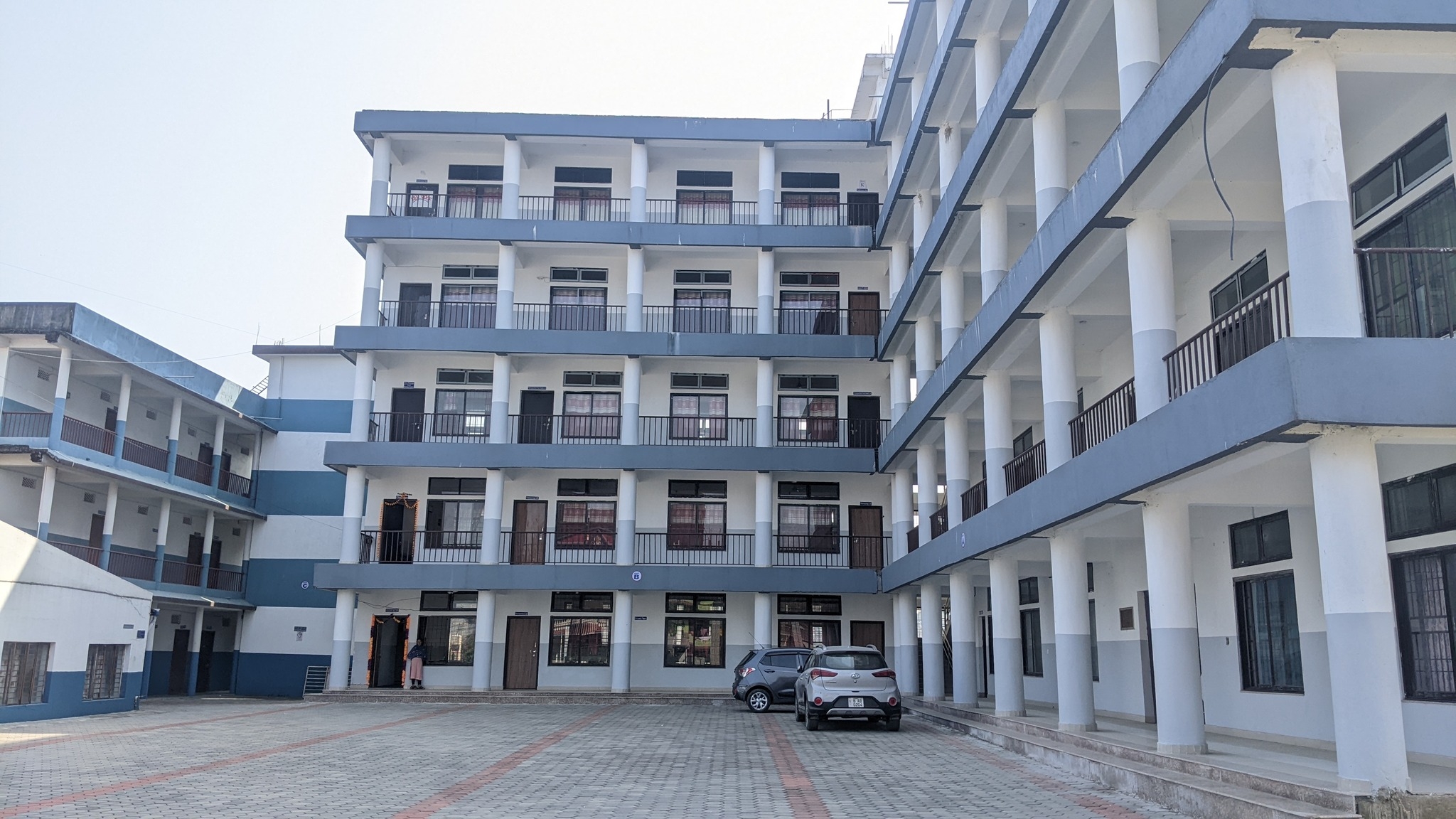
The college operates a separate Nursing Block at Bharatpur-10, Thani Chowk, near Bharatpur Secondary School, Chitwan.
Its academic facilities include laboratories, a library, a computer laboratory, internet access, and spaces used for health-science education. The BSc Nursing curriculum itself requires skill-based, clinical, field, community, and research-related learning in addition to classroom study.
The curriculum prepares graduates for nursing responsibilities in settings such as hospitals, communities, health agencies, schools, educational institutions, and nursing-related administrative or research environments.
Possible professional roles described within the academic scope include nursing care, nursing administration, education, community services, and basic-level research. Employment depends on professional registration, licensing, recruitment requirements, experience, and the conditions of individual employers.
After completing BSc Nursing, graduates must fulfill the professional licensing requirements of the Nepal Nursing Council before entering regulated nursing practice.
BSc Nursing seat allocation is determined for the relevant admission cycle under the MEC system. A seat figure from an earlier year should not be treated as a permanent annual intake because MEC may revise allocations.
Fees, scholarship provisions, seat distribution, admission procedures, and examination guidance also follow the rules and decisions applicable to the current MEC admission calendar.
The BSc Nursing program has a duration of four academic years.
The program is affiliated with Purbanchal University.
Admission to the program is based on MECEE-BL under the Medical Education Commission.
The curriculum covers basic health sciences, foundation nursing, medical-surgical nursing, psychiatric nursing, community health nursing, pediatric nursing, midwifery, gynaecology nursing, epidemiology, research, educational science, leadership, and management.
Yes. Practical, clinical, field, skill-laboratory, community, research, education, and management components are distributed across the four-year curriculum.
The Nursing Block is located at Bharatpur-10, Thani Chowk, near Bharatpur Secondary School, Chitwan.
Yes. Graduates must fulfill the applicable Nepal Nursing Council licensing requirements before entering regulated nursing practice.
No. Seat allocation is determined for the applicable admission cycle under the MEC system and may change from one year to another.