



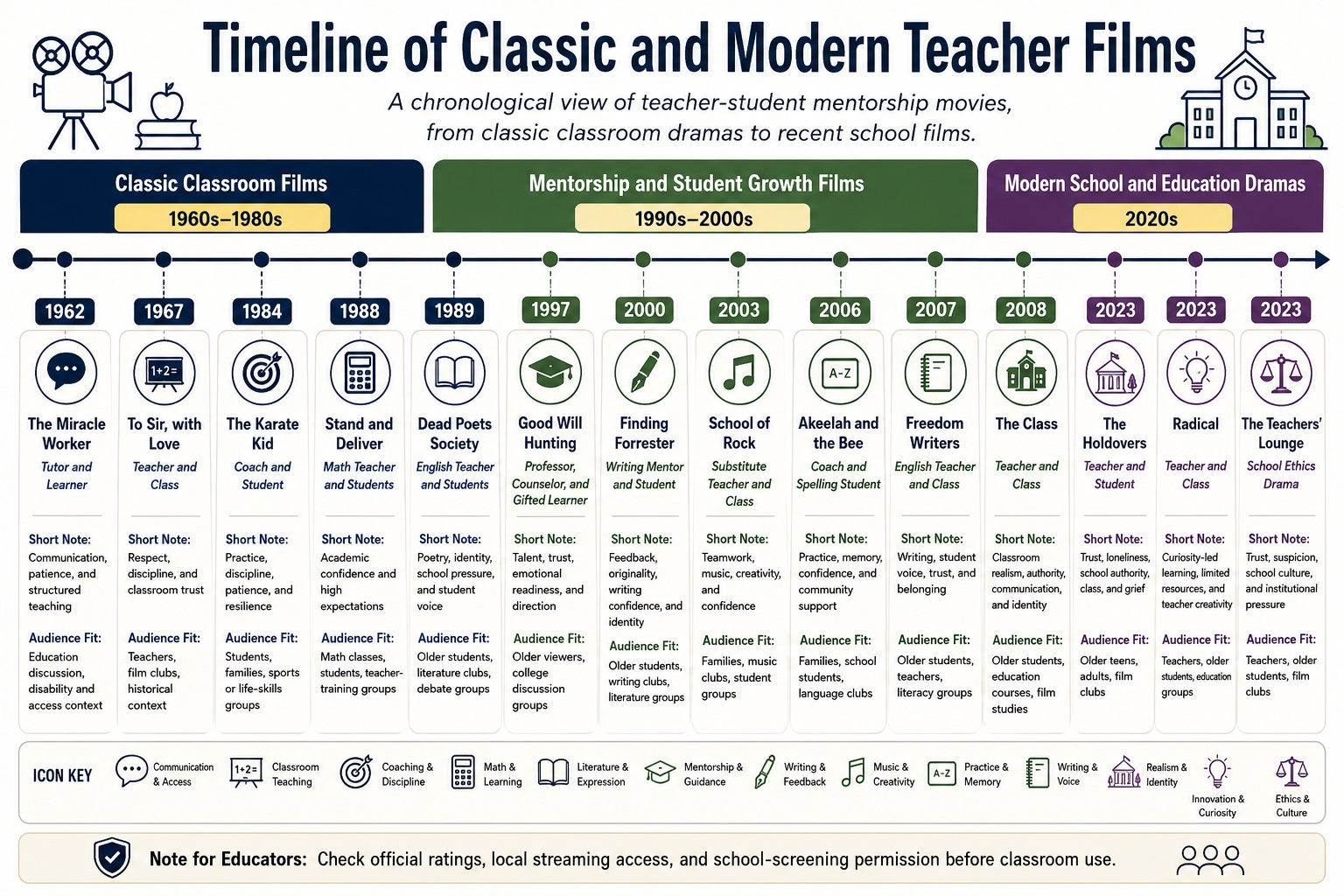
Teacher student relationship movies are most useful when they focus on mentorship, classroom guidance, coaching, academic confidence, and student growth. This guide covers films where teachers, tutors, coaches, professors, counselors, or mentors support learners through education, discipline, creativity, writing, communication, or personal development.
The phrase “student teacher relationship movies” can be confusing because it can point to different kinds of stories. This article uses the educational meaning only: teacher-student bonds built through learning, trust, feedback, boundaries, and responsible guidance. It does not cover romantic or exploitative storylines.
For students, parents, teachers, and school clubs, the practical question is not only “Which movie should I watch?” It is also “Which film fits the audience, purpose, rating, emotional tone, and discussion setting?” A film for a literature class, Teachers’ Day event, family viewing night, or teacher-training discussion may need a different level of guidance.
The British Film Institute’s teacher-film list treats teacher films as a long-running cinema category, while AARP’s updated teacher-movie guide shows how classroom stories remain tied to teacher appreciation and education-themed viewing.
Answer Summary
Teacher student relationship movies should be selected for mentorship value, audience age, and discussion purpose. Useful choices include Stand and Deliver for academic confidence, Freedom Writers for writing and classroom voice, Akeelah and the Bee for coaching, School of Rock for teamwork, Finding Forrester for writing mentorship, The Karate Kid for practice and discipline, The Class for classroom realism, and The Holdovers for older viewers interested in school-based character drama.
Table of Content
- What Does Teacher Student Relationship Mean Here?
- Teacher Student Relationship Movies at a Glance
- Classic Teacher Student Relationship Movies
- Classroom Drama Movies About Teachers Helping Students
- Mentor Student Movies Outside the Classroom
- Recent Teacher Student Bond Movies
- Movies by Audience and Use Case
- How to Choose the Right Film
- School and Family Viewing Notes
- Conclusion
Key Takeaways
-
This guide covers mentorship, not romance.
-
Check ratings and content notes before school viewing.
-
Stand and Deliver fits academic confidence and math discussion.
-
Freedom Writers fits writing, voice, and classroom trust.
-
Akeelah and the Bee works well for family discussion.
-
The Holdovers and Good Will Hunting suit older viewers.
-
Streaming access and screening permission need separate checks.
What Does Teacher Student Relationship Mean Here?
Teacher student relationship means an educational bond between a learner and someone who teaches, guides, coaches, or mentors them. In this article, the relationship is about learning support, not romance.
A teacher-student bond can appear in several forms. Some films show formal classroom teaching. Others show tutoring, coaching, writing mentorship, music instruction, school leadership, or a professor helping a gifted learner. The useful editorial test is simple: does the film show a learner gaining skill, confidence, discipline, judgment, communication, or voice through responsible guidance?
This framing also protects reader intent. The search phrase can be ambiguous, so the article keeps the focus on classroom bonds, teacher guidance, student growth, and ethical mentorship.
Main Relationship Types
Teacher-student movies are easier to compare when grouped by the kind of guidance shown. A classroom teacher, coach, tutor, professor, counselor, or principal may support students in different ways.
Classroom Teacher
A classroom teacher film usually focuses on group learning, school rules, peer pressure, and academic expectations. Stand and Deliver, Freedom Writers, To Sir, with Love, and The Class fit this category.
Tutor or Coach
A tutor or coach film usually focuses on practice, feedback, repetition, and confidence. Akeelah and the Bee and The Karate Kid fit this category because students learn through guided skill-building.
Professor or Counselor
A professor or counselor film often focuses on talent, identity, trust, and decision-making. Finding Forrester and Good Will Hunting fit this group better than standard classroom dramas.
School Leader
A school-leader film focuses on discipline, culture, authority, and institutional limits. Lean on Me fits this category, though it needs careful discussion because leadership styles in films can be debated.
Teacher Student Relationship Movies at a Glance
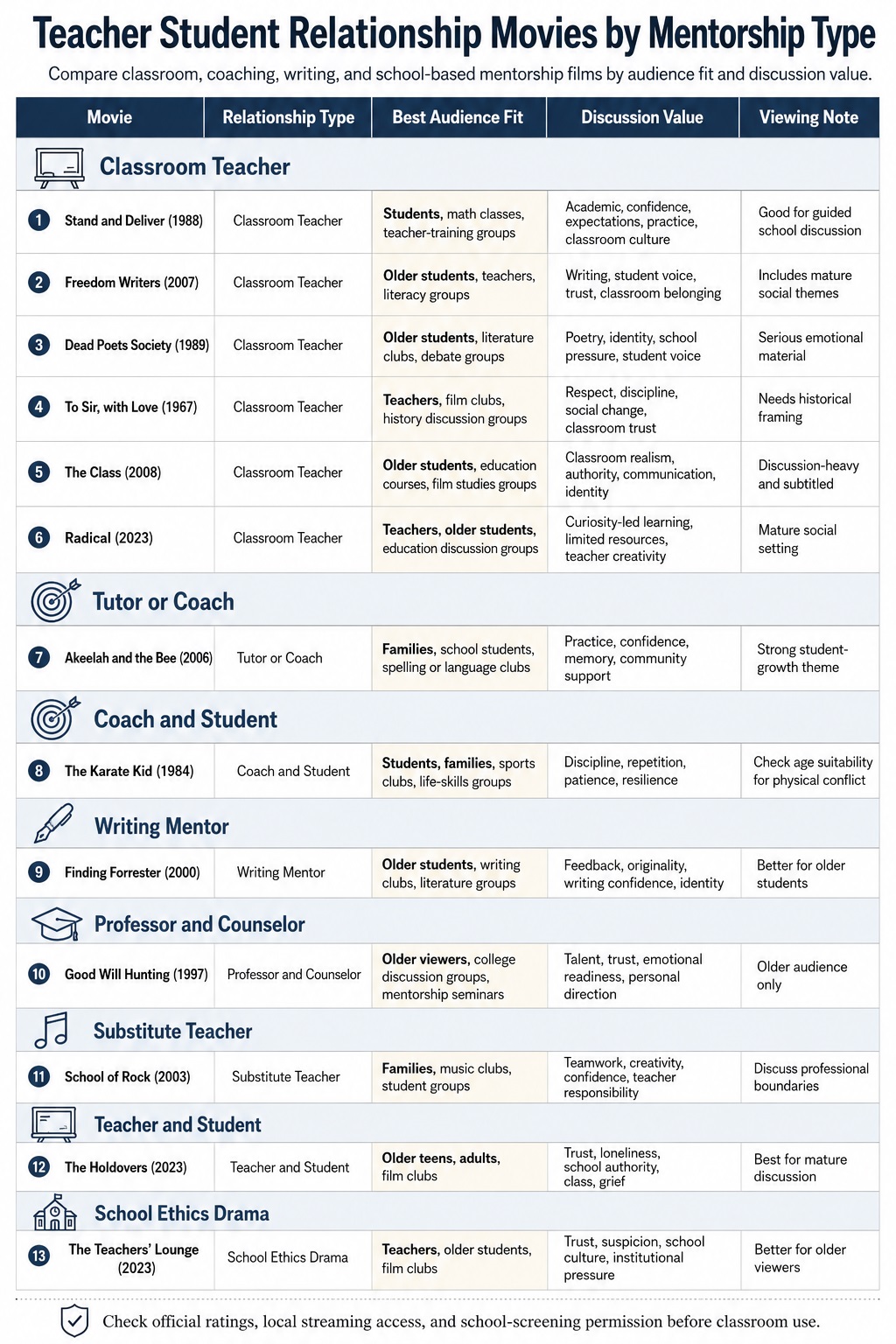
A quick comparison helps readers choose by relationship type, tone, and viewing purpose. These notes are editorial guidance, not official age ratings.
| Movie | Year | Relationship Type | Good For | Viewing Note |
|---|---|---|---|---|
| Stand and Deliver | 1988 | Math teacher and students | Academic confidence, exam pressure | Good for guided school discussion |
| Freedom Writers | 2007 | English teacher and class | Writing, voice, classroom trust | Includes mature social themes |
| Dead Poets Society | 1989 | English teacher and students | Literature, identity, conformity | Serious emotional material |
| To Sir, with Love | 1967 | Teacher and class | Respect, authority, social context | Needs historical framing |
| The Miracle Worker | 1962 | Tutor and learner | Communication, access, patience | Needs sensitive context |
| Akeelah and the Bee | 2006 | Coach and spelling student | Family discussion, skill-building | Strong student-growth theme |
| School of Rock | 2003 | Substitute teacher and class | Teamwork, music, confidence | Discuss teacher responsibility |
| Finding Forrester | 2000 | Writer mentor and student | Writing, talent, identity | Better for older students |
| Good Will Hunting | 1997 | Professor, counselor, gifted learner | Talent, trust, personal growth | Older audience only |
| The Karate Kid | 1984 | Coach and student | Practice, discipline, resilience | Useful for sports and life-skills discussion |
| The Holdovers | 2023 | Teacher and student | Character drama, school life | Older teens and adults |
| Radical | 2023 | Teacher and class | Curiosity-led learning | Mature social setting |
| The Class | 2008 | Teacher and class | Classroom realism, education study | Discussion-heavy and subtitled |
| The Teachers’ Lounge | 2023 | Teacher, students, school staff | School ethics and trust | Better for older viewers |
Classic Teacher Student Relationship Movies
Classic teacher-student films remain useful because they show how cinema has framed education across decades. They also need context because older films may reflect classroom norms, social attitudes, and teaching styles that differ from current schools.
Stand and Deliver
Stand and Deliver is a teacher-student movie about academic belief, disciplined practice, and high expectations. The Rotten Tomatoes page for Stand and Deliver describes the film as an underdog math-class drama that pays tribute to a real-life figure.
The film works well for math classes, exam-preparation discussions, and teacher-training sessions. Its classroom value comes from the way it links expectations with repeated practice. It also gives students a useful discussion point: confidence in math is not presented as a fixed trait, but as something shaped by instruction, effort, feedback, and trust.
This film also pairs well with Collegenp’s article on why educators should teach students and not make them memorize, because both ideas focus on understanding, practice, and active learning rather than passive recall.
Discussion use: Ask students what changes first in the film: the curriculum, the students’ confidence, the classroom culture, or expectations.
Dead Poets Society
Dead Poets Society is a literature-focused teacher-student film about poetry, identity, school pressure, and independent thinking. Common Sense Media’s Dead Poets Society review notes positive messages around poetry and self-expression while also flagging serious emotional content.
This film is better for older students than casual mixed-age viewing. It can support literature classes, debate clubs, and discussions about school culture, but it needs teacher or parent guidance because its emotional material is heavy.
The film is useful when the discussion goes beyond admiration for one teacher. Students can examine where encouragement helps, where boundaries matter, and how schools can balance tradition, discipline, student voice, and emotional support.
Discussion use: Ask whether inspiration in education needs boundaries, and how schools should balance discipline with student voice.
To Sir, with Love
To Sir, with Love is a classic school drama about respect, classroom discipline, and social change. The IMDb plot summary for To Sir, with Love describes Mark Thackeray as an engineer who arrives to teach an undisciplined class at an East End school.
The film should be introduced with historical context. Its classroom setting, language, gender expectations, and social tensions belong to an earlier period, so viewers should not treat it as a direct model for current teaching.
Its value is comparative. Students can discuss how respect was framed in older school films and how teacher-student trust is understood now.
Discussion use: Compare how the film defines respect with how students define respect in present-day classrooms.
The Miracle Worker
The Miracle Worker is a tutor-student film centered on communication, patience, and structured teaching. It can support discussion about access, learning differences, persistence, and the ethics of support.
This film needs sensitive framing. It should not be used as a simple motivation story. A better focus is dignity, communication, agency, and how teaching methods have changed over time.
Discussion use: Ask how a teacher can support a learner while respecting the learner’s dignity and agency.
Classroom Drama Movies About Teachers Helping Students
Classroom dramas show learning as a social process. They often include family pressure, school rules, peer conflict, language, identity, community expectations, or institutional limits.
Freedom Writers
Freedom Writers is a classroom drama about reading, writing, and student voice. The Rotten Tomatoes page for Freedom Writers places it within the inspirational inner-city teacher genre, while Common Sense Media’s Freedom Writers review flags mature themes for families and educators to consider.
The film is useful for older students and teacher-education contexts. It can support discussion about writing journals, trust, listening, classroom belonging, and how students use language to process experience.
It also needs a critical lens. Like many teacher-centered dramas, it can simplify broader school pressures by focusing on one determined educator. That does not make the film unusable; it means viewers should ask what support a real school would need beyond one teacher’s effort.
This section connects naturally with Collegenp’s guide to communication skills for students, since Freedom Writers can open discussion about writing, listening, and speaking with purpose.
Discussion use: Ask students how writing changes the classroom relationships in the film.
The Class
The Class, also known as Entre les murs, is a realist classroom film that avoids a neat teacher-hero formula. The Guardian’s review of The Class describes it as a French classroom drama based on François Bégaudeau’s autobiographical novel.
This film fits older students, education courses, and film clubs. Its value is realism: students and teachers negotiate respect, misunderstanding, authority, language, and classroom identity. It may not satisfy viewers looking for a simple uplifting story, but it gives serious groups more to discuss.
The film also supports media-literacy work because viewers can examine how camera style, dialogue, realism, and classroom tension shape meaning. Collegenp’s guide to media literacy for students can be a useful internal link for readers who want to evaluate film messages more carefully.
Discussion use: Ask where communication breaks down and what each side misunderstands.
Lean on Me
Lean on Me focuses more on school leadership than classroom teaching. It is useful for discussions about discipline, school culture, institutional authority, and public expectations.
The film should not be presented as a universal leadership model. A better classroom use is comparison: what parts of strong leadership help students, and what parts can create ethical concerns?
Discussion use: Ask whether strict leadership improves school culture, damages trust, or does both depending on context.
Mona Lisa Smile
Mona Lisa Smile is a college-set teacher-student film about education, gender expectations, and social choice. It works best for older students who can discuss historical context and social pressure.
The film’s value is in the questions it raises: What is education for? Who defines a student’s future? How can a teacher challenge assumptions without dismissing students’ backgrounds?
Discussion use: Ask whether the professor listens enough before challenging her students.
Mentor Student Movies Outside the Classroom
Some teacher-student movies do not happen mainly in classrooms. They still fit the topic when the story centers on learning through coaching, feedback, practice, communication, and trust.
Akeelah and the Bee
Akeelah and the Bee focuses on spelling, coaching, confidence, and community support. The Rotten Tomatoes page for Akeelah and the Bee describes it as a warm, family-friendly underdog story.
The film is useful for students because it presents skill-building as a process. The mentor does not only praise the learner; he sets standards, gives feedback, and helps the student handle pressure.
This movie can also support conversations about study habits. Readers looking for practical learning support can connect it with Collegenp’s article on effective learning strategies for school students.
Discussion use: Ask students how practice, memory, confidence, and community support work together.
School of Rock
School of Rock is a comedy about music, teamwork, and student confidence. Common Sense Media’s School of Rock review highlights communication and teamwork themes while giving parents a rating and content guide.
The film is lighter than many teacher-student dramas, but it still needs discussion because the substitute-teacher setup raises ethical questions. That makes it useful: students can enjoy the teamwork story while also asking what responsible teaching should look like.
The film can support discussions about confidence, creativity, group roles, and performance pressure. It also gives teachers a way to separate student engagement from weak professional boundaries.
Discussion use: Ask what the students gain from music and what the adult character handles poorly.
Finding Forrester
Finding Forrester is a writing mentorship film about a talented student and a private older writer. The Rotten Tomatoes page for Finding Forrester notes the rapport between Sean Connery and Rob Brown while also describing the plot as predictable.
The film works well for writing clubs and older students. Its strongest educational theme is feedback: a mentor can help a student develop skill without taking ownership of the student’s voice.
This movie can support discussion about drafts, revision, originality, privacy, and academic confidence. It is especially useful for students who write but hesitate to share their work.
Discussion use: Ask what kind of feedback helps a writer grow without copying the mentor.
The Karate Kid
The Karate Kid is a coach-student mentorship film about practice, patience, and discipline. The Rotten Tomatoes page for The Karate Kid highlights many training-focused clips, including “Wax On, Wax Off” and “The Lessons Come Together.”
The film is useful beyond sports. It shows that learning often begins before the student fully understands the lesson. It also gives teachers and parents a way to discuss practice, humility, trust, and self-control.
Because the film includes physical conflict, adults should check age suitability and content notes before school viewing.
Discussion use: Ask when repetition becomes meaningful in learning.
Good Will Hunting
Good Will Hunting is a mentor film for older viewers. The Rotten Tomatoes page for Good Will Hunting describes a gifted young man whose mathematical talent is discovered by an MIT professor, with further support involving therapy.
This is not a school movie for younger audiences. It can be useful for mature discussions about talent, identity, trust, class, emotional readiness, and the limits of academic ability alone.
For student readers, the practical lesson is that talent still needs direction, support, and personal readiness. For teachers, the film can open discussion about how adults respond when a learner has ability but resists help.
Discussion use: Ask whether ability alone is enough for a learner to move forward.
Recent Teacher Student Bond Movies
Recent teacher-student films often challenge the simple inspirational-teacher pattern. They tend to show school systems, emotional limits, institutional pressure, and social context more directly.
The Holdovers
The Holdovers is a teacher-student bond film set at a boarding school during a holiday break. The IMDb page for The Holdovers describes the story as centered on a grumpy instructor at a New England prep school who forms an unexpected bond with a troubled student.
This film is better for older teens and adults. Its pace is slower than a classroom motivation film, but it offers a thoughtful story about school authority, loneliness, grief, class, trust, and emotional restraint.
Its value is not a single classroom lesson. It shows how a teacher-student bond can change when both people are removed from their normal routines and forced to see each other more clearly.
Discussion use: Ask how trust changes when both teacher and student are isolated from their usual support systems.
Radical
Radical is a 2023 education drama directed by Christopher Zalla and starring Eugenio Derbez as Sergio Juárez Correa. The Associated Press review of Radical describes it as a based-on-a-true-story drama about an unconventional teacher in Matamoros, Mexico.
The film is useful for education readers because it raises questions about curiosity-led learning, limited resources, teacher creativity, and the gap between classroom ideals and social conditions.
It also needs mature viewing judgment because the setting includes difficult social pressures. Teachers should prepare context before using it in class.
Discussion use: Ask what the film suggests about curiosity as a teaching method and what curiosity cannot solve by itself.
The Teachers’ Lounge
The Teachers’ Lounge is not a standard teacher-inspires-student story. The British Film Institute article on classroom politics places it within a recent wave of films that examine the challenges and compromises of being a schoolteacher.
The Rotten Tomatoes page for The Teachers’ Lounge describes a teacher caught in a school conflict after thefts lead to suspicion, parent pressure, staff tension, and institutional consequences.
This film is better for older students, teachers, and film clubs. It is useful for discussing school culture, accusation, privacy, trust, authority, and unintended consequences.
Discussion use: Ask how quickly a school community can lose trust, and what adults should do before drawing conclusions.
Movies by Audience and Use Case
Different viewers need different teacher-student movies. A family night, school club, teacher-training session, and film-studies class should not use the same selection criteria.
For Students
Students often respond to films where learning feels connected to identity, effort, and voice. Akeelah and the Bee, School of Rock, Stand and Deliver, and Finding Forrester are practical starting points because each shows growth through practice and feedback.
For students, the strongest discussion questions are usually concrete:
-
What did the learner practice?
-
What barrier made learning harder?
-
What did the mentor do well?
-
What boundary should the mentor respect?
-
Which scene changed the learner’s confidence?
Students who want broader study support can continue with Collegenp’s guide to effective learning strategies for college students.
For Teachers
Teachers may prefer films that show classroom complexity rather than simple praise. Freedom Writers, The Class, Radical, Stand and Deliver, and The Holdovers offer different views of teaching, from literacy work to school systems and emotional limits.
Teacher discussion can focus on workload, boundaries, classroom trust, culturally aware teaching, assessment pressure, and how films simplify school problems. The point is not to copy a movie teacher, but to use scenes as prompts for professional reflection.
For Parents
Parents choosing a teacher-student movie should check rating, language, mature themes, emotional intensity, and whether the film needs conversation after viewing. Akeelah and the Bee and School of Rock are easier starting points for many families. Dead Poets Society, Freedom Writers, Good Will Hunting, The Holdovers, and Radical require closer review.
For parents, a useful post-viewing question is: What did the adult guide do that helped the student, and what would need more care in real life?
For School Clubs
School clubs should choose films that match a discussion goal. For literature and identity, use Dead Poets Society or Finding Forrester. For math and expectations, use Stand and Deliver. For writing and voice, use Freedom Writers. For family discussion, use Akeelah and the Bee. For realism and school culture, use The Class or The Teachers’ Lounge.
A short post-viewing activity can improve learning value: ask students to name one teaching strategy, one student barrier, one ethical issue, and one scene that changed their view of learning.
For Teachers’ Day Events
Teachers’ Day movie events work better when the film’s message fits the audience. Akeelah and the Bee, School of Rock, Stand and Deliver, Freedom Writers, and To Sir, with Love can work in different settings, but event organizers should check rating and content suitability first.
A Teachers’ Day film should not only praise teachers. It should also invite viewers to think about student effort, classroom trust, family context, school systems, and responsible mentorship.
How to Choose the Right Film
The right film depends on audience age, viewing purpose, emotional tone, and discussion goal. A film that works for a college seminar may not work for a family evening or a school assembly.
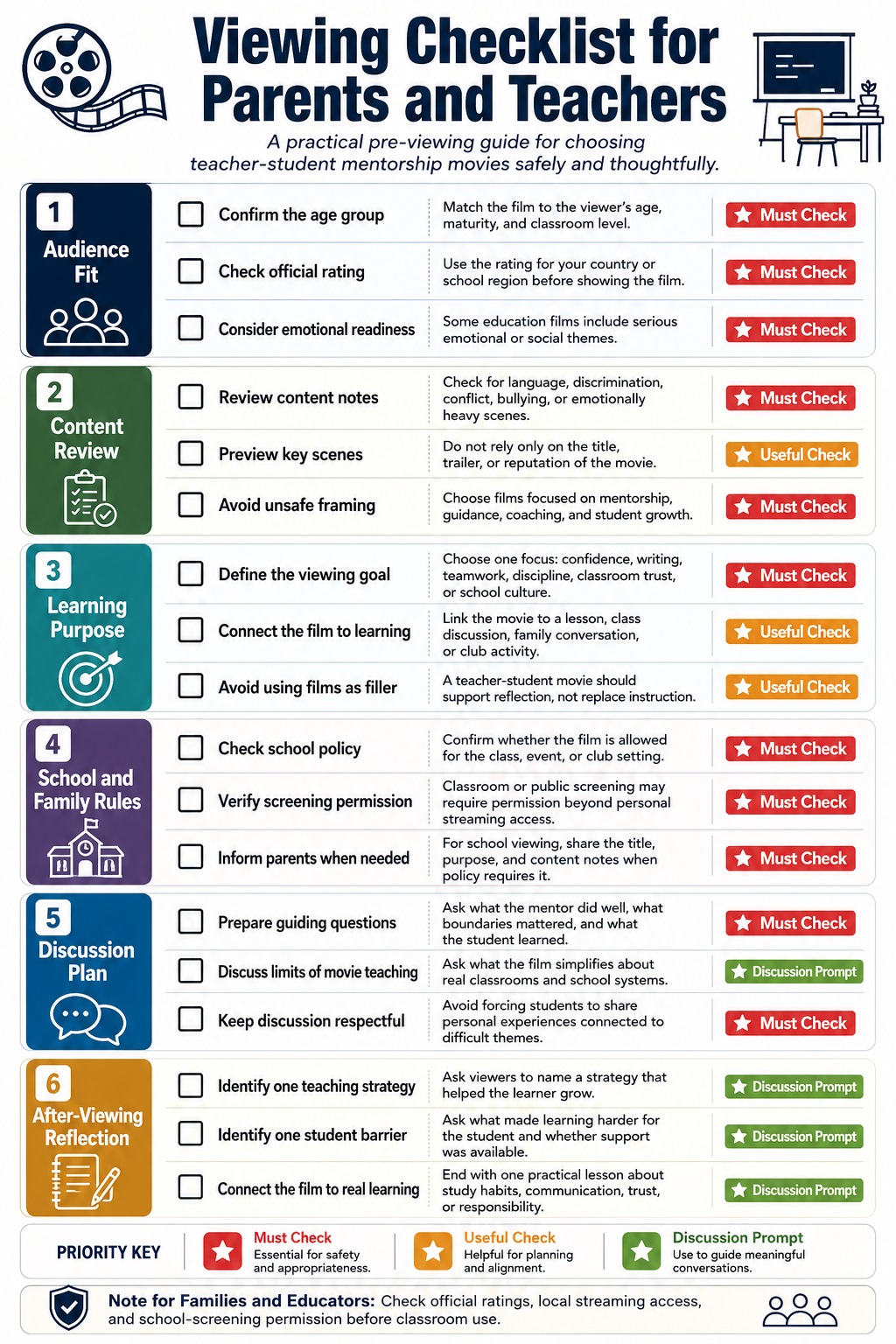
Use these filters before choosing:
-
Audience age: Check official rating and parent guidance.
-
Purpose: Choose academic motivation, writing, teamwork, realism, or character drama.
-
Mood: Decide whether the group needs a lighter film or a serious discussion film.
-
Content sensitivity: Review language, discrimination, social conflict, and emotionally serious material.
-
Cultural context: Explain older films or international films before viewing.
-
School policy: Confirm whether the school permits the film.
-
Screening permission: Verify whether classroom or public screening rights apply.
-
Discussion plan: Prepare questions before showing the film.
A useful teacher-student movie should not leave viewers only admiring one inspiring adult. It should help them think about learning conditions, student agency, teacher responsibility, boundaries, and the limits of individual effort.
School and Family Viewing Notes
A film being educational does not automatically make it suitable for every student. Parents and teachers should check rating guidance and content notes before viewing.
For mixed-age or family discussion, Akeelah and the Bee and School of Rock are easier starting points, though both still need rating checks. For older students, Stand and Deliver, Freedom Writers, Finding Forrester, and Dead Poets Society can support deeper discussion. For teachers, education students, and film clubs, The Class, The Holdovers, Radical, and The Teachers’ Lounge offer more complex school settings.
Streaming availability changes by country and date. School-screening permission can also differ from private home viewing. Before publication or classroom use, verify each film’s official rating in the target country, current streaming availability, school-screening permission, and content notes from a reliable rating or parent-guide source.
Conclusion
Teacher student relationship movies are most helpful when chosen for mentorship value, audience fit, and discussion purpose. Stand and Deliver, Freedom Writers, Akeelah and the Bee, School of Rock, Finding Forrester, The Karate Kid, Dead Poets Society, Radical, The Holdovers, The Class, and The Teachers’ Lounge all show different forms of educational guidance.
For younger or mixed audiences, begin with lighter mentorship stories and check ratings. For older students, choose films that support guided discussion about identity, pressure, trust, writing, academic confidence, or school systems. For teachers and school leaders, use these films not as simple praise, but as conversation starters about responsibility, boundaries, and the conditions students need to learn well.






Comments 0
No comments yet. Be the first to start the conversation.