



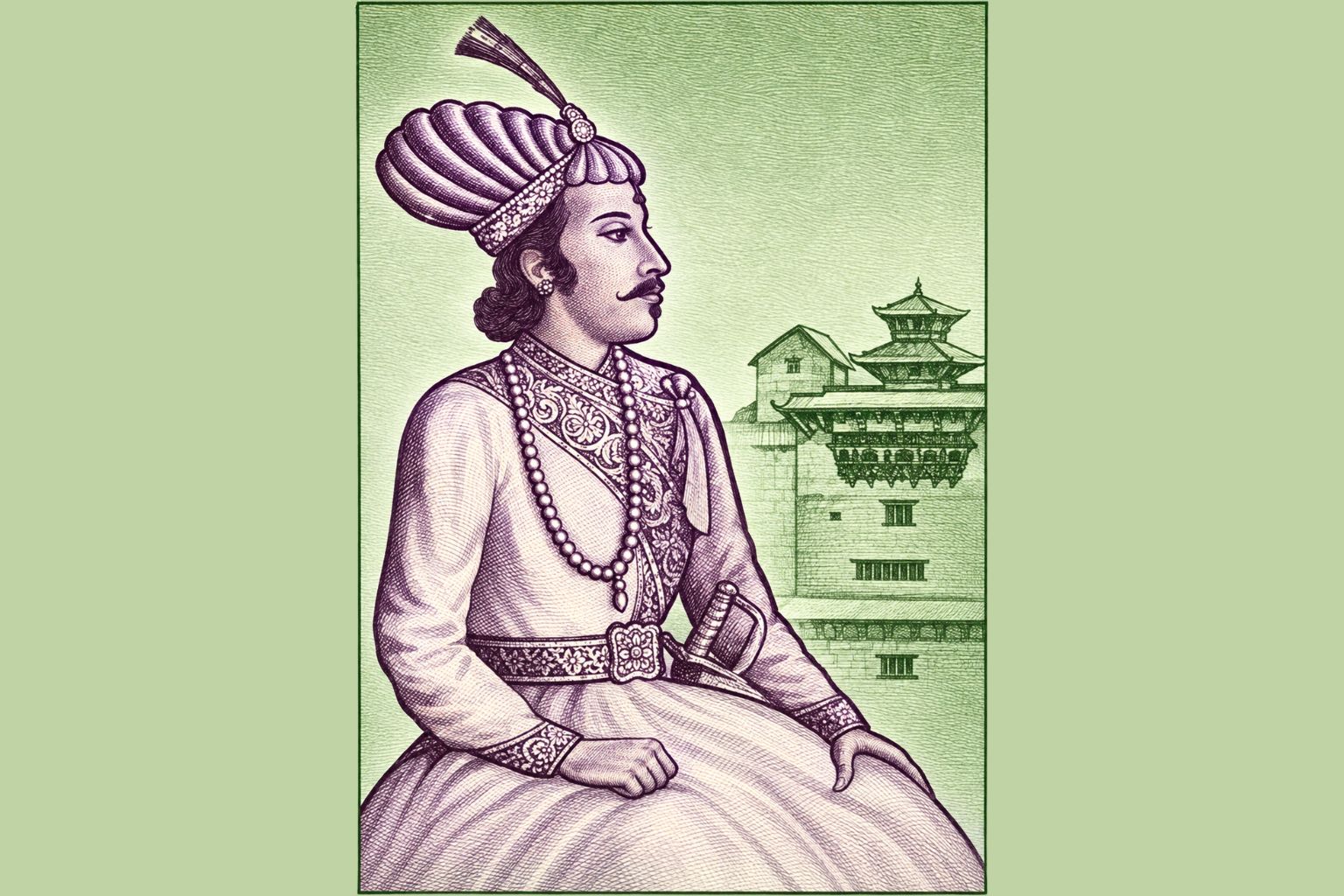
Anshuvarma (also written as Amshuvarman or Amsuvarman) was an important ruler and administrator in Nepal's Licchavi history. Active in the country's political administration from the late sixth century to the early seventh century CE, he initially served under Licchavi King Shivadeva I as a Samanta (feudatory chief) and later as a Mahasamanta (high-ranking feudatory). He gradually became the principal political authority and eventually exercised royal powers independently.
His political career is generally dated to approximately 594–621 CE. Inscriptions dating from 605 to 621 CE provide particularly important evidence of his independent governing authority. However, historians do not entirely agree on the exact date when he acquired full royal powers or the sequence in which his official titles changed.
Anshuvarma's historical contributions are associated with Kailashkut Bhawan (Kailashkut Palace), local administration, taxation, coinage, public construction, and the patronage of religious institutions. Inscriptions issued during his period provide valuable information about royal authority, village administration, economic activities, and the management of public property in ancient Nepal.
The Chinese Buddhist traveller Xuanzang (Hiuen Tsang) also described Anshuvarma as a learned ruler. His account mentions that Anshuvarma composed a work related to Shabdavidya, the study of language and grammar. However, there is no conclusive evidence that Xuanzang personally visited the Kathmandu Valley. His description should therefore be understood as a historical account based on information obtained from others rather than direct observation.
Some aspects of Anshuvarma's biography are established through contemporary stone inscriptions, while others come from later chronicles and religious traditions. This distinction is particularly important when examining his alleged relationship with Princess Bhrikuti, the architectural features of Kailashkut Palace, and accounts of diplomatic marriages.
Anshuvarma: Key Historical Facts
|
Detail |
Historical information |
|---|---|
|
Name |
Anshuvarma / Amshuvarman / Amsuvarman (अंशुवर्मा) |
|
Historical period |
Licchavi period |
|
Political activity |
Approximately 594–621 CE |
|
Period associated with independent rule |
Approximately 605–621 CE |
|
Early positions |
Samanta, Mahasamanta |
|
Royal title |
Maharajadhiraja |
|
Initial political association |
King Shivadeva I |
|
Principal royal centre |
Kailashkut Bhawan |
|
Probable palace location |
Hadigaun area, Kathmandu |
|
Principal historical evidence |
Stone inscriptions and coins |
|
Religious associations |
Devotion to Pashupatinath; royal support for various religious institutions |
|
Intellectual contribution |
Mention of a work on Shabdavidya |
|
Family members identified in inscriptions |
Sister Bhogadevi, nephew Bhogvarman, and niece Bhagyadevi |
|
Person associated with the succession |
Crown Prince Udayadeva |
|
End of reign |
Generally placed around 621 CE |
|
Death |
Exact date and circumstances unknown |
These details are based on Licchavi-period inscriptions, surviving coins, Xuanzang's account, and chronologies established by historians.
Birth and Family Background of Anshuvarma
Reliable contemporary information about Anshuvarma's date and place of birth, parents, and childhood is unavailable. Inscriptions bearing his name primarily concern royal orders, administrative decisions, and the management of public affairs.
Consequently, it is not possible to establish with certainty where he was born, how he received his education, or the social and political circumstances of his upbringing.
Which Dynasty Did Anshuvarma Belong To?
Anshuvarma's dynastic identity remains a subject of historical debate.
Later Nepali chronicles and traditional historical accounts associate him with the Thakuri dynasty. Some accounts also suggest that he had family ties with the Licchavi royal household.
However, the available contemporary inscriptions do not clearly establish his dynastic ancestry.
There is therefore insufficient inscriptional evidence to identify him conclusively either as the founder of the Thakuri dynasty or as a member of the Licchavi royal family by birth.
Royal expressions such as Bappapadanudhyata, found in inscriptions associated with Anshuvarma, cannot independently establish his actual genealogy. Such expressions formed part of the honorific and eulogistic language used in royal records.
Historians have proposed different interpretations of his origins, but a distinction remains between contemporary evidence and the claims preserved in later chronicles.
What Do Inscriptions Reveal About His Family?
An important source concerning Anshuvarma's family is a stone inscription dated to Era 39 from the Pashupati area.
The inscription mentions his sister Bhogadevi, her husband Shurasena, their son Bhogvarman, and their daughter Bhagyadevi.
Bhogadevi established a Shiva linga named Surabhogeshvara for the religious merit of her husband, Shurasena. Her daughter Bhagyadevi also undertook a religious dedication associated with Laditamaheshvara.
Anshuvarma issued an order assigning responsibility for the protection and management of these religious properties to the local Panchali institution.
The inscription is important not only because it identifies members of his family but also because it documents their religious activities and the involvement of royal administration in managing religious property.
However, it does not provide a clear account of Anshuvarma's wife, his own children, or his complete family lineage.
Political Background of the Licchavi Period
Understanding Anshuvarma's political rise requires an examination of the administrative structure of Licchavi Nepal.
During the Licchavi period, the king was the principal political figure, but senior officials also played important roles in everyday administration, military affairs, and royal decision-making.
Officials holding positions such as Samanta, Mahasamanta, and Mahapratihara could exercise considerable influence. At certain times, their actual administrative authority could be greater than that exercised by the person formally occupying the throne.
Influence of the Abhira Gupta Officials
Before Anshuvarma's rise, senior officials belonging to the Abhira Gupta family held significant influence in Nepal's political administration.
Figures such as Bhaumagupta occupied important positions in the royal administration. Studies of contemporary inscriptions provide evidence of the political influence exercised by such officials at court.
Under these circumstances, formal royal titles and actual administrative power were not always concentrated in the same person.
Anshuvarma's rise can be understood as a transfer of political influence within this administrative structure.
However, claims that he acquired power through a particular rebellion, military campaign, or palace conspiracy should not be treated as established history without contemporary evidence.
Reign of King Shivadeva I
Anshuvarma began appearing as a prominent political official during the reign of King Shivadeva I.
Shivadeva I was a king of the Licchavi dynasty. His inscriptions indicate that formal authority to issue royal orders remained vested in the king.
However, several orders refer to Anshuvarma's recommendations and administrative involvement.
These records establish that Anshuvarma was not merely an ordinary court official. He was an influential figure who participated in important royal decisions.
Traditional accounts sometimes claim that Shivadeva I devoted himself primarily to religious activities and consequently entrusted the administration to Anshuvarma.
Nevertheless, sufficient contemporary evidence is unavailable to establish the king's personal inclinations with such certainty.
What the inscriptions directly demonstrate is Anshuvarma's growing administrative authority.
How Did Anshuvarma Come to Power?
Anshuvarma was initially active as a Samanta. He subsequently became a Mahasamanta and gradually reached a position from which he could issue royal orders independently.
This transition was not necessarily a single event. Rather, it was a political process that developed over several years.
Early Position as Samanta
An inscription dated to Era 517, discovered in the Bhimsen Temple area of Patan, mentions Samanta Anshuvarma alongside King Shivadeva I.
According to the inscription, certain settlements received administrative and tax-related concessions following Anshuvarma's recommendation.
This indicates that he already had considerable influence over decisions concerning local administration during the early stage of his political career.
The inscription also mentions restrictions on the entry of officials from particular government offices and exemptions from certain taxes.
Rise to the Position of Mahasamanta
An inscription dated to Era 519 from Satungal mentions King Shivadeva I and Mahasamanta Anshuvarma.
The record indicates that Anshuvarma's request received consideration in an order issued by King Shivadeva.
This inscription demonstrates that Anshuvarma's official position and political influence had increased compared with his earlier status.
Mahasamanta was a high-ranking position within the administrative structure of the period. However, it should not be considered directly equivalent to the office of prime minister in a modern parliamentary system.
The authority of Licchavi officials, their relationship with the king, and their military and administrative responsibilities differed from those of modern constitutional officeholders.
The Khopasi Inscription
The Khopasi inscription dated to Era 520 is another important source for understanding the political relationship between Shivadeva I and Anshuvarma.
The order, issued in the name of King Shivadeva I, describes certain arrangements concerning the local community.
It provides information about Anshuvarma's participation in royal decision-making and the exercise of administrative authority during that period.
The inscription suggests that he had progressed beyond the role of royal adviser and had acquired direct influence over administrative decisions.
Beginning of Independent Rule
Anshuvarma is generally believed to have begun exercising royal authority independently around 605 CE.
The Bungmati inscription is among the earliest sources associated with his independent governing role.
Unlike earlier records issued in the name of King Shivadeva I, this inscription records an order in Anshuvarma's own name.
It also mentions Kailashkut Bhawan.
Nevertheless, the evidence indicates that Anshuvarma continued using the title Mahasamanta for some time after he began issuing independent orders.
This distinction demonstrates that acquiring effective ruling authority and adopting the highest royal title did not necessarily occur simultaneously.
Later inscriptions remember him with the status of Maharajadhiraja, indicating that his political authority had advanced considerably beyond his initial position as a Samanta.
Anshuvarma's Reign and the Era Systems
Understanding the relationship between the dating systems used in Licchavi inscriptions and the modern Common Era calendar is essential when studying Anshuvarma's reign.
Not all Licchavi-period inscriptions used the same chronological system.
The dating system found in earlier inscriptions differs from the later era used in records associated with Anshuvarma's independent rule.
Scholarly discussions refer to the later system as the Manadeva Era or Anshuvarma Era. Its starting point is generally calculated at approximately 576 CE.
However, historians have expressed differing views concerning the origin of the era and the interpretation of numerical dates in certain inscriptions.
Important Dates Associated with His Reign
|
Inscriptional date |
Approximate CE date |
Related evidence |
|---|---|---|
|
Era 517 |
595 CE |
Anshuvarma mentioned as Samanta |
|
Era 519 |
597 CE |
Appearance as Mahasamanta |
|
Era 520 |
598 CE |
Khopasi inscription associated with Shivadeva I |
|
Era 29 |
605 CE |
Common later reading of the Bungmati inscription |
|
Era 30 |
606 CE |
Hadigaun inscription |
|
Era 32 |
608 CE |
Hadigaun and Sanga inscriptions |
|
Era 34 |
610 CE |
Patan Sundhara inscription |
|
Era 39 |
615 CE |
Inscription from the Pashupati area |
|
Era 45 |
621 CE |
Inscription concerning a water structure associated with Anshuvarma |
The dates in the first group and those in the later group were not calculated from the same chronological starting point.
Particular caution is necessary when interpreting the date of the Bungmati inscription.
Some earlier readings identified its date as Era 34, while later studies and the Siddham inscription database identify it as Era 29.
The Nepal Heritage Documentation Project, associated with Heidelberg University, also dates the Bungmati inscription to 605 CE.
Thus, the commonly accepted date of 605 CE reflects the prevailing historical chronology, while differing interpretations of the inscription's text must also be acknowledged.
Kailashkut Palace: Anshuvarma's Royal Centre
Kailashkut Bhawan, commonly referred to as Kailashkut Palace, was a major royal structure associated with Anshuvarma.
Its existence is not based solely on folklore or later chronicles. The palace is explicitly mentioned in contemporary stone inscriptions.
Several royal orders issued during Anshuvarma's rule identify Kailashkut Bhawan as the place from which they originated.
Where Was Kailashkut Palace Located?
The most probable location of Kailashkut Palace is considered to be the Hadigaun area of present-day Kathmandu.
According to the Nepal Heritage Documentation Project, the Bungmati inscription dated to 605 CE contains an early reference to Kailashkut Bhawan.
Licchavi-period inscriptions discovered at Hadigaun also provide evidence of the area's political importance during that period.
However, the complete palace complex, its original entrance, total area, and the precise location of its principal structures have not been conclusively established.
It is therefore reasonable to identify Hadigaun as the probable location, but not to claim that the remains of the original palace have been definitively identified.
Construction and Administrative Use
Because Kailashkut Bhawan is closely associated with Anshuvarma's reign, its construction is generally attributed to him.
Evidence that royal orders were issued from the palace by 605 CE indicates that the structure was already in use by that time.
The palace served not only as a royal residence but also as a centre for issuing administrative decisions.
Inscriptions from Hadigaun, Sanga, Patan Sundhara, and the Pashupati area mention orders issued from Kailashkut Bhawan.
These records indicate the existence of an administrative arrangement through which central authorities communicated instructions to settlements and institutions in different parts of the kingdom.
Was Kailashkut Palace Seven Storeys High?
Chinese historical accounts from the Tang period contain descriptions of distinctive royal buildings in Nepal.
These descriptions mention multi-storeyed structures, decorated pillars, the use of copper, and arrangements for water drainage.
Popular accounts of Kailashkut Palace also describe a seven-storeyed structure and a large assembly hall.
However, these descriptions cannot all be accepted as direct archaeological evidence of the original palace constructed during Anshuvarma's reign.
Some Chinese accounts relate to periods after Anshuvarma.
It is therefore necessary to exercise caution before concluding that descriptions of later royal buildings refer to the same structure that existed during his rule.
The Claim That It Accommodated 10,000 People
Another frequently repeated claim is that the assembly hall or courtyard of Kailashkut Palace could accommodate 10,000 people.
This description is also associated with Chinese historical accounts.
However, the figure should not be treated as a scientifically verified capacity based on modern architectural measurements.
Ancient descriptions of royal buildings sometimes used large numbers and elaborate architectural details to convey royal grandeur.
Determining the actual capacity and physical structure of Kailashkut Palace would require material remains and archaeological investigation.
The palace's historical significance rests primarily on its documented role as an administrative centre of Licchavi Nepal rather than its supposed height or accommodation capacity.
Administrative System Under Anshuvarma
Inscriptions from Anshuvarma's reign reveal important relationships among local communities, government offices, and royal authority.
He assigned specific administrative responsibilities to certain settlements and institutions. Some orders also restricted interference by government officials.
These records demonstrate that administration was not conducted exclusively through direct control from the royal court. Local institutions also played a role in managing public affairs.
What Was the Panchali System?
Panchali was an institution associated with local administration during the Licchavi period.
It had responsibilities relating to the management of certain public, religious, and economic affairs within villages or settlements.
A 2024 study by Arpita Tripathy on the Panchali system describes it as a local administrative unit of ancient Nepal.
However, the Panchali institution should not be regarded as directly equivalent to modern elected local governments.
The social structure, systems of representation, and sources of authority during the Licchavi period differed substantially from those of modern democratic institutions.
Responsibilities Assigned to Local Institutions
Anshuvarma's inscription dated to Era 39 from the Pashupati area provides an important example of the Panchali system.
The inscription records that responsibility for maintaining religious properties was assigned to the Adhahshala Panchali.
Officials of the Western Adhikarana were instructed not to interfere in matters concerning these properties.
This arrangement indicates that a local institution could receive authority to manage specific religious assets.
However, such authority was not unlimited.
The inscription also provided for royal examination of the matter if the Panchali failed to fulfil its responsibilities.
This demonstrates a relationship between local administrative responsibility and central royal supervision.
Adhikaranas and Government Offices
Licchavi inscriptions mention several Adhikaranas, or administrative offices.
Terms associated with Kuther, Shulli, Lingwal, and other offices are important for understanding the administrative system of the period.
The responsibilities of these offices could relate to taxation, local administration, judicial matters, or other governmental functions.
The inscription dated to Era 517 from the Bhimsen Temple area describes restrictions preventing officials of certain Adhikaranas from entering specified settlements.
This suggests that government officials were directly involved in local affairs.
It also demonstrates that royal authority could restrict the jurisdiction or activities of such offices when considered necessary.
Limits of Administrative Reform
Anshuvarma's decision to assign responsibilities to Panchali institutions does not mean that his administration practised democratic decentralisation in the modern sense.
The authority of local institutions originated from royal orders.
The power to maintain, restrict, or make final decisions concerning those responsibilities remained associated with the central administration.
Nevertheless, assigning local communities responsibility for managing religious and public properties was a notable feature of the administrative arrangements of that period.
The evidence confirms that functional relationships existed between village institutions and the royal court.
Economic Policies, Taxation, and Trade
The principal sources of information about Anshuvarma's economic administration are tax-related orders, references to commercial goods, financial provisions for religious institutions, and surviving coins.
Reliable figures are unavailable for the state's total revenue, average household income, or the overall volume of commercial transactions during his reign.
However, inscriptions provide evidence of specific economic regulations and forms of royal control.
Tax Exemptions and Concessions
Several inscriptions associated with Anshuvarma's rule record tax concessions granted to local communities.
The Bungmati inscription mentions matters involving chickens, pigs, and fish.
It indicates that interference by government offices in certain activities of the local population was restricted.
However, parts of the inscription are damaged, making it difficult to determine the exact nature of every tax and administrative regulation described.
The inscription should therefore not be interpreted as evidence that the entire kingdom operated under a tax-free economic system.
The Sanga Inscription
The Sanga inscription dated to Era 32 provides information about taxation and obligations requiring local residents to supply particular goods.
It refers to obligations involving containers of oil and other local products.
The inscription indicates that Anshuvarma granted certain exemptions after recognising the difficulties these obligations caused the community.
This demonstrates that the royal administration could make decisions concerning economic burdens imposed on local settlements.
However, concessions granted to one settlement cannot be assumed to represent a uniform economic policy applied throughout the kingdom.
Tistung and Commercial Activities
Licchavi-period inscriptions associated with Tistung are important sources for the study of trade and customs administration.
They provide information relating to the movement of commercial goods and royal regulation of trading activities.
Goods such as iron, wool, yak-tail fly whisks, musk, and metal products were associated with trade in the hill and Himalayan regions.
Taxes and permit requirements could vary according to the nature of the goods involved.
These records suggest that trade was subject to royal regulations rather than being entirely unrestricted.
However, the available evidence does not establish that Anshuvarma personally created a particular international trade route or that all trade between Nepal and Tibet began during his reign.
His economic role is more appropriately understood in terms of royal regulation within a regional trading system that had developed over time.
Anshuvarma's Coins and Monetary Contributions
The existence of coins bearing Anshuvarma's name provides important material evidence of his royal standing.
Alongside inscriptions, coins are valuable sources for studying the political and economic history of the period.
Symbols Used on His Coins
Copper coins associated with Anshuvarma feature animal figures and royal inscriptions.
Numismatic catalogues describe coins bearing a winged lion and an inscription associated with his name.
Some other specimens featuring a cow and calf have also been linked to coinage of Anshuvarma's period.
However, identifying and classifying these coins requires careful examination of the inscriptions and distinguishing characteristics of individual specimens.
The designs provide information about contemporary royal symbolism and artistic traditions.
Political Significance of Coinage
Issuing coins bearing his own name was an important indication of royal authority and prestige.
It allowed the ruler's name to appear in economic transactions as well as official inscriptions.
Nevertheless, surviving coins alone do not establish that Anshuvarma transformed the entire monetary system, made a single currency compulsory throughout the kingdom, or introduced a new national unit of weight.
The verified aspect of his monetary contribution concerns the existence of coins bearing his name and associated royal symbols.
Public Construction and Irrigation
Inscriptions from Anshuvarma's period contain information concerning irrigation canals, water facilities, and the maintenance of religious and public structures.
Because water was essential to agriculture and settlement life, such facilities were important matters of administration.
Construction and Maintenance of Irrigation Canals
An inscription associated with Dhruvadeva and Jishnugupta, issued after Anshuvarma's period, refers to an irrigation canal that Anshuvarma had previously arranged for a local settlement.
The inscription records that the canal required repairs and that the succeeding administration made decisions concerning its maintenance.
This demonstrates that public infrastructure associated with Anshuvarma's period remained in use after his rule.
It also illustrates the importance of maintenance and local management in keeping water facilities operational.
Water Structure Inscription Dated to Era 45
A short inscription dated to Era 45, associated with Anshuvarma's name, records that a person named Vibhuvarman constructed a water facility for the religious merit of his father.
The inscription states that the work was undertaken through Anshuvarma's favour.
This indicates that royal permission or patronage remained important in matters involving public water facilities during the final phase of his reign.
However, the inscription does not state that Anshuvarma personally constructed the facility.
Repair of a Religious Building at Patan Sundhara
The Patan Sundhara inscription dated to Era 34 is an important source concerning the preservation of public and religious property.
It records that a religious building associated with Matingrama had deteriorated.
Its doors, windows, and other wooden components had sustained damage, leading to repairs.
Income derived from land was assigned to support the building's long-term maintenance.
Responsibility for managing this arrangement was entrusted to the local Panchali.
The inscription demonstrates that administrative arrangements for public structures could include both repairs and the allocation of financial resources for their continuing maintenance.
Religious Beliefs and Policies of Anshuvarma
Anshuvarma was a ruler devoted to Lord Pashupatinath.
His inscriptions contain royal expressions identifying him as someone who had received the grace of Pashupatinath.
These references establish his association with the Shaiva religious tradition.
However, evidence also shows that Buddhist monasteries and other religious institutions received royal assistance during his reign.
Devotion to Lord Pashupatinath
Several inscriptions associated with Anshuvarma use expressions related to Bhagavatpashupatibhattarakapadanugrihita.
The expression broadly conveys the meaning of a person blessed by the grace of Lord Pashupatinath.
Such terminology formed part of the royal eulogistic language of the period.
The inscription dated to Era 39 from the Pashupati area also records arrangements for protecting Shiva lingas established by members of Anshuvarma's family.
These records illustrate the relationship between religious devotion and royal administration.
Financial Support for Buddhist Monasteries
The Hadigaun inscription dated to Era 32 contains provisions concerning payments and rights granted to various religious institutions.
It mentions monasteries including Gumbihara, Shrimanvihara, Rajavihara, Kharjurikavihara, and Madhyamavihara, among others.
The same inscription also refers to Pashupatinath and other religious establishments.
This demonstrates that both Buddhist and non-Buddhist institutions were included in arrangements involving royal financial support.
Assessing Religious Tolerance
Historical evidence confirms that different religious institutions received royal assistance during Anshuvarma's reign.
This may be regarded as an important indication of religious coexistence during the period.
However, the situation should not be considered equivalent to the modern constitutional principles of religious freedom, secularism, and equal citizenship.
The receipt of royal assistance by religious institutions and the religious rights of ordinary citizens are separate matters.
Anshuvarma's religious policy is therefore best evaluated through documented royal support for institutions belonging to different religious traditions.
Education, Literature, and Shabdavidya
The account of the Chinese traveller Xuanzang is an important source concerning Anshuvarma's intellectual reputation.
Xuanzang described him as a ruler recognised for his learning and intellectual ability.
He also mentioned that Anshuvarma composed a work relating to Shabdavidya.
What Is Shabdavidya?
Shabdavidya refers to a field of study concerned with words, language, and grammar within the Sanskrit scholarly tradition.
Xuanzang's account mentions Anshuvarma's composition of a scholarly work relating to sounds or words.
Nepali historical writing generally presents this as a grammatical work known as Shabdavidya.
However, there is no confirmed surviving complete original text or independently authenticated manuscript establishing Anshuvarma's authorship.
It is therefore historically appropriate to state that Xuanzang attributed a work on Shabdavidya to Anshuvarma.
References to Scholarly Learning in Inscriptions
Anshuvarma's inscription dated to Era 39 from the Pashupati area contains royal descriptions associated with the study and interpretation of various scholarly disciplines.
The inscription includes expressions relating to scriptural reasoning, religious decisions, and governance.
This demonstrates the importance attached to scholarly knowledge and administration in contemporary royal language.
However, royal eulogies were also intended to praise the ruler. Their complimentary descriptions cannot automatically be accepted as independent historical evaluations.
Nevertheless, there is a connection between the scholarly prestige reflected in local inscriptions and Xuanzang's external account.
Did Xuanzang Visit Nepal?
Xuanzang travelled through various regions of South Asia during the seventh century.
His travel account contains information concerning Nepal's geography, agriculture, religious life, and political conditions.
However, there is no conclusive evidence that he personally visited the Kathmandu Valley.
Samuel Beal's English translation of the travel records also discusses the possibility that Xuanzang obtained information about Nepal from other sources.
He should therefore not be identified as a traveller who personally observed Kailashkut Palace or met Anshuvarma.
His account remains a useful external source concerning Anshuvarma's intellectual reputation, but it does not constitute eyewitness testimony.
Foreign Relations and Diplomacy of Anshuvarma
Anshuvarma's reign coincided with significant political developments in South Asia and the Himalayan region.
During the early seventh century, Harshavardhana's political influence was expanding in northern India. Political consolidation and the expansion of Tibetan power were also taking place north of the Himalayas.
Nepal's geographical position was important for both commercial and political relations.
However, sufficient contemporary diplomatic records are unavailable to establish exactly when Anshuvarma concluded agreements with particular foreign rulers.
Political Relations with India
Anshuvarma's reign partially overlapped with that of Harshavardhana in northern India.
Political developments in northern India during this period could have affected trade and communication with Himalayan kingdoms.
However, reliable evidence is unavailable to establish that Anshuvarma and Harshavardhana held direct meetings, concluded military agreements, or negotiated diplomatic marriages.
Claims that Anshuvarma prevented an invasion by Harshavardhana, defeated him, or protected Nepal's independence through marriage diplomacy should therefore not be presented as established historical facts.
Marriage of Bhogadevi and Shurasena
The inscription dated to Era 39 records that Anshuvarma's sister Bhogadevi was married to a prince named Shurasena.
The inscription confirms their family relationship.
However, additional evidence is required to establish the political kingdom to which Shurasena belonged, when the marriage took place, and whether it had a diplomatic purpose.
Consequently, Bhogadevi's marriage should not be described as a confirmed international political treaty.
Relations with Tibet
Relations between Nepal and Tibet are among the most frequently discussed foreign affairs associated with Anshuvarma's reign.
Tibetan religious and historical traditions mention the marriage of the Nepali princess Bhrikuti to the Tibetan ruler Songtsen Gampo.
This account occupies an important place in the cultural history of Nepal–Tibet relations.
However, the actual date of the marriage, Bhrikuti's family identity, and Anshuvarma's direct involvement have not been conclusively established.
Princess Bhrikuti and Her Relationship with Anshuvarma
The tradition that Princess Bhrikuti was Anshuvarma's daughter is widely found in Nepali and Tibetan religious histories.
However, the available contemporary Licchavi inscriptions do not clearly establish Bhrikuti's parentage.
Bhrikuti in Traditional Historical Accounts
Tibetan Buddhist tradition remembers Bhrikuti as the Nepali queen of Songtsen Gampo.
She is associated with the transmission of Buddhist religious culture, artistic traditions, and other forms of cultural contact in Tibet.
Tibetan religious traditions also associate her with the goddess Tara.
These accounts are important elements of religious memory and cultural history.
However, religious recognition and contemporary historical evidence are not equivalent.
Was Princess Bhrikuti Anshuvarma's Daughter?
Two principal interpretations appear in historical discussions of Bhrikuti's family background.
One tradition identifies her as Anshuvarma's daughter.
Another interpretation associates her with the Licchavi royal family, identifying her as the daughter of King Udayadeva and a member of the royal family connected with Narendradeva.
Different interpretations of Bhrikuti's identity appear in historical writings associated with Sylvain Lévi, Baburam Acharya, and other historians.
Min Bahadur Shakya's study of Tibetan sources concerning Bhrikuti also provides information about the religious and historical traditions surrounding her.
However, the available evidence does not allow any one account of her parentage to be declared an undisputed historical fact.
Why Is the Date of Bhrikuti's Marriage Disputed?
Anshuvarma's reign is generally considered to have ended around 621 CE.
Later sources propose different dates for the marriage of Bhrikuti and Songtsen Gampo.
Some of these proposed dates fall after the end of Anshuvarma's reign.
This creates chronological difficulties for claims that the marriage took place during his rule and that he personally arranged it.
For this reason, Bhrikuti's marriage should not be presented as a conclusively established diplomatic achievement of Anshuvarma.
Significance of Nepal–Tibet Cultural Relations
Nepal and Tibet have maintained historical religious, commercial, and cultural contacts.
However, these relationships cannot all be traced to a single royal marriage.
The exchange of Buddhist texts, religious ideas, artistic skills, and commercial goods developed through contacts established at different times.
Anshuvarma's reign represents an important period within this broader history of regional connections.
Nevertheless, attributing the entire process of transmitting Nepali art and Buddhist culture to Tibet personally to Anshuvarma would go beyond the available evidence.
Death of Anshuvarma and Royal Succession
Anshuvarma's reign is generally considered to have ended around 621 CE.
Reliable contemporary information about the exact day, month, or circumstances of his death is unavailable.
Therefore, although 621 CE is commonly associated with the end of his rule, it should not be treated as a conclusively established date of death.
Role of Crown Prince Udayadeva
Inscriptions from Anshuvarma's reign mention Crown Prince Udayadeva.
The inscription dated to Era 39 from the Pashupati area identifies Udayadeva as a Dutaka associated with a royal order.
The role of Dutaka was connected with the communication and implementation of royal instructions.
This establishes that Udayadeva was already participating in the royal administrative structure during Anshuvarma's reign.
However, the inscription does not independently establish that Anshuvarma formally declared Udayadeva his successor during his final years.
Political Changes After Anshuvarma
According to the chronology reconstructed from Licchavi inscriptions, Udayadeva appears in royal records around 621 CE.
In subsequent years, political figures such as Dhruvadeva and Jishnugupta gained influence.
Inscriptions associated with Dhruvadeva and Jishnugupta again demonstrate the relationship between kings holding formal royal titles and powerful officials exercising substantial administrative authority.
This indicates that the distribution of political power remained subject to change after Anshuvarma.
The later rise of Narendradeva was another important development in Licchavi political history.
These events suggest that the relationship between senior officials and dynastic successors continued to be complex after the end of Anshuvarma's personal rule.
Major Historical Inscriptions of Anshuvarma
Stone inscriptions are particularly important sources for studying Anshuvarma's biography.
They provide information about the ruler's name, official titles, the locations from which orders were issued, and decisions concerning administration.
For this reason, inscriptional evidence should receive priority when evaluating traditional narratives about Anshuvarma.
|
Inscription |
Era date |
Principal historical information |
|---|---|---|
|
Patan Bhimsen area |
517 |
Anshuvarma mentioned as Samanta; tax-related concessions |
|
Satungal |
519 |
Relationship between Shivadeva I and Mahasamanta Anshuvarma |
|
Khopasi |
520 |
Anshuvarma's influence in royal administration |
|
Bungmati |
29, according to the commonly accepted reading |
Kailashkut Bhawan and local administration |
|
Hadigaun |
30 |
Arrangements concerning royal payments and recipients |
|
Sanga |
32 |
Local obligations and tax concessions |
|
Hadigaun |
32 |
Financial provisions concerning religious institutions |
|
Patan Sundhara |
34 |
Repair of a religious building and responsibilities of the Panchali |
|
Pashupati area |
39 |
Family members, religious properties, and Crown Prince Udayadeva |
|
Water structure inscription |
45 |
Construction of a water facility through Anshuvarma's favour |
Different published editions contain some variations in the reading of these inscriptions, particularly where the original text is damaged or the numerical dates are uncertain.
The Sanskrit inscription texts published by the Siddham Asian Inscription Database and the DHARMA Project provide important materials for studying Anshuvarma's reign.
Major Historical Contributions of Anshuvarma
Anshuvarma's contributions are associated with Nepal's political, administrative, economic, and cultural history.
The surviving evidence from his reign provides information about several aspects of government and public administration.
Political Contributions
Anshuvarma's rise illustrates the considerable political influence that a senior feudatory could acquire within the Licchavi administrative structure.
He progressed from serving as an official under the king to exercising independent royal authority.
His career demonstrates that dynastic titles and actual administrative power could be held by different individuals.
Administrative Contributions
Evidence of his administration includes assigning responsibilities to local Panchali institutions, restricting interference by government offices, and issuing orders concerning particular settlements.
These arrangements demonstrate that the administrative structure extended beyond the royal court and involved local communities.
Economic Contributions
His recorded economic activities include tax exemptions, royal regulation of commercial goods, the allocation of funds to religious institutions, and the circulation of coins bearing his name.
These sources establish the existence of royal regulations and institutional arrangements within the economy.
However, the surviving materials are insufficient to measure the kingdom's overall economic prosperity.
Contributions to Public Construction
Kailashkut Bhawan, irrigation-related works, and the protection of religious structures are among the principal examples of public administration associated with Anshuvarma's period.
Particularly noteworthy are arrangements assigning land and income for the repair and continuing maintenance of structures.
These records demonstrate an administrative approach that connected construction and repair with arrangements for long-term preservation.
Cultural and Intellectual Contributions
Xuanzang's reference to a work on Shabdavidya and the documented assistance provided to different religious institutions offer information about Anshuvarma's intellectual and cultural associations.
However, it remains important to distinguish complimentary descriptions of his personality from independently verifiable evidence.
Can Anshuvarma's Reign Be Called a Golden Age?
Some traditional historical accounts associate Anshuvarma's reign with a golden age in Nepal's history.
However, the term golden age is not a formally established inscriptional title or an objective historical measurement.
It is an expression used to evaluate the political, economic, or cultural conditions of a particular period.
Evidence survives from Anshuvarma's reign concerning royal construction, local administration, religious patronage, and coinage.
Nevertheless, these records do not establish that the entire population enjoyed uniformly high living standards, that the kingdom experienced no political difficulties, or that all social groups received equal economic benefits.
It is therefore more historically precise to describe Anshuvarma's reign as an important political and administrative phase of the Licchavi period.
Importance of Historical Evidence in Studying Anshuvarma
Information about Anshuvarma comes primarily from three types of historical sources.
Contemporary stone inscriptions and coins provide direct material evidence of his political and administrative activities.
Accounts written by external authors, such as Xuanzang, preserve information about Nepal obtained from sources available outside the kingdom.
Later chronicles and religious traditions preserve narratives and cultural memories associated with Anshuvarma.
These sources do not carry equal evidentiary weight.
For example, the name Kailashkut Bhawan appears in contemporary inscriptions, allowing its historical existence to be accepted. However, the palace's actual height and complete architectural design have not been established through evidence of the same quality.
Similarly, contemporary inscriptions confirm that Bhogadevi was Anshuvarma's sister. By contrast, the claim that Princess Bhrikuti was his daughter is not supported by equally direct contemporary evidence.
Maintaining these distinctions is essential for reaching historically sound conclusions.
Conclusion
Anshuvarma was an important ruler in Nepal's Licchavi history. He emerged as an influential official under King Shivadeva I toward the end of the sixth century and began exercising independent royal authority during the early seventh century.
His reign is associated with Kailashkut Bhawan, the local Panchali system, tax-related orders, coinage, public construction, and the protection of religious institutions. These subjects can be examined through surviving historical inscriptions.
The reference to a work on Shabdavidya provides information about his intellectual reputation. However, the original text of that work has not been confirmed as surviving, making it impossible to establish its detailed contents.
Historical disagreements and evidentiary limitations remain concerning his relationship with Bhrikuti, marriage-related diplomacy, and the complete architecture of Kailashkut Palace.
Understanding Anshuvarma's importance does not require exaggerated praise. The surviving inscriptions themselves demonstrate that he was an influential figure in the history of Nepal's governance, administration, religious institutions, and public property management.
References
1. Vajracharya, Dhanavajra (BS 2030). Licchavikalka Abhilekh (Inscriptions of the Licchavi Period). Kathmandu: Institute of Nepal and Asian Studies, Tribhuvan University.
2. Regmi, D. R. (1983). Inscriptions of Ancient Nepal. New Delhi: Abhinav Publications. A scholarly source containing published inscription texts and translations.
3. DHARMA Project. Bhimasena Bridge Stone Inscription. Records King Shivadeva I and Samanta Anshuvarma in Era 517.
4. DHARMA Project. Satungal Stone Inscription. Documents the role of Mahasamanta Anshuvarma in Era 519.
5. DHARMA Project. Khopasi Stone Inscription. A royal order dated to Era 520.
6. DHARMA Project. Bungmati Stone Inscription of Amsuvarma. An inscription concerning Kailashkut Bhawan and local administration.
7. DHARMA Project. Harigaon Stone Inscriptions of Amsuvarma. Records concerning religious institutions and royal financial arrangements.
8. DHARMA Project. Sanga Stone Inscription of Amsuvarma. Documents local economic obligations and tax concessions.
9. DHARMA Project. Sundhara Stone Inscription of Amsuvarma. Records repairs to a religious building and the responsibilities of a Panchali institution.
10. DHARMA Project. Deopatan Stone Inscription 1. Contains information concerning Anshuvarma's family relationships, religious dedications, and Crown Prince Udayadeva.
11. DHARMA Project. Water Reservoir Inscription of Amsuvarma. Records the construction of a public water facility in Era 45.
12. DHARMA Project. Patan Stone Inscription of Jisnugupta. Evidence concerning an irrigation canal associated with Anshuvarma's period and its subsequent management.
13. Nepal Heritage Documentation Project, Heidelberg University. Buṅgamatī Heritage Documentation. Documentation concerning the Bungmati inscription and its early reference to Kailashkut Bhawan.
14. Siddham: The Asian Inscription Database. Bungmati Stone Inscription of Amsuvarman. Includes the commonly accepted reading of Era 29.
15. Beal, Samuel (1884). Si-Yu-Ki: Buddhist Records of the Western World, Volume 2. English translation of Xuanzang's account concerning Nepal.
16. Tripathy, Arpita (2024). “Pāňcālī — A Local Administrative Unit of Ancient Nepal (4th to 8th Century A.D.): An Inscriptional Overview.” International Journal of Archaeology, 12(2), 23–26.
17. Śākya, Mīnabahādura (1997). The Life and Contribution of the Nepalese Princess Bhrikuti Devi to Tibetan History: From Tibetan Sources. Book Faith India. A study of Tibetan traditions concerning Princess Bhrikuti.
18. Rhodes, Nicholas G., Karl Gabrisch, and Carlo Valdettaro (1989). The Coinage of Nepal: From the Earliest Times Until 1911. Royal Numismatic Society. A numismatic reference cited in catalogues of Anshuvarma's coins.







Comments 0
No comments yet. Be the first to start the conversation.