



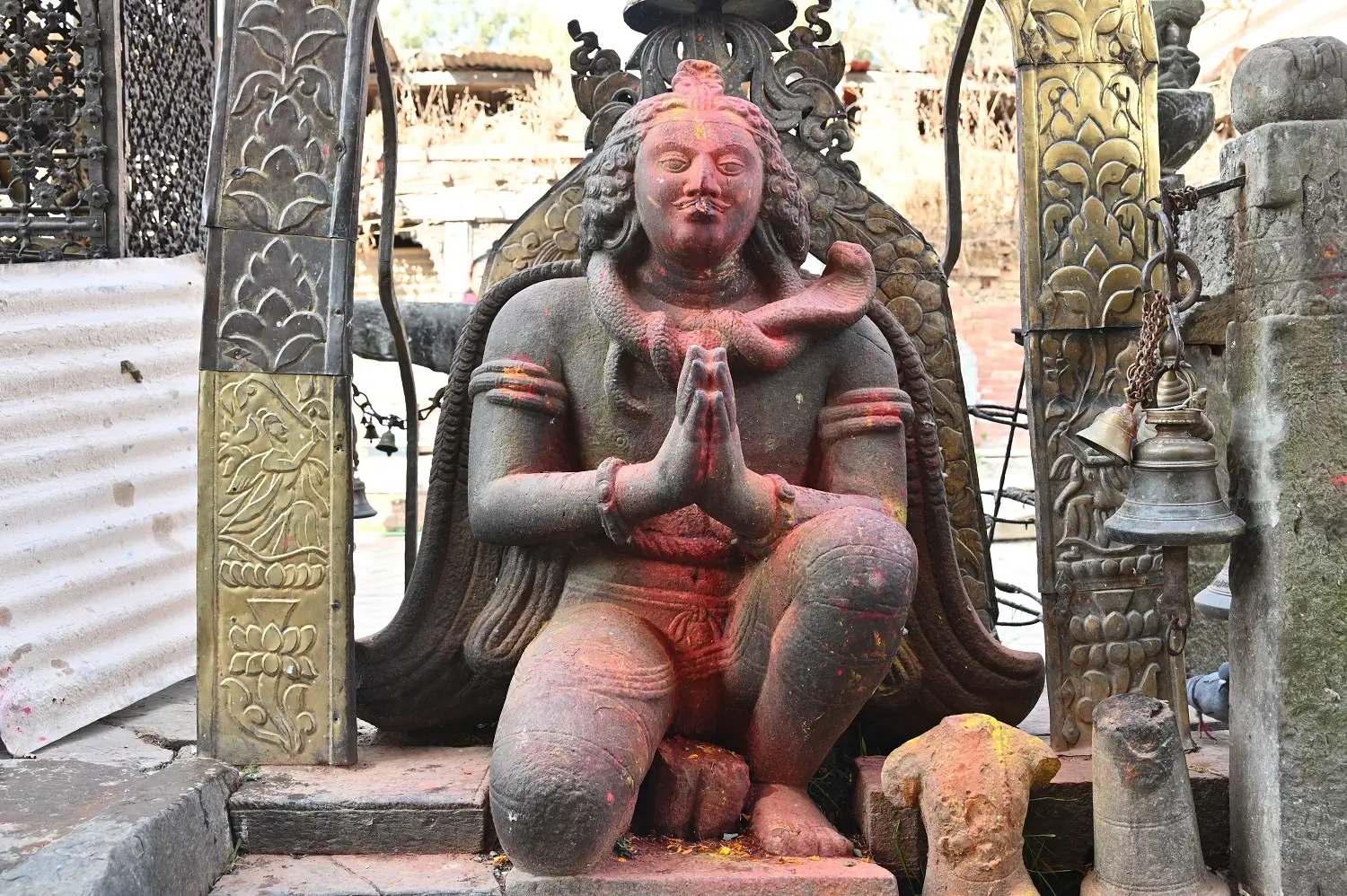
King Manadeva I (c. 464–505 CE) was an important ruler of the Licchavi dynasty in ancient Nepal. His reign marks one of the earliest periods in Nepalese political history for which relatively detailed and chronological contemporary inscriptions are available. The pillar inscription dated Samvat 386 (464 CE) at Changu Narayan is particularly significant because it provides information about his ancestors, royal succession, family circumstances, and military campaigns.
Manadeva has traditionally been described in Nepalese historical writing as the first historically authenticated king of Nepal. However, this interpretation requires qualification following the discovery of the Jaya Varman inscription, dated Samvat 107 and generally associated with approximately 185 CE, at Maligaon in Kathmandu in 1992. It is therefore more accurate to describe Manadeva as one of the earliest Nepalese rulers whose political activities are documented in substantial contemporary inscriptions, rather than as the earliest ruler known from inscriptional evidence.
Manadeva's historical importance extends beyond his military campaigns. Inscriptions from his reign provide information about members of the royal family, merchants, religious establishments, land donations, and contemporary art and culture. These records are important sources for understanding Nepal's political, social, and cultural history during the fifth century.
King Manadeva I: Key Facts
| Particulars | Historical Information |
|---|---|
| Name | Manadeva |
| Common historical designation | Manadeva I |
| Dynasty | Licchavi |
| Documented reign | Samvat 386–427 |
| Commonly accepted CE chronology | 464–505 CE |
| Territory | Ancient Nepal, with the Kathmandu Valley as its political centre |
| Father | King Dharmadeva |
| Mother | Queen Rajyavati |
| Grandfather | Shankaradeva |
| Great-grandfather | Vrishadeva |
| Queens mentioned in inscriptions | Bhogini, Kshemasundari, and Gunavati |
| Daughter | Vijayavati |
| Succession | Mahideva, followed by Vasantadeva |
| Principal inscription | Changu Narayan pillar inscription, Samvat 386 |
| Other important evidence | Trivikrama image inscriptions, Suryaghat inscription, and religious donation inscriptions from his reign |
| Associated historical coinage | Sri Mananka (date of issue disputed among scholars) |
| Death | Exact date and cause unknown |
The available dated inscriptions associated with Manadeva's reign extend from Samvat 386 to Samvat 427. These dates are generally correlated with 464–505 CE using the Saka-era chronology commonly applied to this period.
Historical Background Before Manadeva's Reign
Political authority, religious traditions, settlements, and artistic practices had already developed in the Kathmandu Valley before Manadeva's reign. However, continuous contemporary records documenting the succession, length of reign, and political activities of earlier rulers remain limited.
Historians studying this period of ancient Nepal compare dynastic chronicles, sculptures, inscriptions, archaeological remains, and references found in external historical sources.
The Gopalarajavamsavali and other later chronicles mention the Gopala, Mahishapala, Kirata, and Licchavi rulers. Nevertheless, the names, dates, and events recorded in these chronicles cannot all be independently confirmed through contemporary evidence.
The Prayaga Prashasti of the Gupta emperor Samudragupta, dating to the fourth century CE, mentions Nepal among the frontier kingdoms. This reference establishes Nepal's presence within the political relationships of South Asia during that period. However, it does not provide a detailed account of Nepal's internal dynastic succession.
The Jaya Varman Inscription and Manadeva's Place in History
In 1992, a full-length ancient stone sculpture was discovered at Maligaon in Kathmandu. An inscription on its pedestal contains the name Jaya Varman and the date Samvat 107.
In their research, Kashinath Tamot and Ian Alsop proposed that this date corresponded to approximately 185 CE when interpreted in relation to the Saka era. Alternative scholarly views have also been expressed concerning the reading of the numerals and the identity of the figure depicted in the sculpture.
Before this discovery, a fragmentary inscription dated Samvat 381 (approximately 459 CE), found in the Pashupati area, had also been recognized as older than the Changu Narayan inscription of Samvat 386.
These discoveries changed the earlier assumption that Manadeva's Changu Narayan pillar was the oldest dated inscription in Nepal.
Nevertheless, the historical importance of Manadeva's inscriptions remains substantial. His reign provides comparatively detailed contemporary evidence concerning royal genealogy, political campaigns, and family events.
Manadeva's Ancestry and Family Background
The Changu Narayan inscription of Samvat 386 presents information about three generations of kings preceding Manadeva.
According to the inscription, Vrishadeva was succeeded by his son Shankaradeva. Shankaradeva was followed by his son Dharmadeva, whose successor was Manadeva.
King Vrishadeva
Vrishadeva was Manadeva's great-grandfather. The Changu Narayan inscription praises him as a ruler possessing religious devotion, truthfulness, and qualities associated with kingship.
His name also appears in later Licchavi inscriptions. Such descriptions need to be interpreted within the literary conventions of contemporary royal eulogies.
King Shankaradeva
Shankaradeva was the son of Vrishadeva and the grandfather of Manadeva.
The Changu Narayan inscription praises his military strength, generosity, and administrative abilities. It also refers to his relationship with subordinate rulers and feudatories in the administration of the kingdom.
King Dharmadeva
Dharmadeva was Manadeva's father and the son of Shankaradeva.
The Changu Narayan inscription portrays him as a ruler who performed religious ceremonies, observed royal duties, and governed with concern for his subjects.
His queen was Rajyavati. The same inscription describes Manadeva's assumption of royal authority following Dharmadeva's death.
Birth, Childhood, and Education of Manadeva
Manadeva was born to King Dharmadeva and Queen Rajyavati. His exact date of birth, birth year, and birthplace are not recorded in the principal contemporary inscriptions currently available.
Descriptions of his accession and military leadership suggest that he may have been a young man when he ascended the throne. However, these accounts do not provide sufficient evidence to establish a specific birth year.
There is also no direct record identifying his childhood teachers, the subjects he formally studied, or the location of his military training.
The Changu Narayan inscription describes Manadeva as a ruler possessing military skills, leadership abilities, and political judgment. These descriptions help explain how the royal court represented his capabilities.
However, there is insufficient direct evidence to claim that he formally studied specific texts such as the Vedas, Arthashastra, or Nitishastra.
The literary character of Sanskrit inscriptions from his reign does indicate the presence of Sanskrit language use and classical literary traditions within contemporary royal and religious institutions.
Death of Dharmadeva and Manadeva's Accession
Manadeva assumed royal authority following the death of King Dharmadeva. The Changu Narayan inscription describes Dharmadeva's death as sudden but does not specify its cause.
The inscription gives particular attention to the grief within the royal family and the conversation between Manadeva and his mother, Rajyavati.
The Role of Queen Rajyavati
According to the Changu Narayan inscription, Queen Rajyavati expressed an intention to follow her husband in death through the practice of sati. However, after Manadeva appealed to her, she abandoned that intention and participated in Dharmadeva's funeral rites.
The inscription subsequently describes Rajyavati as engaging in religious observances, donations, and vows.
This episode provides evidence concerning the religious expectations and family roles associated with royal widows in fifth-century Nepal.
However, a single incident involving the royal family cannot establish the prevalence of sati or the social rules governing the practice across all sections of contemporary society.
The inscription presents Rajyavati as a queen who occupied an important position in Manadeva's family and royal life.
Political Challenges Following the Succession
The Changu Narayan inscription states that Manadeva faced disobedience from subordinate feudatories in the eastern and western regions following his father's death.
Local rulers and feudatories who maintained relationships with the central monarchy played an important role in the political system of the period.
Re-establishing their allegiance following a change in royal leadership appears to have been one of Manadeva's immediate political responsibilities.
Military Campaigns of King Manadeva
The Changu Narayan inscription describes Manadeva's campaigns toward the east and west. These accounts provide information about the political geography of his reign and the relationship between the central monarchy and subordinate rulers.
Campaign Against Eastern Feudatories
According to the inscription, Manadeva undertook an expedition to compel eastern feudatories to obey the authority of the central monarchy.
Following the campaign, the feudatories reportedly acknowledged his supremacy, and Manadeva restored them to their respective positions.
This account suggests that Manadeva preferred to maintain administrative relationships through the submission of local rulers rather than permanently removing all subordinate authorities.
However, the inscription does not clearly identify every location involved, the names of all local rulers, or the extent of military losses.
Western Campaign and the Conquest of Mallapuri
After the eastern campaign, Manadeva also conducted an expedition against feudatories in the west.
The references to the Gandaki River and a place called Mallapuri are especially important in this account.
According to the Changu Narayan inscription, Manadeva instructed his maternal uncle to participate in the western expedition. The account describes the crossing of the Gandaki River and a subsequent victory at Mallapuri.
This description indicates that relatives from the maternal side of the royal family could also play a role in military affairs.
The precise geographical location of Mallapuri remains uncertain. Although it is generally associated with an ancient political or administrative centre beyond the Gandaki River, it has not been conclusively identified with any particular modern district or municipality of Nepal.
Therefore, the inscription does not provide sufficient evidence to determine the exact present-day districts included within Manadeva's territory.
Historical Significance of the Campaigns
The eastern and western campaigns described in the Changu Narayan inscription show that the central monarchy sought to maintain its authority over subordinate territories during Manadeva's reign.
The accounts suggest that military force and the renewed acceptance of royal authority by feudatories were important elements of his political administration.
However, these campaigns should not be interpreted as evidence that Manadeva unified the entire territory of modern Nepal or established the country's present national boundaries.
Changu Narayan Pillar Inscription of Manadeva
The Changu Narayan pillar inscription is the principal primary historical source for Manadeva's reign. It is dated Samvat 386, Jyeshtha Shukla Pratipada, generally corresponding to 464 CE.
The inscription is written in Sanskrit, using characters associated with the Brahmi-Gupta script tradition of the period.
Its text extends across three faces of the stone pillar. Some portions have been damaged or are difficult to read, so the complete original text cannot be described as perfectly preserved.
The inscription principally contains the following information:
- The royal genealogy from Vrishadeva to Manadeva.
- The death of King Dharmadeva and the role of Queen Rajyavati.
- Praise of Manadeva's political qualities and military abilities.
- The expedition against eastern feudatories.
- The western campaign, including references to the Gandaki River and the victory at Mallapuri.
- Religious donations and royal activities associated with Changu Narayan.
The inscription presents these events within the conventions of a royal eulogy. Consequently, historical analysis must distinguish its literary praise from information about specific political events.
Its significance lies not merely in its early date but also in the substantial contemporary information it provides about Manadeva's ancestry, royal succession, and military campaigns.
Administration and Land Management During Manadeva's Reign
Inscriptions from Manadeva's reign provide information about royal authority, the role of feudatories, land donations, and resources assigned to religious institutions.
However, there is insufficient evidence to establish that every administrative institution or practice associated with the Licchavi period was personally introduced by Manadeva.
Royal Administration and the Feudatory System
Manadeva appears in his inscriptions as the central ruler.
References to eastern and western feudatories suggest that local authorities administered different territories while maintaining political relationships with the monarchy.
Other inscriptions from his reign also show that local donors and officials undertook religious activities within the broader political setting of royal rule.
These records indicate relationships among the royal court, influential local individuals, and religious establishments in contemporary administration.
The Historical Significance of Managriha Palace
Managriha was an important royal centre during the Licchavi period.
An inscription dated Samvat 428, associated with King Vasantadeva and found at Adinarayan in Thankot, records the issue of a royal order from Managriha.
This confirms that Managriha was associated with royal administration by the early sixth century.
Historical and archaeological interpretations generally associate its location with the Hadigaon and Maligaon areas of Kathmandu.
However, direct evidence has not established that Manadeva personally constructed Managriha, resided there permanently, or issued all his royal orders from that location.
Managriha may therefore be discussed as an important centre of the Licchavi royal tradition associated with Manadeva's period, but its construction should not be presented as a confirmed personal achievement of the king.
Land Donations and Religious Endowments
Inscriptions from Manadeva's reign contain references to land donated for religious purposes.
Such records provide information about the measurement of land, the income derived from it, and arrangements for maintaining religious activities.
The Jayalambha inscription from the Pashupati area, dated Samvat 413, records the establishment of a Shiva linga and the donation of land for its worship.
These records show that land was connected to the financial maintenance of religious institutions.
Revenue-related terms such as bhaga, bhoga, and kara also appear in later Licchavi inscriptions. However, the provisions concerning land rights, boundary demarcation, and taxation in Vasantadeva's Thankot inscription of Samvat 428 must not be attributed to Manadeva as his own orders.
Mananka Coins and Their Connection with Manadeva
Sri Mananka occupies an important place in the study of early Licchavi coinage in Nepal. The coins contain inscriptions associated with the name Manadeva and the name of Queen Bhogini.
Their principal characteristics are summarized below.
| Feature | Description |
|---|---|
| Coin name | Sri Mananka |
| Obverse | Figure of a lion and the inscription Sri Mananka |
| Reverse | Figure of a seated female deity on a lotus and the inscription Sri Bhogini |
| Metal | Copper or copper-based alloy varieties |
| Historical association | King Manadeva and Queen Bhogini |
| Date of issue | Disputed in numismatic scholarship |
Traditional Nepalese historical writing has commonly regarded Mananka as an early Nepalese coin issued by Manadeva.
However, numismatic research has proposed a different chronology for its issue.
In The Coinage of Nepal from the Earliest Times until 1911, published in 1989, Nicholas Rhodes, Karl Gabrisch, and Carlo Valdettaro assigned Sri Mananka coins to approximately 576–605 CE.
According to their interpretation, these coins may have been issued during the reign of Shivadeva I, possibly under the influence of Amshuvarma, in honour of the earlier King Manadeva and Queen Bhogini.
The British Museum also identifies a Sri Mananka-type coin in its collection with Shivadeva I and assigns it an approximate date of 576–605 CE.
Therefore, the presence of Manadeva's name on the coin and the claim that he personally issued it during his reign must be treated as separate historical questions.
Although the coin's association with Manadeva is clear, the identity of the issuing authority and the date of issue remain subjects of scholarly interpretation.
Trade and Economic Activities During Manadeva's Reign
Evidence from Manadeva's reign indicates that members of the merchant community established religious institutions and donated property for their maintenance.
The Tebahal inscription of Samvat 402 (480 CE), found in Kathmandu, provides an example.
The inscription records that a sarthavaha named Guhamitra established an image of Divakara, representing the Sun deity, and donated land associated with its worship.
The term sarthavaha generally referred to the leader of a merchant group or trading caravan.
Its use indicates the presence of an organized merchant community and the participation of merchants in religious donations.
However, this inscription alone cannot establish the volume of trade between Nepal and Tibet or India, the principal export commodities, commercial income, or the level of economic growth.
Similarly, the existence of Mananka coinage does not, by itself, prove that domestic and international trade expanded significantly during Manadeva's own reign.
Major Inscriptions and Artistic Evidence from Manadeva's Reign
Inscriptions associated with Manadeva's reign have been discovered at several locations. Some directly mention the king, while others record activities undertaken by queens, princesses, merchants, and other donors.
The following table presents important dated evidence.
| Samvat | CE Year | Inscription or Evidence | Main Subject |
|---|---|---|---|
| 386 | 464 | Changu Narayan pillar | Royal genealogy, succession-related events, and military campaigns |
| 388 | 466 | Lazimpat | Establishment of a Shiva linga by Naravarma |
| 389 | 467 | Tilganga and Lazimpat | Establishment of Trivikrama Vishnu images by Manadeva |
| 390 | 468 | Lazimpat | Establishment of a Shiva linga by Queen Kshemasundari |
| 402 | 480 | Tebahal | Establishment of a Sun image and land donation by the merchant leader Guhamitra |
| 413 | 491 | Pashupati area | Establishment of a Shiva linga and land donation by Jayalambha |
| 419 | 497 | Lazimpat | Establishment of a Shiva linga by Gunavati |
| 425 | 503 | Palanchok | Establishment of an image of Goddess Vijayeshvari by Vijayasvamini |
| 427 | 505 | Pashupati Suryaghat | Establishment of the Vijayeshvara Shiva linga by Princess Vijayavati |
| 427 | 505 | Changu Narayan | Establishment of an image by Nirapeksha in memory of his parents |
These dates follow the commonly used Saka-era chronology. Published editions differ in their readings of some damaged characters, donor names, and inscriptional details.
Trivikrama Images of Samvat 389
Two Trivikrama image inscriptions dated Samvat 389 are important examples of artistic evidence from Manadeva's reign.
The sculptures are associated with Tilganga and Lazimpat.
According to the inscriptions, Manadeva established images of Vishnu in the Trivikrama form for the religious merit of his mother, Rajyavati.
Because these sculptures are dated, they provide a chronological basis for studying Nepalese stone sculpture in the fifth century.
Kshemasundari Inscription of Samvat 390
The Lazimpat inscription dated Samvat 390 records the establishment of a Shiva linga by Queen Kshemasundari, the wife of Manadeva.
The inscription concerns her religious donation.
It should not be identified as a Samvat 413 inscription documenting the construction of a public water supply system.
Jayalambha Inscription of Samvat 413
The inscription from the Pashupati area dated Samvat 413 records that a donor named Jayalambha established a Shiva linga called Jayeshvara.
It also includes information about land donated for the performance of religious worship.
The inscription demonstrates the use of private donations and land-based financial arrangements to maintain religious establishments.
Gunavati Inscription of Samvat 419
The Lazimpat inscription dated Samvat 419 records that Gunavati established a Shiva linga.
It also mentions her father, Kinnaravarma.
The inscription provides evidence of women's participation in religious donations and commemorative activities within families associated with the royal establishment.
Palanchok Inscription of Samvat 425
An inscription dated Samvat 425, Magha Shukla Purnima, found in the Palanchok area of Kavrepalanchok, records the establishment of an image of Goddess Vijayeshvari during Manadeva's reign.
The inscription names a woman called Vijayasvamini as the donor who established the image.
This is important evidence for studying Shakta religious activities and goddess-image production during the period.
Suryaghat Inscription of Samvat 427
The Suryaghat inscription in the Pashupati area, dated Samvat 427, records that Princess Vijayavati established the Vijayeshvara Shiva linga.
It provides information about King Manadeva, Queen Bhogini, their daughter Vijayavati, and Vijayavati's husband.
This inscription is an important source for understanding Manadeva's family and the public religious roles of women in the royal household.
Changu Narayan Inscription of Samvat 427
An inscription dated Samvat 427, Kartika Shukla Trayodashi, found at Changu Narayan records the establishment of an image by a person named Nirapeksha in memory of his parents.
The inscription also refers to Manadeva as the reigning king.
This provides evidence that his rule continued into the later part of Samvat 427.
Religious Practices and Cultural Contributions During Manadeva's Reign
Manadeva's personal religious affiliation appears to have been closely associated with the Vaishnava tradition. However, inscriptions from his reign also document Shaiva, Shakta, and Saura religious activities.
Vaishnava Religious Affiliation
The Changu Narayan inscription contains praise of Vishnu.
Similarly, the Trivikrama image inscriptions of Samvat 389 record that Manadeva established images of Vishnu for the religious merit of his mother, Rajyavati.
These records directly confirm the association of Manadeva and his royal family with Vaishnava religious practices.
Shaiva and Shakta Traditions
Inscriptions from Manadeva's reign mention donors who established Shiva lingas.
Examples include inscriptions associated with Queen Kshemasundari, Gunavati, Princess Vijayavati, and other individuals.
The establishment of an image of Goddess Vijayeshvari at Palanchok provides evidence of Shakta religious practices during the same period.
Sun Worship
The Tebahal inscription of Samvat 402 records that the merchant Guhamitra established an image of Divakara, the Sun deity.
This shows that Sun worship also formed part of contemporary religious activity.
Association with Buddhist Traditions
Later historical accounts and Buddhist traditions associate Manadeva with monasteries and religious institutions.
However, claims that Manadeva personally constructed a particular Buddhist monastery require separate confirmation from contemporary evidence.
Although records from his period show the presence of different religious traditions, there is insufficient direct evidence to conclude that he introduced a formal royal policy guaranteeing equal rights to every religious community.
Evidence of religious coexistence should therefore be distinguished from the modern concept of a formally defined state policy of religious tolerance.
Stone Sculpture and Water Supply Systems During Manadeva's Reign
Sculptures associated with Manadeva's reign provide an important basis for dating early Nepalese art.
The Trivikrama images of Samvat 389 are particularly significant because they demonstrate the existence of stone sculpture and religious image-making traditions in the fifth century.
Their style, figures, ornamentation, and production techniques can be compared with other ancient sculptures that do not contain dates.
Evidence of Public Water Supply Systems
An inscription from Keltole in Kathmandu, associated with Manadeva's reign, refers to the provision of water for public use.
However, the surviving text is fragmentary, and a definite date has not been preserved.
It would therefore be inaccurate to describe this record as an inscription definitively dated Samvat 406 or as undisputed evidence of the earliest stone water spout constructed in Nepal.
Nevertheless, it indicates that activities related to public water supply existed during Manadeva's period.
Personal Life and Family of King Manadeva
Information about Manadeva's family comes primarily from inscriptions concerning religious donations, the establishment of images, and royal genealogy.
Detailed contemporary records of the private lives, personal characteristics, or daily activities of members of his household are not available.
Queen Bhogini
Queen Bhogini is mentioned in the Suryaghat inscription of Samvat 427.
According to this inscription, she was Manadeva's queen and the mother of Princess Vijayavati.
The name Sri Bhogini also appears on Sri Mananka coinage.
However, because the date of issue of these coins remains disputed, their inscriptions alone cannot establish the precise extent of her royal authority or political position.
Queen Kshemasundari
Kshemasundari was a wife of Manadeva.
The Lazimpat inscription of Samvat 390 records that she established a Shiva linga.
This confirms her direct participation in the establishment of a religious institution.
Queen Gunavati
The Lazimpat inscription of Samvat 419 records Gunavati's establishment of a Shiva linga.
It provides information about her family relationship and religious activity.
The inscriptions associated with Bhogini, Kshemasundari, and Gunavati show that women in Manadeva's royal family participated in religious donations.
However, these records do not establish that all women in contemporary society enjoyed the same rights to property, education, or social independence.
Princess Vijayavati
Vijayavati was the daughter of Manadeva and Queen Bhogini.
The Suryaghat inscription of Samvat 427 praises her proficiency in different arts.
Her marriage to Vartadevalabha is also mentioned.
The account of Vijayavati's establishment of the Vijayeshvara Shiva linga confirms her participation in public religious activities.
This suggests that some women in the Licchavi royal family had opportunities to participate in artistic and religious life.
However, the inscription does not provide detailed information about the specific subjects she formally studied or the organization of education during the period.
Differences Between Chronicles and Inscriptions Concerning Dharmadeva's Death
It is necessary to distinguish the information contained in contemporary inscriptions from accounts preserved in later chronicles when studying Manadeva's biography.
The Changu Narayan inscription of Samvat 386 describes King Dharmadeva's death and the subsequent royal succession.
It does not specify the exact cause of his death.
Later chronicles and oral traditions, however, contain a story connecting Dharmadeva's death with an unintentional act of patricide attributed to Manadeva. This narrative is also associated with the construction of Boudhanath Stupa and religious atonement.
No contemporary inscriptional evidence has been established to confirm this account.
The Changu Narayan inscription instead describes the religious obligations and funeral rites performed by Manadeva and Rajyavati following Dharmadeva's death. It does not recount an incident of patricide.
Nevertheless, the absence of an event from an inscription does not, by itself, conclusively establish that the event never occurred.
Because historical research generally gives priority to contemporary evidence, the Changu Narayan inscription remains the principal source for understanding the circumstances surrounding Dharmadeva's death.
The account of patricide is therefore more appropriately presented as a narrative preserved in later chronicles and oral traditions than as an established historical event.
Similarly, the claim that Manadeva personally constructed Boudhanath Stupa cannot be accepted as a confirmed historical fact solely on the basis of this story.
Final Years and Death of King Manadeva
The dated inscriptions associated with Manadeva's reign extend from Samvat 386 to Samvat 427.
The Palanchok inscription of Samvat 425 and the Suryaghat and Changu Narayan inscriptions of Samvat 427 provide information about the later part of his reign.
In particular, the Changu Narayan inscription dated Samvat 427, Kartika Shukla Trayodashi, refers to Manadeva as the reigning king.
A subsequent Adinarayan inscription from Thankot, dated Samvat 428, identifies Vasantadeva as the king issuing royal orders.
The available evidence therefore indicates that a change in royal succession occurred between Samvat 427 and Samvat 428.
However, the inscriptions do not reveal the exact date or cause of Manadeva's death.
There is also insufficient direct evidence to state conclusively that he died of natural causes in old age.
Succession After Manadeva
The genealogical inscription of Jayadeva II, found in the Pashupati area, mentions Mahideva after Manadeva and Vasantadeva after Mahideva.
On this basis, historians generally recognize the succession as Manadeva, Mahideva, and Vasantadeva.
No directly dated inscription from Mahideva's reign has been established, so the exact length of his rule remains uncertain.
Vasantadeva's inscription of Samvat 428 confirms that he had become king by that date.
This allows the possibility that Mahideva ruled for a comparatively short period, but the evidence is insufficient to determine an exact number of months.
The Calendar Era Used During Manadeva's Reign
The dates found in Manadeva's inscriptions are generally correlated with the Common Era through the Saka calendar.
Because the Saka era begins in 78 CE, Samvat 386 is commonly correlated with 464 CE, while Samvat 427 corresponds to 505 CE.
However, the conversion of ancient inscriptional dates also depends on the beginning of the calendar year, lunar months, and the chronological system used.
Therefore, simply adding 78 to an inscriptional year is not always sufficient to determine its exact date in the Common Era.
Historians have studied the relationship between different calendar eras used during the Licchavi period.
In research published in 2017 and revised in 2022, Gautama V. Vajracharya presented a new inscriptional interpretation of the relationship between the Saka era and the Manadeva era.
Consequently, although 464–505 CE remains the commonly accepted general chronology for Manadeva's reign, scholarly discussions continue concerning the use and relationship of different calendar eras in Licchavi inscriptions.
Historical Contributions and Significance of Manadeva
The historical contributions of King Manadeva should be evaluated through contemporary inscriptions and archaeological evidence.
A Foundation for the Study of Political History
The Changu Narayan pillar inscription provides detailed information about three generations of rulers preceding Manadeva and the political campaigns conducted during his reign.
It offers a substantial foundation for studying Nepal's royal history in the fifth century.
Relations Between the Monarchy and Feudatories
Manadeva's eastern and western campaigns provide evidence of how the central monarchy sought to maintain the allegiance of subordinate rulers.
These accounts contribute to an understanding of political organization in ancient Nepal.
Religious and Public Donations
Inscriptions from Manadeva's reign record religious activities undertaken by kings, queens, princesses, merchants, and other donors.
They demonstrate the connections among religious institutions, land donations, and social standing during the period.
Chronology of Nepalese Sculpture
The Trivikrama images dated Samvat 389 and other dated artistic remains are important for the historical study of Nepalese stone sculpture.
They help establish the chronology of sculptural production in fifth-century Nepal.
Early Economic History
Inscriptions from Manadeva's reign mention merchants, land, religious donations, and income derived from donated property.
These references provide evidence for studying contemporary economic relationships.
The historical association between Manadeva and Mananka coinage is also significant. However, because scholars disagree about the actual period in which the coins were issued, their circulation should not be presented as an undisputed personal achievement of Manadeva.
Conclusion
King Manadeva I was an important ruler in the inscriptional history of Licchavi-period Nepal. His reign is generally dated from 464 to 505 CE.
The Changu Narayan pillar inscription provides detailed information about his ancestors, royal succession, and military campaigns. Other inscriptions from his reign offer evidence concerning women in the royal family, merchants, religious institutions, and land donations.
The traditional description of Manadeva as Nepal's first historically authenticated king requires qualification following the discovery of earlier inscriptions, particularly those associated with Jaya Varman.
Nevertheless, Manadeva's reign remains an important period for studying Nepal's early political history through substantial contemporary evidence.
An accurate understanding of his place in history requires the Changu Narayan inscription, other contemporary records, sculpture, coinage, and later chronicles to be examined according to their dates, purposes, and reliability.
References and Sources
-
Vajracharya, Dhanavajra. Licchavikalaka Abhilekha (लिच्छविकालका अभिलेख). Kathmandu: Centre for Nepal and Asian Studies, Tribhuvan University, 2030 BS.
-
Regmi, D. R. Inscriptions of Ancient Nepal. Volumes 1–3. New Delhi: Abhinav Publications, 1983.
-
Gnoli, Raniero. Nepalese Inscriptions in Gupta Characters. Rome: Istituto Italiano per il Medio ed Estremo Oriente, 1956.
-
Riccardi, Theodore, Jr. “The Inscription of King Mānadeva at Changu Narayan.” Journal of the American Oriental Society, Vol. 109, No. 4, 1989, pp. 611–620. Research article.
-
Tamot, Kashinath, and Ian Alsop. “A Kushan-period Sculpture from the Reign of Jaya Varman, A.D. 185.” Asianart.com, 1996; revised version published in Orientations, 2001. Study of the Jaya Varman sculpture.
-
Rhodes, Nicholas G., Karl Gabrisch, and Carlo Valdettaro. The Coinage of Nepal from the Earliest Times until 1911. London: Royal Numismatic Society, 1989.
-
British Museum. Collection Object OR.6831. Licchavi-period coin associated with Shivadeva I, approximately 576–605 CE. British Museum collection record.
-
Vajracharya, Gautama V. “Mānadeva Saṃvat: Old Problem, New Evidence.” Asianart.com, 2017; amended 2022. Research on the Manadeva era.
-
Siddham: The Asian Inscription Database. Changu Narayana Pillar Inscription – East Shaft, Samvat 386. Inscriptional text and translation based on D. R. Regmi's published work. Eastern face of the Changu Narayan inscription.
-
Siddham: The Asian Inscription Database. Changu Narayana Pillar Inscription – North Shaft, Samvat 386. Northern face of the Changu Narayan inscription.
-
Siddham: The Asian Inscription Database. Changu Narayana Pillar Inscription – West Shaft, Samvat 386. Western face of the Changu Narayan inscription.
-
DHARMA Epigraphic Database. Changu Narayana Base of Effigy Inscription, Samvat 427. Edited by Csaba Kiss and Dániel Balogh. Changu Narayan inscription of Samvat 427.
-
DHARMA Epigraphic Database. Te-Bahal Pedestal Inscription of Mānadeva, Samvat 402. Original text of the Tebahal inscription.
-
Slusser, Mary Shepherd. Nepal Mandala: A Cultural Study of the Kathmandu Valley. Princeton: Princeton University Press, 1982.
-
Bangdel, Lain Singh. The Early Sculptures of Nepal. New Delhi: Vikas Publishing House, 1982.






Comments 0
No comments yet. Be the first to start the conversation.