



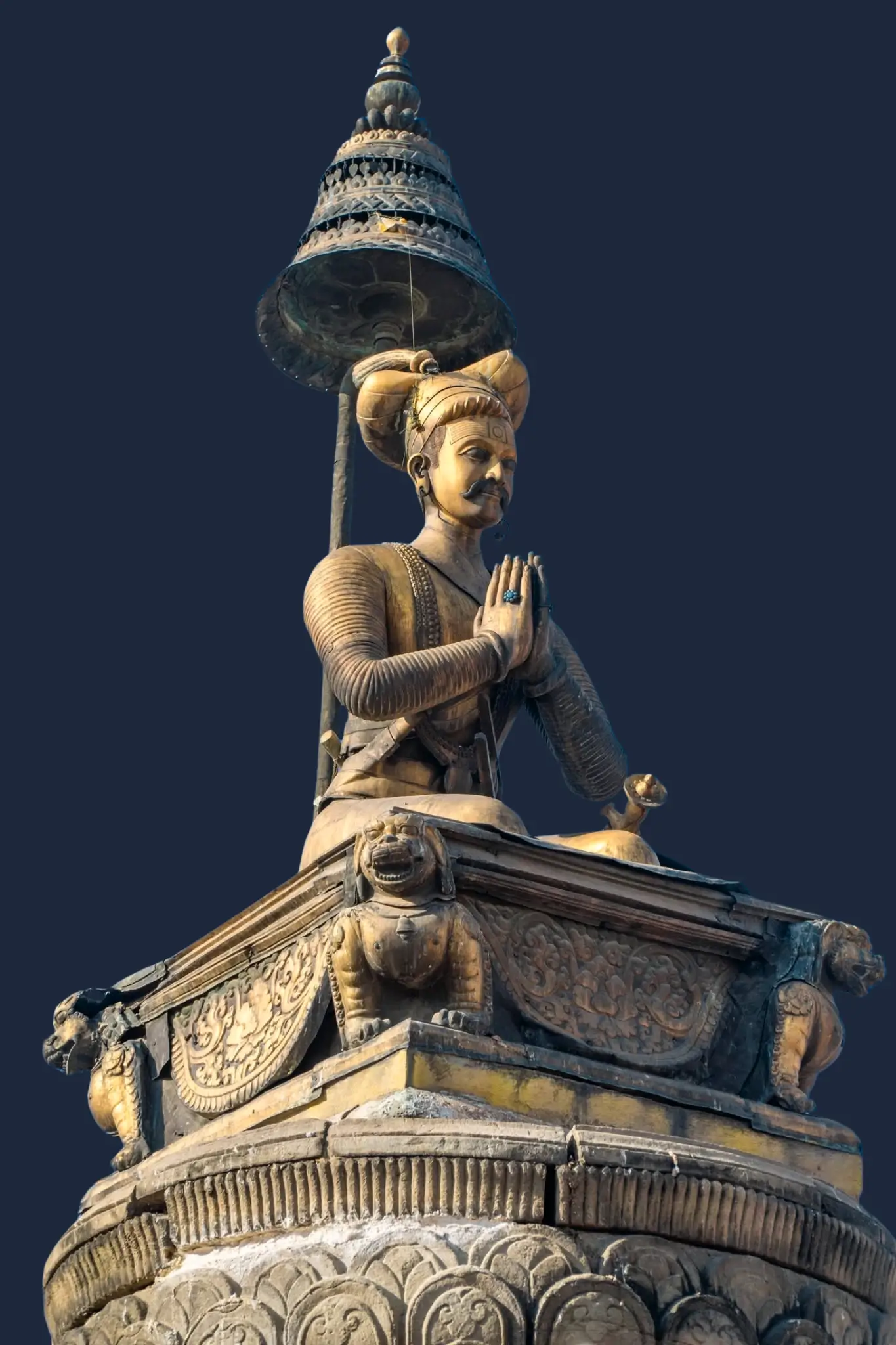
Yaksha Malla (reigned 1428–1482 CE) was a Malla dynasty king of medieval Nepal and the last sole ruler of the unified Nepal Mandala. He ruled for more than five decades, with Bhaktapur serving as his principal royal center. He was the son of King Jayajyoti Malla and the grandson of Jayasthiti Malla, an influential ruler of the Malla period.
Yaksha Malla's reign holds an important place in the political, administrative, and cultural history of the Kathmandu Valley. He maintained the authority of the central monarchy within the valley while seeking to extend his influence into surrounding territories. The construction of Bhaktapur's defensive moat and walls, regulations for protecting public structures, and the development of religious monuments were among the notable features of his rule.
Inscriptions and historical accounts associated with his period describe military campaigns toward Mithila, Magadha, Gorkha, and Tibet. However, there is insufficient evidence that permanent Malla administration was established in all these territories. It is therefore necessary to distinguish between claims of military victory and areas under actual administrative control.
Following Yaksha Malla's death in 1482 CE, his sons initially governed jointly. However, succession disputes and the influence of local political authorities gradually weakened the unified Malla kingdom. Through this process, Bhaktapur, Kantipur, and Lalitpur eventually developed into separate political centers.
Historical studies by Rishikesh Shaha and Mary Shepherd Slusser provide important foundations for understanding Yaksha Malla's reign, building activities, and the political changes that followed his death.
Quick Facts About Yaksha Malla
| Particulars | Historical Information |
|---|---|
| Full name | Jayayaksha Malla (Yaksha Malla) - यक्ष मल्ल |
| Dynasty | Malla dynasty |
| Father | King Jayajyoti Malla (Jyoti Malla) |
| Grandfather | King Jayasthiti Malla |
| Birth | Exact date not established |
| Accession | Around 1428 CE |
| Reign | 1428–1482 CE |
| Length of reign | Approximately 53–54 years |
| Principal royal center | Bhaktapur (then Bhadgaon or Khwopa) |
| Major administrative contribution | Fortification of Bhaktapur and its urban security arrangements |
| Associated construction works | Bhaktapur's moat and defensive walls; the historic rest house at Tachapal |
| Associated religious heritage | Yaksheshwar Mahadev, Dattatreya, and Pashupatinath |
| Principal successors | Raya Malla, Ratna Malla, and Rana Malla |
| Death | 1482 CE (Nepal Sambat 602) |
| Historical significance | Last sole Malla ruler of the unified Nepal Mandala |
The historical Nepal Mandala should not be confused with the geographical boundaries of present-day Nepal. In the medieval context, the term primarily referred to the Kathmandu Valley and surrounding areas connected to it politically and culturally.
Historical Background and Family
Yaksha Malla rose to power in a political environment shaped by the consolidation of central royal authority in the Kathmandu Valley under his grandfather, Jayasthiti Malla.
During the fourteenth century, the valley's political system was influenced by competition among local feudal authorities, royal families, and powerful court officials. External invasions also contributed to political instability.
One significant event was the invasion of the Kathmandu Valley in 1349 CE by Shamsuddin Ilyas Shah, the Sultan of Bengal. In the following decades, different royal and feudal groups continued to compete for political control.
Jayasthiti Malla and Political Unification
Jayasthiti Malla established his supreme royal authority in the Kathmandu Valley during his reign from 1382 to 1395 CE.
His administration sought to organize legal, social, and administrative practices. Efforts to strengthen the monarchy by controlling influential local authorities created a political foundation for subsequent Malla rulers.
After Jayasthiti Malla's death, his three sons—Jayadharma Malla, Jayajyoti Malla, and Jayakirti Malla—jointly exercised royal authority.
Following the deaths of his brothers, Jayajyoti Malla eventually became the sole ruler. His period of sole rule is generally placed between 1408 and 1428 CE.
According to historian Rishikesh Shaha, Jayajyoti Malla attempted to end the political influence of powerful local groups associated with the Bhonta royal family of Banepa. He maintained Bhaktapur's royal importance while exercising sole authority over the valley.
Yaksha Malla's Family Background
Yaksha Malla was the eldest son of King Jayajyoti Malla. He grew up within the royal traditions of Bhaktapur.
The earlier practice of joint government among the sons of Jayasthiti Malla was an important feature of his family's political history. A similar arrangement was initially adopted by Yaksha Malla's successors after his death.
Historical sources mention several queens associated with Yaksha Malla, although their names and total number are not recorded consistently.
The name of Karpuradevi is particularly associated with the history of the Yaksheshwar Mahadev Temple. Historical studies refer to religious donations and temple-related activities undertaken by a queen after Yaksha Malla's death.
Birth, Childhood and Early Life
Yaksha Malla's exact date and place of birth have not been conclusively established through surviving contemporary evidence.
Some biographical accounts place his birth around 1408 CE. However, sufficient direct evidence is unavailable to treat that year as a confirmed birth date.
Information about his childhood, education, and early administrative training is also limited.
Sanskrit literature, religious texts, astrology, royal customs, and administrative knowledge occupied important places in the intellectual environment of medieval royal households. Yaksha Malla grew up within this setting.
Bhaktapur was an important center of royal activity during Jayajyoti Malla's reign. As royal heirs were commonly associated with administrative affairs, Yaksha Malla may have become familiar with governance during his youth.
Nevertheless, there is no clear evidence identifying his teachers, the subjects of his formal training, or any specific administrative position he held before becoming king.
Accession and Consolidation of Central Authority
Yaksha Malla succeeded to the throne of Nepal Mandala around 1428 CE following the death of his father, Jayajyoti Malla.
He governed from Bhaktapur, which remained his principal royal center. Maintaining the central monarchy established by his predecessors and securing royal authority over other towns in the valley were among his main political challenges.
Although the king was based in Bhaktapur, powerful local officials and Mahapatras continued to exercise influence in Kantipur, Patan, and surrounding towns.
The Mahapatras were influential administrative officials or feudal groups who played important roles in local governance, revenue collection, and political affairs.
Royal Authority in Patan and Kantipur
Yaksha Malla attempted to maintain his supremacy over local political authorities in Patan and Kantipur.
During his reign, these towns had not yet developed into fully independent monarchies. However, influential local families sought to retain administrative autonomy.
According to Rishikesh Shaha, Yaksha Malla managed to control opposition from local rulers but could not eliminate the long-term tendency of individual towns toward political independence.
This tendency later became one of the important factors behind the kingdom's fragmentation.
Relations with Banepa and the Eastern Region
Banepa and the surrounding Bhonta region held an important position in the political history of medieval Nepal Mandala.
Local families in Banepa continued to exercise political influence during the reigns of Jayasthiti Malla and Jayajyoti Malla. Under Yaksha Malla, Bhaktapur's royal authority continued to extend into this region.
However, the available evidence does not establish that all local political authorities in Banepa were completely absorbed into the central administration at a single point in time.
The political control exercised during Yaksha Malla's reign should therefore be distinguished from the separate royal status that Banepa acquired under his successors.
Military Campaigns and Territorial Expansion
Yaksha Malla's reign witnessed military activities and efforts to expand political influence along the borders of Nepal Mandala.
Historical accounts of his victories mention Mithila, Magadha, Gorkha, Bengal, and Tibet. However, these references do not establish that permanent royal administration existed in all the territories mentioned.
Royal eulogies, later chronicles, and contemporary inscriptions differ in their historical purposes and reliability. These distinctions are important when assessing the actual extent of Yaksha Malla's military achievements.
Southern Campaigns: Mithila and Magadha
Mithila and Magadha feature prominently in historical descriptions of Yaksha Malla's military campaigns.
Accounts associated with the later Malla-period text Narapatijayacharya claim that Yaksha Malla conquered Mithila and extended his military influence toward Magadha and Gaya.
Some accounts also describe his influence reaching the Ganges River to the south.
However, these descriptions do not establish that he introduced permanent Malla administration throughout Mithila, Magadha, or the territories surrounding the Ganges.
They are therefore better understood as accounts of military activity and royal claims of victory rather than conclusive evidence of lasting territorial control.
Political Influence Toward the East
Various historical texts mention Yaksha Malla's political involvement in the eastern border regions.
Some accounts claim that his influence extended as far east as Bengal.
However, sufficient administrative evidence is unavailable to confirm continuous Malla rule in Bengal or other distant eastern territories.
By comparison, the historical basis for Malla authority in Banepa and its adjoining eastern areas is stronger.
Western Campaigns: Gorkha
Historical accounts also refer to military conflict between Yaksha Malla and local rulers in the Gorkha region.
Historian Rishikesh Shaha discusses Yaksha Malla's campaigns against hill rulers, including the ruler of Gorkha.
Nevertheless, there is insufficient evidence to conclude that permanent Malla administration was established throughout Gorkha and the entire Gandaki region.
Military attacks, temporary submission, and permanent administrative control represented different forms of political relationships among medieval hill states.
Northern Campaigns: Tibet
Historical literature also contains claims that Yaksha Malla's military influence reached Shikarjong in Tibet.
The Himalayan routes held considerable political importance because Nepal and Tibet maintained trade and religious connections.
However, clear evidence of permanent Malla administration extending to Shikarjong is lacking.
This claim should therefore be presented as a reported historical victory rather than an established instance of permanent territorial expansion.
Historical Assessment of Territorial Expansion
The language and conventions of medieval inscriptions must be considered when evaluating Yaksha Malla's military victories.
Royal eulogies often described rulers as powerful conquerors and referred to extensive territories to emphasize their achievements. Consequently, claims of victory should not automatically be equated with the boundaries of actual administrative authority.
According to Rishikesh Shaha, although later accounts exaggerated Yaksha Malla's conquests, he did extend the political influence of the kingdom inherited from his father.
On this basis, Yaksha Malla can be recognized as a ruler who conducted military operations in surrounding regions and sought to expand royal influence. However, portraying him as an emperor who permanently governed all territories from Mithila to Tibet would not be historically justified.
Administrative System and the Fortification of Bhaktapur
One of Yaksha Malla's notable administrative contributions was strengthening Bhaktapur's defensive infrastructure.
The king held supreme royal authority, while Mahapatras, court officials, and other administrators performed important functions at the local level.
Public construction, maintenance, and urban security arrangements were carried out through royal directives and the participation of local communities.
The Bhaktapur Fortification Inscription of Nepal Sambat 573
An inscription dated Shrawan, Nepal Sambat 573 (1453 CE), is an important historical source from Yaksha Malla's reign.
It records arrangements concerning the construction and protection of Bhaktapur's defensive moat, fortifications, and associated structures.
Defensive ditches and walls were constructed around the city to protect the royal capital. The inscription also refers to facilities for storing military equipment and provisions for maintaining defensive structures.
The translation of this inscription published in Daniel Wright's edited History of Nepāl provides information about community participation in construction and the regulations governing the city's defenses.
Participation of Local Communities in Construction
Members of different social groups were mobilized for the construction of Bhaktapur's fortifications.
The inscription mentions the participation of local residents in transporting bricks and earth for construction work.
This provides evidence of the use of community labor in public construction projects in medieval Nepal.
However, the arrangement should not be interpreted as a system of equal civic rights or equitable labor participation in the modern sense. Medieval society was structured around distinctions of caste, social status, and occupation.
Maintenance and Penalties
The Bhaktapur fortification inscription also records regulations intended to protect defensive structures.
The principal provisions included:
- Protecting the fortifications and associated defensive structures.
- Maintaining the city's cleanliness and carrying out necessary repairs.
- Preventing damage to bricks, stones, timber, and other materials used in the defensive walls.
- Restricting livestock grazing in prohibited areas where it could damage the fortifications.
- Imposing fines on officials who neglected their responsibilities or individuals who violated the prescribed rules.
The inscription identifies an official responsible for the fortifications as the Kotanayaka, or fortress officer.
Penalties were prescribed for a Kotanayaka who failed to fulfill assigned duties. Financial penalties were also imposed for damaging walls and other defensive structures.
The inscription's historical significance extends beyond the construction of fortifications. It also provides evidence of urban administration, public property protection, official responsibilities, and systems of punishment in medieval Nepal.
Contributions to Architecture, Temples and Cultural Heritage
Yaksha Malla's reign is closely associated with the architectural history of Bhaktapur.
Important heritage structures linked to his name include the historic rest house at Tachapal and the Yaksheshwar Mahadev Temple. Surviving inscriptions and architectural studies provide useful information about their construction and subsequent development.
Yaksheshwar Mahadev Temple
<AsyncImageGroup query={["Yaksheshwar Mahadev Temple Bhaktapur Durbar Square exterior","Yaksheshwar Mahadev temple Bhaktapur traditional pagoda architecture"]} aspectRatio="5:4" layout="carousel"/>
The Yaksheshwar Mahadev Temple, located in Bhaktapur Durbar Square, is a religious monument associated with Yaksha Malla.
Locally, it is also known as the Pashupatinath Temple of Bhaktapur. Its architectural form resembles that of the Pashupatinath Temple in Kathmandu.
Historical studies, however, offer different conclusions regarding its original construction date and builder.
In an architectural study published in 1974, Mary Shepherd Slusser and Gautamavajra Vajracharya associated the temple's establishment with Yaksha Malla.
According to earlier research cited in their study, evidence indicates that in Nepal Sambat 607 (1487 CE), Yaksha Malla's widow made a donation to an existing temple in his memory.
In contrast, historian Dr. Purushottamlochan Shrestha, as quoted in a report published by Kantipur, stated that Queen Karpuradevi built the temple in memory of Yaksha Malla in Nepal Sambat 605, following his death.
These differences show that questions concerning the temple's original foundation, construction, and subsequent patronage remain matters of historical interpretation.
Dattatreya Temple and the Historic Tachapal Rest House
<AsyncImageGroup query={["Dattatreya Temple Tachapal Square Bhaktapur Nepal exterior","Dattatreya Square Bhaktapur traditional Nepalese wooden architecture"]} aspectRatio="5:4" layout="carousel"/>
The early construction history of the Dattatreya Temple in Bhaktapur's Tachapal neighborhood is associated with Yaksha Malla's reign.
An important finding from architectural research is that the structure now known as the Dattatreya Temple was not originally built specifically as a temple.
According to the study by Mary Shepherd Slusser and Gautamavajra Vajracharya, its original structure served as a sattal, or rest house, for Shaivite ascetics and travelers.
A sattal is a public building traditionally constructed to provide rest and temporary accommodation for travelers, religious practitioners, and other visitors.
The researchers examined a damaged Sanskrit–Nepal Bhasa inscription that refers to construction undertaken by Yaksha Malla. The inscription also mentions his son, Raja Malla.
Because the year is not clearly preserved, the exact construction date cannot be established. However, evidence that Raja Malla died before 1467 CE supports the conclusion that the original rest house was constructed during Yaksha Malla's reign.
The building appears initially to have been associated with Shaivite religious practices. It was later developed into a temple dedicated to Dattatreya.
Historical researchers have proposed different possibilities regarding the date of this transformation.
Siddha Pokhari and Water Heritage
<AsyncImage query="Siddha Pokhari Ta Pukhu historic pond Bhaktapur Nepal" aspectRatio="16:9"/>
Siddha Pokhari, known in Nepal Bhasa as Ta Pukhu, is an important historic water reservoir in Bhaktapur.
Traditional accounts associate its construction or expansion with Yaksha Malla. However, historical descriptions do not agree on the date of its original construction.
It would therefore be inappropriate to present Yaksha Malla as the confirmed builder of the entire pond.
Nevertheless, the development of ponds, water sources, public rest houses, and religious structures was an important feature of medieval urban life in Bhaktapur.
Association with Pashupatinath and Religious Traditions
Yaksha Malla's name is also associated with the worship system of Pashupatinath and the tradition of South Indian Bhatta priests.
Historian Rishikesh Shaha connects the introduction of South Indian Bhatta Brahmins for worship at Pashupatinath with Yaksha Malla.
The chronicle edited by Daniel Wright also contains an account of South Indian Bhatta Brahmins being entrusted with worship at Pashupatinath during Yaksha Malla's reign.
However, the available evidence does not conclusively establish that Yaksha Malla personally introduced every element of the priestly system practiced at the temple today.
Pashupatinath's religious and administrative arrangements developed over time under different rulers.
Yaksha Malla's connection should therefore be understood as part of the historical tradition surrounding the temple's priesthood rather than an undisputed account of the origin of its entire present-day system.
Contributions to Language, Literature and Intellectual Life
Yaksha Malla's reign was an important period in the expanding use of Nepal Bhasa in written records.
Sanskrit held a prominent position in the official and literary traditions of medieval Nepal. However, Nepal Bhasa had already appeared in written records before Yaksha Malla became king.
Examples of Nepal Bhasa in inscriptions can also be found from the reign of Jayasthiti Malla.
According to Rishikesh Shaha, its use expanded further during Yaksha Malla's reign, increasing its importance in royal records.
Nepal Bhasa in Royal Inscriptions
The use of Nepal Bhasa for public and administrative purposes was a notable feature of Yaksha Malla's period.
It demonstrates that the language was not limited to everyday speech but had also become associated with official records and public administration.
Inscriptions combining Sanskrit and Nepal Bhasa provide valuable evidence for understanding the relationship between royal administration and local languages.
The bilingual inscription associated with the historic rest house at Tachapal is important in this context.
Nevertheless, the claim that Yaksha Malla was the first ruler to recognize or use Nepal Bhasa in royal records is inconsistent with earlier historical evidence.
Manuscripts and Literary Traditions
During the Malla period, the study and copying of religious, philosophical, astrological, and literary texts in Sanskrit and local languages formed part of the region's intellectual culture.
Colophons, or notes written at the end of manuscripts, are important historical sources. They may record the reigning monarch, the date of copying, and sometimes the location or donor associated with a manuscript.
Materials connected with Yaksha Malla's reign can therefore help researchers understand the intellectual and religious activities of the period.
However, specific claims about manuscripts commissioned directly by his court or plays performed under his patronage require verification from the relevant original sources.
His reign can be discussed within the broader history of medieval literary activity, but he should not be presented as the founder of a particular literary work or theatrical tradition without sufficient evidence.
Religious Policies and Social Organization
Shaivite, Vaishnavite, and Buddhist traditions were important aspects of religious and social life in Nepal Mandala during Yaksha Malla's reign.
Religious patronage by the Malla royal family was connected with temples, shrines, religious endowments, and royal rituals.
Connections with Hindu Religious Traditions
The Yaksheshwar Mahadev Temple and the early Shaivite rest house at Tachapal provide evidence of Yaksha Malla's association with institutions connected to the worship of Shiva.
Architectural research also shows that the original rest house at Tachapal was subsequently developed into a place of worship dedicated to Dattatreya.
This illustrates how the purpose and religious associations of a historic structure could change over time.
Buddhism and Local Religious Life
Hindu and Buddhist traditions had a long history of coexistence in medieval Kathmandu Valley society.
Buddhist monasteries, temples, stupas, religious endowments, and local festivals were important institutions within the valley's social and religious life.
The society governed by Yaksha Malla formed part of this wider cultural environment.
However, there is insufficient evidence to conclude that no religious disputes occurred during his reign or that all religious communities enjoyed equal social and political rights.
Caste and Occupational Structure
Social organization during Yaksha Malla's reign was closely connected with caste, social status, occupations, and local customs.
Some of the social and administrative practices organized during the reign of his grandfather, Jayasthiti Malla, continued under later Malla rulers.
The participation of different social groups in the construction of Bhaktapur's fortifications, as recorded in the contemporary inscription, provides evidence of this social organization.
Although the inscription demonstrates the mobilization of communities for public responsibilities, the hierarchical and occupational divisions of medieval society must also be considered.
Family Life and Successors
Information about Yaksha Malla's children is important for understanding the political history of medieval Nepal.
Succession disputes following his death contributed to major changes in the political structure of the unified Malla kingdom.
Sons of Yaksha Malla
According to historian Rishikesh Shaha, at least six sons of Yaksha Malla were involved in the succession.
They are listed as follows:
- Raya Malla
- Ratna Malla
- Rana Malla
- Rama Malla
- Ari Malla
- Purna Malla
In addition, Yaksha Malla had another son named Raja Malla, who died during his father's lifetime.
It is therefore more accurate to state that Yaksha Malla had at least six sons involved in the succession rather than claiming that he had only six sons in total.
Historical studies also mention a daughter named Dharmavati. Her son, Bhima Malla, later became associated with royal succession arrangements.
Yaksha Malla's Death and the Division of the Kingdom
Yaksha Malla died in 1482 CE. The succession disputes that followed his death changed the political history of the Kathmandu Valley.
Traditional chronicles contain an account claiming that Yaksha Malla divided his kingdom among his sons during his lifetime.
However, modern historical research based on contemporary evidence does not accept this account as established fact.
Did Yaksha Malla Divide the Kathmandu Valley into Three Kingdoms?
According to modern historical research, Yaksha Malla did not divide Nepal Mandala into separate independent kingdoms during his lifetime.
Some chronicles published in the nineteenth century claim that he assigned Bhaktapur to Raya Malla, Kantipur to Ratna Malla, and other territories to his remaining children.
However, historians comparing contemporary records with later chronicles have given greater weight to evidence indicating that the successors initially governed jointly.
According to Rishikesh Shaha, Raya Malla, Ratna Malla, and Rana Malla initially exercised royal authority together.
This arrangement resembled the joint government established by the sons of Jayasthiti Malla after their father's death.
Ratna Malla's Separate Rule in Kantipur
Succession disputes following Yaksha Malla's death led Ratna Malla to establish his political authority in Kantipur.
Historical studies indicate that by 1484 CE, he had begun exercising separate rule in Kantipur.
During this initial period, his brother Ari Malla was also associated with the administration of Kantipur.
Ratna Malla's political activities accelerated the breakup of the unified monarchy centered in Bhaktapur.
As Kantipur developed into a separate royal center, the political balance within the Kathmandu Valley changed.
Raya Malla's Rule in Bhaktapur
Raya Malla was the eldest son of Yaksha Malla.
Following his father's death, he held a prominent position in the succession. However, the joint monarchy could not be maintained as a unified political system for long.
Raya Malla subsequently became established as the separate ruler of Bhaktapur.
Thus, the Bhaktapur-centered monarchy that had remained unified during Yaksha Malla's reign developed into a divided political structure under his successors.
Rana Malla and the Kingdom of Banepa
Rana Malla established his royal authority in Banepa and its surrounding areas.
This gave Banepa an important place in the political fragmentation of Nepal Mandala.
According to Rishikesh Shaha, Rana Malla died in 1529 CE. In the absence of a direct successor, royal authority over Banepa became associated with Bhaktapur again.
This demonstrates that not all political entities formed during the initial division remained permanently independent.
The Separate Political Development of Lalitpur
Lalitpur's political development differed somewhat from that of Kantipur and Bhaktapur.
There is no clear evidence that one of Yaksha Malla's sons established a permanent independent royal dynasty in Lalitpur immediately after his death.
Influential local Mahapatras continued to exercise authority there, and their autonomy increased over time.
Lalitpur gradually acquired a separate political identity over the following decades. The development of its independent monarchy was a gradual process.
The three major Malla kingdoms of the Kathmandu Valley should therefore not be understood as having been established simultaneously through a single royal decree.
Final Years and Death
Yaksha Malla died in 1482 CE, corresponding to Nepal Sambat 602.
Because his exact birth date has not been established, his age at death cannot be determined with certainty.
The available historical materials also do not provide clear and undisputed information about the cause of his death.
The joint government that followed his death, together with its gradual collapse, represents one of the most significant political consequences of his reign.
Historical Contributions and Significance
Yaksha Malla's historical significance is primarily associated with the continuation of political unity, the fortification of Bhaktapur, the preservation of cultural heritage, and the division of the kingdom after his death.
Political Contributions
Yaksha Malla maintained the central monarchy that Jayasthiti Malla had consolidated.
He attempted to control local political authorities and expand Malla influence into surrounding regions.
However, the tendency toward local autonomy was not eliminated during his reign. After his death, the political structure gradually fragmented.
Administrative Contributions
The Bhaktapur fortification inscription of Nepal Sambat 573 is an important record of Yaksha Malla's administration.
It documents the mobilization of labor for urban defense, the maintenance of public structures, official responsibilities, and penalties for violating prescribed regulations.
The inscription is a useful source for studying urban administration and public construction in medieval Nepal.
Cultural and Architectural Contributions
Yaksha Malla's name is associated with religious and public buildings in Bhaktapur.
The inscription and architectural research concerning the original rest house at Tachapal provide information about construction activities during his reign.
Historical traditions and later records of donations associated with the Yaksheshwar Mahadev Temple also shed light on religious patronage by his family.
Linguistic Contributions
Yaksha Malla's reign was a period when the use of Nepal Bhasa expanded in royal and public inscriptions.
This development shows how written administrative practices in medieval Nepal Mandala increasingly incorporated a local language alongside Sanskrit.
Succession and Political Change
The division of the Malla kingdom following Yaksha Malla's death had a lasting influence on the subsequent history of the Kathmandu Valley.
As Bhaktapur, Kantipur, and Lalitpur developed into separate political centers, their rulers entered different phases of rivalry and conflict.
Religious and cultural construction activities also continued amid this political competition.
Separate royal administrations remained in the valley until the conquest of its kingdoms by King Prithvi Narayan Shah of Gorkha in the eighteenth century.
From this perspective, Yaksha Malla's reign represents the final phase of the unified Malla monarchy and an important historical background to the later system of separate kingdoms.
Conclusion
Yaksha Malla was an important ruler of medieval Nepal Mandala. He governed the Bhaktapur-centered monarchy from 1428 to 1482 CE.
The construction of Bhaktapur's defensive moat and walls, the administration of local affairs, the patronage of religious structures, and the expanding use of Nepal Bhasa in inscriptions were significant features of his reign.
Historical accounts of his military campaigns demonstrate the political ambitions of the Malla monarchy. However, claims of victories in distant territories should not be treated as evidence of permanent territorial expansion.
Following his death, competition over royal succession weakened the unified political structure of Nepal Mandala. Separate Malla kingdoms gradually developed in the Kathmandu Valley.
An assessment of Yaksha Malla's legacy must therefore consider both the administrative and cultural achievements of his long reign and the political limitations of the succession arrangements that followed it.
References
-
Shaha, Rishikesh (1989). “Ancient and Medieval Nepal.” Kailash: A Journal of Himalayan Studies, Vol. 15, Nos. 1–2. Kathmandu: Ratna Pustak Bhandar. Historical study covering Yaksha Malla
-
Slusser, Mary Shepherd, and Gautamavajra Vajrācārya (1974). “Two Medieval Nepalese Buildings: An Architectural and Cultural Study.” Artibus Asiae, Vol. 36, No. 3, pp. 169–218. Original architectural research article
-
Wright, Daniel, ed. (1877). History of Nepāl. Cambridge: Cambridge University Press. Historical chronicles and inscription texts
-
Slusser, Mary Shepherd (1982). Nepal Mandala: A Cultural Study of the Kathmandu Valley. Vols. 1–2. Princeton: Princeton University Press.
-
Shrestha, Lila (March 15, 2023). “५३८ वर्ष पुरानो मन्दिरको पुनर्निर्माण अलपत्र” [Reconstruction of a 538-Year-Old Temple Remains Incomplete]. Kantipur Daily. Includes historical commentary by Dr. Purushottamlochan Shrestha concerning the Yaksheshwar Mahadev Temple. Published news report






Comments 0
No comments yet. Be the first to start the conversation.