



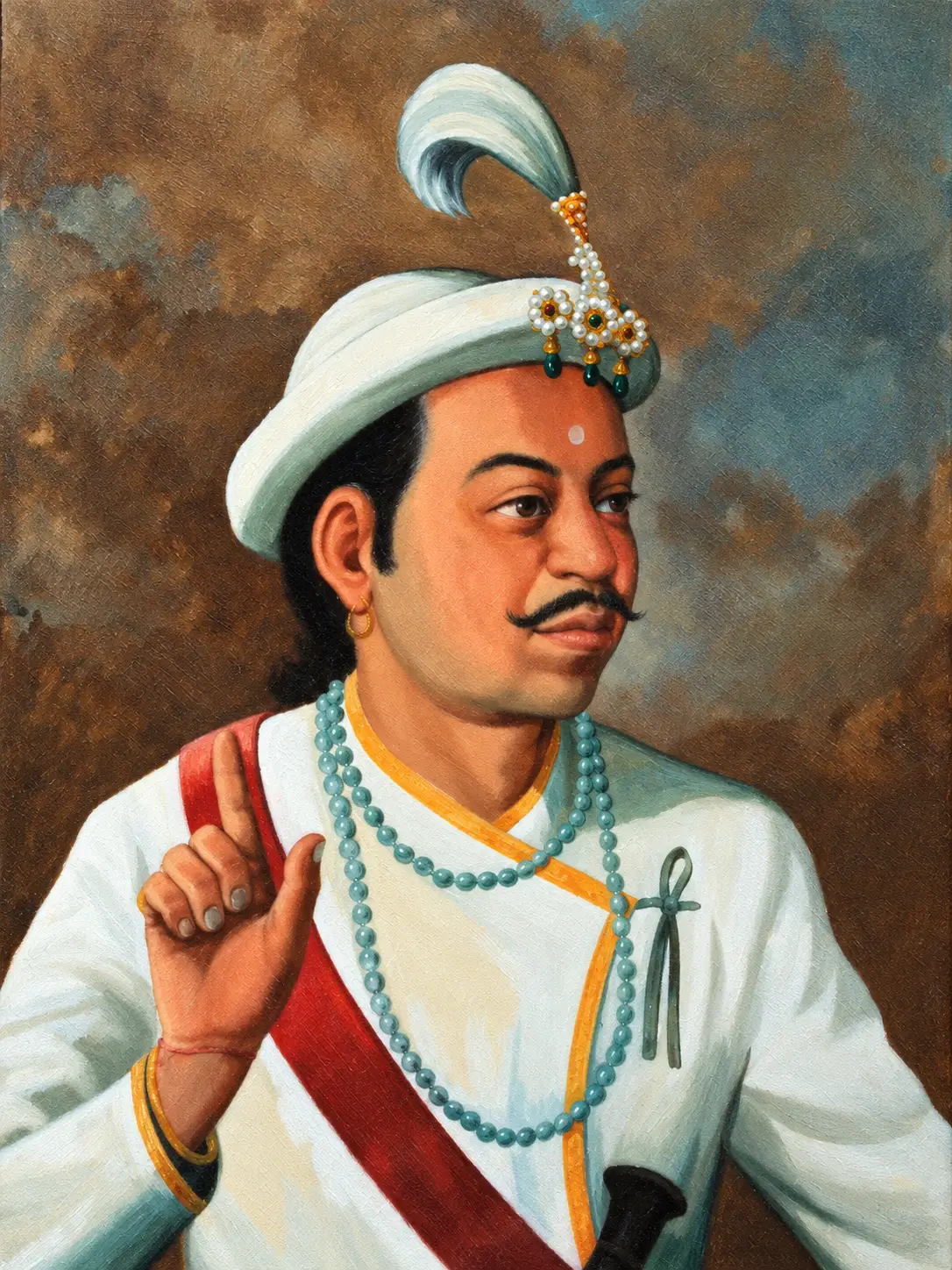
Ram Shah (राम शाह) was a king of the Shah dynasty who ruled the Kingdom of Gorkha during the 17th century. He is particularly known in Nepali history for regulations concerning justice, weights and measures, loans and interest, land administration, and social practices. These regulations associated with his name are commonly known as the "26 Thitis of Ram Shah."
Before the unification of Nepal, Gorkha was an independent hill kingdom. Historical chronicles and legal documents describe the expansion of its political influence during am Shah's reign, along with efforts to regulate administrative and economic activities.
His name is also associated with the well-known saying, "If you cannot obtain justice, go to Gorkha." This reflects the tradition of remembering Ram Shah as a ruler associated with justice in Nepali society.
However, historical sources differ regarding the dates of Ram Shah's accession and death, as well as the original form of his regulations. Understanding his biography therefore requires distinguishing accounts preserved in traditional chronicles from facts supported by contemporary historical records.
Brief Introduction to Ram Shah
|
Detail |
Historical Information |
|---|---|
|
Full Name |
Ram Shah |
|
Position |
King of Gorkha |
|
Dynasty |
Shah dynasty |
|
Reign |
Traditionally dated to BS 1663–1690; records confirm that he ruled during BS 1671–1693 |
|
Father |
King Purandar Shah |
|
Predecessor |
Chhatra Shah |
|
Successor |
Dambar Shah |
|
Grandfather |
Dravya Shah |
|
Seat of Government |
Gorkha |
|
Major Contributions |
Judicial and administrative regulations, standardization of weights and measures, regulation of loans and interest, and rules concerning land and public resources |
|
Diplomatic Relations |
Traditional accounts describe relations with King Siddhi Narasimha Malla of Patan |
|
Historical Recognition |
Regulations attributed to Ram Shah and his reputation for justice |
|
Birth and Death |
Exact dates have not been established |
Family Background and Early Life
Ram Shah belonged to the Shah dynasty that ruled Gorkha. He was the son of King Purandar Shah, the brother of Chhatra Shah, and the grandson of Dravya Shah, who established Shah rule in Gorkha.
Dravya Shah established his rule in Gorkha in AD 1559 (BS 1616). Purandar Shah succeeded him as king. According to traditional Gorkha chronicles, Purandar Shah was succeeded by his eldest son, Chhatra Shah, followed by Ram Shah.
Sufficient contemporary records are not available to provide detailed information about Ram Shah's birth year, childhood, or early education. His date of birth, place of education, and events of his early life therefore cannot be presented as established historical facts.
Sources concerning the royal regulations indicate that royal preceptors, priests, and court officials played roles in the Gorkha palace administration of the period. However, there is no clear evidence identifying Ram Shah's personal teachers or the subjects he studied under them.
Ram Shah's Accession and Reign
There are significant differences between traditional chronicles and archival research concerning the beginning and end of Ram Shah's reign.
Some accounts based on older chronicles state that Ram Shah ascended the throne of Gorkha in AD 1606 (BS 1663), following the death of Chhatra Shah. According to these accounts, he ruled for approximately 27 years, until AD 1633 (BS 1690).
However, historian Dinesh Raj Pant compared this traditional chronology with contemporary records in his 1973 research paper, Ram Shah's Reign: A Discussion (रामशाहको राज्यकाल—एक चर्चा).
His research indicates that the traditional dates of Ram Shah's reign cannot be accepted without qualification.
What Do Historical Records Confirm About Ram Shah's Reign?
Dinesh Raj Pant's study identifies the following evidence:
-
A record dated BS 1666 (AD 1609) identifies Chhatra Shah as king.
-
Evidence dated BS 1671 (AD 1614) identifies Ram Shah as the king of Gorkha.
-
Another record dated BS 1693 (AD 1636) also identifies Ram Shah as king.
-
Evidence shows that Dambar Shah had become king of Gorkha by BS 1701 (AD 1644).
Based on these records, Ram Shah appears to have ascended the throne after BS 1666 and no later than BS 1671. Similarly, his reign ended after BS 1693 and by BS 1701.
The period from BS 1671 to BS 1693 is therefore a documented part of Ram Shah's reign. However, these dates should not be treated as the definite beginning and end of his entire reign.
Historian Pant also concluded that further archival research is necessary to determine the exact dates of Ram Shah's accession and death.
Political Conditions and Expansion of the Gorkha Kingdom
During Ram Shah's reign, Gorkha was a hill kingdom that existed before the unification of Nepal. Its neighboring regions included Lamjung, Tanahun, and territories influenced by various local rulers.
At that time, the strength of a kingdom did not depend solely on military capabilities. Agricultural production, trade connections, relations with local leaders, and the palace's administrative arrangements also played important roles in governance.
Traditional historical chronicles describe Ram Shah as a ruler who expanded Gorkha's territory and political influence.
In his 1977 study, The Royal Edicts of King Rama Shah of Gorkha, Theodore Riccardi Jr. discusses traditional accounts of Ram Shah extending Gorkha's influence toward the Trishuli Valley.
His study also examines Ram Shah's foreign relations and the political consolidation of Gorkha.
However, sufficient contemporary records are not available to verify every military campaign attributed to Ram Shah, the dates of individual battles, or the precise territorial boundaries resulting from each conquest.
Although traditional accounts describe an expansion of Gorkha's political influence during his reign, it would be inappropriate to present specific conquests or territorial acquisitions as established historical facts without sufficient supporting evidence.
What Are the 26 Thitis of Ram Shah?
The 26 Thitis of Ram Shah refer to royal regulations associated with his name that address justice, administration, economic transactions, land management, the use of public resources, religious responsibilities, and social practices.
The term thiti refers to an established rule, arrangement, or customary practice intended to regulate particular activities or conduct.
The regulations preserved under Ram Shah's name cover subjects such as measuring grain, units of weight, interest on loans, irrigation canals, land boundaries, grazing grounds, palace officials, and punishments.
These royal orders are important historical sources for understanding the economic, social, and administrative conditions of the Gorkha Kingdom during that period.
Did Ram Shah Establish Exactly 26 Rules?
These regulations are traditionally known as the "26 Thitis." However, studies of different historical manuscripts reveal variations in both their number and content.
Theodore Riccardi Jr. examined the orders attributed to Ram Shah by comparing various manuscripts and published sources.
According to his study, one principal text contains 26 orders. When an additional order found in other versions is included, the total reaches 27.
Some orders are incomplete. Variations also exist in the wording and interpretation of certain provisions.
Riccardi suggests that the surviving orders may not originally have been prepared as a single, systematically organized legal code. Instead, they may have been separate royal orders issued on different matters.
The language of the detailed surviving texts also contains features associated with periods later than Ram Shah's reign. This suggests that subsequent historical periods influenced how the regulations were collected and recorded.
Therefore, "26 Thitis" is a historically established name. There is insufficient evidence to conclude that Ram Shah issued all these regulations as a complete legal code on a single date.
Reforms in Weights and Measures
One of the major subjects covered by the regulations attributed to Ram Shah is the standardization of weights and measures.
In the society of that period, people used bamboo containers, vessels, and baskets to measure grain. Differences in their sizes could result in inconsistent measurements during transactions.
The second thiti associated with Ram Shah specifies units for measuring grain.
|
Unit of Measurement |
Ratio Mentioned in the Thiti |
|---|---|
|
Mana |
10 handfuls = 1 mana |
|
Pathi |
8 mana = 1 pathi |
|
Muri |
20 pathi = 1 muri |
The same regulation also mentions placing the royal seal on mana and pathi measuring vessels.
This indicates an effort to establish common standards for measuring grain in commercial transactions.
Regulations Concerning Weights
The third thiti contains rules concerning units of weight and weighing equipment.
It mentions units including lal, masa, tola, pal, bodi, bisauli, and dharni.
The texts presented by Riccardi specify the following ratios:
-
10 lal = 1 masa
-
10 masa = 1 tola
-
27 tola = 1 bodi
-
108 tola = 1 bisauli
-
2 bisauli = 1 dharni
However, textual inconsistencies exist in the ratios of certain units, including pal. Consequently, not all historical units can be interpreted in a uniform manner.
The third thiti also mentions the use of royal symbols and seals on weighing scales and weights.
The historical significance of these regulations lies in the attempt to establish uniform standards of measurement in trade.
Rules Concerning Loans and Interest
The regulations attributed to Ram Shah contain separate provisions for interest and recovery on cash loans and grain loans.
In the agricultural society of that period, people commonly borrowed money or grain for farming and household needs. As outstanding loans accumulated interest over time, setting limits on repayment became important.
The regulations refer to lenders as sahu and borrowers as asami.
Interest on Cash Loans
The fifth thiti describes interest on cash loans using the term दसौँद, referring to a one-tenth rate.
According to the text presented by Riccardi, interest was calculated at an annual rate of 10 percent, resulting in the total amount, including principal, doubling over 10 years.
If a borrower was unable to repay the principal and interest even after more than 10 years, the regulation prohibited the lender from recovering more than twice the original principal.
The purpose was to prevent interest from increasing indefinitely when a loan remained unpaid for a prolonged period.
Interest on Grain Loans
The fourth thiti describes interest on grain loans using the term पञ्चौँद, referring to a one-fifth rate.
Riccardi interprets this provision in his edited text as an annual interest rate of one-fifth, or 20 percent.
Under this calculation, the total grain debt, including principal and interest, would become three times the original amount over 10 years.
The regulation also provided that a lender could not recover more than three times the original quantity of grain, even if the borrower failed to repay the loan for more than 10 years.
Some older accounts interpret the interest provisions for grain loans differently. It is therefore necessary to distinguish the original text from its scholarly interpretation.
These historical regulations cannot be applied as the current laws governing loans and interest in Nepal.
Management of Irrigation Canals, Water Sources, and Shared Resources
The regulations attributed to Ram Shah also contain rules governing the use of communal water sources, traditional oil presses, and irrigation canals.
These rules primarily addressed minor disputes that could arise when multiple people used shared resources.
Taking Turns at Public Water Sources
The sixth thiti states that the person who arrives first at a communal water source has the right to collect water first.
Individuals were prohibited from interfering with another person's turn.
The regulation also specified that minor disputes of this nature would not be heard in the royal court.
Use of Traditional Oil Presses
The seventh thiti addressed situations in which several households shared the same traditional oil press.
It required users to take turns when pressing oil.
Interfering with another person's turn was prohibited, and minor disputes over the use of the press were not to be brought before the royal court.
Distribution of Irrigation Water
The eighth thiti established rules for distributing irrigation water according to the respective shares of agricultural land.
Farmers were required to use their allotted water in turn and were prohibited from taking water belonging to another person's share or turn.
These three regulations illustrate an effort to manage everyday disputes through established practical rules.
However, the surviving texts do not clearly establish that such disputes were necessarily required to be resolved by village panchas, or local elders.
Land Administration and Birta Grants
The regulations attributed to Ram Shah contain provisions concerning land grants, measurement of landholdings, and the determination of property boundaries.
The ninth and tenth thitis particularly address the granting of birta land to Brahmins.
Birta was a form of land granted by royal authority under the state system of that period.
Disputes could arise when the actual area and boundaries of granted land were not clearly established.
The regulations therefore required land grants to specify the quantity of land, identify boundaries on all four sides, and clearly demarcate the property.
The texts also describe the roles of the king, chautariya, kaji, and local representatives in this process.
The tenth thiti specifically addresses the identification of land boundaries in the presence of various individuals.
These provisions indicate an attempt to establish defined procedures for granting land.
Production from Newly Cultivated Land
The twenty-third thiti contains provisions concerning the distribution of harvests from land newly brought under cultivation.
According to the text, the person cultivating the land was entitled to the harvest for the first three years.
From the fourth year onward, the regulation provided for separating the landowner's share and the cultivator's remuneration.
This reflects an effort to regulate the relationship between agricultural production, labor, and landownership.
However, these regulations should not be equated with modern laws concerning landownership and labor rights.
Protection of Grazing Grounds, Roadside Trees, and Water Sources
The regulations attributed to Ram Shah also contain provisions for protecting certain natural resources used by the public.
These include grazing grounds, trees along roads, and forests near water sources.
Provision for Grazing Grounds
The twelfth thiti specifies that suitable grazing grounds should be maintained in villages for livestock.
Communal grazing areas were important in the agricultural and livestock-based society of that period.
The regulation also associated the protection of grazing grounds with royal and religious responsibilities.
Protection of Roadside Trees
The thirteenth thiti requires the protection of trees growing along roads.
The order explains that trees provide necessary shade for travelers on foot, people carrying loads, and those returning from work.
It also specifies a fine of five rupees for cutting down a roadside tree.
Protection of Forests Near Water Sources
The fourteenth thiti addresses the protection of trees and forests near communal water sources and springs.
It expresses the belief that deforestation could cause water sources to dry up and increase the risk of landslides.
The regulation also prescribes a fine of five rupees for cutting down forests near communal water sources.
These regulations demonstrate the concern of the administration of that period for protecting public resources.
However, interpreting them as equivalent to a modern environmental legal system would be historically inappropriate.
Tharghar Groups and Palace Administration
The orders preserved under Ram Shah's name contain information about influential groups of court officials and various royal positions within the Gorkha palace.
The eleventh thiti specifically mentions six family groups, known as the Chha Thar.
These groups were:
-
Pande
-
Panth
-
Arjyal
-
Khanal
-
Rana
-
Bohara
According to this regulation, these six family groups were responsible for informing the king if officials such as the chautariya, kaji, or sardar engaged in activities that could harm the royal throne or the administration of justice.
This reflects an attempt to regulate royal responsibilities and the roles of influential groups within the palace.
Other Palace Officials
The twenty-second thiti mentions various royal offices and the family groups assigned responsibilities within them.
These include positions such as kapardar, khajanchi, dharmadhikari, and sardar.
The kapardar was associated with managing palace belongings and royal clothing. The khajanchi was responsible for matters concerning the royal treasury.
Similarly, the dharmadhikari was a senior official associated with judicial and religious responsibilities, while the sardar held responsibilities related to military affairs.
These details indicate that responsibilities were distributed among different offices within the Gorkha palace administration.
However, the available evidence does not establish that Ram Shah personally created all these positions for the first time.
Relations with King Siddhi Narasimha Malla of Patan
One notable diplomatic account associated with Ram Shah's reign concerns his relationship with King Siddhi Narasimha Malla of Patan.
The twenty-fifth thiti attributed to Ram Shah describes an alleged agreement between Gorkha and Patan.
According to this text, if the ruler of either kingdom had no children, a child of the other ruler would be entitled to succeed to the throne.
This account survives in a text of the regulations compiled during a later period. It therefore cannot be treated as direct evidence from an original treaty signed at the time.
Nevertheless, it reflects a historical tradition describing political relations between Gorkha and Patan.
Arrival of Merchants from Patan
The twenty-fifth thiti also mentions that merchants belonging to 24 kothis, or trading establishments, were brought from Patan to Gorkha.
Another related historical text states that these merchants were permitted to settle in Gorkha and were granted land and certain royal privileges.
This supports the traditional account of commercial and business connections between Gorkha and Patan.
However, independent historical records do not clearly establish the exact year of the merchants' arrival, the identities of individual merchants, or the measurable extent of their contributions to Gorkha's economy.
Judicial Administration and the Saying "If You Cannot Obtain Justice, Go to Gorkha"
Ram Shah's name is associated with a reputation for justice in Nepali society.
He is particularly remembered as a historical ruler connected with justice because of the popular saying, "If you cannot obtain justice, go to Gorkha."
The Gorkha chronicles describe instances in which rulers of neighboring kingdoms referred disputes they could not resolve to Ram Shah's court.
Theodore Riccardi presents this account from the chronicles in his study.
The chronicles record a version of the saying that translates as, "If learning is lost, go to Kaski; if justice is lost, go to Gorkha."
This is similar in meaning to the version commonly used today: "If you cannot find knowledge, go to Kashi; if you cannot obtain justice, go to Gorkha."
However, the wording of the two versions differs.
These accounts indicate the existence of a popular tradition associated with Ram Shah's judicial reputation.
Nevertheless, it is not certain when the saying first came into use.
It is therefore more appropriate to understand the saying as a historical expression of the judicial reputation associated with Ram Shah than as a quotation proven to have originated, word for word, during his reign.
Social Order and the System of Punishment
The regulations attributed to Ram Shah also reflect the caste-based, religious, and royal hierarchies of Gorkha society during that period.
The social system of the time was not based on the modern principle of equal citizenship.
The regulations prescribe different punishments depending on a person's caste group, relationship with the royal family, and religious status.
The fifteenth and sixteenth thitis contain provisions for treating different social groups differently in cases involving serious offenses.
Similarly, the seventeenth thiti links the right to wear gold ornaments with royal positions and social status.
These provisions demonstrate that social discrimination was institutionally embedded in the governance system of that period.
For this reason, Ram Shah's regulations should not be presented as a legal code based on equality and impartial justice in the modern sense.
Some orders attributed to him attempted to establish specific rules for economic transactions and the use of public resources. Others reinforced existing social inequalities.
Both aspects must be considered when evaluating his historical role.
Religious and Cultural Aspects
There is evidence of connections between royal administration and religious institutions during Ram Shah's reign.
The first thiti traditionally attributed to Ram Shah mentions the appointment of Nanda Mishra as the royal preceptor, or rajguru, and provides for his descendants to continue holding that responsibility.
This indicates the role of the royal preceptor within the Gorkha palace administration of that period.
Certain inscriptions associated with religious structures are also important for determining the chronology of Ram Shah's reign.
According to Dinesh Raj Pant's research, an inscription dated BS 1671 at the Muralidhar Narayan Temple in Pokharithok, Gorkha, identifies Ram Shah as king.
Similarly, an inscription dated BS 1693 associated with the Rameshwar Temple in Gorkha also mentions his name.
These inscriptions provide information about religious activities associated with his reign and serve as evidence for examining the traditional chronology of his rule.
Various religious and supernatural stories associated with Ram Shah also appear in historical chronicles and local traditions.
However, such stories cannot be treated as equivalent to historical events verified through contemporary records.
Ram Shah's Death and Successor
The exact date and place of Ram Shah's death have not been established.
Traditional accounts place his death around AD 1633 (BS 1690).
However, archival evidence identifying Ram Shah as king in BS 1693 (AD 1636) raises questions about this traditional date.
According to Dinesh Raj Pant's research, Ram Shah was king in BS 1693, while Dambar Shah had become king of Gorkha by BS 1701.
This indicates that Ram Shah's reign ended after BS 1693 and by BS 1701.
Nevertheless, sufficient evidence is not available to determine the exact year or place of his death.
Ram Shah was succeeded by his son, Dambar Shah, as king of Gorkha.
Ram Shah's Contributions to Nepal's Legal History
Ram Shah is recognized in Nepali history as a ruler associated with judicial and administrative regulations.
The regulations preserved under his name provide important information about the economic, social, and administrative life of the Gorkha Kingdom during that period.
Their historical significance is particularly evident in the following areas:
-
Efforts to regulate the measurement of grain and other commodities.
-
Establishment of limits on interest and recovery for cash and grain loans.
-
Rules governing the use of communal water sources, irrigation canals, and shared oil presses.
-
Provisions for specifying land area and boundaries when granting birta land.
-
Protection of grazing grounds, roadside trees, and forests near water sources.
-
Regulations concerning the responsibilities of influential court groups and palace officials.
-
Royal orders concerning social hierarchy, religious positions, and punishments.
These regulations demonstrate an effort to establish defined standards for various activities within the Gorkha Kingdom.
Reference to Ram Shah in Prithvi Narayan Shah's Dibya Upadesh
The tradition of regulations associated with Ram Shah also appears in later Shah-era political thought.
The Dibya Upadesh of Prithvi Narayan Shah refers to the regulations established by Ram Shah, Jayasthiti Malla, and Mahendra Malla.
This reference indicates that later rulers remembered Ram Shah as a historical example of establishing rules for governing a kingdom.
However, the mention of his name in the Dibya Upadesh does not, by itself, establish that every surviving text of the thitis was prepared in its present form during Ram Shah's reign.
Historical Relationship with the Muluki Ain
In Nepal's legal history, the regulations attributed to Ram Shah are studied as an important example of traditional royal orders.
Theodore Riccardi presents these orders as useful historical sources for understanding the development of Nepal's legal system.
Later, during the rule of Jung Bahadur Rana, the Muluki Ain introduced extensive legal codification.
However, there is insufficient evidence to conclude that all relevant provisions of the Muluki Ain were directly derived from Ram Shah's regulations.
Religious legal traditions, local customs, orders issued by different rulers, and administrative practices developed over time also contributed to the evolution of Nepal's legal system.
Ram Shah's contributions should therefore be understood as one stage in Nepal's traditional legal history.
Historical Assessment of Ram Shah
Ram Shah's historical significance is associated with the development of the Gorkha Kingdom and the administrative and legal orders preserved under his name.
These regulations reflect attempts to address practical problems in society through royal rules.
Provisions concerning weights and measures, loans, land, irrigation, and public resources provide valuable insights into Gorkha's economic and social life during that period.
The popular tradition surrounding his judicial reputation also reflects his place in Nepal's historical memory.
However, three important considerations are necessary when assessing Ram Shah's historical role.
First, traditional chronicles and archival evidence differ regarding the beginning and end of his reign.
Second, not all surviving texts of the thitis are original documents written during his reign. Their compilation, language, and interpretation show influences from later historical periods.
Third, the regulations attributed to him include both attempts to improve economic and administrative arrangements and provisions that maintained existing social inequalities.
Considering these factors allows Ram Shah to be understood within his historical circumstances. Recognizing the significance of his contributions and acknowledging the limitations of the available evidence are not contradictory.
Conclusion
Ram Shah was a king of Gorkha whose name remains associated with Nepal's traditional judicial and administrative history.
The regulations attributed to him reflect efforts to govern weights and measures, loans, land, water use, public resources, and palace administration. Accounts of his relations with Patan also help explain Gorkha's political and commercial connections during that period.
However, historical uncertainties remain regarding the exact dates of his accession and death, the original form of the thitis, and certain events in his life.
An evidence-based understanding of Ram Shah's contributions requires comparing archival records, historical chronicles, and different versions of the regulations.
From this perspective, Ram Shah was not only a ruler remembered for his association with justice but also an important historical figure for understanding the rules of governance and the social structure of his time.
References
1. Pant, Dinesh Raj (1973). रामशाहको राज्यकाल—एक चर्चा (Ram Shah's Reign: A Discussion). Kailash: A Journal of Himalayan Studies, Vol. 1, No. 1, pp. 76–79. Archival research concerning the chronology of Ram Shah's reign.
2. Riccardi, Theodore Jr. (1977). The Royal Edicts of King Rama Shah of Gorkha. Kailash: A Journal of Himalayan Studies, Vol. 5, No. 1. Texts, English translations, and scholarly analysis of the regulations attributed to Ram Shah. University of Cambridge Repository.
3. Gorkhapatra Online. राष्ट्रिय एकताका प्रवर्तक (Promoter of National Unity). An article discussing references to the regulations established by Ram Shah, Jayasthiti Malla, and Mahendra Malla in Prithvi Narayan Shah's Dibya Upadesh.







Comments 0
No comments yet. Be the first to start the conversation.