



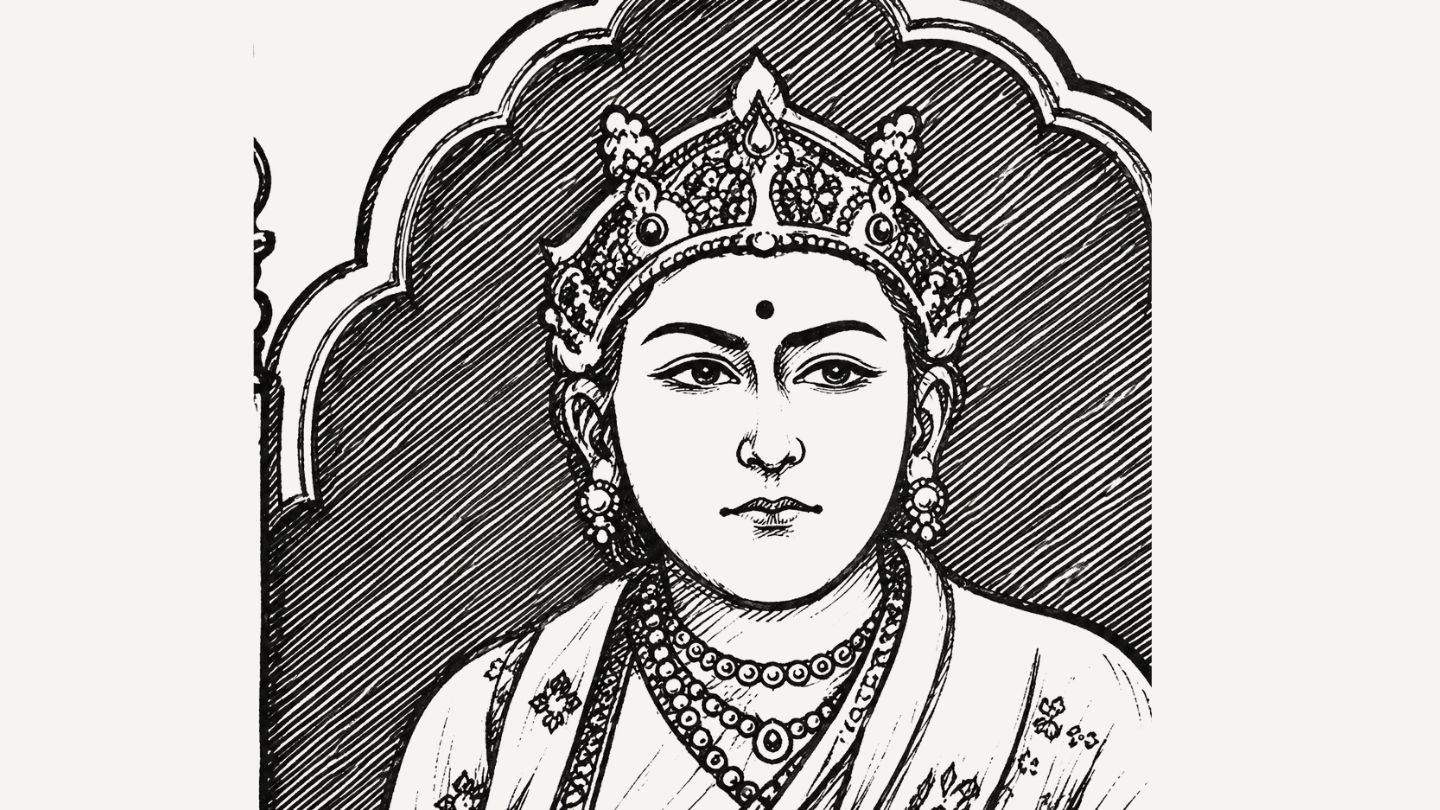
Rajendra Rajya Lakshmi Devi, commonly known in historical accounts as Queen Rajendra Lakshmi, was the first female regent of unified Nepal under the Shah dynasty. She was the daughter-in-law of King Prithvi Narayan Shah, the wife of King Pratap Singh Shah, and the mother of King Rana Bahadur Shah.
Following the death of King Pratap Singh Shah in 1777, their young son, Rana Bahadur Shah, ascended the throne. Rajendra Lakshmi subsequently assumed responsibility for governing the kingdom as queen mother. Her regency, spanning the period from 1777 to 1785, witnessed significant internal political struggles and territorial expansion toward western Nepal.
Rajendra Lakshmi did not exercise uninterrupted authority throughout this period. In 1778, she temporarily lost control of the government following a power struggle with her brother-in-law, Prince Bahadur Shah. She regained her regency on 20 June 1779 and continued governing until her death.
During her rule, Gorkhali control was established over several Chaubisi states, including Tanahun, Lamjung, and Kaski. Major developments associated with her administration included resisting a joint military offensive by the Chaubisi states in the Siranchok region, conducting western military campaigns, managing influential royal officials, and protecting the succession of the minor king.
Her historical role extended beyond territorial expansion. Rajendra Lakshmi exercised significant authority over state administration and political decisions. However, some actions during her rule, particularly the execution of Kaji Vamsharaj Pande and her conflict with Bahadur Shah, remain subjects of historical criticism.
Her life provides an important perspective on the continuation of Nepal's unification campaign, eighteenth-century court politics, and the exercise of political authority by women within the monarchy.
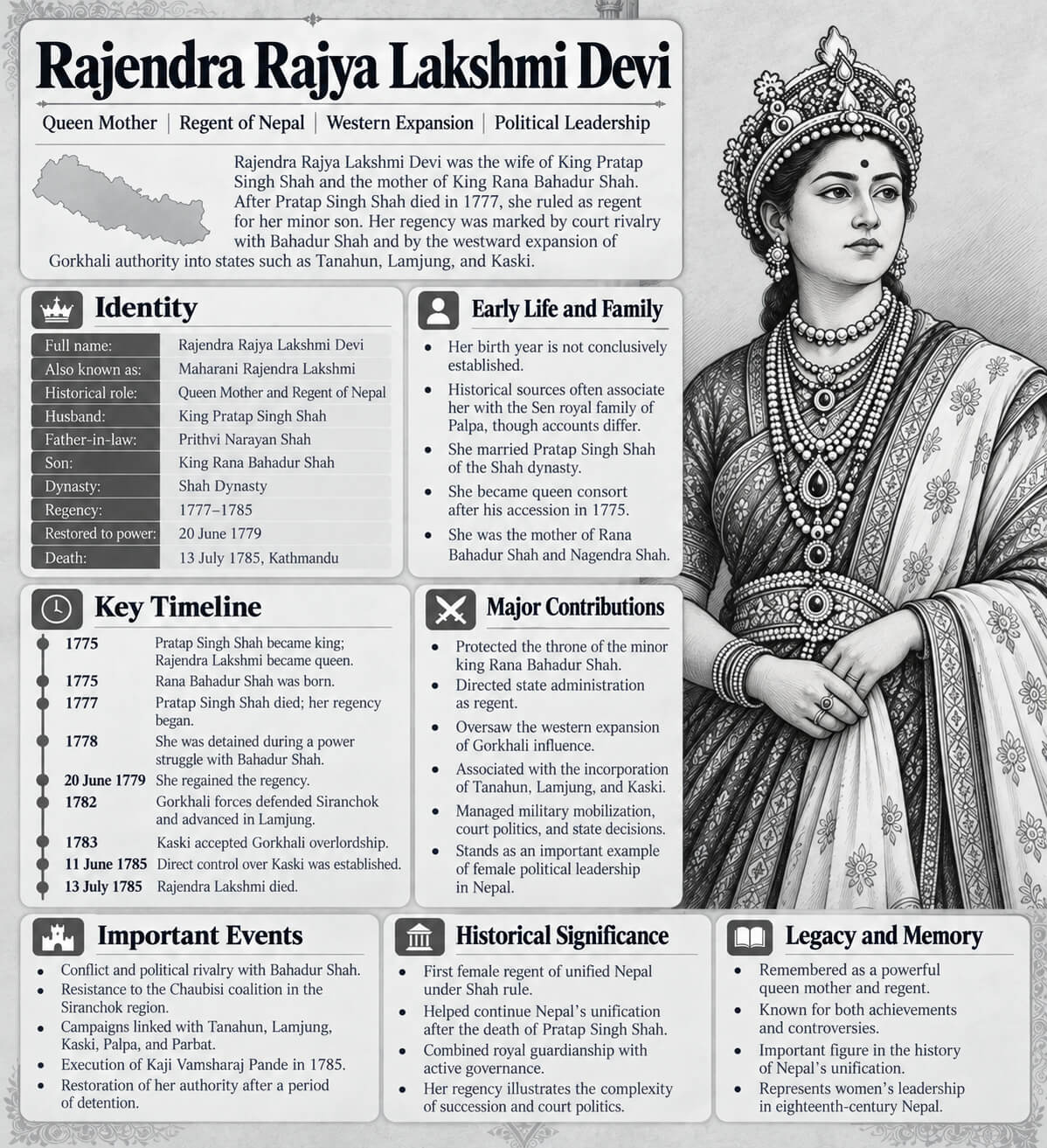
Rajendra Rajya Lakshmi Devi: Quick Facts
|
Particulars |
Historical Information |
|---|---|
|
Full Name |
Rajendra Rajya Lakshmi Devi (राजेन्द्र राज्य लक्ष्मी देवी शाह) |
|
Commonly Known As |
Queen Rajendra Lakshmi, Maharani Rajendra Lakshmi |
|
Historical Identity |
First female regent of unified Nepal under the Shah dynasty |
|
Date of Birth |
Not conclusively established |
|
Family Origin and Birthplace |
Traditionally associated with the Sen royal family of Palpa; historical sources differ |
|
Husband |
King Pratap Singh Shah |
|
Father-in-Law |
King Prithvi Narayan Shah |
|
Children |
King Rana Bahadur Shah and Prince Nagendra Shah |
|
Brother-in-Law |
Prince Bahadur Shah |
|
Period as Queen Consort |
1775–1777 |
|
Regency |
1777–1785, including an interruption in her authority |
|
Restoration of Regency |
20 June 1779 |
|
Major Historical Contribution |
Expansion of Gorkhali authority over Tanahun, Lamjung, Kaski, and surrounding states |
|
Date of Death |
13 July 1785 |
|
Place of Death |
Hanuman Dhoka Palace area, Kathmandu |
|
Successor as Regent |
Prince Bahadur Shah |
These principal details concerning Rajendra Lakshmi's life and reign are consistent with the historical studies of Baburam Acharya and information available through Documenta Nepalica, a historical records project associated with the Heidelberg Academy of Sciences and Humanities.
Birth, Family Origin, and Early Background
Historical information about Rajendra Lakshmi's birth, family origin, and early life remains incomplete. She is commonly identified as a princess associated with the Sen royal family of Palpa. However, some historical accounts suggest that her maternal family was connected to the Gorakhpur region of India.
Where Was Rajendra Lakshmi Born?
Several biographies and historical articles identify Palpa as Rajendra Lakshmi's birthplace. Some accounts describe her as a daughter of King Mukunda Sen of Palpa.
However, there are also uncertainties regarding which Mukunda Sen was associated with her family.
Historian and researcher Rajkumar Dikpal examined this issue in an article titled Itihas Shiromaniko Bajhiyeko Itihas, published in Himalkhabar.
According to Dikpal, two works by historian Baburam Acharya contain different accounts of Rajendra Lakshmi's family origin.
In Shree 5 Badamaharajadhiraj Prithvi Narayan Shahko Sankshipta Jeevani, Acharya states that Crown Prince Pratap Singh Shah married a woman brought from the Gorakhpur region.
However, another account by Acharya, published in the journal Purnima, associates Rajendra Lakshmi with the Sen royal family of Palpa.
Although the tradition identifying her as a princess of Palpa is widespread, it would be inappropriate to treat every detail of her birthplace and ancestry as an undisputed historical fact.
Connection with the Sen Dynasty of Palpa
Palpa was an influential kingdom in western Nepal during the eighteenth century. It was ruled by monarchs belonging to the Sen dynasty.
Gorkha and Palpa maintained political and family connections, although their relationship was not consistently friendly.
From the reign of Prithvi Narayan Shah, the expansion of Gorkhali authority became increasingly connected with the western kingdoms. Relations among these states involved marriage alliances, political agreements, competition, and military conflict.
The traditional account connecting Rajendra Lakshmi's family with Palpa should be understood within this historical setting.
However, her possible family connection with Palpa does not establish that every political decision she made was motivated by support for or opposition to Palpa's interests.
Childhood and Education
Reliable information about Rajendra Lakshmi's childhood, formal education, and early political training is limited.
Some popular biographies claim that she learned horse riding, military skills, and warfare from an early age. However, clear contemporary records supporting these claims have not been established.
Her political involvement during the regency is documented through historical events. These records provide a more reliable basis for examining her administrative role and participation in military decision-making.
Rather than presenting assumptions about her childhood as established facts, greater importance should be given to evidence from her years in government.
Marriage to Pratap Singh Shah and Life as Queen
Rajendra Lakshmi married Pratap Singh Shah, the eldest son of King Prithvi Narayan Shah. Following their marriage, she became a member of the Shah royal family of Gorkha.
One account by Baburam Acharya places the marriage around 1766. However, because genealogical records and the political circumstances surrounding the marriage are interpreted differently across sources, the date cannot be treated as conclusively verified.
Political Transition After the Death of Prithvi Narayan Shah
King Prithvi Narayan Shah died in January 1775. His eldest son, Pratap Singh Shah, subsequently ascended the throne of Nepal.
Rajendra Lakshmi became queen consort following her husband's accession.
At that time, the territorial expansion initiated by Prithvi Narayan Shah remained incomplete. Although the Kathmandu Valley and several surrounding territories had come under Gorkhali control, many western kingdoms remained independent.
The new administration faced the responsibility of managing recently acquired territories, maintaining security, and handling relations with local political authorities.
Pratap Singh Shah's reign lasted less than three years. His death in 1777 created a new situation concerning royal succession.
Birth of King Rana Bahadur Shah
Rajendra Lakshmi's son, Rana Bahadur Shah, was born in 1775.
He was approximately two and a half years old when his father died. Although he inherited the throne, his age prevented him from personally conducting the affairs of government.
Historical genealogies also mention Rajendra Lakshmi's other son, Nagendra Shah. The biographical record of Rajendra Lakshmi in Documenta Nepalica identifies Nagendra Shah alongside Rana Bahadur Shah.
However, detailed information about Nagendra Shah's birth and death is not consistent across all sources.
Because Rana Bahadur Shah occupied the principal position in the royal succession, Rajendra Lakshmi's subsequent political career became closely connected with protecting his position and exercising authority on his behalf.
How Did Rajendra Lakshmi Become Regent of Nepal?
Following the death of Pratap Singh Shah in 1777, Rajendra Lakshmi assumed responsibility for governing on behalf of her minor son, King Rana Bahadur Shah.
She consequently became Nepal's principal royal regent.
Meaning of Regency
A regency is a system in which another person exercises governing authority in the name of the reigning monarch.
When a king was a minor or otherwise unable to perform royal duties, a regent could exercise the principal powers of government.
Under this arrangement, the legal right to the throne remained with the king. However, administrative decisions, appointments of senior officials, military deployment, and political directives could be managed by the regent.
In Rajendra Lakshmi's case, Rana Bahadur Shah remained king while his mother exercised authority as regent.
She was therefore not an independent sovereign queen ruling in her own name. She governed as the representative of her minor son.
Circumstances Surrounding Her Appointment as Regent
The death of Pratap Singh Shah made the protection of royal succession a major concern within the Shah family.
With a minor king on the throne, influential court officials, royal priests, and members of the royal family had opportunities to exercise political influence.
According to Baburam Acharya, disputes arose within the royal court concerning both Rajendra Lakshmi's personal future and her political position.
At that time, widows could face religious and social pressure to follow the practice of sati. Historical accounts suggest that Rajendra Lakshmi also faced pressure associated with this custom.
However, because of her responsibility to protect the minor king, she assumed the role of royal guardian.
This development helped preserve Rana Bahadur Shah's succession and establish the political authority of the queen mother.
Major Challenges at the Beginning of Her Regency
Rajendra Lakshmi faced several challenges when she began governing.
Influential court officials were competing for political authority in the capital. Members of the royal family had not reached a clear understanding regarding the distribution of power, while military tensions with western kingdoms continued.
The government also needed to maintain administrative continuity across territories that had recently come under Gorkhali control.
Rajendra Lakshmi had to protect her son's royal status while directing the affairs of government. Her personal responsibilities and political position were therefore closely connected.
It was under these circumstances that cooperation began between Rajendra Lakshmi and her brother-in-law, Bahadur Shah.
Political Conflict Between Rajendra Lakshmi and Bahadur Shah
The most significant internal political struggle during Rajendra Lakshmi's regency involved Prince Bahadur Shah.
Bahadur Shah was the youngest son of Prithvi Narayan Shah and the younger brother of Pratap Singh Shah.
As a member of the royal family, he held an important political position. He was particularly active in advocating military campaigns to expand the kingdom's territory.
The disagreement between Rajendra Lakshmi and Bahadur Shah was not merely a family dispute. It involved governing authority, appointments of senior officials, military policy, and guardianship of the minor king.
Bahadur Shah's Return to Kathmandu
During the reign of Pratap Singh Shah, Bahadur Shah had lived outside Nepal because of political disagreements.
He returned to Kathmandu following Pratap Singh Shah's death.
According to Baburam Acharya, Rajendra Lakshmi and Bahadur Shah initially cooperated in administering the kingdom.
Bahadur Shah began taking responsibility for various governmental matters and gained the support of several influential court officials.
However, this cooperation did not last long.
Disagreement Over Administrative Authority
Bahadur Shah favored military campaigns against kingdoms in western Nepal.
Historical accounts particularly mention a disagreement with Rajendra Lakshmi over deploying additional troops toward Tanahun.
Rajendra Lakshmi was more cautious about immediately expanding military operations in that direction.
Another major source of disagreement concerned control of the government.
As the mother of the minor king, Rajendra Lakshmi wanted to retain authority over major decisions. Bahadur Shah also sought an influential position in government as a senior member of the royal family.
As court officials began supporting different political factions, the dispute intensified.
Sarvajit Rana and the Detention of Bahadur Shah
Kaji Sarvajit Rana was one of Rajendra Lakshmi's principal political supporters.
According to Baburam Acharya, Rajendra Lakshmi temporarily placed Bahadur Shah under detention with Sarvajit Rana's assistance.
Bahadur Shah was subsequently released through mediation.
However, the underlying dispute over political authority remained unresolved, and distrust between the two continued to grow.
The incident illustrates how support from influential court officials became an important factor in securing political power.
Rajendra Lakshmi's Detention in 1778
The political situation at the royal court changed in August 1778.
A faction supporting Bahadur Shah took action against Kaji Sarvajit Rana. Sarvajit Rana was killed, and Rajendra Lakshmi was placed under detention.
According to historian Baburam Acharya, the queen was confined in silver shackles.
During this period, allegations were also made concerning a personal relationship between Rajendra Lakshmi and Sarvajit Rana.
However, these allegations should not be presented as established historical facts. They must be understood as accusations made amid contemporary political rivalry.
Following these events, Bahadur Shah gained principal authority over the government.
Rajendra Lakshmi temporarily lost her powers as regent.
Restoration of Power on 20 June 1779
Rajendra Lakshmi regained her governing authority on 20 June 1779.
While Bahadur Shah was away from the capital, court officials supporting Rajendra Lakshmi undertook political efforts to restore her position.
According to Baburam Acharya, Mahoddam Kirti Shah and several other individuals played active roles in this process.
Rajendra Lakshmi was released from detention and returned to power.
Bahadur Shah subsequently left the capital, while some officials associated with his faction also faced political action.
From 1779 onward, Rajendra Lakshmi's political position became stronger than before.
However, the rivalry between her and Bahadur Shah did not completely disappear. Their relationship continued to alternate between reconciliation and distrust in the following years.
Rajendra Lakshmi's Role in the Unification of Nepal
One of the most important historical developments during Rajendra Lakshmi's regency was the westward expansion of Nepal's unification campaign.
During her administration, Gorkhali authority expanded over Tanahun, Lamjung, Kaski, and several other states in the Gandaki region.
This expansion was not accomplished through a single war.
Military conflicts, political agreements, temporary victories, defeats, and renewed campaigns against different kingdoms shaped the unification process.
Rajendra Lakshmi's role was primarily associated with the political direction and authorization of military operations. The actual campaigns were conducted by appointed commanders and soldiers.
Political Situation of the Chaubisi States
Before Nepal's unification, several separate kingdoms existed in the Gandaki region and surrounding areas. Many of these were collectively known as the Chaubisi states.
These kingdoms did not operate under a single central government.
Each had its own ruler, administrative arrangements, and military organization. Political relations between the states changed over time.
At certain times, they cooperated with one another. At others, they fought over territory and political authority.
As the Gorkhali kingdom expanded, several western states took measures to protect their independence and territorial boundaries.
Under these circumstances, some Chaubisi states formed a joint military alliance against Gorkha.
The Battle of Siranchok
Toward the end of 1781, the Chaubisi states intensified preparations for an attack against Gorkha.
Military developments involving Palpa, Lamjung, Parbat, and Tanahun became particularly significant during this period.
In early 1782, a combined military force advanced toward the Siranchok region of Gorkha.
Rajendra Lakshmi's regency administration mobilized troops to defend Gorkhali territory.
According to Baburam Acharya, the defensive campaign was led by Kaji Balbhadra Shah, with the participation of military commanders including Kaji Devdatta Thapa, Kaji Damodar Pande, and Sardar Amar Singh Thapa.
Gorkhali forces successfully resisted the Chaubisi offensive in and around Siranchok.
The defensive operation is reported to have succeeded in early February 1782.
The resistance at Siranchok played an important role in protecting the Gorkhali kingdom against an immediate military threat.
Role of Kaski's King Siddhinarayan Shah
Kaski's position during the military developments at Siranchok was not identical to that of the other Chaubisi states.
King Siddhinarayan Shah had maintained political relations with Gorkha at different times.
According to Baburam Acharya, tensions also existed within the Chaubisi alliance concerning Kaski's participation.
Following the Siranchok conflict, relations between Kaski and Lamjung became complicated again.
This illustrates that the western kingdoms did not belong to a single permanent alliance.
Rajendra Lakshmi's administration also had to account for such political differences when making military and diplomatic decisions.
Unification of Tanahun
Tanahun was one of the important Chaubisi kingdoms of western Nepal.
Its rivalry with the Gorkhali kingdom had begun before Rajendra Lakshmi's regency. Military campaigns against Tanahun continued during her rule.
Initial Campaign Against Tanahun
Baburam Acharya's historical study mentions military operations toward Tanahun in 1779, when Bahadur Shah still exercised political influence.
Although Gorkhali troops temporarily occupied certain areas, local resistance and political developments prevented them from establishing permanent control.
Following Rajendra Lakshmi's restoration to power, the priorities of military deployment also changed.
This situation demonstrates the direct relationship between political disputes in the capital and military campaigns outside it.
Incorporation of Tanahun into Nepal
Tanahun's final incorporation into Nepal took place during Rajendra Lakshmi's regency.
According to the official historical profile published by the District Coordination Committee, Tanahun, the kingdom, ruled by Sen dynasty kings, existed until BS 1839.
The profile states that Tanahun was subsequently incorporated into Nepal during the reign of Rana Bahadur Shah and the regency of Queen Mother Rajendra Lakshmi.
The incorporation of Tanahun provided the Gorkhali kingdom with an important political and geographical area for further military activities toward the west.
Rajendra Lakshmi's administration and the military commanders serving under it were associated with this achievement.
Conquest of Lamjung
The conquest of Lamjung was among the major military achievements clearly documented during Rajendra Lakshmi's regency.
Gorkha and Lamjung had a long history of political rivalry.
The end of Lamjung's independent status represented an important development in the westward expansion of Gorkhali authority.
Military Campaign Against Lamjung
The military campaign against Lamjung reached a decisive stage in 1782.
According to Baburam Acharya, Kaji Vamsharaj Pande played a principal role in the campaign.
He mobilized troops from Gorkha and surrounding areas and prepared an offensive against Lamjung.
Military commanders including Sardar Amar Singh Thapa were also involved in military operations in western Nepal.
Gorkhali forces established control over important locations, including Tarku, the capital of Lamjung, bringing the kingdom's independent rule to an end.
Historical accounts indicate that King Birmardan Shah of Lamjung left his kingdom toward the end of 1782.
Significance of the Lamjung Conquest
Control over Lamjung created opportunities for the Gorkhali kingdom to expand its authority farther west.
The conquest ended the independent political existence of a kingdom that had long competed with Gorkha.
However, there is insufficient evidence to claim that Rajendra Lakshmi personally participated in the battle or led the conquest from the battlefield.
Her contribution was connected with her responsibilities as regent, including authorizing military campaigns, mobilizing commanders, and making decisions on behalf of the government.
The direct military leadership was provided by commanders including Kaji Vamsharaj Pande.
Unification of Kaski
The incorporation of Kaski was another important achievement during Rajendra Lakshmi's regency. However, the political agreements preceding its incorporation must be distinguished from the eventual military conquest.
Kaski had previously accepted Gorkhali supremacy. Following a change in political relations, the kingdom was directly incorporated into Nepal through military operations in 1785.
Political Agreement of 1783
Following the conquest of Lamjung, the Gorkhali court entered into negotiations with King Siddhinarayan Shah of Kaski.
According to Baburam Acharya, Kaji Vamsharaj Pande played a role in establishing a political understanding with Kaski.
Under an agreement reached in 1783, Kaski accepted Gorkhali overlordship.
However, Kaski's local royal administration did not immediately cease to exist following the agreement.
Accepting the supremacy of another state and becoming directly incorporated into that state were therefore different political situations.
Breakdown of the Agreement and Renewed Military Tensions
In 1784, as military operations intensified in western Nepal, King Siddhinarayan Shah reportedly broke the earlier agreement.
This development renewed tensions between Kaski and the Gorkhali kingdom.
The military strategy toward western Nepal subsequently changed.
Rajendra Lakshmi's administration began preparing a campaign to establish direct control over Kaski.
Conquest of Kaski on 11 June 1785
A decisive military campaign against Kaski took place in June 1785.
According to Baburam Acharya, Kaji Daljit Shah and Kaji Swaroop Singh Karki were assigned to the operation.
Gorkhali forces captured Rupakot and Arghau before advancing toward Sarangkot, a major political center of Kaski.
Historical accounts place the establishment of Gorkhali control over Sarangkot on 11 June 1785.
Following this development, King Siddhinarayan Shah left the kingdom, and Kaski was incorporated into Nepal.
Presenting Kaski's final unification as having been completed in 1782 or 1783 would therefore be inconsistent with this historical sequence.
The political agreement of 1783 and the direct incorporation of Kaski in 1785 must be understood as separate events.
Expansion of Gorkhali Influence Over Other Chaubisi States
During Rajendra Lakshmi's regency, Gorkhali authority also expanded into several smaller states in the Gandaki region beyond Tanahun, Lamjung, and Kaski.
However, these states did not all come under Gorkhali authority through the same process.
Some accepted Gorkhali overlordship. Others maintained their local rulers under arrangements involving political protection, while some lost their independent political status.
Satahun, Garahun, and Rising
The political positions of Satahun, Garahun, Rising, and several other states were affected by a military campaign led by Kaji Abhiman Singh Basnyat in 1785.
According to Baburam Acharya, King Bhup Narayan Shah of Satahun accepted Gorkhali overlordship.
King Bhakta Khan of Garahun was a minor. Historical accounts indicate that his guardians accepted the protection of the Gorkhali kingdom.
Similarly, King Beni Prasad of Rising and Chakrapati Khan, the ruler of Charikot, accepted Gorkhali protection.
The local rulers of these states did not immediately lose all their political authority.
The distinction between accepting political overlordship and direct territorial incorporation is therefore important in understanding these developments.
Dhor and Paiyun
The political situations of smaller states such as Dhor and Paiyun were somewhat different.
According to Baburam Acharya, the rulers of these states provided political and military support to the Kingdom of Parbat.
Their independent political authority subsequently came to an end during Gorkhali military campaigns.
These events demonstrate how the westward unification process was influenced by the political decisions and military alliances of individual kingdoms.
Expansion Toward the Kali Gandaki Region
By the final years of Rajendra Lakshmi's regency, Gorkhali influence in western Nepal had extended toward the Kali Gandaki region.
However, expanding control as far as the Kali Gandaki was not equivalent to permanently incorporating every kingdom beyond the river.
Parbat, Palpa, and other western states remained important political powers.
It would therefore be historically inaccurate to claim that all Chaubisi kingdoms were incorporated into Nepal during Rajendra Lakshmi's regency.
Military Relations with Palpa and Parbat
Political and military relations with Palpa and Parbat were also significant during Rajendra Lakshmi's rule.
These kingdoms were influential regional powers. Gorkhali expansion directly affected their political interests and territorial security.
Military Campaign Against Palpa
A Gorkhali military campaign against Palpa took place in 1784.
According to Baburam Acharya, a Gorkhali force led by Kaji Abhiman Singh Basnyat advanced toward Palpa.
Historical accounts indicate that Gorkhali troops temporarily occupied Tansen, the capital of Palpa, during this campaign.
However, new military challenges in Parbat and surrounding areas forced the Gorkhali administration to recall its troops.
Consequently, Palpa was not permanently incorporated into Nepal during Rajendra Lakshmi's regency.
This episode illustrates the distinction between a temporary military victory and lasting political incorporation.
Political Rivalry with Parbat
The Kingdom of Parbat was another significant rival to Gorkhali expansion.
The political and military activities of King Kirtibam Malla of Parbat were connected with developments in Lamjung, Kaski, and neighboring kingdoms.
Gorkhali troops were also deployed toward Parbat in 1784.
However, military circumstances in the region became complicated, requiring the Gorkhali administration to reposition its forces.
The permanent incorporation of all territories belonging to Parbat was not completed during Rajendra Lakshmi's rule.
Although territorial expansion achieved significant results under her regency, military operations were not uniformly successful.
Administration and Political Decisions
Rajendra Lakshmi's reign involved both military expansion and changes in the organization of royal administration.
While formal royal authority remained vested in the minor King Rana Bahadur Shah, Rajendra Lakshmi governed with the involvement of influential court officials.
Appointment and Role of Senior Officials
Under the Shah monarchy, officials holding positions such as Kaji, Chautariya, and Sardar exercised significant political and administrative influence.
During Rajendra Lakshmi's regency, officials including Sarvajit Rana, Vamsharaj Pande, Balbhadra Shah, Swaroop Singh Karki, Abhiman Singh Basnyat, and Bhim Khawas held various administrative and military responsibilities.
Their relationships with Rajendra Lakshmi changed over time.
In some circumstances, she restored responsibilities to individuals who had previously supported opposing factions. In others, influential officials were removed from office or subjected to political action.
These developments show how administrative appointments and political relationships within the royal court were closely connected.
Military Decisions and Contributions of Commanders
When assessing Rajendra Lakshmi's leadership, it is important to distinguish her governing authority as regent from the direct battlefield responsibilities of military commanders.
Military campaigns required government authorization, mobilization of personnel, and administrative coordination.
However, the implementation of military plans and direct leadership in battle were undertaken by military officers.
Historical accounts identify Vamsharaj Pande in the Lamjung campaign, Daljit Shah and Swaroop Singh Karki in Kaski, and several other commanders in different military operations.
Because there is insufficient established evidence that Rajendra Lakshmi personally participated in every campaign, describing her as the direct commander of all these victories would be inaccurate.
The Question of Internal Political Stability
Although Rajendra Lakshmi maintained her regency for much of the period between 1777 and 1785, political unity at the royal court was not consistently stable.
Her disputes with Bahadur Shah, competition among senior officials, and repeated appointments and political actions complicated the administration.
Changes in the political situation in Kathmandu also affected military campaigns in western Nepal.
Her regency therefore cannot be accurately characterized solely as a period of stable administration or continuous political disorder.
Territorial achievements occurred alongside persistent internal political difficulties.
Diplomacy and Foreign Relations
During Rajendra Lakshmi's regency, Nepal maintained external relations involving the East India Company, Tibet, and neighboring hill kingdoms.
These relationships concerned not only military rivalry but also territorial boundaries, trade, and political communication.
Relations with the East India Company
During the late eighteenth century, the political influence of the British East India Company was expanding across the Indian subcontinent.
Diplomatic contact with the Company government was necessary regarding boundaries and territorial rights associated with Nepal's southern plains.
Baburam Acharya discusses the role of Subba Dinanath Upadhyaya and disputes concerning the Rautahat region.
During Warren Hastings's administration, attempts were made to resolve certain issues between Nepal and the Company government through diplomatic discussions.
These developments indicate that Nepal's political relations to the south during Rajendra Lakshmi's regency were not limited to military activities.
Trade Relations with Tibet
Relations with Tibet were important in Nepal's commercial history.
Baburam Acharya mentions that problems began emerging in trade relations with Tibet during Rajendra Lakshmi's regency.
These relations became more complicated during the subsequent regency of Bahadur Shah.
It would therefore be inaccurate to suggest that Nepal's external relations with both its northern and southern neighbors were entirely free of difficulties during Rajendra Lakshmi's rule.
Role of Political Agreements in Territorial Expansion
The western campaigns conducted during Rajendra Lakshmi's regency demonstrate that political agreements accompanied the use of military force.
Kaski accepted Gorkhali overlordship in 1783. Similar arrangements involving protection or subordinate political relationships were established with states such as Satahun, Garahun, and Rising.
These developments illustrate that the unification process did not involve the same method of control in every kingdom.
Military operations, agreements with local rulers, and different forms of political overlordship were all part of the process.
Execution of Kaji Vamsharaj Pande and Political Controversy
The execution of Kaji Vamsharaj Pande was among the most controversial events of Rajendra Lakshmi's regency.
Vamsharaj Pande belonged to the influential Pande family and had been politically active since the reign of Prithvi Narayan Shah.
He played an important role in the Lamjung military campaign during Rajendra Lakshmi's administration.
However, political competition within the royal court subsequently changed his position.
Vamsharaj Pande and Court Rivalries
Vamsharaj Pande competed with other influential officials over administrative responsibilities and political authority.
The growing influence of Swaroop Singh Karki and other officials was particularly important in changing the balance of power at court.
According to Baburam Acharya, Vamsharaj Pande returned to Kathmandu in March 1785.
Serious accusations were subsequently made against him, followed by punitive action by the royal administration.
Events of 21 April 1785
Historical sources record that Vamsharaj Pande was executed on 21 April 1785.
Baburam Acharya considered the action unjust.
However, surviving evidence is limited regarding the precise motives of everyone involved in the decision and the full circumstances surrounding the accusations.
It is therefore necessary to distinguish the documented outcome of the event from historians' interpretations of its causes.
The execution of Vamsharaj Pande represents an important subject of criticism concerning Rajendra Lakshmi's government.
Ignoring this event and presenting her regency exclusively as a period of successful political leadership would produce an incomplete historical account.
Final Years and Death of Rajendra Lakshmi
Rajendra Lakshmi's final years were marked by declining health and continuing political tensions within the royal court.
Baburam Acharya suggested that her health had deteriorated and that she may have shown symptoms associated with tuberculosis.
The biographical record in Documenta Nepalica also associates her death with tuberculosis.
However, because eighteenth-century medical records are unavailable, this should not be presented as a diagnosis confirmed through modern medical examination.
Rana Bahadur Shah's Bratabandha and Bahadur Shah's Return
The bratabandha ceremony of the young King Rana Bahadur Shah was performed in early 1785.
According to Baburam Acharya, Rajendra Lakshmi traveled to Gorkha for the ceremony.
Bahadur Shah also attended the event.
He subsequently returned to political activities in Kathmandu.
This episode shows that the claim that Bahadur Shah remained continuously in exile from 1779 until Rajendra Lakshmi's death is inaccurate.
Renewed Detention of Bahadur Shah
Distrust between Rajendra Lakshmi and Bahadur Shah increased again in 1785.
According to Baburam Acharya, Bahadur Shah was arrested and placed under detention in Pharping.
Acharya's historical account, published in the Regmi Research Series edited by Mahesh Chandra Regmi, dates this event to 2 July 1785.
Rajendra Lakshmi died shortly afterward.
This incident illustrates that the struggle over governing authority within the royal court continued until the final days of her life.
Death on 13 July 1785
Rajendra Rajya Lakshmi Devi is generally considered to have died on 13 July 1785 in the Hanuman Dhoka Palace area of Kathmandu.
The same date appears in the historical biographical record maintained by Documenta Nepalica, associated with the Heidelberg Academy of Sciences and Humanities.
Baburam Acharya's account, published in Mahesh Chandra Regmi's research series, also supports 13 July 1785.
However, some digital editions of Acharya's Nepali text contain inconsistencies in the years and dates of her death and the events immediately preceding it.
For this biography, the comparatively well-supported date of 13 July 1785 has therefore been used.
King Rana Bahadur Shah was approximately ten years old when his mother died.
Regency of Bahadur Shah After Rajendra Lakshmi's Death
Following Rajendra Lakshmi's death, Prince Bahadur Shah assumed responsibility for governing as regent on behalf of the young King Rana Bahadur Shah.
His principal regency lasted from 1785 to 1794.
During his administration, Nepal's territorial expansion advanced farther west.
The military victories and political changes in the Gandaki region during Rajendra Lakshmi's regency had helped establish the conditions for subsequent expansion.
However, the territorial conquests accomplished under Bahadur Shah cannot all be attributed to Rajendra Lakshmi's rule.
To understand the chronology of Nepal's unification accurately, the developments during the reigns and administrations of Prithvi Narayan Shah, Pratap Singh Shah, Rajendra Lakshmi, and Bahadur Shah must be examined separately.
Historical Significance and Assessment of Rajendra Lakshmi
Rajendra Lakshmi's historical importance rests on her regency, her contribution to territorial expansion, and her role in exercising royal administrative authority.
She governed as the representative of her minor son. During her administration, Gorkhali territorial control expanded in western Nepal.
However, her rule was not free from political controversy.
Her rivalry with Bahadur Shah, factional competition among court officials, and the action taken against Vamsharaj Pande must also be considered in any historical assessment.
Historical Significance of Female Political Leadership
Rajendra Lakshmi's regency provides an example of female political leadership in eighteenth-century Nepal.
As queen mother, she exercised significant administrative and political authority.
Her regency demonstrates that women's participation in the political affairs of the monarchy was not necessarily confined to family relationships.
However, she did not occupy the throne as an independent sovereign ruling in her own name.
Her authority was exercised on behalf of her minor son, King Rana Bahadur Shah.
Different Historical Interpretations
Historians have not assessed Rajendra Lakshmi's administration in entirely the same way.
Baburam Acharya discussed her political determination while also criticizing certain decisions made during her regency.
Some of Acharya's assessments reflect the social and gender perspectives of his time.
It is therefore important to distinguish historians' descriptions of an individual's character from events that can be established through documentary evidence.
Rajendra Lakshmi's contributions should neither be reduced to exaggerated praise nor dismissed by overlooking her political achievements.
The Wider Historical Context of Nepal's Unification
The territorial expansion during Rajendra Lakshmi's regency cannot be adequately understood solely as an achievement of one royal family.
Various Gorkhali military officers, local rulers, soldiers, and political groups participated in the process.
Unification also brought changes to the political systems of previously independent kingdoms. Some local rulers accepted new forms of overlordship, while others resisted Gorkhali expansion.
An examination of Nepal's unification must therefore consider both the expanding Gorkhali state and the circumstances of the local kingdoms affected by the process.
Rajendra Lakshmi's contribution forms an important part of this wider historical development.
Rajendra Lakshmi in Literature and Theatre
Rajendra Lakshmi's life has also been represented in Nepali theatre.
In 2018, a dance drama titled Rajendra Laxmi, based on her life, was performed at Mandala Theatre in Kathmandu.
According to The Kathmandu Post, the production was directed by Namrata KC.
The performance presented Rajendra Lakshmi's life, political role, and historical identity through an artistic interpretation.
Around the same period, Abha Lal's review, Revisiting Revisionist History, questioned approaches to evaluating historical women primarily through royal authority and military achievements.
Such theatrical productions illustrate the cultural and public interest in Rajendra Lakshmi as a historical figure.
However, dramatic narratives and historical records are not equivalent forms of evidence. Historical studies and archival records should take priority when establishing factual details about her life.
Major Events in the Life of Rajendra Rajya Lakshmi Devi
|
Date or Period |
Historical Event |
|---|---|
|
1775 |
Rajendra Lakshmi became queen consort following Pratap Singh Shah's accession to the throne. |
|
1775 |
Rana Bahadur Shah was born. |
|
1777 |
Following Pratap Singh Shah's death, Rana Bahadur Shah became king, and Rajendra Lakshmi assumed the regency. |
|
1778 |
Rajendra Lakshmi was detained during a political conflict with Bahadur Shah. |
|
20 June 1779 |
Rajendra Lakshmi regained her authority as regent. |
|
February 1782 |
Gorkhali forces successfully resisted the Chaubisi alliance in the Siranchok region. |
|
1782 |
Lamjung came under Gorkhali control. |
|
By BS 1839 |
Tanahun's independent rule ended, and the kingdom was incorporated into Nepal. |
|
1783 |
Kaski entered into an agreement accepting Gorkhali overlordship. |
|
1784 |
Military campaigns were conducted toward Palpa and Parbat. |
|
21 April 1785 |
Kaji Vamsharaj Pande was executed. |
|
11 June 1785 |
Direct Gorkhali control was established over Kaski. |
|
June 1785 |
Arrangements involving Gorkhali overlordship and protection were established with Satahun, Garahun, Rising, and other states. |
|
July 1785 |
Bahadur Shah was again placed under detention. |
|
13 July 1785 |
Rajendra Lakshmi died. |
|
After 1785 |
Bahadur Shah assumed principal responsibility for governing as regent. |
Conclusion
Rajendra Rajya Lakshmi Devi was an important female regent in the history of Nepal's Shah dynasty.
Following the death of her husband, Pratap Singh Shah, she governed on behalf of their minor son, Rana Bahadur Shah. During her regency, Gorkhali authority expanded over Tanahun, Lamjung, Kaski, and several other western states.
Rajendra Lakshmi played a significant role in decisions concerning royal administration and military campaigns.
However, her administration also experienced power struggles with Bahadur Shah, competition among influential court officials, and controversial political actions.
Her historical role must therefore be assessed by considering both her achievements and the controversies associated with her government.
Rajendra Lakshmi's life provides an important basis for understanding the political complexities of Nepal's unification, the administration of royal succession, and the exercise of political authority by women during the eighteenth century.
References
1. Acharya, Baburam. Nepalko Sankshipta Vrittanta (A Brief Account of Nepal). Section: "Reconciliation and Conflict Between Queen Rajendra Lakshmi and Prince Bahadur Shah." Online text of the original work.
2. Acharya, Baburam. Nepalko Sankshipta Vrittanta. Section: "The Attack on Nepal by Sikkim and the Chaubisi States and the Counteroffensive Against Them." Online text of the original work.
3. Acharya, Baburam. Nepalko Sankshipta Vrittanta. Section: "Control Over the Chaubisi States East of the Kali Gandaki River and the Death of Queen Rajendra Lakshmi." Online text of the original work.
4. Regmi, Mahesh C. (Ed.). (1974). Regmi Research Series, Year 6. English presentations of Baburam Acharya's historical studies concerning the regency and the Chaubisi states. Digital Himalaya archive.
5. Heidelberg Academy of Sciences and Humanities. Documenta Nepalica: Historical Documents of Pre-modern Nepal. Historical biographical record: "Rājendra Rājyalakṣmī."
6. District Coordination Committee, Tanahun. Tanahun District Profile. Official historical information concerning the Kingdom of Tanahun and its incorporation into Nepal.
7. Dikpal, Rajkumar. (8 Bhadra 2078 BS). "Itihas Shiromaniko Bajhiyeko Itihas" (Contradictions in the Historical Accounts of Itihas Shiromani). Himalkhabar. An examination of conflicting historical accounts concerning Rajendra Lakshmi's family origin and the writings of Baburam Acharya.
8. The Kathmandu Post. (28 June 2018). "Queen Rajendra Laxmi's Life and Times on Stage."
9. Lal, Abha. "Revisiting Revisionist History." Republica. A critical review of a theatrical production about Rajendra Lakshmi.






Comments 0
No comments yet. Be the first to start the conversation.