



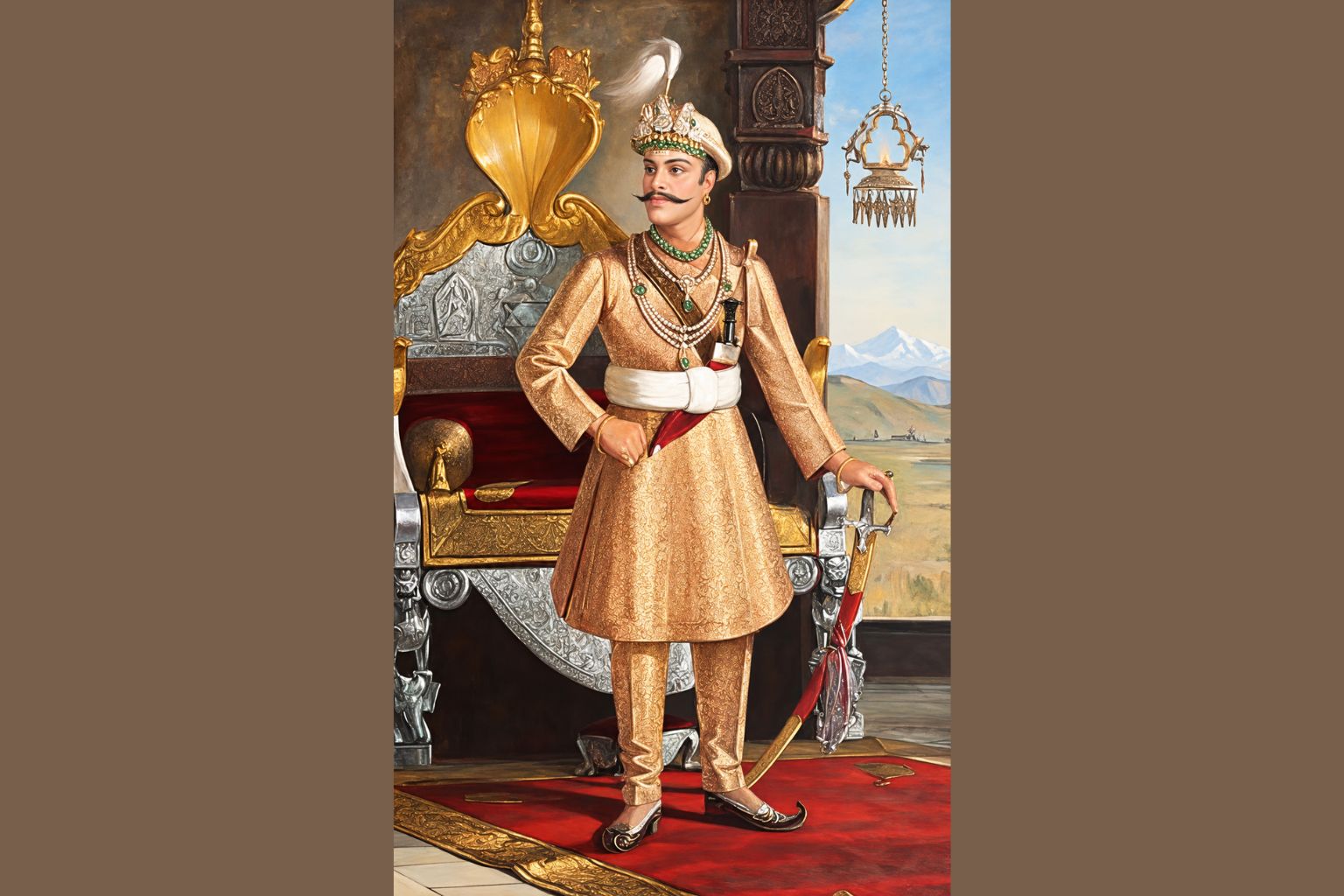
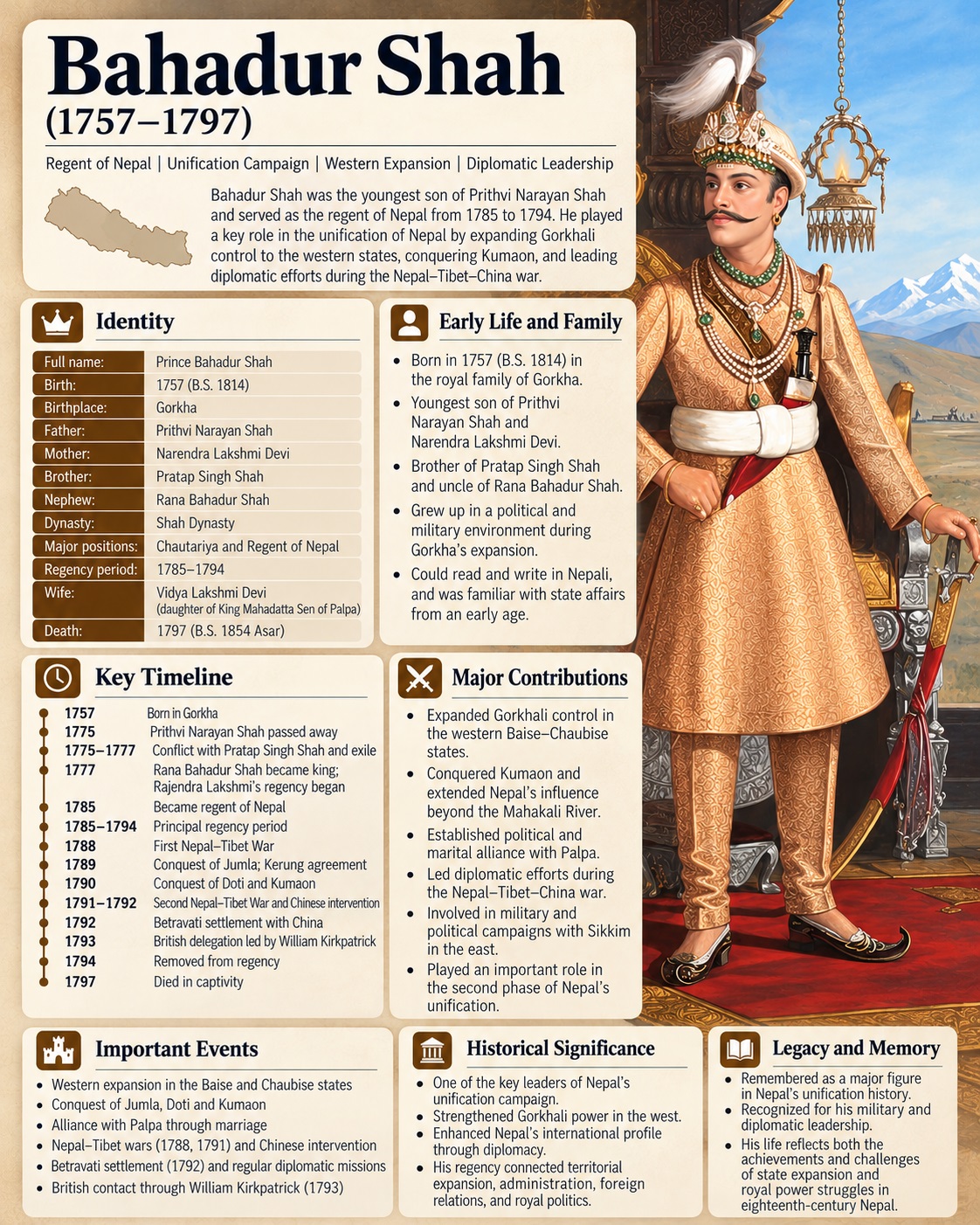
Bahadur Shah (1757–1797) was a major political leader in Nepal's unification campaign and served as regent for King Rana Bahadur Shah. The youngest son of King Prithvi Narayan Shah, he governed Nepal from 1785 to 1794. During his regency, Gorkhali control expanded across the western Baise and Chaubise states, while Nepal's political influence extended beyond the Mahakali River into Kumaon.
Bahadur Shah's role in Nepalese history was not limited to military expansion. He established political and marital ties with Palpa, continued the westward expansion of the Gorkhali state, and led diplomatic efforts during the wars involving Tibet and China. His administration also witnessed military and political conflicts with Sikkim in the east.
His personal life, however, was marked by struggles for power within the royal court. Following the death of his father, Prithvi Narayan Shah, disagreements with his elder brother, Pratap Singh Shah, forced him into exile. He later became involved in disputes over royal authority with his sister-in-law, Rajendra Lakshmi. His political influence ended when his nephew, Rana Bahadur Shah, began exercising royal authority directly. Bahadur Shah eventually died in captivity in 1797.
Historian Bhadra Ratna Bajracharya examined his regency in detail in Bahadur Shah: The Regent of Nepal (1785–1794 A.D.). Bahadur Shah's biography provides an important account of how territorial expansion, administration, foreign relations, and struggles for power within the royal family were connected in eighteenth-century Nepal.
Quick Facts About Bahadur Shah
|
Details |
Information |
|---|---|
|
Full Name |
Prince Bahadur Shah (बहादुर शाह) |
|
Birth |
BS 1814 (AD 1757) |
|
Birthplace |
Kingdom of Gorkha |
|
Father |
|
|
Mother |
Queen Narendra Lakshmi Devi |
|
Elder Brother |
King Pratap Singh Shah |
|
Nephew |
King Rana Bahadur Shah |
|
Dynasty |
Shah Dynasty |
|
Major Positions |
Chautariya and Regent of Nepal |
|
Principal Regency |
1785–1794 |
|
Wife |
Vidya Lakshmi Devi, daughter of King Mahadatta Sen of Palpa |
|
Major Contributions |
Unification campaigns in the western states, conquest of Kumaon, and diplomatic leadership |
|
Major International Events |
Nepal–Tibet War and the 1792 peace settlement with China |
|
Death |
Asar BS 1854 (AD 1797) |
|
Circumstances of Death |
Died under unusual circumstances while in political detention |
Bahadur Shah's date of birth is commonly recorded as 16 June 1757. Nepalese historical accounts place his death on 15 Asar BS 1854, while some English-language biographies give the date as 24 June 1797. Because historical sources are not entirely consistent regarding the calendar correspondence and circumstances of his death, this biography primarily uses the years.
Birth, Family, and Childhood of Bahadur Shah
Bahadur Shah was born in BS 1814 (AD 1757) into the Shah royal family of the Kingdom of Gorkha. His father was King Prithvi Narayan Shah, and his mother was Queen Narendra Lakshmi Devi. He was the younger brother of Pratap Singh Shah.
Among the historical records confirming his family background, an inscription at Basantapur Palace is particularly important.
According to Shah-period inscriptions compiled by historians Dhanavajra Vajracharya and Tek Bahadur Shrestha, an inscription dated BS 1826 identifies Pratap Singh Shah and Bahadur Shah as the two sons of Prithvi Narayan Shah.
This contemporary inscription provides documentary evidence of Bahadur Shah's relationship to Prithvi Narayan Shah.
Political Conditions During His Childhood
Bahadur Shah was born when Gorkha was actively expanding its territory. Prithvi Narayan Shah was conducting military and political campaigns in Nuwakot, the Kathmandu Valley, and surrounding kingdoms.
Consequently, Bahadur Shah did not grow up in an exclusively domestic setting. His childhood unfolded within a royal household closely associated with political decisions, military preparations, and activities at the court.
Historians have noted that he received practical instruction in political affairs from his father during his early years.
However, no available evidence establishes that he attended a formal military academy or completed a particular military training program.
Education and Early Knowledge
According to historian Baburam Acharya, there is no clear evidence that Bahadur Shah received extensive formal education. Nevertheless, he could read and write correspondence in Nepali.
A handwritten letter associated with the final years of his life has also been published in historical research. The document confirms his ability to communicate in writing.
His later political abilities cannot be attributed solely to formal education. They were also associated with his family circumstances, political disputes, exile, and direct experience of governance.
Rajkumar Dikpal has presented information about Bahadur Shah's childhood, education, and family circumstances in an article based on historical records and the studies of historians.
Background of Prithvi Narayan Shah's Unification Campaign
Understanding Bahadur Shah's contribution requires examining the historical circumstances of the territorial expansion initiated by Prithvi Narayan Shah.
In the middle of the eighteenth century, the territory of present-day Nepal was divided among various political entities. The Kathmandu Valley was governed by Malla kingdoms, while numerous kings and local rulers controlled the western hills.
Prithvi Narayan Shah captured Nuwakot in 1744 and subsequently advanced the territorial expansion of Gorkha.
By 1768–1769, the principal kingdoms of the Kathmandu Valley had come under Gorkhali control. As Kathmandu became the political center, the territory and political character of the Gorkha state continued to expand.
However, Prithvi Narayan Shah did not bring all of present-day Nepal under a single administration during his lifetime. Numerous western hill states remained independent, while political and territorial relations in the eastern and northern regions had not been fully settled.
The expansion campaign was still underway when Prithvi Narayan Shah died in 1775.
After his death, the process continued through different phases associated with the reigns and regencies of Pratap Singh Shah, Rajendra Lakshmi, and Bahadur Shah.
Bahadur Shah is therefore regarded as one of the principal leaders who continued Nepal's unification campaign after Prithvi Narayan Shah.
Disagreements with Pratap Singh Shah and First Exile
Following Prithvi Narayan Shah's death in 1775, his eldest son, Pratap Singh Shah, became king.
At that time, royal succession traditionally favored the eldest son. However, historians have documented differences of opinion within the royal family and among court officials regarding the suitability of the prospective ruler.
According to historian Gyanmani Nepal, some influential court figures had suggested that Bahadur Shah should be appointed heir to the throne.
Nevertheless, Prithvi Narayan Shah retained Pratap Singh Shah as his successor.
Distrust Between the Brothers
Political distrust toward Bahadur Shah increased after Pratap Singh Shah became king.
Historians have suggested that Bahadur Shah may have been regarded as a potential rival because of his royal status and relationships with influential members of the court.
Pratap Singh Shah placed Bahadur Shah under restraint. Bahadur Shah was subsequently exiled to Bettiah in what was then India.
Bettiah is located in the present-day Indian state of Bihar.
Life in Exile in Bettiah
During his stay in Bettiah, Bahadur Shah maintained contact with a local Christian priest named Michael Angelo, as indicated by historical correspondence.
A letter sent from Bettiah to Pratap Singh Shah in BS 1834 requested permission for Bahadur Shah to return to Nepal.
Historian Dinesh Raj Pant published the letter in Purnima, a historical journal.
The document provides evidence of Bahadur Shah's exile and efforts to return to Nepal.
However, the claim that he received formal military training under the British East India Company's military system during his exile remains unverified.
The historical significance of his exile lies primarily in the political insecurity he faced, distrust within the royal family, and the distribution of power at the royal court.
His political circumstances changed following Pratap Singh Shah's death in 1777.
Rana Bahadur Shah's Accession and Rajendra Lakshmi's Regency
When Pratap Singh Shah died in 1777, his son Rana Bahadur Shah was approximately two and a half years old.
Although Rana Bahadur Shah succeeded to the throne, he was too young to exercise royal authority directly. His mother, Rajendra Lakshmi, therefore assumed responsibility for governing the kingdom as regent.
A regent is a representative who governs on behalf of a monarch who is underage or otherwise unable to perform royal duties directly.
While managing the political affairs of the royal court, Rajendra Lakshmi arranged for Bahadur Shah to return from exile.
Cooperation Between Rajendra Lakshmi and Bahadur Shah
After returning to Nepal, Bahadur Shah became involved in royal administration.
Although Rajendra Lakshmi and Bahadur Shah initially cooperated, disagreements gradually emerged concerning governing authority and the roles of influential court officials.
Rajendra Lakshmi was the mother of the minor king and served as regent. Bahadur Shah, meanwhile, was a son of former King Prithvi Narayan Shah and a prince with considerable influence at court.
Both maintained support among influential courtiers.
Competition intensified over who would make royal decisions, direct military campaigns, and appoint individuals to important positions.
Struggles for Power at the Royal Court
Between 1778 and 1779, the struggle for authority between Rajendra Lakshmi and Bahadur Shah became more intense.
During this period, Bahadur Shah gained influence at certain points, while Rajendra Lakshmi subsequently regained control.
The period also witnessed disputes involving senior court officials and incidents of political violence.
Eventually, Rajendra Lakshmi removed Bahadur Shah from government and placed him under restraint. He later found himself living outside Nepal once again.
These events cannot adequately be understood as a personal family dispute alone. They also involved royal succession, the influence of court officials, administrative authority, and political security.
Historical Contributions of Rajendra Lakshmi
Rajendra Lakshmi's regency represents an important phase of Nepal's unification with its own historical significance.
During her administration, the Gorkhali state continued military operations toward the west. Campaigns involving Lamjung, Kaski, and Tanahun were among the important events of the period.
It would therefore be historically inaccurate to attribute the entire western expansion campaign to Bahadur Shah alone.
Rajendra Lakshmi also contributed to territorial expansion and the maintenance of political control during her regency.
Bahadur Shah's Regency: 1785–1794
Following Rajendra Lakshmi's death in 1785, Bahadur Shah returned to a position of major political authority.
He subsequently governed the kingdom as regent for his nephew, Rana Bahadur Shah.
His principal regency lasted approximately nine years, from 1785 to 1794.
During this period, numerous states in western Nepal came under Gorkhali control. The conquest of Kumaon and the wars involving Tibet and China were also major events of his regency.
Historian Bhadra Ratna Bajracharya examined the military, administrative, social, economic, and diplomatic dimensions of these nine years of government in separate areas of his historical research.
Priorities of the Regency
Bahadur Shah's main political responsibilities included territorial expansion, managing relationships with local rulers, mobilizing military forces, and maintaining diplomatic contact with foreign powers.
During his administration, royal decisions were made at the Kathmandu court. However, responsibility for military campaigns in different regions was assigned to Kajis, Sardars, and other officials.
This arrangement shows that territorial expansion did not depend exclusively on the direct military leadership of one individual.
Bahadur Shah provided political direction, while appointed officials conducted campaigns on different fronts.
Marriage Alliance and Political Relations with Palpa
The relationship established with Palpa during Bahadur Shah's regency became important for the western expansion campaigns.
Palpa was an influential Sen-ruled kingdom in the western hills. It maintained political and economic relations with neighboring hill states and territories in the Tarai.
As the Gorkhali state advanced westward, securing Palpa's cooperation offered political and military advantages.
Marriage to Vidya Lakshmi Devi
Bahadur Shah married Vidya Lakshmi Devi, the daughter of King Mahadatta Sen of Palpa.
The marriage established a family relationship between the royal houses of Gorkha and Palpa.
This relationship also had political significance. Cooperation with Palpa created more favorable conditions for Gorkhali campaigns against other western states.
Prithvipal Sen, the son of King Mahadatta Sen of Palpa, was Bahadur Shah's brother-in-law.
Palpa's Support in the Western Campaigns
Palpa participated in the western campaigns as an allied kingdom.
Historical accounts indicate that Palpa obtained control over territories associated with Gulmi, Argha, and Khanchi following the conquest campaigns in those areas.
This arrangement illustrates how Gorkhali expansion involved not only military victories but also the distribution of political benefits to allied states.
However, Palpa was not directly incorporated into Nepal during Bahadur Shah's regency.
It continued to exist as a separate kingdom. Its direct annexation by the Gorkhali state was associated with later political developments in 1804.
The alliance with Palpa and the subsequent annexation of the Palpa kingdom should therefore be treated as separate historical events.
Unification Campaigns in the Chaubise States
Gorkhali expansion into the western Chaubise states accelerated during Bahadur Shah's administration.
The term Chaubise states refers mainly to a group of historical hill kingdoms situated in the Gandaki region and surrounding areas.
These states differed in geography, political strength, and relationships with one another.
Some resisted Gorkhali expansion, while others entered into political agreements or accepted subordinate relationships.
Conduct of the Western Campaigns
Bahadur Shah further expanded the western campaigns that had continued during Rajendra Lakshmi's regency.
Under the leadership of Kaji Damodar Pande and other military officers, Gorkhali forces were deployed against several states.
Historical studies record Gorkhali victories in areas including Parbat, Musikot, Galkot, and Pyuthan.
Palpa played an allied role in campaigns involving Gulmi, Argha, and Khanchi.
Military campaigns were accompanied by changes in local political arrangements.
Different Forms of Conquest and Subordination
Not all Chaubise states came under Gorkhali authority in the same way.
Some were conquered through direct military action. In other cases, local rulers accepted Gorkhali supremacy. In certain areas, allied states received territorial or political rights.
It would therefore be inaccurate to interpret the conquest of the Chaubise states as the immediate integration of every territory into a single, uniform administrative system.
Even after political control had been established, arrangements concerning local officials, revenue, land rights, and security remained necessary.
Western expansion was consequently a prolonged political and administrative process rather than a series of military victories alone.
Unification Campaigns in the Baise States
Following the expansion of Gorkhali influence among the Chaubise states, the campaigns advanced toward the Baise states of Karnali and far-western Nepal.
The Baise states were a group of historical political entities situated in the western hill region.
Jumla, Dailekh, Jajarkot, Doti, and Achham were among the states of political importance at the time.
The geography of these states was difficult, and their local rulers maintained shifting alliances and rivalries.
The Gorkhali side adopted military and political strategies according to these circumstances.
Conquest of Jumla
Jumla was an influential state in the Karnali region.
Its political traditions and regional influence made it an important target for Gorkhali expansion.
Historical accounts place the Gorkhali conquest of Jumla around 1789.
Damodar Pande and other military officers are identified as participants in the campaign.
The establishment of control over Jumla extended Gorkhali influence into the Karnali region.
However, local political resistance and administrative difficulties did not disappear immediately.
Conquest of Doti
Doti was another important kingdom involved in the western campaigns.
Its geographical position near the Mahakali River and its connections with western territories gave it particular political significance.
Around 1790, Gorkhali forces established control over Doti.
This extended the western influence of the Gorkhali state toward the Mahakali River.
The conquest of Doti also provided a basis for advancing into Kumaon, situated beyond the Mahakali River.
Consequences of the Conquest of the Baise States
The expansion into the Baise states increased the territory controlled by the Kathmandu-based Gorkhali administration.
However, acquiring new territory did not automatically mean that governance had become stable.
Difficulties arose in managing local political rights, revenue collection, military security, and administrative responsibilities.
Establishing working relationships between newly appointed rulers and existing local leaders was essential after territorial expansion.
In examining the social and economic effects of Gorkhali expansion, historian Mahesh Chandra Regmi emphasized both the benefits obtained by ruling groups and the burdens of taxation and labor placed on peasants and workers.
His analysis demonstrates the importance of examining territorial expansion from the perspective of local communities rather than considering only the achievements of rulers.
Conquest of Kumaon and Nepal's Expansion to Almora
The conquest of Kumaon was one of the principal western military achievements of Bahadur Shah's regency.
Kumaon is a historical hill region that now forms part of Uttarakhand state in India. Almora was its major political center at the time.
Before the Gorkhali campaign, local rulers and political groups in Kumaon were involved in struggles for power.
The Gorkhali army advanced westward under these circumstances.
Gorkhali Entry into Kumaon
Around 1790, Gorkhali forces launched a campaign toward Kumaon.
Several Gorkhali military officers participated in the campaign. Historical accounts mention Amar Singh Thapa, Jagajit Pande, and other military leaders.
After the Gorkhali army established control over Almora, Kumaon came under Nepalese rule.
This victory extended the influence of the Gorkhali state beyond the western boundary of present-day Nepal.
Research presented at an academic conference on Nepal and the Himalayas, held in Kathmandu in 2022, also associates the 1790 conquest of Kumaon with Bahadur Shah's period of authority.
Historical Significance of the Conquest of Kumaon
The establishment of control over Kumaon represented an important stage in territorial expansion beyond the Mahakali River.
It also created conditions for further Gorkhali military operations in the western Himalayan region.
Gorkhali control over Kumaon continued after Bahadur Shah's death.
The region later came under British control as a consequence of the Anglo-Nepalese War.
The conquest of Kumaon can therefore be considered an achievement of Bahadur Shah's regency. However, the entire subsequent history of administration and military operations in the region should not be attributed to his personal leadership.
Conquest of Garhwal and Bahadur Shah's Actual Role
During Bahadur Shah's regency, the Gorkhali state also conducted military and political activities toward Garhwal.
Situated west of Kumaon, Garhwal was an independent hill kingdom at the time.
Around 1790–1791, Gorkhali forces entered Garhwal and exerted political pressure on King Pradyumna Shah.
Historical accounts indicate that Garhwal subsequently accepted arrangements involving annual payments and political relations with the Gorkhali side.
However, a permanent and complete Gorkhali administration was not established over Garhwal at that time.
When Was Garhwal Fully Conquered?
The decisive Gorkhali conquest of Garhwal occurred in 1803–1804.
By then, Bahadur Shah's regency had ended, and he had already died.
Gorkhali control over Garhwal was established following campaigns led by Amar Singh Thapa and other military officers.
It would therefore be historically incorrect to attribute the complete conquest of Garhwal to Bahadur Shah's period of direct regency.
During his administration, Gorkhali military pressure and political influence expanded toward Garhwal. Its full conquest occurred later.
This chronology is consistent with research presented at an academic conference in 2022 and historical administrative accounts from India.
Political Relations with Sikkim and the Eastern Region
Territorial expansion during Bahadur Shah's regency was not confined to the west.
Military and political conflicts also occurred between the Gorkhali state and Sikkim in the eastern Himalayan region.
Historical studies record that Gorkhali forces established control over parts of Sikkim during 1788–1789.
Accounts of these campaigns indicate that Gorkhali troops reached Rabdentse, the capital of Sikkim at the time.
Consequences of the Sikkim Campaigns
Gorkhali military operations affected Sikkim's local royal administration.
Disputes concerning boundaries and political authority continued between Sikkim's rulers and the Gorkhali state.
Gorkhali control extended into parts of western and southern Sikkim.
However, temporary military occupation and the establishment of permanent international boundaries are not the same.
Kumar Pradhan's The Gorkha Conquests examines Gorkhali expansion in eastern Nepal and Sikkim, including its consequences for local political society.
Relations with Sikkim involved several phases of warfare, local resistance, and subsequent treaties. It would therefore be inaccurate to claim that the entire eastern boundary was conclusively settled during Bahadur Shah's regency.
Administrative and Military Leadership of Bahadur Shah
As regent, Bahadur Shah assumed administrative and military responsibilities alongside the expansion of the kingdom.
During his administration, Kajis, Sardars, and local officials were assigned responsibility for campaigns in different regions.
This arrangement required coordination between political decisions made at the royal court and military leadership in the field.
Mobilization of Military Leadership
Campaigns in the western hills required arrangements for military routes, food supplies, essential materials, and local cooperation.
Maintaining military security remained necessary even after a territory had been conquered.
Officers including Damodar Pande and Amar Singh Thapa played important roles in this process.
Bahadur Shah's contribution was associated with providing political and military direction to such officials.
It would not be justified to conclude that he personally made every decision on the battlefield.
Revenue and Local Administration
An expanding kingdom required arrangements concerning land rights, revenue, local officeholders, and military service.
Birta, Jagir, and other systems of landholding and land rights were in use during that period.
As different states came under Gorkhali control, it became necessary to establish relationships between the new royal administration and existing local arrangements.
These changes affected not only ruling groups but also local farmers, workers, and other communities.
In Kings and Political Leaders of the Gorkhali Empire, 1768–1814, historian Mahesh Chandra Regmi gave particular attention to the distinction between the benefits territorial expansion brought to ruling groups and the economic burdens imposed on ordinary people.
An assessment of Bahadur Shah's administrative role must therefore consider the associated social and economic consequences alongside territorial expansion.
There is insufficient evidence to present his administration as the beginning of administrative reform based on equal rights in the modern sense.
Background of the Nepal–Tibet War
One of the major international events of Bahadur Shah's regency was the war between Nepal and Tibet.
Nepal and Tibet had maintained trading relations for a considerable period.
Merchants from the Kathmandu Valley were active in trade with Tibet, and Nepalese coins also circulated in Tibetan markets.
Disputes arose over currency and trade arrangements that had existed since the Malla period, particularly after political changes in Nepal.
Currency and Trade Disputes
Disagreements between Nepal and Tibet concerned the quality of coins, exchange rates between old and new currencies, and commercial rights.
Following the establishment of Shah rule in Nepal, tensions increased over monetary and trade arrangements.
Trade routes through the Himalayas, merchants' rights, and regional political influence were also involved in the disputes.
Consequently, the Nepal–Tibet War cannot adequately be explained as a conflict caused solely by disputes over counterfeit coins.
Issues involving currency, trade, and political influence collectively contributed to the circumstances that led to war.
First Nepal–Tibet War: 1788
In 1788, Nepal launched a military campaign toward Tibet.
After Gorkhali forces achieved success in parts of Tibetan territory, the two sides entered negotiations.
Historical studies record an agreement associated with Kerung in 1789.
The agreement included provisions for annual payments from the Tibetan side to Nepal and arrangements for addressing currency and trade disputes.
Some historical accounts mention an annual payment equivalent to 50,000 rupees.
However, difficulties arose in implementing the agreement.
Disagreements over payments and other matters continued, increasing tensions between the two sides.
These unresolved issues created conditions for another military conflict.
Second Nepal–Tibet War and Chinese Intervention
In 1791, Nepal launched a second military campaign against Tibet.
This time, Gorkhali forces advanced deeper into Tibetan territory.
Events involving Shigatse and the Tashilhunpo Monastery intensified the conflict.
At that time, Tibet was under the influence of the Qing Empire. After the Tibetan side requested assistance, China became directly involved in the war.
Chinese Military Campaign
Under the orders of the Qianlong Emperor, Chinese forces were mobilized under the leadership of General Fuk'anggan.
Following Chinese intervention, the Gorkhali army lost the military advantage it had gained in Tibet.
In 1792, Chinese forces advanced toward Nepal through the Himalayan routes.
The Gorkhali army was consequently forced into a defensive position.
As Chinese forces reached the region toward Nuwakot, the security of Nepal's capital came under threat.
Military clashes took place around Betravati, after which conditions emerged for negotiations.
Bahadur Shah's Role in the War
Bahadur Shah was serving as Nepal's regent during this period.
He therefore held a leading role in political decisions concerning the war, the deployment of military officers, and diplomatic efforts.
However, there is no evidence that he personally commanded every battle against Tibet and China from the battlefield.
Decisions concerning the war were made at the royal court, while appointed military officers carried out responsibilities at the front.
A study published by Kulmandan Subedi in 2025 comparatively examined the leadership roles of Bahadur Shah and Chinese General Fuk'anggan.
Betravati Settlement and Nepal–China Relations
In 1792, a peace settlement associated with Betravati brought the war between Nepal and the China–Tibet side to an end.
Many Nepalese history books refer to this arrangement as the Treaty of Betravati.
Following these events, new arrangements developed for official relations between Nepal and the Qing Empire.
Postwar Political Arrangements
After the war, a practice developed under which Nepal sent official missions to the Chinese imperial court at regular intervals.
These are generally known as the five-year diplomatic missions.
Trade and political relations between Nepal and Tibet also entered a new phase following the war.
Within the Chinese imperial system of the period, such missions were interpreted in terms of respect for the emperor and concepts of political subordination.
From the Nepalese perspective, however, maintaining relations with China was also a matter of regional political balance.
It would therefore be historically inappropriate to interpret these missions exclusively through either the modern concept of diplomatic equality or the notion of complete political subordination.
Historical Disagreements About the Outcome of the War
Nepalese and Chinese historical sources have interpreted the outcome of the Nepal–China War differently.
The 2026 book Who Won the Sino-Nepalese War of 1791–1792? A Study in Transcultural Complexity, by Axel Michaels and Xu Yunheng, provides a comparative examination of Nepalese, Chinese, and Tibetan sources.
The study advances the conclusion that both sides were able to present the outcome of the war as a success within their respective political narratives.
It particularly emphasizes differences in the interpretation of concepts and diplomatic language used to conclude the conflict.
Historians have also raised questions about the absence of an undisputed original formal document establishing all the terms of the Betravati settlement.
Claims that the Treaty of Betravati definitively established Nepal's entire present-day northern boundary, or that one side achieved an unequivocal victory in every respect, therefore require careful historical qualification.
Relations with the British East India Company
During Bahadur Shah's regency, Nepal also maintained diplomatic contact with the British East India Company.
At that time, the Company was extending its political and commercial influence across the Indian subcontinent.
Historical accounts indicate that Nepal requested assistance from the Company during its war with China.
However, the British side was unwilling to become directly involved in a military conflict with China.
Rather than providing direct military support, the Company proposed mediation.
William Kirkpatrick's Visit to Nepal
In 1793, a British delegation led by William Kirkpatrick visited Nepal.
The mission arose from diplomatic circumstances associated with the Nepal–China War.
Although the war had already ended, discussions continued concerning the development of trade and political relations between Nepal and the Company.
Kirkpatrick later published An Account of the Kingdom of Nepaul, based on his observations during the visit.
Published in 1811, the book is a historical source on Nepal's geography, trade, administration, and society toward the end of the eighteenth century.
Although Kirkpatrick's visit was relatively brief, his account provides an external observer's description of Nepal's foreign relations and governance at the time.
Disagreements with Rana Bahadur Shah and the End of the Regency
Bahadur Shah's political decline was associated with changes in the distribution of power between him and King Rana Bahadur Shah.
Because Rana Bahadur Shah became king during childhood, regents initially exercised royal authority on his behalf.
However, as he grew older, he wished to exercise that authority directly.
This created tension between Bahadur Shah's established powers and the king's political ambitions.
Rivalries among influential court officials also affected the situation.
Removal from Office in 1794
In 1794, Rana Bahadur Shah terminated Bahadur Shah's authority as regent.
This ended his principal regency, which had lasted approximately nine years.
Following his removal, Bahadur Shah was excluded from the center of royal decision-making.
Historical accounts indicate that he attempted to live away from the court and devote himself to religious activities.
However, distrust within the royal family did not disappear completely.
Even after losing his governing authority, Bahadur Shah continued to be regarded as a potential political rival.
Arrest, Imprisonment, and Death of Bahadur Shah
Bahadur Shah's death remains one of the disputed events in the history of Nepal's royal court.
He was arrested several years after the end of his regency.
Nepalese historical accounts place his arrest in Falgun BS 1853.
He faced allegations concerning the settlement of accounts related to royal affairs and his political activities.
Historians have offered different interpretations of the validity of these allegations and their possible political motivations.
Letter Written During Imprisonment
A letter written during Bahadur Shah's imprisonment is among the important pieces of evidence concerning the final period of his life.
Historian Surya Bikram Gyawali published a letter bearing Bahadur Shah's signature in the journal Prachin Nepal.
The letter provides information about the deteriorating relationship between Bahadur Shah and King Rana Bahadur Shah and confirms that Bahadur Shah was in custody.
It offers contemporary written evidence for understanding his final political circumstances.
Date of Death
Historical studies in Nepal record Bahadur Shah's death as occurring on 15 Asar BS 1854.
English-language biographical accounts give a date in June 1797.
He was approximately 40 years old at the time of his death.
Historical Interpretations of His Death
Many historians agree that Bahadur Shah died under unusual circumstances while in custody. However, interpretations of the actual cause of death differ.
Historian Gyanmani Nepal has interpreted his death as a political killing.
Bhadra Ratna Bajracharya also gave considerable attention to accounts concerning royal retaliation and the unusual circumstances of Bahadur Shah's death.
On the other hand, a report sent to the Chinese imperial court at the time reportedly attributed his death to health-related causes.
Because these sources differ, it would not be appropriate to present a single cause of death as conclusively established.
The principal facts supported by the available historical accounts are that Bahadur Shah was arrested after losing his authority as regent and died in captivity in 1797.
Historical Contributions and Assessment of Bahadur Shah
Bahadur Shah's principal contribution to Nepalese history was his political leadership of the Gorkhali expansion into the western states.
During his regency, numerous kingdoms in Karnali and far-western Nepal came under Gorkhali control. The conquest of Kumaon extended Nepal's influence beyond the Mahakali River.
His alliance with Palpa, military relations with Sikkim, and diplomatic leadership during the wars involving Tibet and China were also significant aspects of his political career.
A Leader of the Second Phase of Nepal's Unification
Traditional Nepalese historiography describes Rajendra Lakshmi and Bahadur Shah as having continued the unification campaign initiated by Prithvi Narayan Shah at different stages.
Because many western hill states came under Gorkhali control during his regency, Bahadur Shah is regarded as one of the principal leaders of the second phase of Nepal's unification.
However, attributing the entire territorial expansion to a single individual would not be historically accurate.
Rajendra Lakshmi, Damodar Pande, Amar Singh Thapa, and other military and political officials played important roles at different times.
Historical Perspectives on Unification and Territorial Expansion
Nepalese historical writing uses both the terms unification and expansion of the Gorkha state.
Traditional national histories describe the process of bringing separate kingdoms under a single royal administration as unification.
Researchers such as Kumar Pradhan and Mahesh Chandra Regmi have also examined the effects of military conquest on local political power, economic arrangements, and ordinary communities.
This perspective demonstrates that the history of state formation extends beyond the achievements of rulers.
Although territorial expansion changed political boundaries, it could also create both benefits and burdens for local societies.
An assessment of Bahadur Shah's contribution should therefore consider the territorial expansion that occurred under his leadership, the consequences of military campaigns, and their effects on local communities.
Limitations of His Administration
Although Bahadur Shah's regency witnessed substantial territorial expansion, not all military campaigns were successful.
The war involving Tibet and China exposed limitations in the Gorkhali state's military and diplomatic capabilities.
Conducting military campaigns in several directions simultaneously created difficulties in managing security, revenue, and political relations.
The absence of a stable arrangement for royal authority at the court also left Bahadur Shah personally vulnerable to political insecurity.
His life demonstrates both the importance of leadership in territorial expansion and the ways in which distrust within a royal family and political instability can affect government.
Nepal's Territorial Expansion After Bahadur Shah
Following Bahadur Shah's death in 1797, Gorkhali military campaigns continued in the western Himalayan region.
In subsequent years, Amar Singh Thapa and other military leaders conducted campaigns toward Garhwal.
Decisive Gorkhali control over Garhwal was established in 1803–1804.
Gorkhali military influence subsequently expanded farther west.
However, these events occurred after Bahadur Shah's period of direct political authority.
It would therefore be historically inaccurate to describe the complete conquest of Garhwal and subsequent campaigns farther west as achievements of his regency.
Changes Following the Treaty of Sugauli
The Anglo-Nepalese War of 1814–1816 brought major changes to Nepal's political and territorial position.
Following the arrangements associated with the Treaty of Sugauli in 1816, Nepal lost territories in both the western and eastern regions.
Kumaon and Garhwal ceased to be part of Nepal.
The war took place many years after Bahadur Shah's death.
Its outcome should therefore not be presented as a direct consequence of his personal administration.
Nevertheless, these developments are important for understanding the subsequent history of the western territories that had come under Gorkhali control during Bahadur Shah's regency.
Major Events in Bahadur Shah's Life
|
Year |
Historical Event |
|---|---|
|
1757 |
Born into the Shah royal family of the Kingdom of Gorkha |
|
1775 |
Pratap Singh Shah became king following Prithvi Narayan Shah's death |
|
1775–1777 |
Political disagreements with Pratap Singh Shah and exile |
|
1777 |
Rana Bahadur Shah became king, and Rajendra Lakshmi's regency began |
|
1778–1779 |
Struggles over royal authority between Bahadur Shah and Rajendra Lakshmi |
|
1785 |
Bahadur Shah became principal regent following Rajendra Lakshmi's death |
|
1785–1787 |
Gorkhali expansion accelerated in the western Chaubise states |
|
1788 |
First Nepal–Tibet War |
|
1788–1789 |
Gorkhali military campaigns toward Sikkim |
|
1789 |
Conquest of Jumla and the Kerung agreement with Tibet |
|
Around 1790 |
Gorkhali conquests in Doti and Kumaon |
|
1791–1792 |
Second Nepal–Tibet War and Chinese intervention |
|
1792 |
Peace settlement associated with Betravati |
|
1793 |
British delegation led by William Kirkpatrick arrived in Nepal |
|
1794 |
Bahadur Shah's authority as regent ended |
|
1797 |
Died in captivity following his arrest |
Conclusion
Bahadur Shah was an important figure in Nepal's eighteenth-century political history. As the youngest son of Prithvi Narayan Shah, he led the Gorkhali expansion into the western states while serving as regent for King Rana Bahadur Shah.
During his regency, Gorkhali control expanded across the Baise and Chaubise states, Kumaon was conquered, and political cooperation with Palpa continued. The wars involving Tibet and China also required him to manage difficult international circumstances.
However, his political career was not characterized by uninterrupted success. Conflicts with his elder brother Pratap Singh Shah and sister-in-law Rajendra Lakshmi, periods of exile, the termination of his regency, and his death in captivity were major events in his life.
Assessing Bahadur Shah's contribution to Nepal's unification requires more than treating him as the sole leader responsible for territorial expansion. A historically grounded assessment must also consider his specific role, the contributions of military officers, the circumstances of local kingdoms, and subsequent historical developments.
His biography provides an important basis for understanding state formation, royal authority, diplomacy, and political instability within Nepal's royal court.
References and Historical Sources
1. Bajracharya, Bhadra Ratna. (1992). Bahadur Shah: The Regent of Nepal (1785–1794 A.D.). Anmol Publications, New Delhi. A specialized historical study of Bahadur Shah's nine-year regency, military campaigns, administration, and diplomatic role.
2. Stiller, Ludwig F. (1973). The Rise of the House of Gorkha: A Study in the Unification of Nepal, 1768–1816. Manjusri Publishing House. A historical study of Gorkhali territorial expansion and Nepal's unification campaign.
3. Regmi, Mahesh Chandra. (1995). Kings and Political Leaders of the Gorkhali Empire, 1768–1814. Orient Longman. A study addressing the political, social, and economic effects of Gorkhali territorial expansion.
4. Pradhan, Kumar. The Gorkha Conquests: The Process and Consequences of the Unification of Nepal, with Particular Reference to Eastern Nepal. Historical research on Gorkhali expansion in eastern Nepal and Sikkim. Sikkim University repository.
5. Michaels, Axel, and Xu Yunheng. (2026). Who Won the Sino-Nepalese War of 1791–1792? A Study in Transcultural Complexity. Heidelberg University Publishing. A comparative study based on historical records concerning the Nepal–Tibet–China War and the Betravati settlement. Research edition published by the publisher.
6. Subedi, Kulmandan. (2025). Chautariya Bahadur Shah and General Fuk'anggan: Opposing Leaders of Nepal-Tibet China War. Unity Journal, 6(1), 48–62. A comparative research article examining the leaders involved in the Nepal–Tibet–China War.
7. Kirkpatrick, William. (1811). An Account of the Kingdom of Nepaul: Being the Substance of Observations Made During a Mission to That Country, in the Year 1793. William Miller, London. A contemporary account of Nepal's administration, trade, society, and foreign relations.
8. Whelpton, John. (2005). A History of Nepal. Cambridge University Press. A historical study providing background on state formation under the Shah dynasty and Nepal's political history.
9. Gairola, Anukta. (2022). Forays of the English East India Company into the Kumaon-Garhwal Belt of the Central Himalayas. Annual Kathmandu Conference on Nepal and the Himalaya. Conference research addressing the chronology of Gorkhali expansion into Kumaon and Garhwal.
10. Dikpal, Rajkumar. (BS 2082). Jelmai Biteka Bahadur Shahko Chithi (A Letter from Bahadur Shah's Imprisonment). Onlinekhabar. A historical article examining Shah-period records and sources concerning Bahadur Shah's exile, imprisonment, and death.







Comments 0
No comments yet. Be the first to start the conversation.