



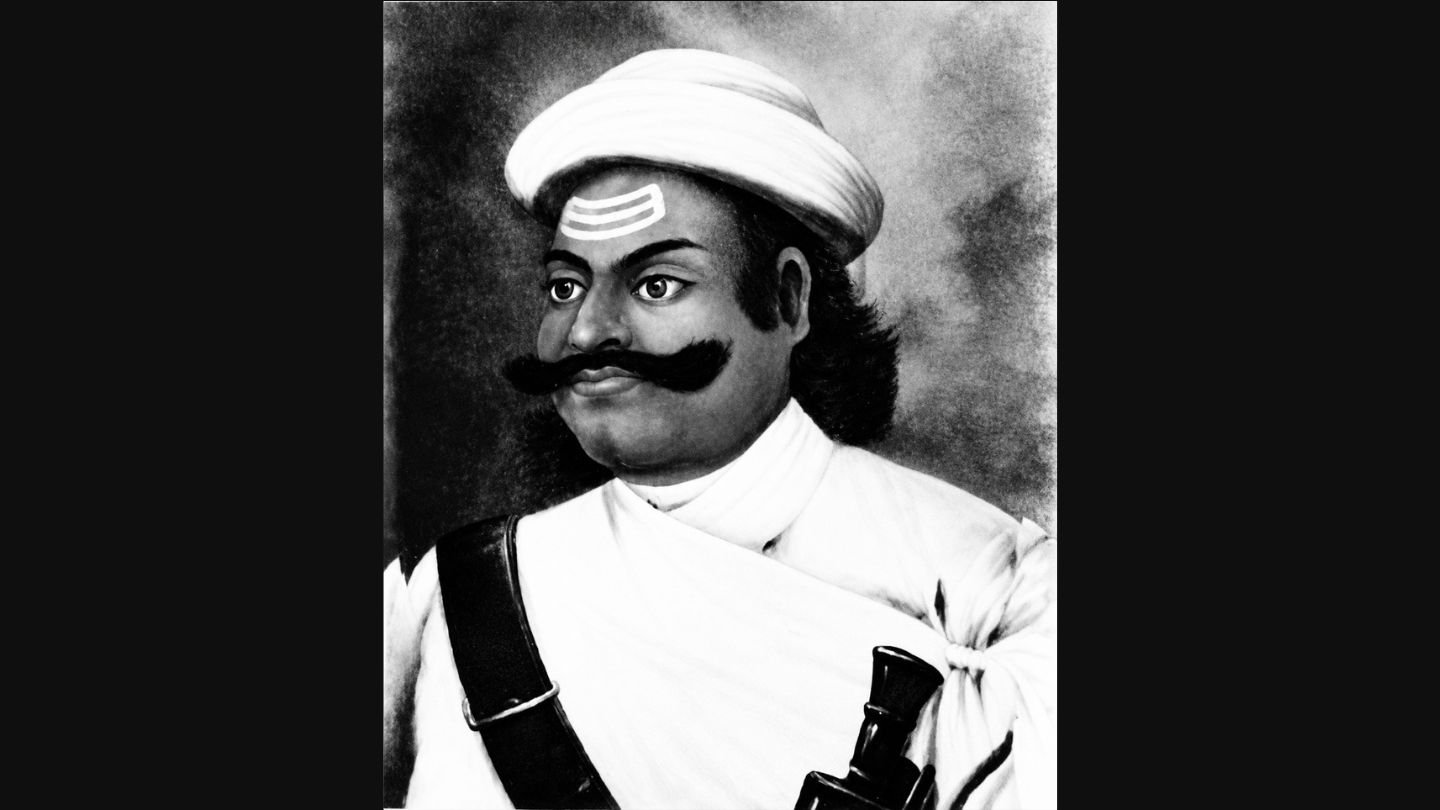
Kaji Kalu Pande (Vamshidhar Pande) was a prominent Kaji, military leader, and diplomat of the Gorkha Kingdom during the eighteenth century. He played an important role in the early territorial expansion campaigns of King Prithvi Narayan Shah. His contributions are particularly associated with the treaty with Lamjung, the conquest of Nuwakot, the leadership of Gorkhali forces, and efforts to maintain political cooperation between influential families within the royal court.
Kalu Pande died during the First Battle of Kirtipur in BS 1814 (AD 1757), in which the Gorkhali army suffered a defeat. His death was a significant loss to Gorkha's military campaign towards the Kathmandu Valley. Nevertheless, his earlier diplomatic and military activities had made an important contribution to the initial expansion of the Gorkha Kingdom.
Kalu Pande's historical significance extends beyond the battlefield. Dibya Upadesh, a collection of teachings attributed to Prithvi Narayan Shah, contains accounts of his appointment as Kaji, negotiations with Lamjung, and the marriage alliance between the Pande and Basnyat families. These accounts help explain his political influence in the administration of the Gorkha Kingdom.
Understanding Kalu Pande's contribution to Nepal's unification requires consideration not only of Gorkha's military achievements but also of the resistance offered by the kingdoms of the Kathmandu Valley, the role of local communities, and the political circumstances of eighteenth-century Nepal.
This biography examines Kalu Pande's birth, family background, appointment as Kaji, military and diplomatic contributions, participation in the First Battle of Kirtipur, death, descendants, memorial site, and historical significance based on available sources.
Kalu Pande: Quick Facts
|
Details |
Information |
|---|---|
|
Full Name |
Vamshidhar Pande |
|
Popular Name |
Kaji Kalu Pande (कालु पाँडे) |
|
Birth |
BS 1770 (approximately AD 1713), according to commonly cited biographies |
|
Birthplace |
Former Gorkha Kingdom |
|
Father |
Kaji Bhimraj Pande |
|
Principal Position |
Kaji and senior military leader of the Gorkhali forces |
|
Associated Ruler |
|
|
Major Diplomatic Contribution |
Role in negotiations leading to a treaty with Lamjung |
|
Major Military Campaigns |
Nuwakot, Belkot, and Kirtipur |
|
Death |
BS 1814 Jestha 19, according to commonly cited Nepali historical accounts |
|
Battle in Which He Died |
First Battle of Kirtipur, AD 1757 |
|
Children |
Vamsharaj Pande, Ranashur Pande, Damodar Pande, and Chitravati Pande |
|
Memorial Site |
Dahachok, Chandragiri Municipality–1, Kathmandu |
The birth year is based on commonly cited historical biographies. Although Jestha 19 is observed as the anniversary of his death, published accounts differ regarding the exact Gregorian date of the First Battle of Kirtipur. Historical studies support the conclusion that Kalu Pande died during the first Gorkhali attack on Kirtipur in AD 1757.
Birth and Family Background
Kalu Pande was born into the Pande family, which was involved in the political and administrative affairs of the former Gorkha Kingdom. His birth is generally placed around BS 1770. According to available biographical accounts, his father was Kaji Bhimraj Pande.
Real Name and Nickname
Kalu Pande's original name was Vamshidhar Pande. Historical and biographical sources refer to him using several variations, including Kalu Pande, Kalu Pandey, and Kaji Kalu Pande.
The name Kalu Pande became more widely recognized than his original name. Some traditional accounts suggest that the name originated as a childhood nickname. However, contemporary records do not clearly establish when the name "Kalu" first came into use or the precise reason behind it.
Therefore, explanations about the origin of his nickname should not be treated as unquestionable historical facts. Evidence concerning his name, political position, and historical contributions is comparatively clearer.
Historical Background of the Pande Family
The history of Kalu Pande's family is connected with the early establishment of Shah rule in Gorkha.
According to traditional genealogies, Ganesh Pande, an ancestor of the Pande family, assisted Dravya Shah in gaining control of Gorkha. This association indicates that the Pande family had been connected with the political administration of the Shah dynasty from its early period.
Kalu Pande's father, Bhimraj Pande, was also a Kaji associated with the administration of the Gorkha Kingdom. This family background may have provided Kalu Pande with opportunities to become familiar with the political affairs of the royal court.
However, reliable information about his childhood education, the individuals who trained him in warfare, or when he first received responsibilities at court remains limited.
It is therefore more appropriate to understand his character through his documented political and military activities than to make assumptions about his early life.
Role of the Bharadars in the Gorkha Kingdom
During the eighteenth century, various Bharadars, or senior state officials, participated in the administration and military affairs of the Gorkha Kingdom alongside the king.
Bharadars were high-ranking officials involved in state governance. Individuals holding positions such as Kaji, Chautariya, and Sardar could participate in political consultation, administration, and military leadership.
Historian Mahesh Chandra Regmi, in Kings and Political Leaders of the Gorkhali Empire, 1768–1814, examines the involvement of different families in Gorkhali political leadership and their administrative influence. His study indicates that the Pande and Basnyat families continued to hold important positions in the kingdom's political affairs during the subsequent period.
Against this background, Kalu Pande's emergence can be understood in relation to both his military abilities and the political structure of the royal court.
How Was Kalu Pande Appointed as Kaji?
Kalu Pande's appointment as Kaji is a notable episode in the political history of Gorkha. According to Dibya Upadesh, Prithvi Narayan Shah initially preferred another individual for the position but appointed Kalu Pande after receiving advice.
Accession of Prithvi Narayan Shah
Prithvi Narayan Shah ascended the throne of Gorkha in BS 1799 (AD 1743), following the death of his father, Narabhupal Shah.
At that time, the territory of present-day Nepal was divided into several political kingdoms and administrative units. The Kathmandu Valley contained the Malla kingdoms of Kantipur, Patan, and Bhaktapur. The western hills were home to the Baise and Chaubise principalities.
As Gorkha sought to expand its territory, relations with neighboring kingdoms, military mobilization, financial resources, and political cooperation became important considerations.
Efforts to capture Nuwakot had begun before Prithvi Narayan Shah's reign. An attempt made during Narabhupal Shah's rule had failed, and Prithvi Narayan Shah's initial attempt was also unsuccessful.
Consequently, achieving territorial expansion required the assistance of capable Kajis and other senior officials.
Biraj Bakheti and the Appointment of Kalu Pande
According to Dibya Upadesh, Prithvi Narayan Shah initially intended to appoint Biraj Bakheti as Kaji.
However, when he sought the opinions of people in Gorkha and the neighboring Baise and Chaubise political powers, he found support for Kalu Pande.
The text records advice suggesting that Kalu Pande could effectively manage both internal and external political relations.
Prithvi Narayan Shah eventually appointed Kalu Pande as Kaji instead of Biraj Bakheti.
The 2023 edition of Dibya Upadesh, edited by Nirmal Raj Joshi, discusses the negotiations with Lamjung and the appointment of Kalu Pande on pages 10–11.
This appointment demonstrates the importance of political acceptance and the ability to manage relations with neighboring kingdoms in the administration of the time.
However, it should not be interpreted as an appointment made through a modern election or democratic voting process. Gorkha was a monarchy, and the king retained the final authority to make appointments. Although the text mentions consultation with the people, equating that consultation with a contemporary electoral system would be historically inaccurate.
What Were the Responsibilities of a Kaji?
During the eighteenth century, Kaji was a senior political and administrative position in the Gorkha Kingdom.
A Kaji could advise the king, participate in administrative affairs, conduct diplomatic negotiations, and assume military leadership when necessary.
Historian Ludwig F. Stiller, in Prithwinarayan Shah in the Light of Dibya Upadesh, describes the Kaji as one of the principal government officials outside the royal family. According to his interpretation, Kajis performed many functions comparable to those of a chief minister and could also command military forces.
Kalu Pande's position should be understood within this historical administrative structure.
Some modern biographies describe him as a "Prime Minister" or the "first Commander-in-Chief." However, these designations should not be treated as fully equivalent to the constitutional office of Prime Minister in modern Nepal or the institutional position of Chief of Army Staff in the present-day Nepali Army.
Describing Kalu Pande as a senior Kaji and military leader of the Gorkha Kingdom is historically more precise.
Kalu Pande's Diplomatic Contribution to the Treaty with Lamjung
Managing relations with Lamjung was one of Kalu Pande's major diplomatic contributions. As Gorkha planned to expand eastward, maintaining relations with Lamjung, located to its west, was also important.
Political Relations Between Gorkha and Lamjung
Gorkha and Lamjung were established kingdoms in the western hills. Although their ruling families had historical dynastic connections, their political interests did not always align.
As Gorkha prepared campaigns towards Nuwakot and the Kathmandu Valley, the possibility of challenges emerging from the west was a significant concern.
For a kingdom with limited military and financial resources, conflicts on several fronts simultaneously could create serious difficulties.
Political understanding with Lamjung was therefore beneficial to Gorkha. Treaties with neighboring kingdoms formed an important part of Prithvi Narayan Shah's early expansion plans.
Negotiations with King Ripumardan Shah at Chepeghat
Dibya Upadesh records that Prithvi Narayan Shah met King Ripumardan Shah of Lamjung at Chepeghat.
The two sides discussed a treaty and matters relating to their internal political affairs.
According to the account, Prithvi Narayan Shah had an important issue he wanted to raise but was unable to present it clearly during the negotiations. Kalu Pande raised the matter, helping the two sides reach an understanding.
The text records that Prithvi Narayan Shah expressed both surprise and satisfaction at Kalu Pande's intervention.
This account provides important historical evidence of Kalu Pande's diplomatic abilities. It indicates that he was not only a military leader but also a trusted associate capable of discussing sensitive political matters with neighboring rulers.
Historical Importance of the Lamjung Treaty
The understanding with Lamjung is considered to have created more favorable political circumstances for Gorkha to concentrate on its eastern campaigns.
This episode highlights several important features of diplomacy during that period.
Gorkha did not depend exclusively on military strength to expand its territory. It also sought to manage relations with neighboring kingdoms. Kalu Pande's involvement illustrates the connection between military objectives and diplomatic negotiations.
However, the available text of Dibya Upadesh does not provide complete details of all written treaty provisions, its exact duration, or its implementation.
It would therefore be inappropriate to claim that Lamjung made a permanent commitment never to undertake activities against Gorkha.
Kalu Pande's documented contribution rests on the historical account of his effective participation in the negotiations that led to the treaty.
Kalu Pande's Role in the Conquest of Nuwakot
The conquest of Nuwakot in BS 1801 (AD 1744) was an important early success in Gorkha's territorial expansion. Kalu Pande was among the kingdom's senior Kajis and military leaders during this period.
Why Was Nuwakot Important?
During the eighteenth century, Nuwakot was a strategically important location controlled by the Kingdom of Kantipur.
It lay to the northwest of the Kathmandu Valley. Important trade routes connecting the valley with Tibet passed through Nuwakot.
Control over Nuwakot therefore offered Gorkha potential military and economic advantages.
Historian Ludwig F. Stiller describes Nuwakot as an important approach to the Kathmandu Valley and a location associated with Nepal–Tibet trade.
According to his study, the conquest of Nuwakot provided Gorkha with a base for conducting further campaigns towards the valley.
Early Attempts to Capture Nuwakot
Attempts to capture Nuwakot began before Prithvi Narayan Shah became king.
During Narabhupal Shah's reign, Gorkha launched an attack on Nuwakot, but the campaign was unsuccessful.
An initial attempt made after Prithvi Narayan Shah's accession also failed.
Following these setbacks, Gorkha organized another campaign against Nuwakot.
The attack launched in AD 1744 succeeded, bringing Nuwakot under Gorkha's control.
Contribution of Gorkhali Military Leaders
The conquest of Nuwakot was a collective military campaign conducted under the leadership of Prithvi Narayan Shah.
Historical accounts associated with the campaign mention Kalu Pande, Mahoddam Kirti Shah, and other Gorkhali leaders.
Descriptions of the attack also indicate that Gorkhali forces advanced from different directions.
Historical writings record that Shankhamani Rana, who was associated with the defense of Nuwakot, was killed during the battle.
Kalu Pande's role in the campaign is considered significant. However, there is insufficient evidence to establish that he alone determined every military plan, operational decision, or route of advance.
It is historically more appropriate to understand the conquest as a collective campaign involving Prithvi Narayan Shah, Kalu Pande, other Gorkhali commanders, and their soldiers.
Changes Following the Conquest of Nuwakot
After Nuwakot came under Gorkha's control, the kingdom extended its influence into the northwestern approaches to the Kathmandu Valley.
The victory provided a foundation for strengthening Gorkha's political and military presence in nearby areas.
Because Nuwakot was associated with important trade routes, its capture also had economic significance for the rulers of the valley.
However, the conquest of Nuwakot did not immediately place the entire Kathmandu Valley under Gorkha's control.
A prolonged campaign was still required to establish control over the valley's kingdoms and surrounding territories.
The historical importance of the Nuwakot victory lies in this early achievement. Kalu Pande's contribution was associated with this stage of Gorkha's expansion.
The Conquest of Belkot and Kalu Pande's Military Judgment
Following the campaigns associated with Nuwakot, Gorkha established control over Belkot.
The events at Belkot are associated with Jayant Rana, who had previously served the Gorkha Kingdom but later became connected with the Kantipur side.
Differences of Opinion Before the Attack on Belkot
Commonly cited historical accounts describe a disagreement between Prithvi Narayan Shah and Kalu Pande concerning the timing of the attack on Belkot.
Kalu Pande reportedly advised that the condition of the soldiers and the need for additional preparation should be considered.
Nevertheless, the attack proceeded, and Gorkha eventually gained control of Belkot.
Accounts of the campaign also mention the capture of Jayant Rana.
However, published historical narratives do not provide equally detailed or consistent accounts of the precise sequence of events involving Nuwakot and Belkot, the circumstances of Jayant Rana's capture, or the alleged conversations between the king and Kalu Pande.
Therefore, statements attributed to participants before the battle should not be presented as verified direct quotations.
Approach to Military Preparation
Historical accounts of the Belkot campaign and the later attack on Kirtipur suggest that Kalu Pande attached importance to military preparation and the timing of attacks.
Both the likelihood of military success and the risks faced by soldiers are important considerations for military leadership.
Historical studies concerning Kalu Pande refer to this cautious approach.
However, there is insufficient evidence to portray him as the inventor of any particular modern military technique or planning method.
His role should be evaluated within the political and military circumstances of his time.
The Pande–Basnyat Marriage Alliance and Political Cooperation
The marriage alliance between the Pande and Basnyat families holds particular significance in Kalu Pande's life.
The relationship was more than a family arrangement. It was also connected with efforts to maintain political cooperation between two influential families within the Gorkha royal court.
Marriage of Chitravati Pande and Kehar Singh Basnyat
According to Dibya Upadesh, Prithvi Narayan Shah arranged a marriage alliance between the Pande and Basnyat families.
As part of this arrangement, Kalu Pande's daughter, Chitravati Pande, married Kehar Singh Basnyat, the son of Shivaram Singh Basnyat.
The text presents this relationship between the Pande and Basnyat families as a means of promoting cooperation during Gorkha's territorial expansion.
Historian Mahesh Chandra Regmi also records in his study that Chitravati, the wife of Kehar Singh Basnyat, was Kalu Pande's daughter.
Political Significance of the Alliance
Relationships between influential families affected political decisions and administrative cooperation in eighteenth-century royal courts.
Kalu Pande was involved in military and diplomatic leadership on behalf of the Pande family. Members of the Basnyat family also participated in Gorkha's military and political administration.
Under these circumstances, the marriage alliance can be understood as an effort to strengthen cooperation between the two families.
The episode demonstrates how family relationships could serve political purposes in the administration of the kingdom.
However, it would be inaccurate to conclude that the marriage ensured permanent political unity between the Pande and Basnyat families.
In later periods, political competition emerged among several influential Bharadar families.
The marriage alliance should therefore be understood in relation to the political needs and efforts at cooperation during that particular period.
The First Battle of Kirtipur and Kalu Pande's Death
The First Battle of Kirtipur, fought in BS 1814 (AD 1757), was the final major military campaign of Kalu Pande's life.
The Gorkhali army suffered a defeat in the battle, and Kalu Pande was killed.
Strategic Importance of Kirtipur
Kirtipur is a historic settlement situated to the west-southwest of the Kathmandu Valley.
During the eighteenth century, it was associated with the Kingdom of Patan.
Kirtipur's geographical location and defensive structures gave it considerable military importance.
For Gorkha, capturing Kirtipur represented an important attempt to extend its influence into the Kathmandu Valley.
For the local inhabitants of Kirtipur and the valley's defending forces, protecting their town and political independence was equally important.
The battle should therefore be understood as a conflict between two sides pursuing different political objectives.
Kalu Pande's Opposition to the Proposed Attack
Historical studies indicate that Kalu Pande did not support an immediate attack on Kirtipur.
Considering Gorkha's military preparations and Kirtipur's defensive position, he believed that the timing of the proposed attack was unsuitable.
On page 30 of Prithwinarayan Shah in the Light of Dibya Upadesh, Ludwig F. Stiller notes that Kalu Pande strongly opposed the first attack on Kirtipur.
However, Prithvi Narayan Shah remained determined to proceed.
Kalu Pande eventually participated in the battle. Stiller's historical assessment characterizes the decision to attack as a serious mistake for Gorkha.
Some traditional accounts suggest that Kalu Pande was compelled to participate after the king questioned his courage.
Although references to such conversations appear in published historical narratives, their precise wording differs across sources. Therefore, the alleged dialogue should not be presented as a direct quotation verified by contemporary records.
Outcome of the First Battle of Kirtipur
When Gorkha attacked Kirtipur in AD 1757, the Malla forces and local defenders offered resistance.
The conflict was associated with Tyanglaphant and surrounding locations northwest of Kirtipur.
During the attack, the Gorkhali forces encountered stronger resistance than anticipated.
According to historian Stiller, despite political rivalries among the kingdoms of the Kathmandu Valley, local communities demonstrated considerable unity in opposing the Gorkhali attack.
Both sides suffered losses, and the Gorkhali army was defeated.
Kalu Pande was killed in the battle, while Prithvi Narayan Shah was forced to withdraw from the battlefield under difficult circumstances.
The defeat represented a major setback to Gorkha's early attempts to capture the Kathmandu Valley.
Role of Kirtipur's Local Population
Resistance by the inhabitants of Kirtipur was an important aspect of the First Battle of Kirtipur.
Limiting the conflict to political competition between Prithvi Narayan Shah and the Malla kings would provide an incomplete historical account.
For the local communities of Kirtipur, the battle involved defending their town, social institutions, and local governance.
The Gorkhali defeat therefore cannot be explained solely by inadequate military preparation. The capabilities and resistance of the defending forces also influenced the outcome.
An examination of Nepal's unification history must consider the experiences of both the Gorkhali campaign and the communities that resisted it.
Date of Kalu Pande's Death
In Nepali historical remembrance, Kalu Pande is generally considered to have died on BS 1814 Jestha 19.
This date has continued to be observed as his memorial day.
According to an account published by Gorkhapatra, he died during the Battle of Kirtipur on BS 1814 Jestha 19. Organizations associated with the Pande family have also organized memorial events on this date.
However, published historical accounts are not entirely consistent regarding the exact Gregorian day and month of the battle in AD 1757.
It is therefore appropriate to distinguish between the traditionally observed Nepali date of his death and the historically documented battle of AD 1757.
Impact of Kalu Pande's Death on the Unification Campaign
Kalu Pande's death during the First Battle of Kirtipur represented a significant military and political loss for Gorkha.
He was a senior Kaji who had participated in negotiations with Lamjung and played a role in Gorkha's early military campaigns.
His death deprived Prithvi Narayan Shah of one of his experienced associates.
What Did the Defeat at Kirtipur Demonstrate?
The First Battle of Kirtipur demonstrated the strength of local defensive forces in the Kathmandu Valley.
Although political disagreements existed among the valley's rulers, the battle showed that coordinated resistance against an external attack was possible.
Following the defeat, Gorkha continued its territorial expansion campaign.
In subsequent years, Gorkha attempted to establish control over other important locations surrounding the Kathmandu Valley.
Kirtipur came under Gorkhali control in AD 1766. Kantipur and Patan followed in AD 1768, while Bhaktapur came under Gorkha's control in AD 1769.
Kalu Pande did not live to participate in these later events.
Nevertheless, the conquest of Nuwakot and the early diplomatic efforts undertaken during his lifetime were connected with the preceding stage of Gorkha's expansion.
Historical Interpretation of the Military Defeat
It would be inappropriate to portray the defeat at Kirtipur solely as Kalu Pande's personal failure.
Available historical studies indicate that he had opposed an immediate attack.
An assessment of the battle's outcome must therefore consider political decisions, military preparation, local resistance, and the overall circumstances.
Military outcomes are influenced by several interconnected factors. Reducing the result of a battle to the decisions or abilities of one individual can produce an incomplete historical interpretation.
Kalu Pande's Children and the Later History of the Pande Family
Following Kalu Pande's death, his descendants continued to be associated with the political and military history of Gorkha and the unified Nepali state.
According to commonly cited genealogies, he had three sons—Vamsharaj Pande, Ranashur Pande, and Damodar Pande—and one daughter, Chitravati Pande.
Vamsharaj Pande
Vamsharaj Pande was Kalu Pande's eldest son.
He held political and military responsibilities during the expansion of Shah rule.
His name is associated with the later reign of Prithvi Narayan Shah and subsequent developments in royal court politics.
He became one of the senior officials of the Gorkhali administration.
Ranashur Pande
Ranashur Pande was another son of Kalu Pande.
His name appears in the genealogical account of the Pande family presented by historian Mahesh Chandra Regmi.
He is recognized as a member of the Pande family involved in military and administrative affairs.
However, detailed information about his individual military campaigns, tenure in office, and political activities is more limited than the information available concerning Vamsharaj and Damodar Pande.
It would therefore be inappropriate to attribute the achievements of other individuals to him.
Damodar Pande
Damodar Pande was Kalu Pande's youngest son.
He held senior political and administrative responsibilities during the later period of Shah rule.
According to historian Mahesh Chandra Regmi, Damodar Pande occupied a leading political position between AD 1799 and 1804.
His influence in Nepal's royal court politics was particularly significant.
Some biographies describe Damodar Pande as Nepal's first Prime Minister. However, historical offices such as Mulkaji and Mukhtiyar should not be treated as identical to the modern constitutional position of Prime Minister.
The official list of former Prime Ministers published by the Office of the Prime Minister and Council of Ministers of Nepal begins with Bhimsen Thapa.
Therefore, describing Damodar Pande as a Mulkaji and senior political leader of his time is more historically precise.
Chitravati Pande
Chitravati Pande was Kalu Pande's daughter.
She married Kehar Singh Basnyat, an alliance that holds significance in the political history of the Gorkha royal court.
Although available information about her personal life is limited, the marriage is mentioned in Dibya Upadesh and subsequent historical studies.
Kalu Pande's Memorial Site at Dahachok
Kalu Pande's memorial site is located at Dahachok, Chandragiri Municipality–1, Kathmandu District.
Chandragiri Municipality identifies Kaji Kalu Pande's memorial site and the Dahachok View Tower among the important local landmarks of Ward No. 1 on its official website.

Why Was the Memorial Established at Dahachok?
According to traditional historical and local accounts, Kalu Pande expressed a wish that, if he died in battle, his final rites should be performed at a location overlooking Gorkha.
The memorial site at Dahachok is associated with this tradition.
A report published by Gorkhapatra also states that the memorial was established at Dahachok in accordance with Kalu Pande's reported final wish.
However, a contemporary written record containing the precise statement of this wish has not been clearly established.
Therefore, while the location of the memorial is supported by official information, the explanation concerning his final wish should be understood as a historical tradition rather than an independently verified account.
Preservation and Commemoration of the Memorial
A statue of Kalu Pande has been installed at the memorial site in Dahachok.
According to Gorkhapatra, construction and improvement work at the memorial premises was carried out in BS 2078 with support from the Nepali Army.
Tribute programs have also been organized at the site on occasions commemorating Kalu Pande's death.
On BS 2079 Jestha 19, then-President Bidya Devi Bhandari attended a program at the memorial and placed a garland on Kalu Pande's statue.
The memorial contributes to the preservation of historical remembrance associated with the eighteenth-century Gorkha Kingdom and the Battle of Kirtipur.
Assessing Kalu Pande's Contributions to Nepal's History
Kalu Pande's historical role can be evaluated through his diplomatic, military, political, and administrative contributions.
Diplomatic Contributions
Kalu Pande's role in negotiations concerning the treaty with Lamjung is directly mentioned in Dibya Upadesh.
This account indicates that he was capable of conducting political discussions with neighboring kingdoms.
His diplomatic contribution was closely connected with Gorkha's political requirements and its plans for expansion towards the east.
Military Leadership
Kalu Pande was among the senior military leaders involved in the conquest of Nuwakot and Gorkha's early campaigns.
Historical studies also record his opinion that the timing of the first attack on Kirtipur was unsuitable.
These accounts indicate that he was actively involved in military decision-making.
However, it would not be historically accurate to claim that all his military decisions were successful or that he independently developed the strategies for every campaign.
Political and Administrative Role
The circumstances surrounding Kalu Pande's appointment as Kaji and the marriage alliance between the Pande and Basnyat families demonstrate his political importance.
His direct mention in the teachings attributed to Prithvi Narayan Shah also provides evidence of his position within the administration of that period.
However, these accounts largely reflect the perspective of the royal court. Understanding the broader history of territorial expansion also requires consideration of the experiences of other communities and political groups.
Important Considerations When Studying Kalu Pande's History
Published accounts of Kalu Pande's life draw on historical works, genealogies, local traditions, and sources associated with commemorative activities.
However, these sources do not all provide the same level of historical evidence.
Dibya Upadesh contains political and administrative accounts attributed to Prithvi Narayan Shah. It is an important textual source for understanding the governing perspective of the period.
Nevertheless, historians have studied and debated aspects of its surviving manuscript tradition and the period in which the text was compiled. It should therefore be examined critically.
Studies by Ludwig F. Stiller, Mahesh Chandra Regmi, and other historians help explain the historical circumstances of Gorkha's expansion, the roles of influential political families, and the Battle of Kirtipur.
Information about the location of Kalu Pande's memorial and subsequent preservation activities is available from Chandragiri Municipality and relevant published news reports.
Based on these sources, certain aspects of Kalu Pande's life are comparatively well documented, while other details depend on traditional narratives.
Particular care is necessary when discussing his childhood education, the origin of his nickname, private conversations before battles, and the precise wording of his reported final wish.
The commonly used term "unification of Nepal" refers to the territorial expansion of the Gorkha Kingdom and the political consolidation of different kingdoms.
However, the history of this process also includes the loss of political independence experienced by other kingdoms and resistance from local communities.
An assessment of Kalu Pande's contributions should therefore prioritize a balanced, evidence-based historical account rather than an exclusively celebratory biography.
Conclusion
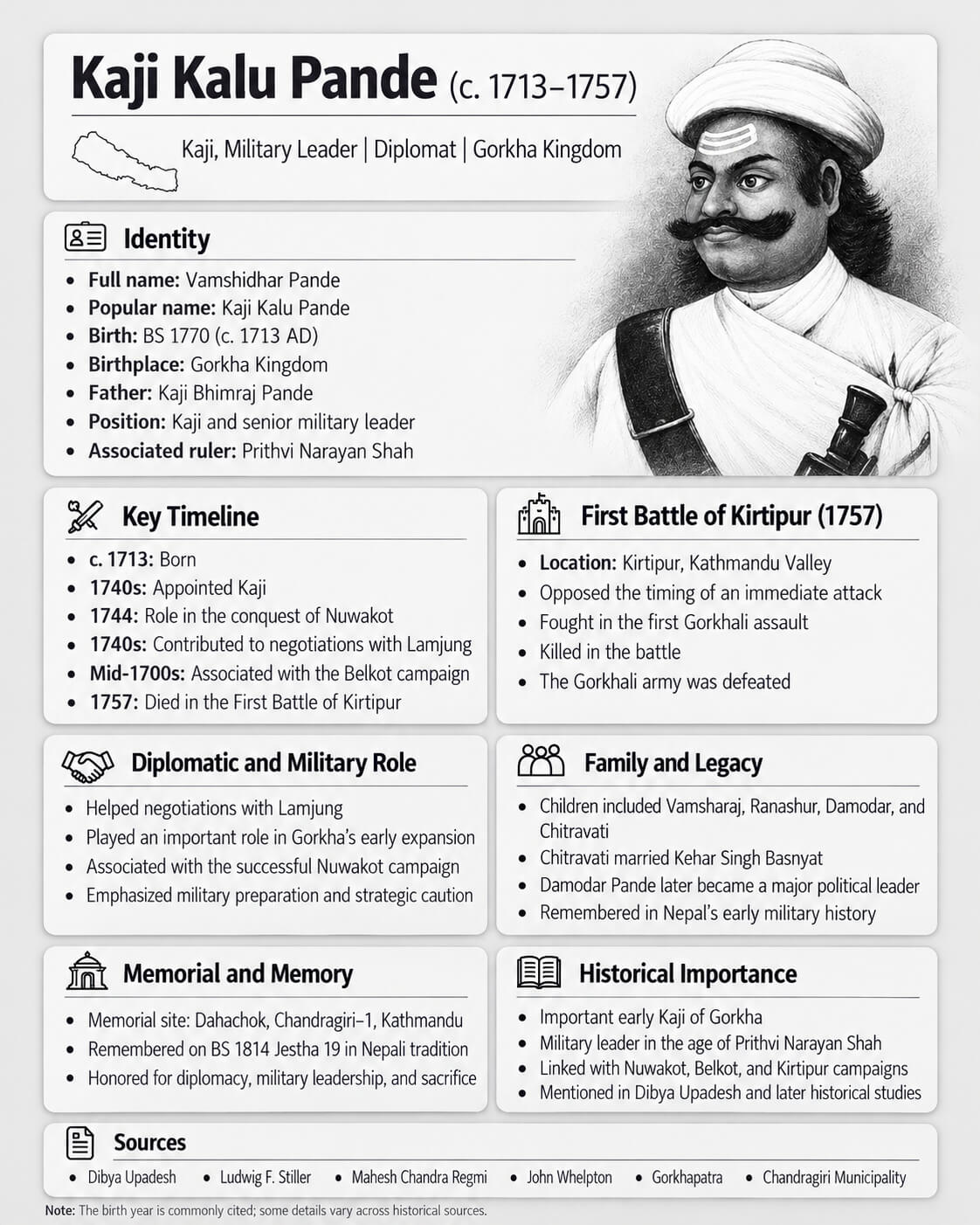
Kaji Kalu Pande was an important political official, military leader, and diplomat of the eighteenth-century Gorkha Kingdom. He contributed to the early territorial expansion campaigns of Prithvi Narayan Shah through negotiations with Lamjung, participation in the conquest of Nuwakot, and efforts to establish political cooperation.
He died during the First Battle of Kirtipur in BS 1814, when the Gorkhali army suffered a defeat.
Kalu Pande's life provides insight into the importance of political consultation, diplomacy, military leadership, and relationships between influential court families in the administration of the Gorkha Kingdom.
An accurate assessment of his historical contribution requires attention to available evidence and a clear distinction between documented events, traditional narratives, and subsequent historical interpretations.
References
-
Prithvi Narayan Shah (attributed). Divya Upadesh of Prithvi Narayan Shah: With Original Text, Modern Nepali Text and English Translation. Edition prepared by Nirmal Raj Joshi. Ink Vault Publications, 2023.
-
Stiller, Ludwig F. Prithwinarayan Shah in the Light of Dibya Upadesh. 1968.
-
Regmi, Mahesh Chandra. Kings and Political Leaders of the Gorkhali Empire, 1768–1814. Sangam Books, 1995.
-
Whelpton, John. A History of Nepal. Cambridge University Press, 2005.
-
Dhungana, Rajesh. "राजहठले मारिएका वीर कालु पाण्डेको समाधिस्थल." Gorkhapatra Online.
-
Gorkhapatra Online. "राष्ट्रपति भण्डारीद्वारा काजी कालु पाँडेको समाधिस्थलमा माल्यार्पण." BS 2079 Jestha 19.
-
Government of Nepal, Office of the Prime Minister and Council of Ministers. "नेपालका पूर्व प्रधानमन्त्रीहरू" (Former Prime Ministers of Nepal).







Comments 0
No comments yet. Be the first to start the conversation.