



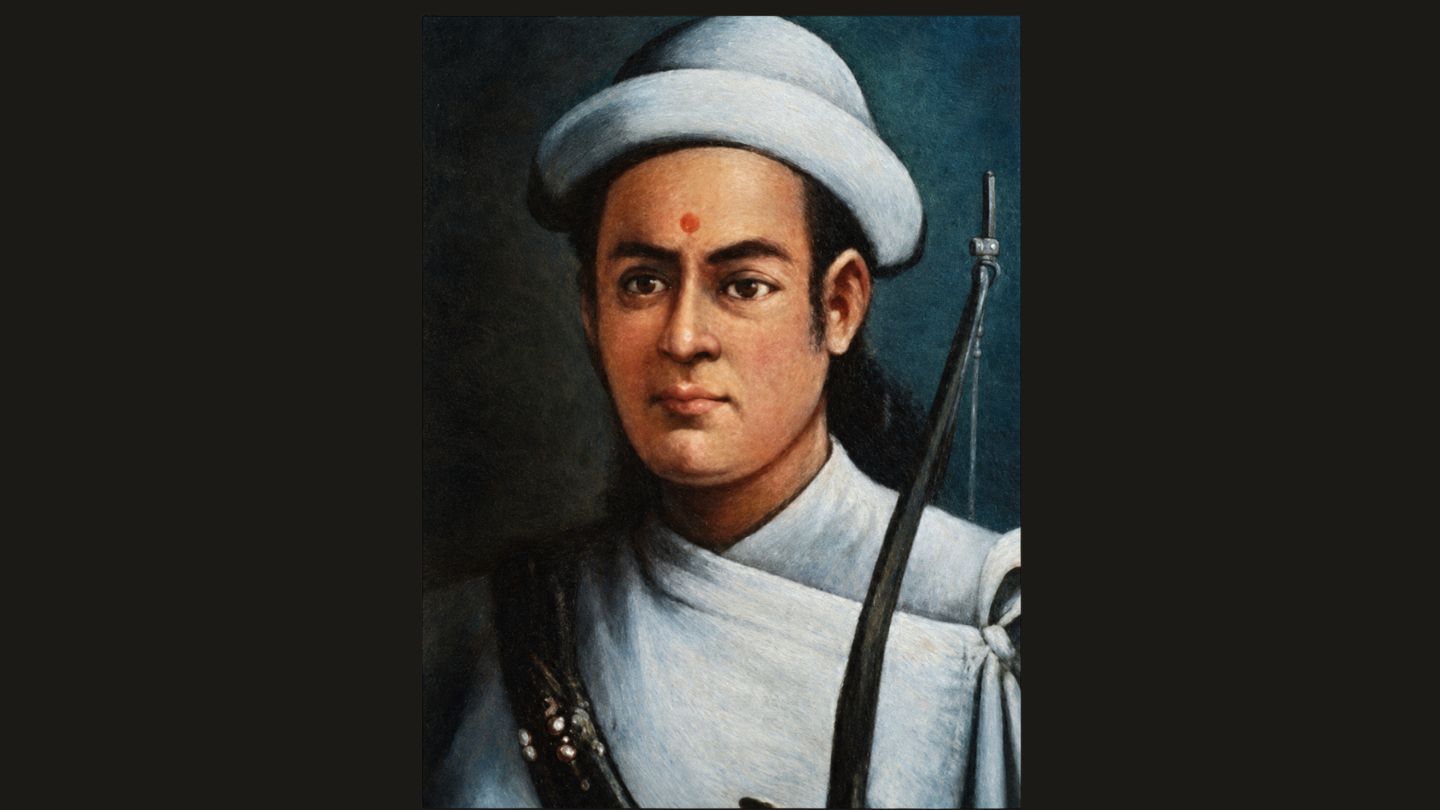
Balbhadra Kunwar (1789–1823) was a National Luminary of Nepal and one of the prominent military commanders of the Anglo-Nepalese War. He is particularly remembered in Nepal's military history for his leadership and courage in defending Khalanga Fort at Nalapani against the forces of the British East India Company in 1814.
Serving as a captain in the Gorkhali Army, Balbhadra resisted British attacks for nearly a month despite having limited troops and resources. After failing to capture the fort through direct assaults, the British forces cut off its water supply. Even under these difficult circumstances, Balbhadra refused to surrender and eventually left the fort with his surviving soldiers.
Following the Anglo-Nepalese War, he travelled to Punjab and joined the Sikh Army under Maharaja Ranjit Singh. There, he commanded Gorkhali soldiers. He died in 1823 during a military conflict between the Sikh and Afghan forces.
His resistance at Nalapani, subsequent military service, and the memorials established in recognition of the battle provide important insights into his historical contributions.
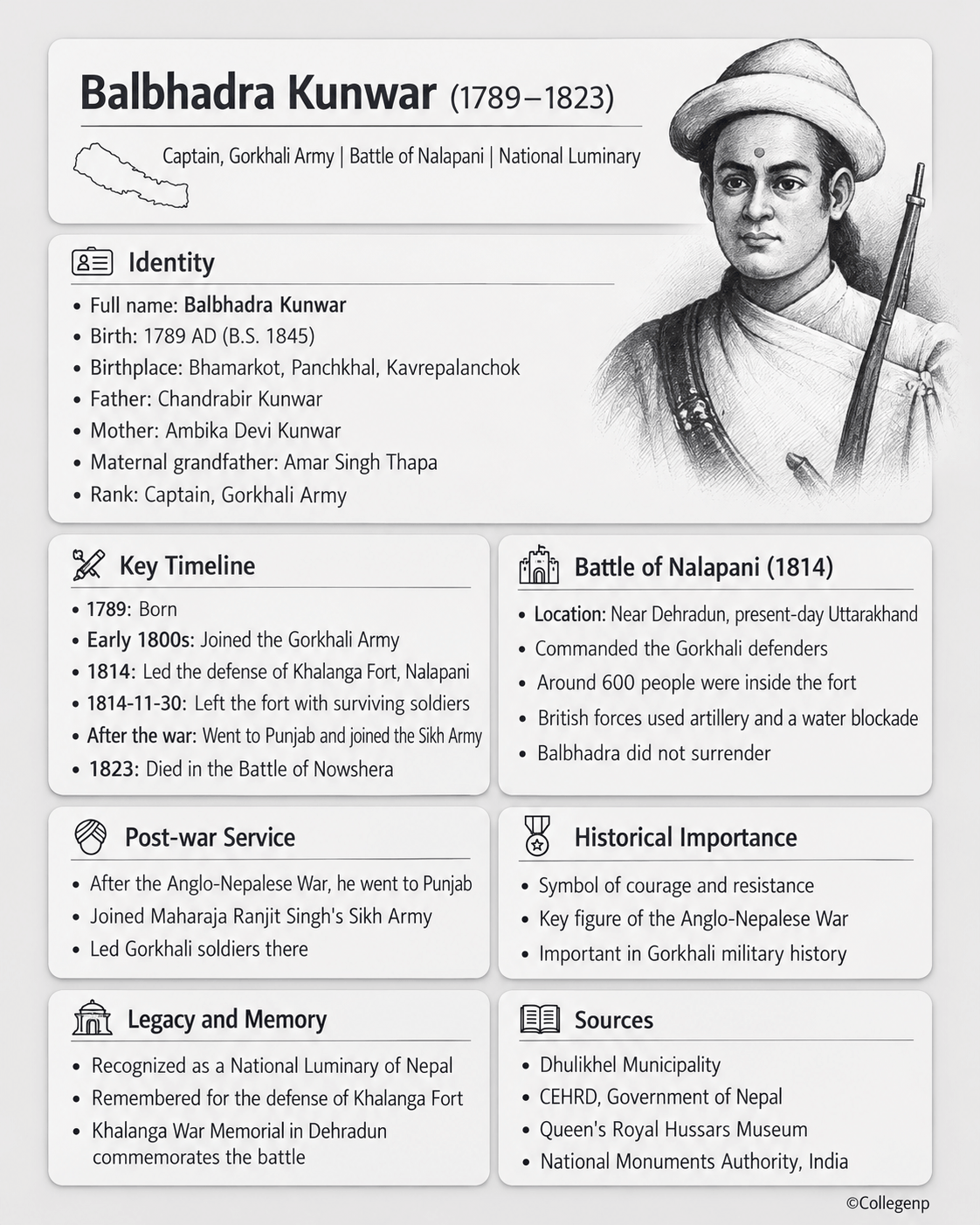
Balbhadra Kunwar: Quick Facts
|
Particulars |
Details |
|---|---|
|
Full Name |
Balbhadra Kunwar (बलभद्र कुँवर) |
|
Birth |
1845 BS (1789 AD) |
|
Birthplace |
Bhamarkot, Panchkhal, Kavrepalanchok |
|
Father |
Chandrabir Kunwar |
|
Mother |
Ambika Devi Kunwar |
|
Maternal Grandfather |
|
|
Maternal Uncle |
Kaji Ranjor Thapa |
|
Military Rank |
Captain in the Gorkhali Army; later held the responsibilities of a general in the Sikh Army |
|
Major Battles |
Battle of Nalapani (1814); Battle of Nowshera (1823) |
|
Death |
1823, Nowshera region (present-day Pakistan) |
|
National Recognition |
National Luminary of Nepal |
Although historical sources generally agree on his year of birth, local records contain differing accounts of his exact birth date. A local educational publication issued by Dhulikhel Municipality mentions 17 Magh 1845 BS, while a local inscription reportedly records 15 Poush 1845 BS.
Birth, Family Background, and Childhood
Balbhadra Kunwar was born in Bhamarkot, in the Panchkhal area of present-day Kavrepalanchok district. His family had connections with the military and administrative services of the Gorkhali state.
His father, Chandrabir Kunwar, was a military and administrative officer of the Gorkhali state. His mother, Ambika Devi Kunwar, was the daughter of Amar Singh Thapa. Through this family relationship, Balbhadra was the nephew of Kaji Ranjor Thapa.
His paternal grandfather, Jayakrishna Kunwar, was also associated with the military history of the Gorkhali state.
Balbhadra therefore came from a family closely connected with the military and administrative establishment of the period.
However, detailed and verified information about his childhood, formal education, and early military training is limited. Consequently, no definite conclusions can be drawn about the education or training he received during his childhood.
Entry into Military Service and Early Responsibilities
Balbhadra Kunwar joined the Gorkhali Army during his youth. By the time of the Anglo-Nepalese War, he was serving as a captain.
By the early nineteenth century, the Gorkhali state had expanded its territorial control westward. During this expansion, Gorkhali administrative establishments and military outposts were established in Garhwal, Kumaon, and surrounding areas.
At the same time, the British East India Company was expanding its political and military influence across the Indian subcontinent. The territorial ambitions of both sides, together with border disputes, eventually created the conditions that led to the Anglo-Nepalese War.
Balbhadra Kunwar was assigned responsibility for the defence of the Dehradun region. Following the advance of British forces, he used Khalanga Fort, located in the northern hills of Dehradun, as a defensive stronghold.
The Historic Battle of Nalapani (1814)
The Battle of Nalapani was one of the earliest and most significant military engagements of the Anglo-Nepalese War. It took place in the Nalapani area near Dehradun, in present-day Uttarakhand, India.
Captain Balbhadra Kunwar commanded the Gorkhali defenders, while the initial major British assault was led by Major General Robert Rollo Gillespie.
Strategic Location of Khalanga Fort
Khalanga Fort was situated in the northern hills overlooking the Dehradun Valley. Its steep surrounding terrain and limited access routes offered certain defensive advantages.
However, the fort was not designed to withstand sustained attacks from modern artillery. Its water supply also depended on sources located outside its defensive perimeter.
According to historical information published by the Queen's Royal Hussars Museum, approximately 600 people were inside the fort. More than half were not regular combat soldiers. The total included family members of the soldiers.
Troop Strength and Military Resources at Nalapani
Balbhadra's forces were at a disadvantage in terms of troop strength and modern military equipment.
The British Army possessed artillery, trained soldiers, and the capacity to deploy additional forces. The Gorkhali defenders had limited resources and relied partly on the fort's geographical position to resist the attacks.
Historical accounts differ regarding the number of British soldiers involved.
The Queen's Royal Hussars Museum states that Gillespie's force entering Dehradun numbered approximately 4,500 troops. Other accounts indicate that additional forces were deployed during subsequent military operations.
It is therefore important to distinguish between the number of soldiers involved at different stages of the battle and the total number of people inside the fort.
British Assaults and the Death of General Gillespie
British forces intensified their attacks on Khalanga Fort toward the end of October 1814.
On 31 October, Major General Robert Rollo Gillespie led an assault intended to capture the fort. He was killed by gunfire from the Gorkhali defenders during the attack.
The British suffered considerable losses, and their immediate attempt to capture the fort was unsuccessful.
Gillespie's death was a significant event in the Battle of Nalapani. It demonstrated the resistance capabilities of the Gorkhali defenders and compelled the British Army to revise its approach to the offensive.
Blockade and Disruption of the Water Supply
After failing to capture Khalanga Fort through direct assaults, British forces adopted a blockade strategy.
The British gained control of the water sources supplying the fort, placing the soldiers and other people inside under severe hardship. Continued military attacks also progressively weakened the fort's defensive structures.
The shortage of drinking water, military casualties, and lack of external assistance reduced the defenders' ability to continue their resistance.
Cutting off the water supply became one of the decisive British strategies during the Battle of Nalapani. It ultimately forced Balbhadra and his soldiers into a situation in which they could no longer remain inside the fort.
Why Did Balbhadra Kunwar Leave Nalapani Fort?
Balbhadra Kunwar decided to leave the fort because of sustained attacks, casualties, and the shortage of drinking water.
On 30 November 1814, he left Khalanga Fort with approximately 70 surviving soldiers. According to historical accounts, they did not surrender. Instead, they broke through the British encirclement and attempted to reach other Gorkhali military positions.
The fort subsequently came under British control.
The military outcome of the battle and its place in historical memory should be understood separately. Although the British ultimately captured Khalanga Fort, the resistance mounted by Balbhadra and his soldiers under difficult circumstances is remembered in Nepali history as an example of courage and military leadership.
The Treaty of Sugauli and the Post-War Period
The Treaty of Sugauli, concluded following the Anglo-Nepalese War, significantly affected Nepal's territorial and political position.
The treaty document was prepared on 2 December 1815, and the ratification process was completed in March 1816. Under the treaty, Nepal lost several territories that had previously been under its control in the west.
The treaty also established a new diplomatic arrangement between Nepal and the British East India Company. Nepal's Ministry of Foreign Affairs identifies the Treaty of Sugauli of 1816 as an early foundation of formal relations between Nepal and the United Kingdom.
In the changed political circumstances following the war, Gorkhali soldiers began serving in different military establishments. Some joined the armed forces of other states.
Balbhadra Kunwar also travelled to Punjab after the Anglo-Nepalese War and entered military service in the Sikh Army.
Balbhadra Kunwar's Journey to Punjab and Service in the Sikh Army
Following the Anglo-Nepalese War, Balbhadra Kunwar served in the army of the Sikh Empire under Maharaja Ranjit Singh.
At the time, Lahore in Punjab was a major political and military centre of the Sikh Empire. Ranjit Singh's army included soldiers and officers from different regions and backgrounds.
Historical information about the Khalanga monuments published by India's National Monuments Authority states that Balbhadra Kunwar served in the Sikh Army with the responsibilities of a general and commanded Gorkhali soldiers.
Balbhadra's Role in the Sikh Army
Balbhadra's responsibilities in the Sikh Army were associated with commanding Gorkhali troops.
Some Gorkhali soldiers who had participated in the Anglo-Nepalese War subsequently entered military service in Punjab. Balbhadra was among those associated with this development.
His journey to Punjab also illustrates the practice of soldiers from one South Asian state entering the military service of another during that period.
Balbhadra Kunwar and the Lahure Tradition
In Nepali, the term Lahure is commonly used to describe a person who travels abroad for employment or military service. The historical origin of the term is associated with Lahore.
The service of Gorkhali soldiers in Punjab provides an important reference for understanding the history of this tradition.
However, there is insufficient evidence to conclude definitively that the term Lahure originated specifically from Balbhadra Kunwar's journey to Punjab.
The history of Nepali military service and movement beyond Nepal's borders extends beyond the experiences of any single individual.
The Battle of Nowshera and the Death of Balbhadra Kunwar
Balbhadra Kunwar died during a military campaign against Afghan forces while serving in the Sikh Army.
In 1823, the Sikh Empire of Punjab and Afghan forces engaged in a military conflict in the Nowshera region. The area is located in present-day Khyber Pakhtunkhwa Province, Pakistan.
During the battle, Maharaja Ranjit Singh's forces confronted the Afghan side. Historical accounts associate Balbhadra Kunwar's death with this military campaign.
The historical account published by India's National Monuments Authority also states that Balbhadra and his Gorkhali soldiers subsequently joined Ranjit Singh's army and were killed in a battle against Afghan forces.
Published accounts are not consistent regarding the exact date of his death and its conversion between the Bikram Sambat and Gregorian calendars.
Therefore, the most reliable approach is to identify his death with the Battle of Nowshera in 1823 without assigning an uncertain exact date.
Historical Significance and Contributions of Balbhadra Kunwar
Balbhadra Kunwar's principal historical contribution was his military leadership during the defence of Nalapani Fort.
His contributions can be understood through the resistance at Nalapani, the history of Gorkhali soldiers, his military service after the Anglo-Nepalese War, and his recognition as a National Luminary.
Military Leadership in the Battle of Nalapani
At Nalapani, Balbhadra confronted a considerably larger military force despite having limited resources.
The defensive strategy he employed at Khalanga Fort and his leadership of the soldiers under difficult circumstances established his place in Nepal's military history.
Although the British eventually captured the fort, the Gorkhali defenders' success in repelling the initial attacks demonstrated their capacity to resist a larger military force.
Historical Identity of Gorkhali Soldiers
The resistance offered by Gorkhali soldiers at Nalapani and other fronts during the Anglo-Nepalese War attracted the attention of British military officers.
Gorkhali soldiers began entering British military service during and after the Anglo-Nepalese War.
However, this development cannot be attributed solely to one battle or one individual.
Nevertheless, the Battle of Nalapani remains an important event in the military history of Gorkhali soldiers.
Recognition as a National Luminary
Balbhadra Kunwar is recognised as one of Nepal's National Luminaries.
The designation refers to individuals who have made distinguished contributions to Nepal's history, culture, society, or nation-building and have received national recognition.
Balbhadra Kunwar is included among Nepal's National Luminaries in local educational materials published by Dhulikhel Municipality and study materials issued by the Government of Nepal's Centre for Education and Human Resource Development.
The Historic Nalapani Memorial
Following the Battle of Nalapani, the British established memorials in the Dehradun area to commemorate both their own soldiers and their Gorkhali opponents.
The Khalanga War Memorial consists of two memorial structures. One is associated with the memory of British commander Gillespie and his soldiers, while the other commemorates the Gorkhali commander and his soldiers.
Historical information published by India's National Monuments Authority and Ministry of Tourism recognises the significance of these memorials.
The memorial is protected by the Archaeological Survey of India.
A distinguishing feature of the site is its commemoration of soldiers from both sides of the conflict. It connects the Battle of Nalapani with the military histories of both Nepal and British India.
Understanding the Historical Significance of Balbhadra Kunwar's Life
Balbhadra Kunwar's life provides insight into the military and political changes that took place in Nepal and South Asia during the early nineteenth century.
His role at Nalapani was associated with the territorial defence efforts of the Gorkhali state. His subsequent military service in Punjab reflected the practice of soldiers entering the armed forces of other states during that period.
Three aspects are particularly important when studying his life: the actual military outcome of the Battle of Nalapani, the way the battle is remembered in Nepali society, and his subsequent service in the Sikh Army.
Viewed in this way, Balbhadra Kunwar's historical significance extends beyond his individual courage in battle.
His life also helps explain the Anglo-Nepalese War, the political circumstances following the Treaty of Sugauli, and the history of Gorkhali soldiers serving in military forces beyond Nepal.
Conclusion
Balbhadra Kunwar is remembered in Nepal's history as a National Luminary for his leadership during the Battle of Nalapani.
In 1814, he commanded the Gorkhali defenders of Khalanga Fort and resisted attacks by the British East India Company for nearly a month.
Although difficult circumstances eventually forced him to leave the fort, he did not surrender. Instead, he departed with his surviving soldiers.
This resistance established his lasting place in Nepal's historical memory.
Following the Anglo-Nepalese War, he served in the Sikh Army in Punjab and died during the Battle of Nowshera in 1823.
His historical importance lies in his military leadership at Nalapani, his association with the history of Gorkhali soldiers, and his involvement in the military connections between Nepal and Punjab during the nineteenth century.
References
1. Dhulikhel Municipality. Hamro Nagar (Grade 4), Lesson 2: National Luminary Balbhadra Kunwar. Dhulikhel Municipality.
2. Centre for Education and Human Resource Development, Government of Nepal. Study Materials on Nepalese History and National Luminaries.
3. Queen's Royal Hussars Museum. Anglo-Nepalese War of 1814–16. Queen's Royal Hussars Museum. qrhmuseum.com.
4. Sijapati, Alisha. (2021). From Nalapani to Kalapani. Nepali Times.
5. National Monuments Authority, Ministry of Culture, Government of India. (2022). Draft Heritage Bye-Laws for Khalanga Monuments, Dehradun, Uttarakhand.
6. Ministry of Tourism, Government of India. Khalanga War Memorial, Dehradun. Incredible India.
7. Ministry of Foreign Affairs, Government of Nepal. Nepal–United Kingdom Relations.







Comments 0
No comments yet. Be the first to start the conversation.