



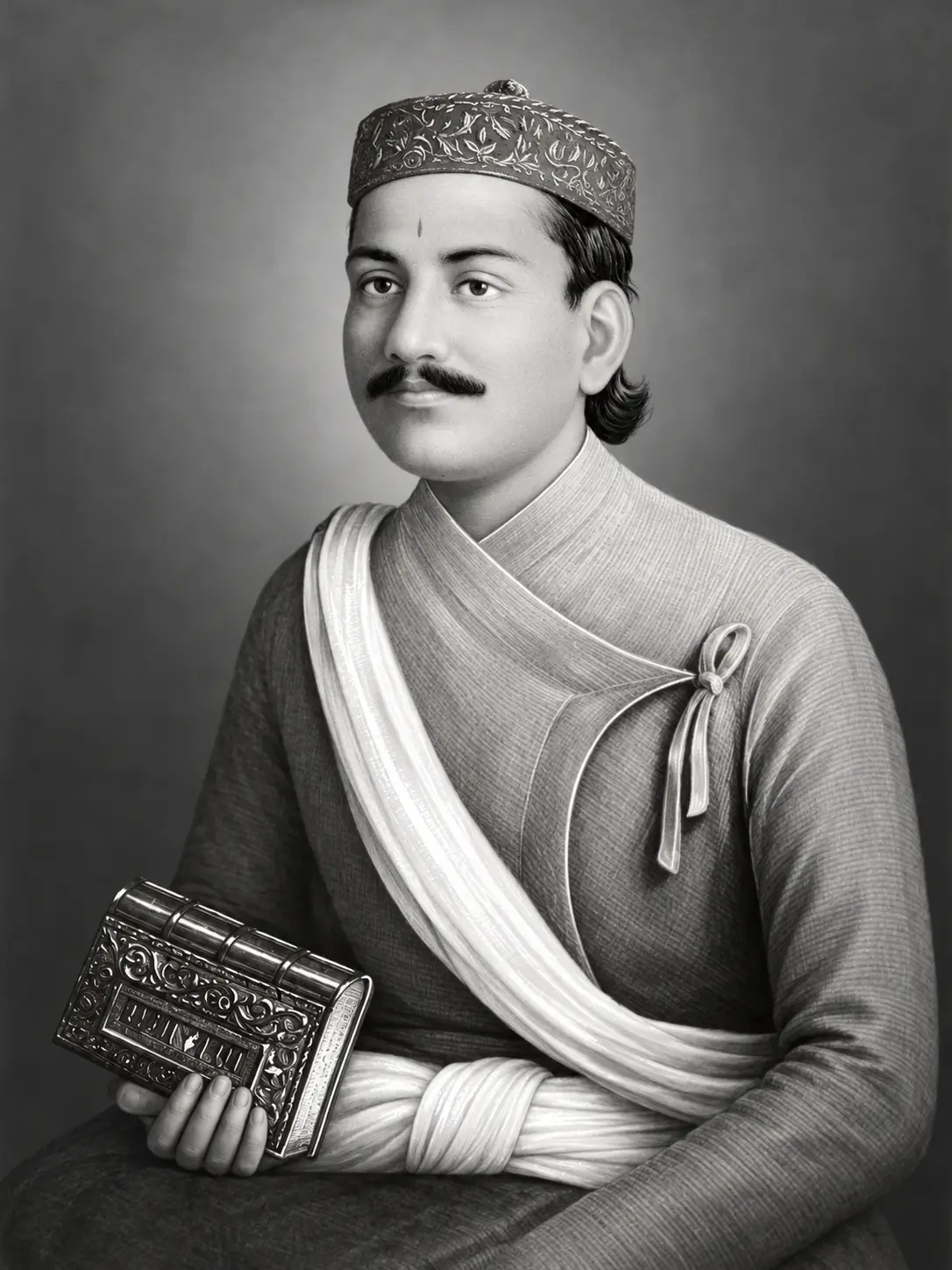
Bhanubhakta Acharya (B.S. 1871–1925) was a Nepali poet and translator. He made a significant contribution to the development of Nepali literature by rendering the Sanskrit Adhyatma Ramayana into Nepali verse. He is widely known as the Adikavi, or the first poet, in Nepali literary tradition.
Poetry had been written in Nepali before Bhanubhakta's time. Therefore, the title Adikavi does not mean that he was literally the first person to write poetry in Nepali. His distinctive position in Nepali literature rests on his ability to express natural Nepali language through classical poetic metres, his adaptation of the Ramayana, and the influence of his work on subsequent literary traditions.
The Bhanubhakta Ramayana is his best-known work. His other notable compositions include Bhaktamala, Prashnottarmala, Vadhushiksha, Ram Gita, and various individual poems. Alongside religious and philosophical themes, his writings reflect contemporary society, administrative practices, and personal experiences.
Historical sources differ on certain aspects of Bhanubhakta's life, including his birth date, his encounter with a grass-cutter, the chronology of his Ramayana composition, and the exact date of his death. Understanding his biography therefore requires distinguishing between widely accepted accounts, literary traditions, and historical research.
Bhanubhakta Acharya: Quick Facts
|
Detail |
Information |
|---|---|
|
Full Name |
Bhanubhakta Acharya |
|
Literary Title |
Adikavi (First Poet) |
|
Date of Birth |
29 Ashadh 1871 B.S. (commonly accepted date) |
|
Birthplace |
Chundi Ramgha, Tanahun, Nepal |
|
Death |
B.S. 1925, Ashwin Shukla Panchami |
|
Exact Date of Death |
Historical disagreement between 6 and 7 Ashoj |
|
Place Associated with Death |
Sati Ghat, Tanahun |
|
Father |
Dhananjay Acharya |
|
Mother |
Dharmavati Devi |
|
Grandfather |
Shrikrishna Acharya |
|
Education |
Sanskrit language, grammar, religious scriptures, and traditional literary studies |
|
Literary Fields |
Poetry, religious verse, and poetic translation |
|
Major Work |
Bhanubhakta Ramayana |
|
Other Works |
Bhaktamala, Prashnottarmala, Vadhushiksha, Ram Gita, and individual poems |
|
Main Contribution |
Poetic adaptation of the Sanskrit Adhyatma Ramayana into Nepali |
Birth and Family Background
The commonly accepted date of Bhanubhakta Acharya's birth is 29 Ashadh 1871 B.S. His birthplace is generally identified as Chundi Ramgha in Tanahun district, Nepal. His father, Dhananjay Acharya, was involved in government service, while his grandfather, Shrikrishna Acharya, was a Sanskrit scholar.
Early information about Bhanubhakta's birth appears in the biography prepared by Motiram Bhatta. However, Motiram recorded his birth year as B.S. 1869.
Later, Bhanubhakta's granddaughter, Bishnumaya Sharma, presented his date of birth as 29 Ashadh 1871 B.S. in Bhanubhakta Manimala, published in B.S. 1998. The publication also included material relating to his birth horoscope.
Researchers have expressed differing views regarding the authenticity and interpretation of the birth horoscope. Nevertheless, 29 Ashadh 1871 B.S. has become the publicly and institutionally accepted date. Official messages issued by the Government of Nepal also refer to this date.
Although Chundi Ramgha is generally accepted as Bhanubhakta's birthplace, family accounts and local oral traditions differ regarding the precise location within Ramgha where he was born. It would therefore be inappropriate to present a particular house or plot of land as an undisputed historical fact accepted by all researchers.
Early Education and Intellectual Development
Bhanubhakta Acharya received his early Sanskrit education from his grandfather, Shrikrishna Acharya. The educational atmosphere within his family is believed to have encouraged his interest in language, religious scriptures, and literature.
Shrikrishna Acharya was knowledgeable in Sanskrit, grammar, astrology, and religious texts. From childhood, Bhanubhakta had opportunities to become familiar with Sanskrit verses, mythological narratives, and classical literature.
Biographers have presented different accounts of his stay in Kashi (Varanasi). According to traditional biographies, he travelled to Kashi with his grandfather. However, reliable information is unavailable about how long he studied there or which subjects he formally pursued.
The influence of Sanskrit grammar, religious philosophy, and classical prosody is evident in Bhanubhakta's literary compositions. In particular, the use of syllabic classical metres in his Ramayana and his adaptation of Sanskrit source material into Nepali demonstrate the influence of his traditional education.
The Linguistic Conditions of His Time
During Bhanubhakta's lifetime, Sanskrit was an important language for religious and classical studies. Although Nepali was used in everyday communication, administrative activities, and various forms of writing, Sanskrit maintained a strong influence on literary expression.
Against this background, adapting an extensive Sanskrit religious narrative into Nepali verse was a notable literary undertaking.
Bhanubhakta employed classical poetic metres while incorporating Nepali vocabulary, sentence structures, and conversational expressions into poetry. His work expanded the possibilities for presenting narrative material from Sanskrit literature in Nepali.
His contribution should therefore be evaluated as an important achievement in the development of Nepali verse literature, rather than as the origin of the Nepali language or the beginning of its literary use.
The Grass-Cutter Story and Literary Inspiration
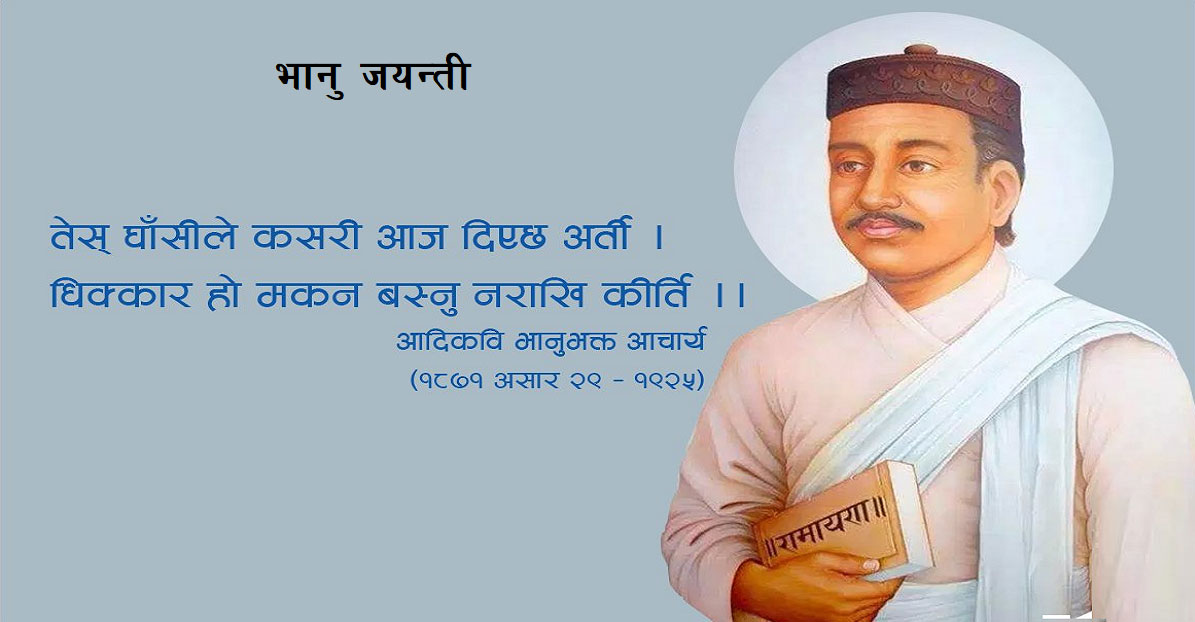
The story of the grass-cutter, commonly known as the Ghansi episode, is a familiar part of Bhanubhakta Acharya's biography.
According to this account, Bhanubhakta was inspired to undertake work that would leave a lasting contribution to society after hearing that a man who earned his livelihood by cutting grass intended to use his income to construct a public well.
In the biographical tradition presented by Motiram Bhatta, this incident is associated with Bhanubhakta's literary awareness and concern for public welfare.
The story describes a grass-cutter who wished to carry out a public service project despite his limited income. Bhanubhakta is said to have been deeply influenced by this intention.
The poem associated with the grass-cutter episode emphasizes the importance of useful work performed for society over the accumulation of personal wealth.
How Historically Accurate Is the Grass-Cutter Story?
Although the grass-cutter story is firmly established in Nepali literary tradition, not every detail of the incident has been confirmed through independent historical evidence.
Motiram Bhatta prepared Bhanubhakta's biography after the poet's death. His account may have combined collected biographical information with events presented in a literary style.
Historians, including Baburam Acharya, have questioned the historicity of the grass-cutter episode. Some critics accept the poem associated with the grass-cutter as Bhanubhakta's composition while maintaining that Motiram's account of their meeting contains imaginative elements.
On the other hand, local oral traditions and later biographers have also interpreted the grass-cutter story as an actual event in Bhanubhakta's life.
The encounter can therefore be described as a traditional story associated with Bhanubhakta's literary inspiration. However, the conclusion that this particular incident inspired him to translate the Ramayana cannot be treated as an undisputed historical fact.
The literary importance of the episode lies in the place it has given to public service, individual reputation, and social welfare in Nepali literary memory.
Journey to Kathmandu and Imprisonment at Kumari Chowk
Bhanubhakta Acharya's journey to Kathmandu and his imprisonment at Kumari Chowk are regarded as notable events in his life.
Various biographies describe how he came under the control of the administration following a dispute involving government financial accounts.
Kumari Chowk was an administrative office responsible for examining government income, expenditure, and financial records at that time.
Sources differ regarding the reason for Bhanubhakta's imprisonment. Some accounts connect the dispute to the official financial transactions of his father, Dhananjay Acharya. Other biographies refer to allegations concerning accounts from Bhanubhakta's own period of government service.
It is therefore necessary to exercise caution when drawing conclusions about the exact administrative reason for his imprisonment and the extent of his personal responsibility.
Five Months at Kumari Chowk
According to traditional biographies, Bhanubhakta spent approximately five months in detention at Kumari Chowk.
Poems associated with this period portray administrative delays, the conditions of imprisonment, and difficulties encountered in obtaining hearings for legal cases.
His criticism of officials who repeatedly postponed government work until the following day is a notable feature of his individual poems.
Bhanubhakta's stay at Kumari Chowk is also associated with the composition of the Bhanubhakta Ramayana. Literary accounts connect the Ayodhya Kanda, Aranya Kanda, Kishkindha Kanda, and Sundara Kanda with this period.
However, sources do not agree on which sections, or how much of each section, were completed during his imprisonment. Differences between the sources must therefore be considered before assigning definite dates and places of composition to these sections.
The Kumari Chowk episode demonstrates that Bhanubhakta's writings expressed not only religious narratives but also administrative experiences, personal dissatisfaction, and social satire.
Bhanubhakta Ramayana: His Major Literary Work
The Bhanubhakta Ramayana is Bhanubhakta Acharya's principal literary work. Based on the Sanskrit Adhyatma Ramayana, it was composed in Nepali verse and is divided into seven books, traditionally called Kandas.
The work presents the story of Rama in Nepali, combining classical poetic metres with natural Nepali linguistic expression.
Which Ramayana Did Bhanubhakta Translate?
The primary Sanskrit source of the Bhanubhakta Ramayana is the Adhyatma Ramayana.
Although both the Valmiki Ramayana and the Adhyatma Ramayana relate to the story of Rama, they differ in their philosophical presentation and narrative detail.
The Valmiki Ramayana provides extensive descriptions of events, characters' conduct, family relationships, and human experiences. The Adhyatma Ramayana, by contrast, places particular emphasis on devotion and Vedanta philosophy.
Bhanubhakta presented the main narrative and religious themes of the Adhyatma Ramayana in Nepali verse. He did not translate every Sanskrit verse word for word.
It is therefore more accurate to describe the Bhanubhakta Ramayana as a poetic adaptation or sense-based translation of the Adhyatma Ramayana.
Seven Kandas and Their Verse Counts
Literary studies report that the commonly circulated seven-Kanda text of the Bhanubhakta Ramayana contains 1,319 verses.
|
Kanda |
Number of Verses |
|---|---|
|
Bala Kanda |
139 |
|
Ayodhya Kanda |
123 |
|
Aranya Kanda |
122 |
|
Kishkindha Kanda |
143 |
|
Sundara Kanda |
154 |
|
Yuddha Kanda |
381 |
|
Uttara Kanda |
257 |
|
Total |
1,319 |
These figures follow the description of the commonly circulated text presented by literary scholar Nabin Poudel.
According to this count, Yuddha Kanda is the longest section, while Aranya Kanda is the shortest.
However, textual variations exist among different manuscripts and published editions of the Bhanubhakta Ramayana. It would therefore be incorrect to assume that every edition contains exactly the same text and number of verses.
Chronology of the Ramayana's Composition
Bhanubhakta did not compose all seven Kandas of the Ramayana at the same time.
Literary research places his work on the Ramayana approximately between 1841 and 1853 AD.
In a study published in 1996, historian Pratyoush Onta reported that Bala Kanda was composed in 1841, the middle Kandas, including Ayodhya Kanda, in 1852, and the final two Kandas in 1853.
However, different biographies and literary studies provide somewhat different accounts, particularly concerning Bhanubhakta's imprisonment at Kumari Chowk and the sections composed during that period.
Consequently, although the general period of composition can be identified, not all sources equally confirm the precise dates and places where each Kanda was written.
Poetic Adaptation and Originality
A defining literary characteristic of the Bhanubhakta Ramayana is its approach to translation.
Bhanubhakta did not reproduce every story, subsidiary narrative, religious hymn, and philosophical explanation from the Sanskrit source in equal detail. Instead, he selected the principal narrative and presented it in a poetic form that Nepali readers and listeners could understand.
He adapted episodes involving Rama, Sita, Lakshmana, Hanuman, and other characters according to the structure of the Nepali language.
Although the narrative was drawn from a Sanskrit text, Bhanubhakta's literary ability is evident in his vocabulary, metre, sentence construction, and presentation.
From this perspective, his Ramayana is not merely a linguistic conversion of its source text. It is also a literary composition that has acquired a distinctive place in Nepali poetic tradition.
Poetic Metre and Linguistic Features
The Bhanubhakta Ramayana employs classical Sanskrit syllabic metres. The use of the Shardulavikridita metre is particularly noteworthy.
His compositions also use other classical metres. His ability to arrange Nepali words and sentences according to metrical requirements is an important aspect of his poetic technique.
His language combines Sanskrit-derived vocabulary with natural Nepali expressions.
This combination makes the story of Rama suitable for rhythmic recitation. Literary analysis of the Bhanubhakta Ramayana commonly focuses on its metre, language, rhythm, narrative condensation, and presentation of dialogue.
Other Major Works of Bhanubhakta Acharya
Apart from the Ramayana, Bhanubhakta Acharya composed works addressing religious, philosophical, ethical, and social subjects.
Bhaktamala
Bhaktamala is a poetic work concerned with devotion, detachment, and spiritual reflection.
It explores worldly attachment, attraction to wealth, the impermanence of life, and devotion to God.
The work provides insight into Bhanubhakta's religious and philosophical outlook.
Prashnottarmala
Prashnottarmala is a poetic composition structured around religious and ethical questions and answers.
It discusses knowledge, moral conduct, self-reflection, human behaviour, and spiritual concerns.
Its question-and-answer structure presents various philosophical and ethical ideas in an organized manner.
The work demonstrates that Bhanubhakta's literary interests extended beyond religious narratives to include ethical and philosophical reflection.
Vadhushiksha
Vadhushiksha is a didactic poem concerning family life and women's roles in the society of its time.
It addresses responsibilities, conduct, and discipline that women were expected to observe within the family.
Traditional biographies associate its composition with a family dispute at the home of Bhanubhakta's friend Tarapati. However, not all details of the reported incident have been independently verified.
Studying Vadhushiksha in its historical setting provides insight into nineteenth-century family structures and the expectations society placed on women.
Nevertheless, some ideas expressed in the work are inconsistent with contemporary principles of gender equality, personal freedom, and women's rights.
Modern literary criticism has examined and challenged the patriarchal perspective reflected in Vadhushiksha.
It is therefore important to evaluate the work critically in relation to the social conditions of its time, while recognizing its value as a historical social document and literary composition.
Ram Gita
Ram Gita is a philosophical work associated with the later years of Bhanubhakta Acharya's life.
It is a Nepali verse translation of the Ram Gita contained in the Uttara Kanda of the Sanskrit Adhyatma Ramayana. The work presents the spiritual and philosophical teachings that Rama gives to Lakshmana.
According to traditional biographies, Bhanubhakta continued translating Ram Gita despite being in poor health. Accounts also describe how he dictated verses to his son, Ramanath, who wrote them down.
Ram Gita presents philosophical ideas concerning the self, Brahman, Maya, knowledge, and liberation.
It is generally identified as Bhanubhakta's final literary composition.
Individual Poems
Bhanubhakta's individual poems address religious subjects as well as social behaviour, administrative experiences, travel, and personal reflections.
His well-known shorter compositions include Kantipuri Nagari, Balaju Varnan, and satirical verses concerning government administration.
Some poems express dissatisfaction with delays in legal proceedings, the complexity of government work, and interpersonal behaviour.
These compositions demonstrate that Bhanubhakta's literature was not confined to religious narratives.
Because textual differences exist among collections and editions of his individual poems, quotations from the original compositions should be checked against reliable edited texts.
Publication of the Bhanubhakta Ramayana and Motiram Bhatta's Contribution
Motiram Bhatta played an important role in collecting, editing, publishing, and introducing Bhanubhakta's works to a wider literary audience.
During Bhanubhakta's lifetime, his writings circulated through handwritten manuscripts and traditions of oral recitation. After his death, efforts to make these compositions available in printed form gained momentum.
Early Publication of the Ramayana
The 1880s were an important period in the publication history of the Bhanubhakta Ramayana.
According to historian Pratyoush Onta's research, Bala Kanda was published in Banaras in 1884 through Motiram Bhatta's efforts. Subsequently, an edition containing all seven Kandas was published through Motiram's efforts in 1888.
The same study records that Damaru Vallabh Pokharel had also published a seven-Kanda edition of the Ramayana in 1886.
These findings indicate that Motiram's publishing contribution cannot be reduced to a claim that he was the first person to publish a complete seven-Kanda Ramayana.
His principal contribution lay in collecting, publishing, promoting, and critically presenting Bhanubhakta's works to Nepali readers.
Biography of Bhanubhakta
Motiram Bhatta published Kavi Bhanubhakta Ko Jeevan Charitra (The Life of Poet Bhanubhakta) in 1891 AD, corresponding to B.S. 1948.
This work is an important early source of biographical information about Bhanubhakta.
It presents details of his writings, personality, and life events. Motiram's biography helped establish Bhanubhakta's reputation as a significant poet in Nepali literature.
However, family accounts and historical research published subsequently have re-examined some events and dates recorded in Motiram's biography.
The work should therefore be recognized as an important source of literary history without assuming that every event it describes has been independently verified.
Why Is Bhanubhakta Acharya Called Adikavi?
Bhanubhakta Acharya is known as the Adikavi in Nepali literature because his poetry played an influential role in the development of Nepali verse.
Motiram Bhatta presented Bhanubhakta as the Adikavi in his biography published in B.S. 1948.
The title was not intended solely to identify him as the earliest poet in the chronological history of Nepali-language writing.
Subsequent literary studies explain that Motiram used the title in recognition of Bhanubhakta's poetic ability, linguistic expression, and literary influence.
Nepali Poets Before Bhanubhakta
Poets were writing in Nepali before Bhanubhakta's lifetime.
Early histories of Nepali literature mention poets such as Suwananda Das, Shaktivallabh Aryal, and Udayananda Aryal.
Their compositions addressed contemporary politics, heroism, loyalty to rulers, and various social and religious subjects.
It is therefore historically inaccurate to suggest that Nepali poetry began exclusively with Bhanubhakta.
His distinctive achievements include presenting a Sanskrit religious narrative in Nepali verse, employing classical poetic metres in Nepali, and influencing subsequent literary traditions.
Historical Debate Surrounding the Adikavi Title
The meaning and justification of the title Adikavi have been subjects of debate in Nepali literary studies.
Some scholars have argued that the existence of poets before Bhanubhakta requires reconsideration of the title's chronological implications.
Others have defended the title by emphasizing his poetic craftsmanship, the influence of his Ramayana, and his contribution to literary tradition.
Recognizing one poet's achievements does not require denying the contributions of others.
Bhanubhakta can be acknowledged as an important figure in Nepali literature while earlier writers and their works continue to receive independent scholarly attention.
Bhanubhakta's Contributions to Nepali Language and Literature
Bhanubhakta Acharya's principal literary contributions concern the development of Nepali verse, the adaptation of religious poetry, and the use of classical poetic metres.
His Ramayana established an influential example of presenting an extensive religious narrative in Nepali.
Development of Nepali Verse Literature
Bhanubhakta adapted a religious narrative from Sanskrit into poetry suited to the structure of the Nepali language.
In doing so, he combined metrical rules with Nepali linguistic expression.
The language and metrical characteristics of the Bhanubhakta Ramayana have provided later literary scholars with an important basis for examining the structure and development of Nepali verse.
Adaptation of Religious Literature into Nepali
The Bhanubhakta Ramayana made the story of Rama, based on the Sanskrit Adhyatma Ramayana, available to Nepali-speaking readers and listeners.
This expanded opportunities for people without a formal education in Sanskrit to hear and understand the Ramayana in Nepali verse.
However, religious storytelling, folk recitation, oral traditions, and spiritual literature in different languages already existed in Nepal before Bhanubhakta's time.
It would therefore be historically inaccurate to attribute the entire effort of making religious literature accessible to the general public exclusively to Bhanubhakta.
His distinctive contribution lies in his poetic adaptation of the Adhyatma Ramayana into Nepali.
Linguistic and Cultural Identity
Bhanubhakta's literary reputation is also associated with Nepali linguistic identity.
His works have been studied, published, and commemorated in Nepal as well as among Nepali-speaking communities in India.
In research published in 1996, historian Pratyoush Onta examined how the renewed recognition of Bhanubhakta's literary work was connected with the construction of linguistic identity among Nepali-speaking communities in British India.
According to this research, Nepali-language and literary activities in Darjeeling during the early twentieth century presented Bhanubhakta's literary reputation within a new historical setting.
This demonstrates that his significance extends beyond his nineteenth-century writings to the subsequent history of language and culture.
Given Nepal's multilingual society, his contribution should be evaluated as a distinctive literary achievement within the Nepali language. At the same time, the independent historical importance of writers, literature, and oral traditions in other mother tongues must also be recognized.
Critical Study of Bhanubhakta's Works
The study of Bhanubhakta's writings is not limited to literary appreciation.
Subsequent research has critically examined the texts, language, social perspectives, and historical influence of his works.
In particular, the teachings concerning women in Vadhushiksha have been assessed through modern concepts of gender equality.
Similarly, textual differences between manuscripts and published editions of the Bhanubhakta Ramayana remain subjects of literary research.
Scholars have also investigated the historical accuracy of the grass-cutter episode, the meaning of the Adikavi title, disputes concerning Bhanubhakta's birth date, and the reliability of sources used in early biographies.
Such studies do not negate Bhanubhakta's literary contributions. Rather, they help readers understand his life and works through evidence, historical circumstances, and critical examination.
Later Life and Death
The final years of Bhanubhakta Acharya's life are associated with health problems and accounts of his translation of Ram Gita.
According to traditional biographies, he continued translating Ram Gita into Nepali verse even while suffering from illness.
When Did Bhanubhakta Acharya Die?
Bhanubhakta Acharya died in B.S. 1925. Family and literary sources record his death on Ashwin Shukla Panchami, the fifth lunar day of the bright fortnight of Ashwin.
However, there is disagreement about the corresponding calendar date.
Some commonly cited biographies record his death as 6 Ashoj. More recent calendrical research, however, suggests that 7 Ashoj was the more likely date.
A study titled Bhanubhakta Ko Mrityu Mitiko Khoji (Searching for the Date of Bhanubhakta's Death), published in Gorkhapatra, compared contemporary calendars, family accounts, and traditional methods of determining lunar dates.
According to the study, Ashwin Shukla Panchami began after midday on 6 Ashoj 1925 B.S. and remained in effect on the morning of 7 Ashoj.
Because Narnath Acharya's biography states that Bhanubhakta died before midday on Panchami, the study concluded that 7 Ashoj was the more likely date.
Nevertheless, because 6 Ashoj continues to appear in published biographies, the historical disagreement concerning the exact date of his death should be acknowledged.
Place of Death and Sati Ghat
Sati Ghat in Tanahun is closely associated with Bhanubhakta's death.
According to accounts based on Narnath Acharya's biography, Bhanubhakta was taken to Sati Ghat on the banks of the Marsyangdi River during the final stage of his life.
These accounts state that he died there.
Sati Ghat is recognized as a historical site associated with Bhanubhakta's last rites and literary remembrance.
Information relating to the Bhanu Birthplace Development Committee also refers to efforts to preserve and develop Sati Ghat.
Bhanu Jayanti and Literary Remembrance
Bhanu Jayanti is observed every year on 29 Ashadh to commemorate the birth anniversary of Bhanubhakta Acharya.
In Nepal, the occasion is marked by poetry recitations, literary discussions, seminars, commemorative gatherings, and other programs.
Bhanu Jayanti also has literary and cultural significance among Nepali-speaking communities in Darjeeling, Sikkim, and other parts of India.
Bhanubhakta's birthplace, Chundi Ramgha, is a site associated with Nepali literary history. Various initiatives have been undertaken over time to preserve the area and recognize its historical importance.
In a message issued on 29 Ashadh 2083 B.S., the Office of the President of Nepal commemorated Bhanubhakta's contributions and emphasized the importance of developing his birthplace as a literary, historical, and cultural site.
Bhanu Jayanti is not only an occasion for literary remembrance but also an opportunity for younger generations to study his works.
A critical examination of his Ramayana, other poetic compositions, language, metre, and social perspectives can contribute to a better understanding of Nepali literary history.
Conclusion
Bhanubhakta Acharya was an important poet and translator in the history of Nepali verse literature. His adaptation of the Sanskrit Adhyatma Ramayana into Nepali poetry made a distinctive contribution to Nepali literature.
The Bhanubhakta Ramayana is generally regarded as his most influential work. Other compositions, including Bhaktamala, Prashnottarmala, Vadhushiksha, Ram Gita, and individual poems, demonstrate that his literary interests extended from religious narratives to ethical reflection and contemporary social experiences.
After Bhanubhakta's death, Motiram Bhatta helped broaden recognition of his literary achievements by collecting and publishing his works and writing his biography.
An informed assessment of Bhanubhakta's contributions should consider earlier Nepali literary traditions, the meaning of the Adikavi title, disagreements among biographical sources, textual variations in his works, and the social perspectives expressed in his writings.
Bhanubhakta should therefore be understood not as the first person to write poetry in Nepali, but as a historical literary figure whose work made an influential contribution to the development of Nepali verse.
References
1. Office of the President, Nepal — Message on the Occasion of the 213th Birth Anniversary of Adikavi Bhanubhakta Acharya, B.S. 2083. Official information concerning Bhanubhakta's birth date, birthplace, and Bhanu Jayanti.
2. Bhawani Shankar Bhattarai — Adikavibare Kehi Tathya, Kantipur, 2018. A study of Bhanubhakta's birth date, birthplace, biographers, and historical disagreements.
3. Pratyoush Onta — Creating a Brave Nepali Nation in British India, Studies in Nepali History and Society, Volume 1, Number 1, 1996. Research concerning Motiram Bhatta's contributions, the publication history of the Ramayana, the Adikavi title, and Nepali linguistic identity.
4. Nabin Poudel — Bhanubhakta Acharya Ko Ramayan Ko Mahattwa Ra Ramkavya Parampara, Samakalin Sahitya, 2023. A study of the Sanskrit source of the Bhanubhakta Ramayana, its seven Kandas, verse counts, translation style, and publication history.
5. Adikaviko Uchai — Gorkhapatra. An examination of Bhanubhakta's major works, literary contributions, and the Adikavi title.
6. Bhanubhakta Le Ghansi Ka Prerana Le Ramayan Racheka Hainan — Desh Sanchar, 2024. A discussion of different scholarly views concerning the historical accuracy and literary interpretation of the grass-cutter episode.
7. Ribhash Rijal — Bhanubhakta Beyond Ramayan: The Other Side of Nepal's Most Revered Poet, The Kathmandu Post, 2026. A contemporary examination of Vadhushiksha from historical and gender-related perspectives.
8. Bhanubhakta Ko Mrityu Mitiko Khoji — Gorkhapatra. Historical analysis of Bhanubhakta's death date, contemporary calendars, family records, and the disagreement between 6 and 7 Ashoj.
9. Sati Ghat Lai Aitihasik, Dharmik Ra Sahityik Sthal Banauna Guru Yojana — Gorkhapatra. Information about the historical site associated with Bhanubhakta's death and final rites.






Comments 0
No comments yet. Be the first to start the conversation.