



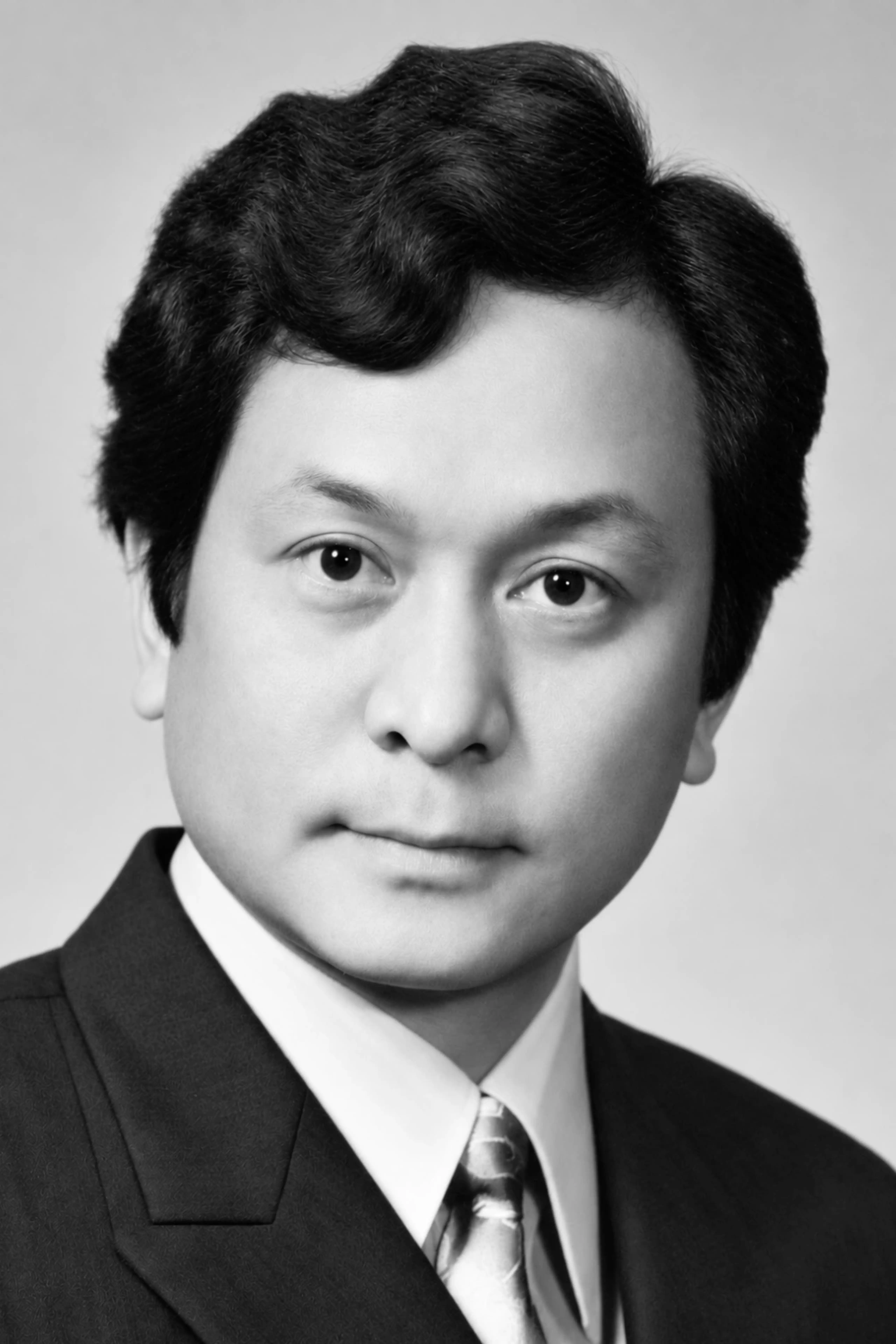
Bhupi Sherchan (BS 1992–2046) was an important poet, lyricist, and influential writer of prose poetry in modern Nepali literature. His real name was Bhupendraman Sherchan. Born in Tukuche in the Thak Khola region of Mustang district, Sherchan made social inequality, political contradictions, human emotions, and national consciousness central themes of his literary work.
Simple language, satire, original imagery, and internal rhythm are distinctive features of his poetry. His works explore subjects ranging from the experiences of ordinary people to the contradictions of public life.
His representative poetry collection, Ghumne Mechmathi Andho Manchhe, was published by Sajha Prakashan in 1969. He received the Sajha Award for BS 2026 for this work. His contribution to the development and wider recognition of Nepali prose poetry holds particular importance in literary studies.
Bhupi Sherchan: Quick Facts
|
Particulars |
Details |
|---|---|
|
Full Name |
Bhupendraman Sherchan |
|
Literary Name |
Bhupi Sherchan |
|
Early Literary Pseudonym |
Sarbahara |
|
Date of Birth |
BS 1992 Poush 10 |
|
Birthplace |
Thak Khola, Tukuche, Mustang, Nepal |
|
Date of Death |
BS 2046 Jestha 1 (May 14, 1989) |
|
Place of Death |
Kathmandu, Nepal |
|
Father's Name |
Hitman Sherchan |
|
Mother's Name |
Padmakumari Sherchan |
|
Education |
Studied in Gorakhpur and Banaras, India |
|
Major Literary Genres |
Poetry, songs, and drama |
|
First Published Work |
Parivartan (play) |
|
Major Works |
Parivartan, Naya Jhy aure, Nirjhar, and Ghumne Mechmathi Andho Manchhe |
|
Representative Work |
Ghumne Mechmathi Andho Manchhe |
|
Major Literary Award |
Sajha Award, BS 2026 |
|
Institutional Affiliation |
Former Royal Nepal Academy |
The birth date and family details are based on biographical records of the poet. Some literary sources provide different Gregorian birth years and publication years for his early works. Therefore, disputed details have not been presented as uniformly established facts.
Birth, Family Background, and Childhood
According to commonly cited biographical records, Bhupi Sherchan was born on BS 1992 Poush 10 in Tukuche, located in the Thak Khola region of Mustang district. His father was Hitman Sherchan, and his mother was Padmakumari Sherchan.
He was born into a trading family belonging to the Thakali community. His father was involved in trade with India and Tibet. At that time, the Thak Khola region was connected to the trade route between Nepal and Tibet.
His family's financial circumstances allowed Bhupi to receive a formal education. However, his childhood was also marked by personal loss. Biographical accounts indicate that his mother died when he was five years old.
The loss of his mother, his family surroundings, and the social behavior he observed during childhood were significant aspects of his early life. His later literary interest in human suffering and social inequality can be examined in relation to his broader life experiences.
Education and Intellectual Development
Bhupi Sherchan spent an important part of his educational life in India. He initially studied in the Anandnagar area of Gorakhpur and later went to Banaras for higher education.
While living in Banaras, he studied in an academic setting associated with Banaras Hindu University. His student years coincided with a period of political and intellectual activity following India's independence movement.
During this time, he became attracted to communist ideology. His interest in social inequality, exploitation, and the problems facing working-class people increased.
This ideological influence also shaped his literary writing. In his early works, he used the pseudonym Sarbahara, a term used in communist thought to refer to the proletariat, or the class dependent on its labor.
His student years in Banaras contributed to the development of his political awareness and literary expression. During this period, he began expressing ideas related to social change through poetry and drama.
Bhupi Sherchan's Early Literary Career
Bhupi Sherchan's literary career began with writing influenced by progressive political thought. His early works addressed social change, economic inequality, and the problems of working-class people.
His first published work was the play Parivartan. It was influenced by the political atmosphere surrounding the changes taking place at that time.
His poetry collection Naya Jhy aure was published afterward. It used traditional Nepali folk rhythms to express progressive ideas.
His next poetry collection, Nirjhar, was published in 1958. The poems in this collection employed traditional meters and rhythmic structures.
During the early stages of his literary career, he wrote under both his real name and the pseudonym Sarbahara. He later adopted the literary name Bhupi Sherchan and expanded his writing into prose poetry.
These works provide a basis for understanding his literary development, from early politically influenced writing to later poetry that placed greater emphasis on social experiences and artistic expression.
Political Ideology and Literary Perspective
Leftist ideology influenced Bhupi Sherchan's early literary outlook. After becoming familiar with communist ideas during his student years in Banaras, he began addressing economic and class inequalities in his writing.
His early poems contain direct expressions of opposition to exploitation and expectations of social change.
Over time, his literary perspective and style of expression changed. Instead of presenting political ideas through direct slogans, he increasingly used satire and symbolism to examine the contradictions of social life, public conduct, and human weaknesses.
Literary scholar Michael Hutt has also discussed the distinction between Bhupi's early ideological commitments and his later prose poetry. According to Hutt, simple language, humor, satire, and social criticism occupy important places in Bhupi's later poems.
His literary career therefore developed from early ideologically influenced writing into modern prose poetry addressing broader human and social concerns.
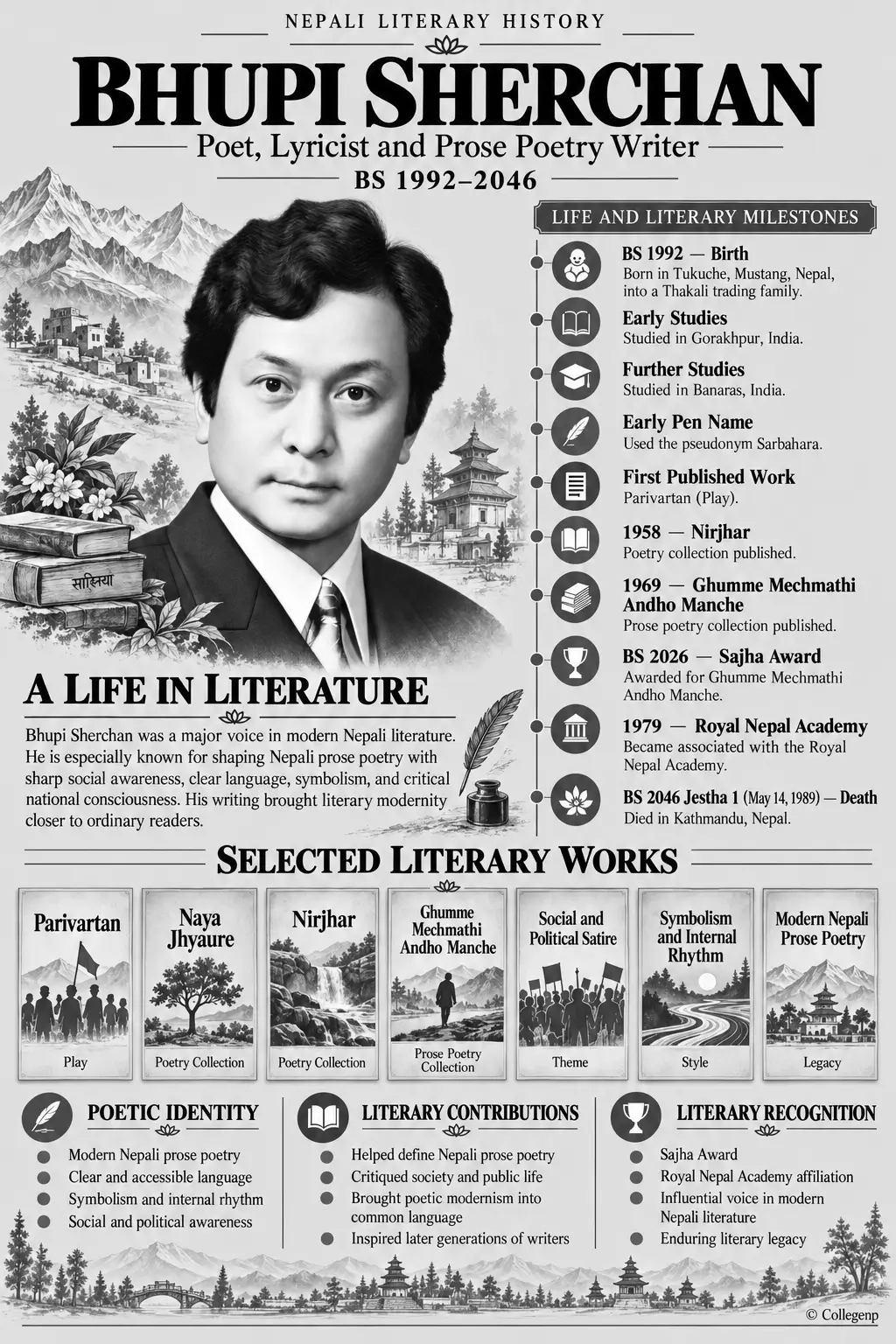
Major Literary Works of Bhupi Sherchan
Bhupi Sherchan wrote plays, poetry, and songs. Among his published works, Ghumne Mechmathi Andho Manchhe holds particular importance in the study of modern Nepali poetry.
1. Parivartan
Parivartan was Bhupi Sherchan's first published play.
The play was inspired by the atmosphere of political change directed against the Rana regime. It presents ideas of change in opposition to the existing social order.
The work is useful for understanding Bhupi's early political awareness and progressive literary outlook.
2. Naya Jhy aure
Naya Jhy aure was Bhupi Sherchan's first published poetry collection.
It uses the traditional Nepali Jhy aure folk rhythm to present social and political themes. Its poems reflect the poet's concern for working-class people, economic inequality, and social change.
The collection represents Bhupi's early poetry, which was shaped by folk rhythms and political ideas.
3. Nirjhar
Nirjhar was Bhupi Sherchan's second poetry collection, published in 1958.
The poems in this collection use traditional meters and rhythmic structures.
The work is important for understanding the stylistic transition between Bhupi's early literary writing and his later prose poetry.
4. Ghumne Mechmathi Andho Manchhe
Ghumne Mechmathi Andho Manchhe is Bhupi Sherchan's representative poetry collection. It was published by Sajha Prakashan in 1969.
In his book Himalayan Voices, Michael Hutt states that the collection contains 42 prose poems.
The poems address social injustice, poverty, political contradictions, human emotions, and national consciousness.
The collection is distinguished by its simple language, satirical style, and symbolic expression. Although the poems do not necessarily follow traditional metrical structures, they create internal rhythm through the arrangement of words and sentences.
The collection received the Sajha Award for BS 2026.
5. Bhupi Sherchanka Kavita
Various works by Bhupi Sherchan continued to be collected and published in book form after his death.
Bhupi Sherchanka Kavita, edited by Shiva Regmi, is one such collection. It brings together poems published in different literary magazines that were not included in Ghumne Mechmathi Andho Manchhe.
The collection provides an opportunity to study Bhupi's literary contributions through works beyond his representative poetry collection.
Major Poems of Bhupi Sherchan and Their Themes
Bhupi Sherchan's poems portray the society of his time while raising questions about human behavior, public authority, history, and national identity.
Ghumne Mechmathi Andho Manchhe
In this poem, a person sitting on a revolving chair is presented as a symbol of authority and power.
The poem satirizes the self-centered attitudes, limited perspectives, and indifference toward public concerns that may be found among people holding positions of public responsibility.
The word andho, meaning "blind," can be understood here as a literary symbol of disregard for social realities rather than a literal reference to a physical condition.
Michael Hutt interprets the poem as a satirical portrayal of a corrupt, narrow-minded, and insensitive person in a position of authority.
Mero Chowk
Mero Chowk portrays social contradictions associated with urban life.
Through the limited setting of a neighborhood square, the poem draws readers' attention to broader issues such as poverty, deprivation, superstition, and human suffering.
It uses the contrast between gods created by people and people created by gods to satirize contradictions between religious belief and social life.
A distinctive feature of the poem is its use of a small geographical setting as a representative image of wider social realities.
Hami
Hami is a poem concerned with social and national self-examination.
It questions the tendency toward imitation, dependence, and the absence of critical awareness.
The poem reinterprets an episode involving Dronacharya and Ekalavya from the Mahabharata. Through this reference, the poet criticizes the tendency to accept authority and tradition without exercising independent judgment.
Michael Hutt also interprets the poem as a work concerned with unquestioning obedience to established authority and social self-examination.
Yo Hallai Hallako Desh Ho
This poem satirizes rumors, political contradictions, and weaknesses in public life.
It questions the social tendency to be influenced by rumors rather than facts and reason.
Concern for the country and criticism of its public conduct are both present in the poem.
Michael Hutt discusses the poem as an expression of Bhupi's attachment to his country and his frustration with political and social weaknesses.
Chiso Ashtray
Chiso Ashtray symbolically presents an urban setting and the sense of disappointment associated with it.
The poem uses imagery such as fire, ashes, smoke, and extinguished beliefs. These images evoke human expectations, failures, and disappointment.
The poem can be studied as an example of Bhupi's ability to give ordinary objects broader social and psychological meanings.
Sahidharuko Samjhanama
Sahidharuko Samjhanama is a poem dedicated to martyrs who contributed to the country's freedom and political transformation.
Along with remembering their contributions, the poem presents the idea that people should remain responsible for the achievements made possible through their sacrifices.
Its rhythmic structure and expression of patriotism distinguish it from Bhupi's other satire-oriented prose poems.
The poem has also been included in Nepal's Grade 8 Nepali textbook.
Bhupi Sherchan's Contribution to Modern Nepali Prose Poetry
Bhupi Sherchan made effective use of simple language, social criticism, internal rhythm, and satire in Nepali prose poetry.
Prose poetry had already begun developing in Nepali literature before Bhupi's emergence. Poets such as Gopal Prasad Rimal had contributed to its development. Bhupi expanded this tradition through his distinctive language, literary techniques, and subject matter.
Simple and Accessible Language
Bhupi preferred words commonly used in everyday life.
Although his poems address serious social and political questions, he did not rely on excessively difficult vocabulary to express them.
His ability to communicate complex meanings through simple language is a defining feature of his poetry.
Satirical Style
Satire occupies an important place in Bhupi's poetry.
He used contradictions in political leadership, bureaucracy, social conduct, and public attitudes as subjects for satire.
His satire combines criticism with a sense of social self-examination.
Images and Symbols from Everyday Life
Ordinary objects and places, including revolving chairs, neighborhood squares, clock towers, and ashtrays, appear as meaningful symbols in Bhupi's poems.
These images lead readers from familiar surroundings toward broader social and intellectual questions.
Internal Rhythm in Prose Poetry
Although Bhupi's prose poems do not necessarily follow traditional meters, they create a natural rhythm through the arrangement of words and sentences.
Repetition, phonetic balance, and pacing suited to the emotions being expressed are distinctive elements of his poetic technique.
His work demonstrates how prose poetry can also achieve rhythmic and expressive effects.
Critical National Consciousness
Patriotism in Bhupi's poems is not limited to expressions of national pride.
He raises questions about the country's social conditions, public behavior, and weaknesses in civic life while emphasizing the need for responsible national consciousness.
His literature expresses both attachment to society and criticism of its shortcomings.
Michael Hutt has particularly examined the influence of simple language, satire, humor, and social criticism in Bhupi's prose poetry.
Bhupi Sherchan's Contribution to Nepali Songs
Bhupi Sherchan's literary contribution was not limited to poetry. He also contributed to Nepali songwriting.
His songs express patriotism, human relationships, and social experiences.
Yo Nepali Shir Uchali
Yo Nepali Shir Uchali is a song based on national sentiment.
Bhupi Sherchan wrote its lyrics, while Natikaji composed the music. The song was recorded in the voices of Prem Dhoj Pradhan and Tara Devi.
The song expresses Nepali identity, self-respect, and national pride.
Aljhechha Kyare Pachhyauri Timro Chiyako Butama
Bhupi Sherchan wrote the lyrics of this song. It features music by Gopal Yonzon and vocals by Narayan Gopal.
The song presents family relationships, memories of one's maternal home, and emotional experiences.
It shows that Bhupi's writing addressed sensitive aspects of human relationships alongside social and political satire.
Professional Life and Contribution to the Royal Nepal Academy
Alongside his literary work, Bhupi Sherchan was involved in his family business and construction-related activities.
According to literary scholar Michael Hutt, he spent time in places including Pokhara, Bhairahawa, and Kathmandu while managing family business activities and construction contracts.
He later became a member of the then Royal Nepal Academy. Hutt states that Bhupi obtained membership in the Academy in 1979.
During his association with the Academy, he was also involved in literary and editorial activities. He edited Kavita, a literary magazine published by the institution.
His public life therefore involved three areas: literary creation, business activities, and academic responsibilities.
Awards and Honors Received by Bhupi Sherchan
Bhupi Sherchan received the Sajha Award for BS 2026 for his poetry collection Ghumne Mechmathi Andho Manchhe.
The collection is identified as the first work to receive the Sajha Award. Literary records also indicate that Bhupi received the Gorkha Dakshin Bahu honor.
Did Bhupi Sherchan Receive the Madan Puraskar?
Bhupi Sherchan did not receive the Madan Puraskar for Ghumne Mechmathi Andho Manchhe. The collection received the Sajha Award.
According to the official records of the Madan Puraskar Guthi, the Madan Puraskar for BS 2026 was awarded to Tana Sharma for Belaittira Baralinda.
It is therefore important to distinguish clearly between the Sajha Award and the Madan Puraskar when discussing Bhupi Sherchan's literary achievements.
Personal Life and Death
Bhupi Sherchan's life involved literary creation, family responsibilities, and health-related difficulties.
According to his biographical records, he married twice. His first wife was Omkumari Tulachan, and his second wife was Kanti Rana.
During the later years of his life, he experienced a prolonged period of illness. Available biographical accounts mention that he suffered from a lung-related health condition.
He died in Kathmandu on BS 2046 Jestha 1 (May 14, 1989).
Literary Significance and Legacy of Bhupi Sherchan
Bhupi Sherchan's literary significance is closely connected to his language, poetic techniques, and social perspective in modern Nepali poetry.
His poems connect personal experiences with social questions. Through the symbolic use of ordinary objects, public places, and everyday behavior, he explores complex social issues.
His contribution can be understood primarily through three aspects.
First, he presented social and political criticism in simple language. This made poems addressing serious subjects more accessible to readers.
Second, he used internal rhythm and satire in prose poetry. This helped expand the expressive possibilities of Nepali poetry.
Third, his poems reflect a critical perspective on history and national identity. He placed importance on the literary practice of questioning established beliefs.
His literary legacy extends beyond portraying the society of his time. The questions his poems raise about authority, civic awareness, social responsibility, and human behavior continue to make them relevant for literary study.
His continuing literary relevance in Nepal is also connected to these enduring social concerns.
Bhupi Sherchan in International Literary Studies
Bhupi Sherchan's literary contributions have also been studied beyond the Nepali language.
In his 1991 book Himalayan Voices: An Introduction to Modern Nepali Literature, scholar Michael Hutt included a literary introduction to Bhupi, an examination of his poetic characteristics, and English translations of selected poems.
Published by the University of California Press, the book introduced modern Nepali literature to English-language readers.
Hutt also published a biographical study titled The Life of Bhupi Sherchan: Poetry and Politics in Post-Rana Nepal in 2010.
Published by Oxford University Press, the book examines the relationships between Bhupi's life, poetry, and the social and political circumstances of his time.
These studies provide a basis for understanding Bhupi Sherchan's life and literature within the history of Nepali literature and its broader social setting.
Conclusion
Bhupi Sherchan was an important figure in modern Nepali literature, particularly in prose poetry, social satire, and critical national consciousness.
His literary career reflects a development from early progressive writing to the satirical prose poetry of his later years. Works such as Naya Jhy aure, Nirjhar, and Ghumne Mechmathi Andho Manchhe represent different stages of his poetic development.
Through Ghumne Mechmathi Andho Manchhe in particular, he portrayed the political, cultural, and human realities of Nepali society using simple yet meaningful language.
The questions raised in his poetry concerning social responsibility, civic awareness, and public behavior remain relevant to literary studies and social discussions today.
References
1. Bhupi Sherchan Biographical Archive. Kavika Bare — Information about the poet's birth, family, education, early literary career, and personal life.
2. Hutt, Michael James. (1991). Himalayan Voices: An Introduction to Modern Nepali Literature. University of California Press. A study of Nepali prose poetry, Bhupi Sherchan's literary significance, and selected poems.
3. Hutt, Michael. (2010). The Life of Bhupi Sherchan: Poetry and Politics in Post-Rana Nepal. Oxford University Press. A biographical study examining Bhupi's life, literature, and the political circumstances of his time.
4. Bhupi Sherchan Literary Archive. Books and Publications — Records of published plays, poetry collections, and edited works.
5. Sajha Prakashan. Ghumne Mechmathi Andho Manchhe — Information about the book and the Sajha Award.
6. Madan Puraskar Guthi. Madan Puraskar BS 2026 — Official records concerning Tana Sharma and Belaittira Baralinda.
7. Center for Education and Human Resource Development. Nepali, Grade 8 — Textbook source for the poem Sahidharuko Samjhanama.







Comments 0
No comments yet. Be the first to start the conversation.