



Introduction
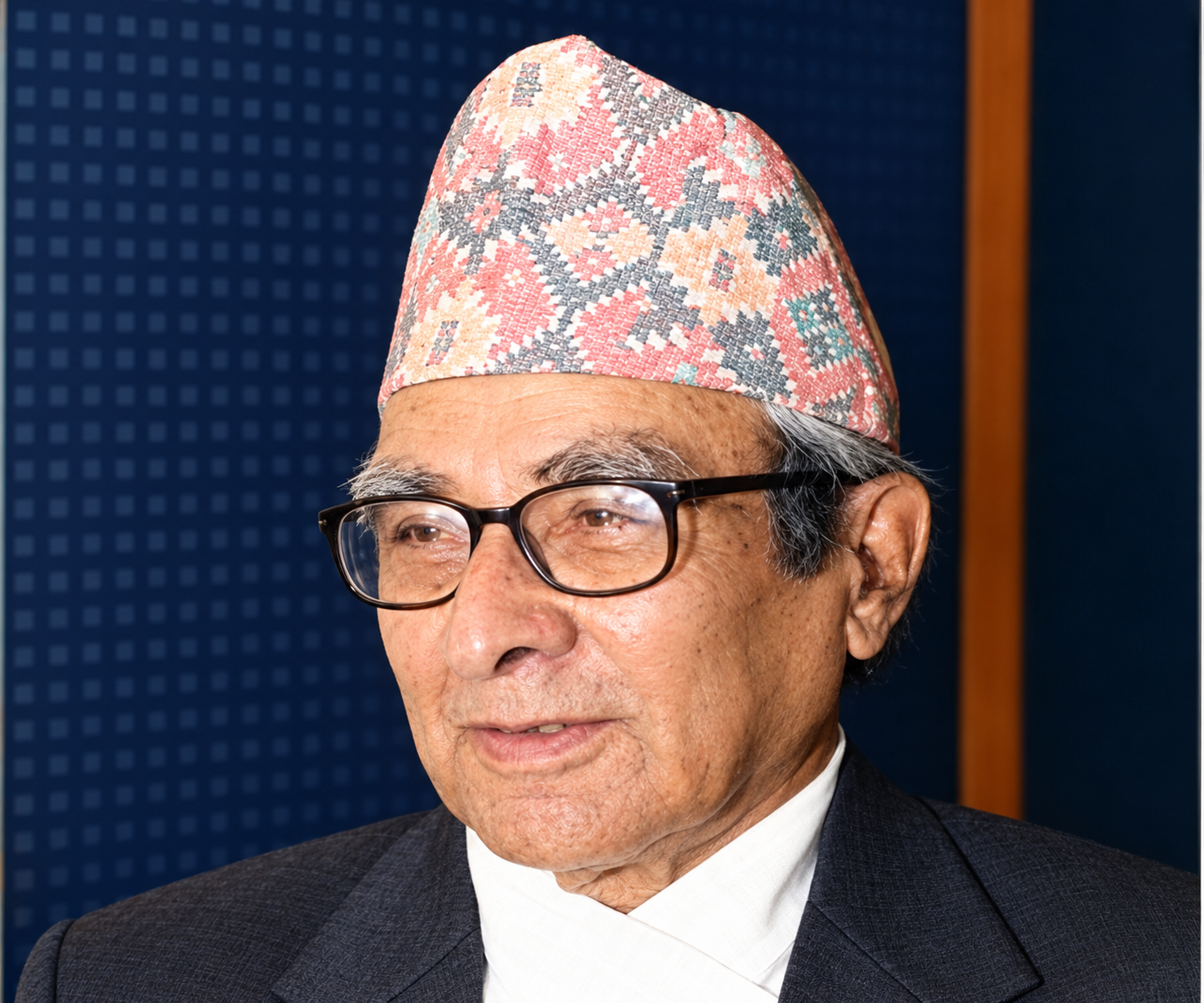
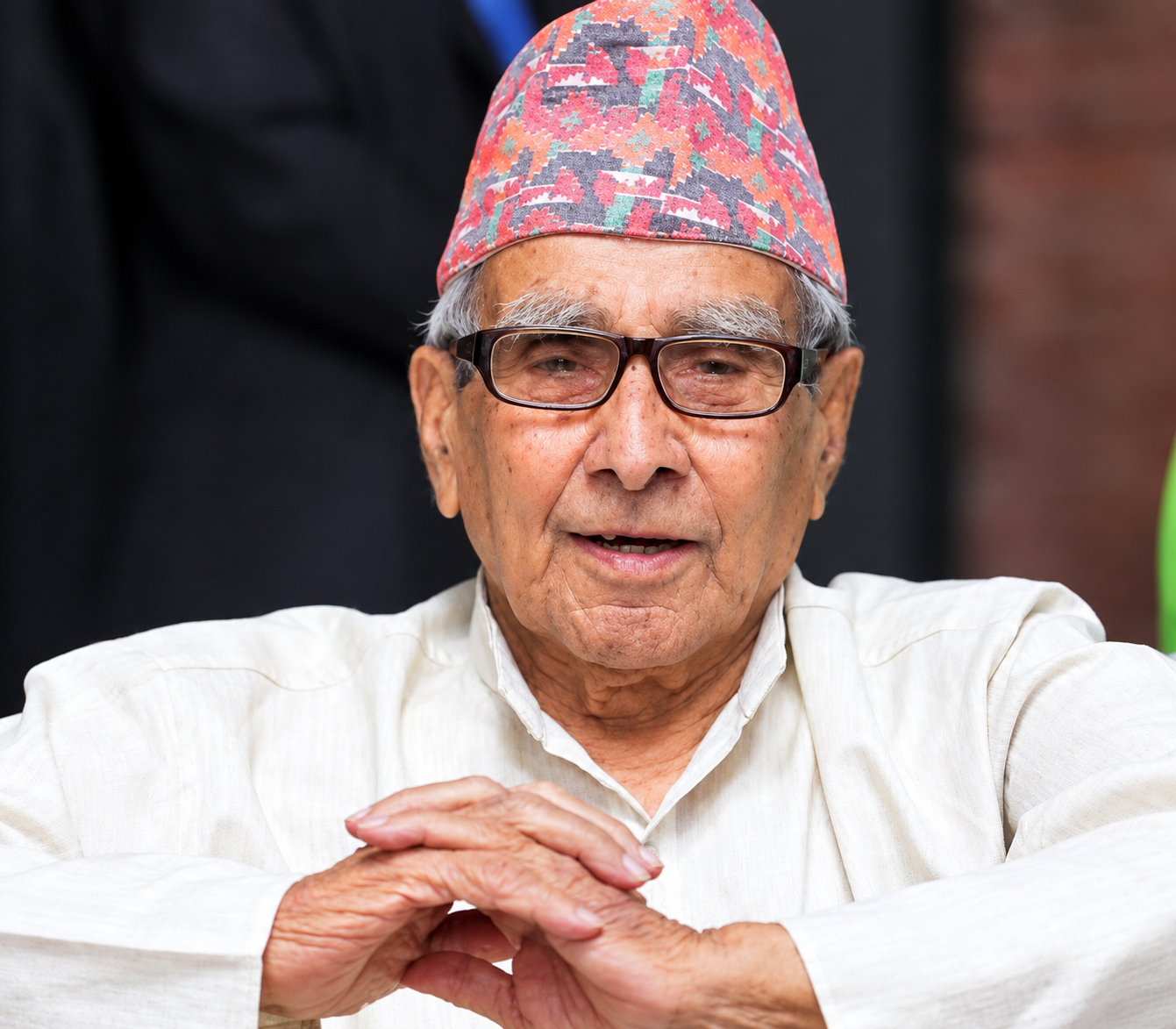
Madhav Prasad Ghimire (7 Ashoj 1976 BS – 2 Bhadra 2077 BS) was a Nepali poet, lyricist, narrative poet, lyrical playwright, essayist, and translator. He is particularly recognized for combining Romantic themes with a refined classical style in Nepali poetry. On 9 Ashoj 2060 BS, the Government of Nepal conferred upon him the title of Rashtra Kavi (National Poet).
Born in Pustun village of Lamjung district, Ghimire combined his classical knowledge of Sanskrit literature with Nepali folk rhythms, an appreciation of nature, human emotions, and national sentiment. His writings are characterized by metrical discipline, musicality, refined language, and emotional expression.
His major works include Gauri, Papini Aama, Rajeshwari, Rashtranirmata, Malati Mangale, Shakuntala, Ashwatthama, Himalpari Himalwari, Kinnar-Kinnari, and Charu Charcha. His epic poem Ritambhara, written during the later years of his life, was published posthumously in 2079 BS.
Beyond literary writing, Ghimire worked with the Bhashanuvad Parishad (Language Translation Council), Gorkhapatra, and the then Royal Nepal Academy. He also served as Vice-Chancellor and Chancellor of the Academy. Through poetry, songs, lyrical dramas, and academic activities, he contributed to the development of Nepali language and literature.
Madhav Prasad Ghimire: Quick Facts
|
Details |
Information |
|---|---|
|
Full Name |
Madhav Prasad Ghimire |
|
Honorary Title |
Rashtra Kavi (National Poet) |
|
Date of Birth |
7 Ashoj 1976 BS (23 September 1919) |
|
Birthplace |
Pustun, Lamjung, Nepal |
|
Date of Death |
2 Bhadra 2077 BS (18 August 2020) |
|
Place of Death |
Lainchaur, Kathmandu |
|
Nationality |
Nepali |
|
Education |
Shastri qualification in Sarvadarshana, Banaras |
|
First Published Poem |
Gyanpushpa (1992 BS) |
|
First Poetry Collection |
Navamanjari (1994 BS) |
|
Literary Genres |
Poetry, narrative poetry, songs, lyrical drama, children's literature, essays, and translation |
|
Major Academic Positions |
Vice-Chancellor and Chancellor of the Royal Nepal Academy |
|
Major Honors |
Tribhuvan Pragya Puraskar, Sajha Puraskar, Padmashree Sadhana Samman, and Honorary Brigadier General |
Birth, Family Background and Childhood
Madhav Prasad Ghimire was born on 7 Ashoj 1976 BS in Pustun village of Lamjung district. His birthplace falls within the present-day Marsyangdi Rural Municipality–6, in the Bahundanda area.
Growing up in a rural setting, Ghimire spent his childhood surrounded by nature, local culture, and traditional forms of education. His mother died when he was three years old. He was subsequently raised under the care of other family members.
Ghimire began learning the alphabet at the age of six. By the age of eight or nine, he had started studying the Panchanga, the traditional Hindu calendar and almanac. During childhood, he developed an interest in Sanskrit verses, religious texts, and traditional learning.
He also became familiar with folk songs, devotional hymns, religious recitations, and oral literary traditions practiced in rural Lamjung. The natural surroundings and folk culture of his village appear to have influenced the development of his literary interests.
His later poetry frequently depicts mountains, rivers, hills, vegetation, seasons, and rural life. From this perspective, the natural and cultural surroundings of his birthplace can be regarded as an important foundation of his literary sensibility.
Education and Intellectual Development
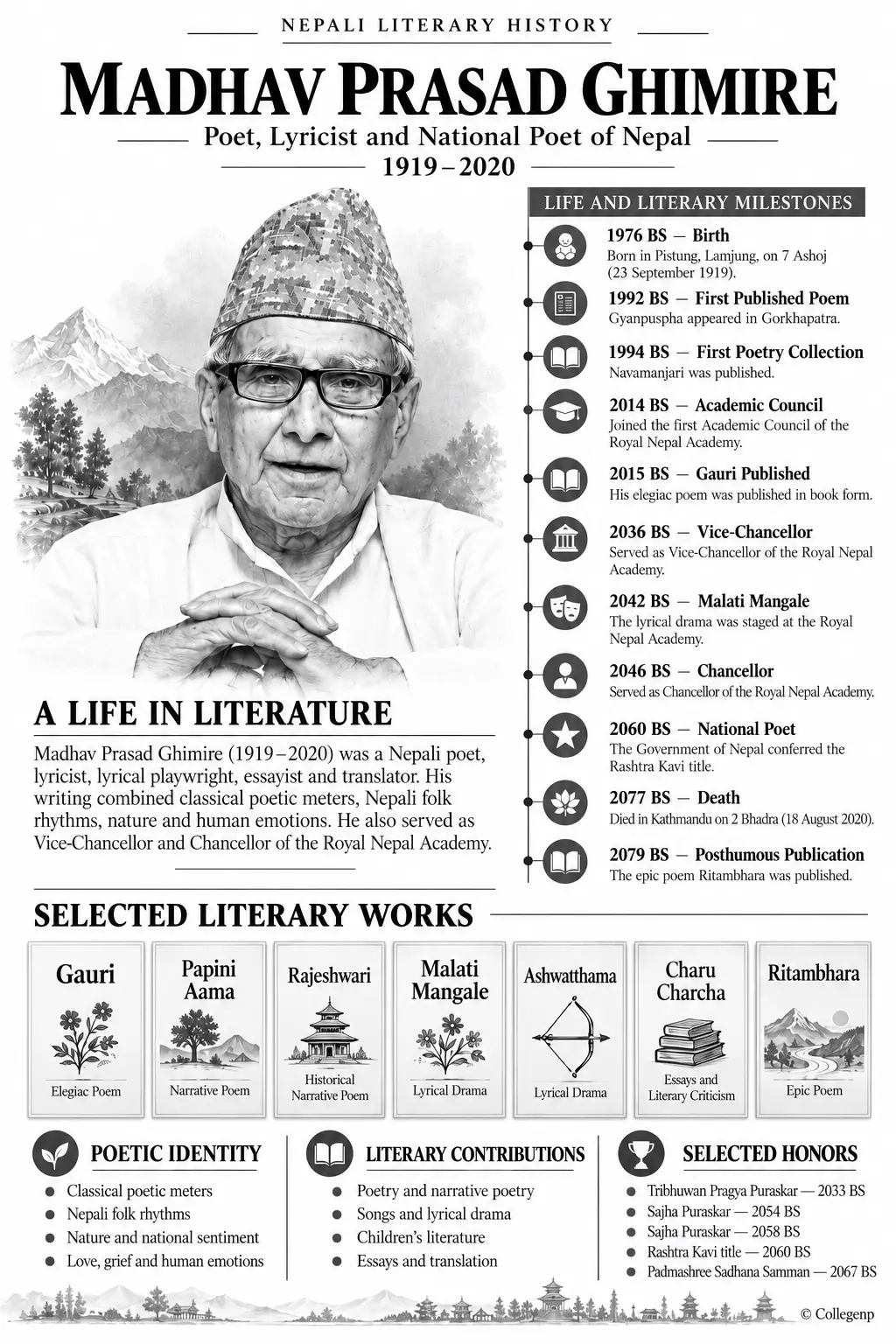
Madhav Prasad Ghimire began his formal studies through traditional Sanskrit education. After receiving his early education, he went to Duradanda in Lamjung for further studies.
Following his Sanskrit studies in Duradanda, he moved to Kathmandu. There, he attended the Sanskrit Pradhan Pathshala at Ranipokhari and the Tindhara Sanskrit Pathshala.
He subsequently traveled to Banaras, India, for higher education. He studied at Queen's College and completed the Shastri-level qualification in Sarvadarshana, the study of philosophical systems.
His education in Sanskrit language, grammar, philosophy, poetics, and prosody appears to have played an important role in shaping his literary outlook.
One of Ghimire's distinctive literary qualities was his ability to connect classical knowledge with the rhythms of Nepali language and everyday life. He incorporated the metrical discipline of Sanskrit literature into expressions of emotion and experience drawn from Nepali society.
Although his poetry contains classical vocabulary, he often expresses emotions in an accessible manner. This combination became a defining characteristic of his literary style.
Beginning of His Literary Career
Madhav Prasad Ghimire's published literary career is generally considered to have begun in 1992 BS, when his poem Gyanpushpa appeared in Gorkhapatra.
According to Gorkhapatra's published records, his first poem appeared in its issue dated 14 Bhadra 1992 BS. At that time, he used the name Madhav Prasad Sharma.
In 1994 BS, his first book-length work, the poetry collection Navamanjari, was published.
Building upon his early literary efforts, he went on to write poetry, narrative poems, songs, lyrical dramas, children's literature, essays, and translations.
His early writings show his engagement with classical poetic meters, nature, and national sentiment. In later works, personal experiences, social issues, historical subjects, and philosophical reflection became increasingly prominent.
Gorkhapatra has a historical connection with both the beginning and the final phase of Ghimire's literary career. The newspaper that published Gyanpushpa also later published material concerning the manuscript and publication of his epic poem Ritambhara.
Professional Career and Literary Activities
Alongside his literary writing, Madhav Prasad Ghimire worked in translation, editing, journalism, and teaching.
After completing his studies in Banaras, Ghimire returned to Nepal and became associated with the then Bhashanuvad Parishad (Language Translation Council). He undertook writing and translation work at the Council.
His contact and collaboration with established Nepali writers during this period appear to have helped broaden his literary experience.
He later became involved in editorial work at Gorkhapatra. His association with the newspaper provided him with experience in journalism, language editing, and the publication of literary material.
He also taught for some time. Following the death of his first wife, Ghimire returned to Lamjung, where he became involved in local educational activities.
His professional career, which began with writing, translation, journalism, and teaching, eventually extended to leadership positions in academic institutions.
Contribution to Nepal Academy
An important part of Madhav Prasad Ghimire's academic career was associated with the then Royal Nepal Academy.
According to the official records of Nepal Academy, he was a member of its first Academic Council, formed in 2014 BS. He was also a member of the Council formed in 2026 BS.
The Academy's records of life members indicate that Ghimire was nominated as a life member in 2028 BS.
Responsibilities as Vice-Chancellor and Chancellor
Nepal Academy's official records of former Academic Councils provide the following details of Ghimire's positions.
|
Year of Academic Council Formation |
Ghimire's Position |
|---|---|
|
2014 BS |
Member |
|
2026 BS |
Member |
|
2036 BS |
Vice-Chancellor |
|
2041 BS |
Vice-Chancellor |
|
2046 BS |
Chancellor |
Lain Singh Bangdel served as Chancellor, while Madhav Prasad Ghimire served as Vice-Chancellor in the Academic Councils formed in 2036 BS and 2041 BS. In the Council formed in 2046 BS, Ghimire served as Chancellor and Vijay Malla as Vice-Chancellor.
During his association with the Academy, Ghimire participated in literary activities, the development of language and literature, and academic work.
The staging of his lyrical dramas helped strengthen connections between literature, music, and theater. The staging of Malati Mangale, in particular, remains a notable event in the history of Nepali lyrical drama.
His relationship with the Academy extended beyond his personal literary writing. By undertaking institutional responsibilities, he also contributed to literary and academic activities.
Major Narrative Poems of Madhav Prasad Ghimire
Madhav Prasad Ghimire's narrative poems explore personal experiences, social circumstances, historical events, and national sentiment.
Gauri
Gauri is one of Madhav Prasad Ghimire's major elegiac poems. He expressed the grief and sense of separation he experienced following the death of his first wife, Gauri, in 2004 BS.
The work was published in book form in 2015 BS.
Gauri explores the emotional dimensions of losing a spouse, family memories, love, compassion, and human relationships.
Its literary significance lies in transforming personal grief into a broader human experience. The poem expresses emotions arising from an event in the poet's private life in a way that enables readers to relate them to their own experiences.
Papini Aama
Papini Aama is a narrative poem that explores the social conventions, motherhood, and moral conflicts of its time.
The work depicts psychological conflicts arising from social pressure, fear of public judgment, and personal circumstances.
Its subject matter presents the harsh social expectations faced by women during that period and the human difficulties resulting from those expectations.
Rajeshwari
Rajeshwari is a narrative poem based on Nepal's historical setting. It presents the life of the historical figure Rajeshwari, the royal court circumstances of the period, and events associated with the practice of Sati.
The work explores political interests, social injustice, and human emotions.
Rajeshwari is an important work for understanding Ghimire's approach to transforming historical subjects into poetic expression.
Rashtranirmata
Rashtranirmata is a narrative poem based on historical events associated with the unification of Nepal and Prithvi Narayan Shah.
It presents episodes associated with Nepal's state formation and national sentiment through literary expression.
The work is useful for examining Ghimire's views on the nation and his poetic treatment of historical subjects.
Dhartimata
Dhartimata is a poetic work centered on the relationship between nature, the motherland, and human life.
It expresses affection for the Earth and nature while highlighting the importance of the natural environment in human existence.
Across several of Ghimire's works, nature is presented not merely as a subject of beauty but also as a fundamental element of human existence.
Contribution to Lyrical Drama and Nepali Theater
Madhav Prasad Ghimire made significant contributions to the development of lyrical drama in Nepali literature.
Lyrical drama is a theatrical genre that combines songs, music, dialogue, and dramatic events. Ghimire's lyrical dramas explore mythological, historical, and social subjects.
A research study titled Dhwani Vidhan in Madhav Ghimire's Lyrical Dramas, available through Tribhuvan University's eLibrary, examines seven of his published lyrical dramas. These works are Shakuntala, Malati Mangale, Vishakanya, Ashwatthama, Himalpari Himalwari, Deuki, and Balakumari.
Shakuntala
Shakuntala is a lyrical drama based on a mythological narrative.
It presents emotional themes associated with Shakuntala's life, including love, memory, separation, and reunion, through a combination of songs and dramatic expression.
The work demonstrates Ghimire's effort to present a classical story through the rhythms and dramatic forms of the Nepali language.
Malati Mangale
Malati Mangale is one of Madhav Prasad Ghimire's representative lyrical dramas. It explores the love between Malati and Mangale, social circumstances, class relations, and human emotions.
Staged at the then Royal Nepal Academy in 2042 BS, the lyrical drama established an important place in Nepali theater.
Its music was composed by Amber Gurung. Singers including Narayan Gopal and Tara Devi performed its songs.
Malati Mangale brought written literature, music, and theater together in a single production. Its emotional presentation and music appear to have contributed to its influence and recognition.
Vishakanya
Vishakanya is a lyrical drama associated with historical and mythological themes.
It presents dramatic conflicts arising from the personal emotions of characters, social circumstances, and political interests.
Ashwatthama
Ashwatthama is a lyrical drama based on the mythological story of Ashwatthama, a character from the Mahabharata.
The work explores questions concerning war, moral conflict, human suffering, and peace through literary expression.
One of its important characteristics is the way it connects mythological characters and events with human experiences.
Himalpari Himalwari
Himalpari Himalwari is a lyrical drama dealing with Nepali life, the natural environment, and human relationships.
Ghimire received the Sajha Puraskar for this work in 2054 BS.
Deuki and Balakumari
Deuki and Balakumari are also among Ghimire's published lyrical dramas.
These works expanded his lyrical dramatic writing into different social and human subjects.
Contribution to Songwriting and Nepali Music
Madhav Prasad Ghimire is also known as a writer of Nepali songs. His lyrics explore national sentiment, an appreciation of nature, personal experiences, and human relationships.
His well-known songs include Gaunchha Geet Nepali, Nepali Hami Rahaula Kahan, Phoolko Thunga Bagera Gayo, and Aajai Ra Rati Ke Dekhen Sapana.
His songs have been performed by various singers to music composed by different musicians. Among them, Phoolko Thunga Bagera Gayo was sung by Tara Devi, while Aajai Ra Rati Ke Dekhen Sapana was performed by Narayan Gopal.
Kinnar-Kinnari is one of Ghimire's major collections of songs. It reflects his identity as a lyricist and his approach to rhythmic expression.
His songs place importance on word choice, rhythm, ease of pronunciation, and emotional flow.
Ghimire used songs as a form of expression connecting poetry and music. This extended his literary identity beyond written poetry into the musical field.
Contribution to Children's Literature
Madhav Prasad Ghimire also wrote poems and songs for children.
His works of children's literature include Ghampani, Balalahari, Sunpankhi Chari, and Bijule Ra Bijula.
These works use simple subjects associated with childhood, nature, imagination, and rhythmic expression.
Simple vocabulary, accessible rhythm, and clear meaning are important in literature written with children's interests and language abilities in mind. These characteristics can be observed in Ghimire's writings for children.
His children's poems introduce young readers to the sounds, rhythms, vocabulary, and literary imagination of the Nepali language.
His contribution to children's literature should not be regarded merely as an extension of the poetry he wrote for adults. His works for children give separate importance to children's experiences and their linguistic understanding.
Essays, Literary Criticism and Translation
Alongside poetry and lyrical drama, Madhav Prasad Ghimire also worked in essay writing and translation.
His notable prose works include Aafno Bansuri Aafnai Geet and Charu Charcha.
Aafno Bansuri Aafnai Geet explores literature, the creative process, and the writer's ideas.
Charu Charcha is a collection of essays dealing with literary thought and criticism. Ghimire received the Sajha Puraskar for this work in 2058 BS.
His education in Sanskrit literature also enabled him to undertake translation work. His engagement with classical literature was not limited to academic study and original writing.
His contributions consequently extended across poetry, songs, drama, essays, literary thought, and translation.
Ritambhara: His Epic Poem
Ritambhara is an epic poem written by Madhav Prasad Ghimire during the later years of his life. It was released posthumously on 7 Ashoj 2079 BS.
Ghimire devoted time to writing and refining this epic during the final phase of his life. However, he was unable to have it published in book form during his lifetime.
The manuscript remained in the care of his family. Following his death, Sajha Prakashan published the work with the family's consent.
Ritambhara explores Vedic thought, nature, human life, and philosophical subjects.
According to details published in Gorkhapatra, Ghimire preferred to present the work as a Geetimantra Mahakavya, or an epic poem combining song and mantra. It contains 13 cantos.
Although the original plan included 16 cantos, the published manuscript contained 13.
Ghimire's handwritten material and typed text were also given importance during the publication process.
The publication of Ritambhara made the poetic work undertaken during the later phase of his literary career available in book form.
List of Major Works by Madhav Prasad Ghimire
Madhav Prasad Ghimire's representative works can be classified according to their literary genres as follows.
|
Literary Work |
Genre |
|---|---|
|
Navamanjari |
Poetry collection |
|
Gauri |
Elegiac poem |
|
Papini Aama |
Narrative poem |
|
Rajeshwari |
Historical narrative poem |
|
Rashtranirmata |
Narrative poem |
|
Dhartimata |
Narrative poem |
|
Kinnar-Kinnari |
Song collection |
|
Shakuntala |
Lyrical drama |
|
Malati Mangale |
Lyrical drama |
|
Vishakanya |
Lyrical drama |
|
Ashwatthama |
Lyrical drama |
|
Himalpari Himalwari |
Lyrical drama |
|
Deuki |
Lyrical drama |
|
Balakumari |
Lyrical drama |
|
Ghampani |
Children's poetry collection |
|
Balalahari |
Children's poetry collection |
|
Sunpankhi Chari |
Children's poetry collection |
|
Bijule Ra Bijula |
Children's poetry collection |
|
Aafno Bansuri Aafnai Geet |
Essay collection |
|
Charu Charcha |
Essays and literary thought |
|
Ritambhara |
Epic poem |
This is a list of Ghimire's representative works. It does not include all his individual poems, songs, edited materials, or translations.
Poetic Themes, Language and Stylistic Characteristics
Madhav Prasad Ghimire's poetic identity is characterized by a combination of Romantic themes and refined classical craftsmanship.
The Romantic tradition emphasizes emotions, imagination, nature, and personal experiences. Classical refinement places importance on discipline in language, structure, poetic meter, and expression.
Both tendencies are evident in Ghimire's writings.
Use of Classical Poetic Meters
Classical poetic meters occupy an important place in Ghimire's poetry.
He adapted the knowledge gained from studying Sanskrit literature and prosody to the pronunciation and rhythmic qualities of the Nepali language.
The discipline of poetic meter provides a rhythmic structure to his poetry.
Folk Rhythms and Musicality
The influence of Nepali folk rhythms is evident in Ghimire's songs and lyrical dramas.
Alongside classical meters, he gave importance to the accessible rhythms used in songs.
The relationship between words and music is particularly evident in his lyrical dramas. Musicality is a defining stylistic characteristic of his writings.
Appreciation of Nature
Nature is one of the major subjects of Ghimire's literature.
Mountains, rivers, hills, vegetation, and changing seasons appear repeatedly in his poems.
Rather than presenting natural scenery solely for description, he frequently connects it with human emotions and experiences.
National Sentiment
Several of Ghimire's songs and poems emphasize affection for Nepal, national identity, and shared cultural feelings.
His works expressing national sentiment present the country's natural beauty, Nepali society, and collective identity.
Human Emotions and Sensibility
Love, separation, compassion, family relationships, and social circumstances are recurring subjects in his works.
Gauri presents personal grief, Rajeshwari explores historical events and human suffering, and Malati Mangale addresses love and social relationships.
Although their subjects differ, human emotion is a common characteristic connecting these works.
Refined Language and Style
Ghimire's writing combines classical vocabulary with the natural rhythms of the Nepali language.
He varied his choice of words, poetic meters, and forms of expression according to the subject and emotional content of his poems.
His works demonstrate the importance of linguistic discipline alongside emotional expression.
Personal and Family Life
Madhav Prasad Ghimire's personal life had a close relationship with his literary writing.
His first marriage was to Gauri, who died in 2004 BS. At the time of her death, the couple had two daughters.
Her death deeply affected Ghimire. The experience of separation inspired him to write the elegiac poem Gauri.
In 2005 BS, he married Mahakali.
He had eight children from his two marriages: six daughters and two sons.
Experiences from his family life appear to have provided subjects for some of his literary works. Gauri, in particular, illustrates how a personal event became the basis of a literary creation.
Awards, Honors and National Recognition
Madhav Prasad Ghimire received various awards and honors for his literary and academic contributions.
Tribhuvan Pragya Puraskar
Ghimire received the Tribhuvan Pragya Puraskar for literature in 2033 BS.
The official award records of Nepal Academy list him as a recipient of its literature award for 2033 BS.
Sajha Puraskar
Ghimire received the Sajha Puraskar for two literary works.
-
In 2054 BS, he received the Sajha Puraskar for Himalpari Himalwari.
-
In 2058 BS, he received the Sajha Puraskar for Charu Charcha.
Rashtra Kavi Title
On 9 Ashoj 2060 BS, the Government of Nepal conferred upon Ghimire the title of Rashtra Kavi (National Poet).
The title was awarded in recognition of his contribution to Nepali literature.
Padmashree Sadhana Samman
Ghimire received the Padmashree Sadhana Samman in 2067 BS.
Honorary Brigadier General
Following a decision by the Government of Nepal, Ghimire was presented with the insignia of an Honorary Brigadier General of the Nepali Army on 2 Falgun 2074 BS.
President Bidya Devi Bhandari presented the honor to him at a ceremony held at Army Headquarters.
This was an honorary military rank rather than a position in regular military service.
Final Years and Death
Madhav Prasad Ghimire continued his literary reflection and writing into the later years of his life.
Although his health weakened with advancing age, he remained active in literary writing. During this period, he worked on the composition and refinement of his epic poem Ritambhara.
He died on 2 Bhadra 2077 BS (18 August 2020) at his residence in Lainchaur, Kathmandu.
As he was born on 23 September 1919, he was 100 years old at the time of his death.
His funeral was held with state honors at Pashupati Aryaghat on 3 Bhadra 2077 BS.
His death marked the loss of a writer who had remained active for many years in classical Nepali poetic traditions, modern poetic thought, and lyrical drama.
Madhav Prasad Ghimire's Contribution and Place in Nepali Literature
Madhav Prasad Ghimire's literary contributions span poetry, narrative poems, songs, lyrical dramas, children's literature, essays, and translation.
He continued the use of classical poetic meters in the Nepali language while incorporating folk rhythms and modern human emotions into literary expression.
His contribution can be understood primarily through three aspects.
First, through works such as Gauri, Papini Aama, and Rajeshwari, he presented personal experiences, social circumstances, and historical subjects in the form of narrative poetry.
Second, through Shakuntala, Malati Mangale, Ashwatthama, and other lyrical dramas, he helped strengthen the relationship between literature, music, and theater.
Third, through songs and children's poetry, he brought the rhythmic expression of the Nepali language to different groups of readers and listeners.
His institutional role at Nepal Academy further expanded his involvement in literary activities and academic work.
Another important aspect of Ghimire's career was his sustained literary activity over many decades. He collaborated with writers from different generations of Nepali literature and continued writing amid changing social and cultural circumstances.
His works remain important materials for the study, criticism, and research of Nepali literature.

Conclusion
Madhav Prasad Ghimire is remembered in Nepali literature for combining classical poetic meters, folk rhythms, and human emotions.
The personal grief expressed in Gauri, the historical subject matter of Rajeshwari, the lyrical dramatic presentation of Malati Mangale, and the philosophical thought of Ritambhara represent different aspects of his literary career.
As a poet, lyricist, lyrical playwright, and academic figure, he contributed to Nepali language, literature, and music. Studying his works provides an understanding of the development of poetic meter, language, folk rhythms, emotions, and subject matter in Nepali poetry.
References
-
Nepal Academy — Former Academic Councils
-
Nepal Academy — Life Members
-
Nepal Academy — Pragya Puraskar Records
-
Marsyangdi Rural Municipality — Brief Introduction
-
Gorkhapatra — From the Beginning with Gyanpushpa to the Conclusion with Ritambhara
-
Kantipur — National Poet Madhav Prasad Ghimire Dies, 18 August 2020
-
Kantipur — National Poet's Ritambhara Released, 23 September 2022
-
The Kathmandu Post — Madhav Prasad Ghimire, the Rastra Kavi, Dies at 101, 19 August 2020
-
Tribhuvan University eLibrary — Research on Dhwani Vidhan in Madhav Ghimire's Lyrical Dramas, Pushkar Nath Rijal
-
Onlinekhabar — An Account of the National Poet's Extensive Literary Contributions, 2018
-
Onlinekhabar — Madhav Ghimire as a Writer of Children's Poetry, 2018
-
Nepal Magazine — Music and Singing in Malati Mangale, 2015







Comments 0
No comments yet. Be the first to start the conversation.