



Introduction
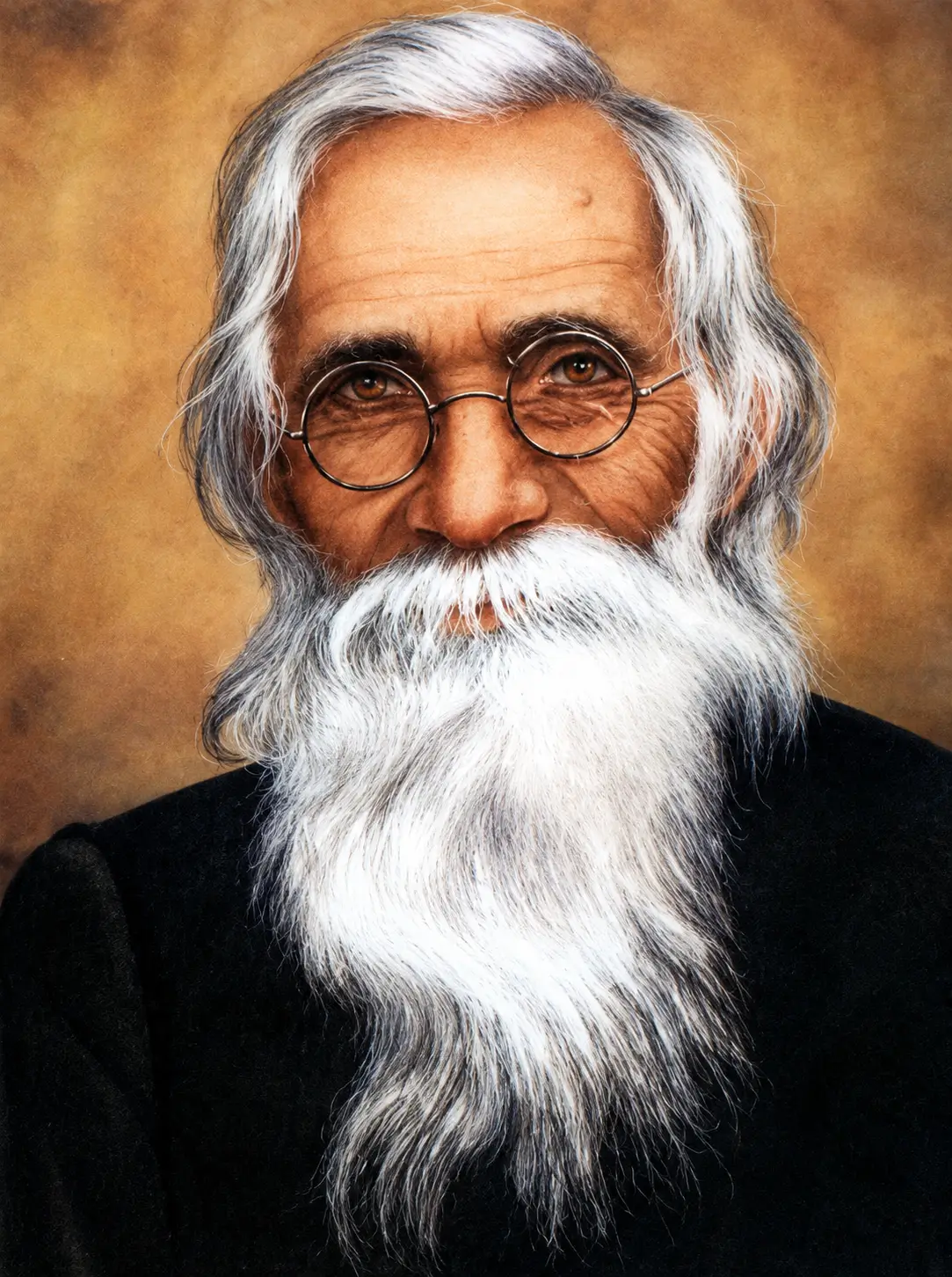
Lekhnath Paudyal (BS 1941–2022) was a Nepali poet, playwright and translator. He is widely recognised as a major pioneer of the classical and refinement-oriented tradition of modern Nepali poetry. His literary work is distinguished by the disciplined use of classical metres, linguistic refinement, descriptions of nature, moral awareness and the artistic expression of Eastern philosophy.
In the history of Nepali literature, Lekhnath Paudyal is regarded as one of the three literary figures collectively known as the Trimurti, alongside Laxmi Prasad Devkota and Balkrishna Sama. Moving beyond the romantic themes and poetic problem-solving exercises associated with the middle period of Nepali literature, he introduced themes concerning social awareness, human life, nature and philosophy into Nepali poetry.
His major works include Buddhi Vinod, Satyakali Samvad, Ritu Vichar, Tarun Tapasi, Mero Ram and Lalitya. His well-known individual poems include Pinjarako Suga, Kal Mahima and Jeevan Changa.
In recognition of his contributions to the Nepali language and literature, the then King Tribhuvan conferred the title Kavi Shiromani upon him on 29 Ashadh BS 2008. A public felicitation ceremony and ceremonial chariot procession were also organised in his honour in BS 2011.
Lekhnath Paudyal: Biography at a Glance
|
Particulars |
Details |
|---|---|
|
Full name |
Lekhnath Paudyal |
|
Literary title |
Kavi Shiromani |
|
Birth |
Poush Shukla Ekadashi, BS 1941 |
|
Commonly observed birth date |
15 Poush |
|
Birthplace |
Arghau Archale, Kaski, Nepal |
|
Father |
Pandit Durgadatta Paudyal |
|
Mother |
Basundhara Devi Paudyal |
|
Nationality |
Nepali |
|
Education |
Early Sanskrit education; Ranipokhari Sanskrit Pathshala, Kathmandu |
|
Literary genres |
Poetry, narrative poetry, Navya Kavya, drama and translation |
|
Literary tradition |
Classical and refinement-oriented |
|
Major works |
Buddhi Vinod, Ritu Vichar, Satyakali Samvad, Tarun Tapasi, Mero Ram, Laxmi Puja, Lalitya |
|
Major honours |
Kavi Shiromani title, public felicitation, Tribhuvan Pragya Puraskar |
|
Institutional affiliation |
Member of the first Academic Council of the then Royal Nepal Academy |
|
Death |
7 Falgun BS 2022 |
|
Place of death |
Devghat, Nepal |
Birth, Family Background and Childhood
Lekhnath Paudyal was born on Poush Shukla Ekadashi in BS 1941 at Arghau Archale in Kaski district. His father was Pandit Durgadatta Paudyal, and his mother was Basundhara Devi Paudyal. He grew up in a family associated with Sanskrit learning and religious traditions.
Differences Regarding His Date of Birth
Literary sources do not provide a consistent date of birth for Lekhnath Paudyal. Some biographies mention 15 Poush BS 1941, while others record 26 Poush.
According to literary scholar Devi Nepal, the practice of observing Paudyal's birth anniversary on 15 Poush became established after the Nepali Shiksha Parishad (Nepal Education Council) determined that date using the calendar for BS 1941.
Therefore, 15 Poush may be regarded as his commonly observed birth date. Several biographies also identify his birth according to the lunar calendar as Poush Shukla Ekadashi.
Childhood and Family Environment
Lekhnath spent his childhood in the rural surroundings of Kaski. Because his father was a Sanskrit scholar, he had opportunities to become familiar with religious scriptures, Sanskrit verses and traditional learning at home.
Biographical accounts indicate that his formal introduction to the alphabet began at home when he was five years old. During his early education, he studied Sanskrit, grammar and religious texts.
The natural surroundings of Arghau Archale can be considered in relation to his later interest in nature. His literary works contain artistic descriptions of seasons, trees, birds, vegetation and changes in the natural environment.
Education and Intellectual Development
After receiving his initial education at home, Lekhnath Paudyal travelled to Kathmandu for further studies in Sanskrit.
At approximately 15 years of age, he enrolled at the Sanskrit Pathshala in Ranipokhari, where he studied Sanskrit grammar and literature.
His educational journey also took him to Varanasi, India. He travelled there to pursue further Sanskrit studies. However, after failing to pass the Madhyama-level examination, he was unable to continue his formal education.
Although he did not obtain a formal academic qualification, his interest in literature and philosophy continued throughout his life. His writings show the influence of classical Sanskrit poetry, prosody, literary ornamentation and Eastern philosophy.
The influence of Kalidasa's descriptions of nature and ideas associated with Vedanta philosophy is particularly evident in his poetic style.
Alongside formal education, independent literary study and contact with contemporary scholars appear to have played important roles in his intellectual development.
Early Literary Career
Lekhnath Paudyal began his literary career by composing romantic poetry and practising Samasyapurti, a traditional exercise in completing a poem from a given poetic line or problem. He later made morality, philosophy, nature and social awareness the principal subjects of his poetry.
Biographical sources indicate that he began writing poetry during his adolescence.
His earliest published writings are associated with Kavita Kalpadrum, a poetry collection published around BS 1961/62. Shringar Pachchisi and Manasakarshini, included in this collection, are regarded as some of his earliest published poems.
In subsequent years, his poems also appeared in literary magazines such as Sundari and Madhavi.
His early writing reflected the romantic literary tradition that developed after Motiram Bhatta. However, this approach did not remain the dominant feature of his poetry for long.
From Romantic Poetry to the Refinement-Oriented Tradition
The transition from romantic subject matter to moral and philosophical reflection is considered an important development in Lekhnath's literary career.
He began placing greater emphasis on social conduct, human duties, moral values, spiritual reflection and nature.
Literary scholar Devi Nepal has interpreted Lekhnath's poetic development as a significant shift from the prevailing romantic tradition towards moral consciousness and linguistic refinement.
This transformation contributed to the development of the classical and refinement-oriented tradition of Nepali poetry.
Professional Life and Association with the Rana Court
Lekhnath Paudyal's association with the Rana court was an important aspect of his professional life. He worked as a teacher and religious scholar at Bhim Shumsher's Tangal Palace.
After completing his Sanskrit studies, he faced financial difficulties while attempting to earn a living. During this period, he sought employment in different places.
After returning to Kathmandu, he came into contact with Ram Mani Acharya Dixit, a literary personality of the time. This relationship helped him in both his literary and professional life.
He subsequently received responsibilities involving Sanskrit and religious education within Bhim Shumsher's family. His association with the Rana court continued for some time after Bhim Shumsher became prime minister.
Although his relationship with the court supported his livelihood, the prevailing political conditions imposed restrictions on freedom of expression.
Some of Lekhnath's poems portray social conditions through symbolism, satire and moral commentary rather than direct political criticism.
His literary works therefore reflect both his association with the ruling establishment and his concern for social reform.
Major Literary Works of Lekhnath Paudyal
Lekhnath Paudyal contributed to Nepali literature through poetry, narrative poems, Navya Kavya, drama, essays and translations.
His major works address subjects related to nature, human life, society, morality and Eastern philosophy.
Major Works and Publication Years
|
Literary Work |
Publication Year (BS) |
|---|---|
|
Buddhi Vinod |
1973 |
|
Ritu Vichar |
1973; expanded edition in 1991 |
|
Shrimad Bhagavad Gitako Gita Sar |
1975 |
|
Satyakali Samvad |
1976 |
|
Gitanjali |
1978 |
|
Laxmi Puja |
1994 |
|
Tyag Ra Udayako Yugal Prakash |
2002 |
|
Nepali translation of Panchatantra |
2004 |
|
Amar Jyotiko Satya Smriti |
2008 |
|
Lalitya, Part One |
2010 |
|
Tarun Tapasi |
2010 |
|
Mero Ram or Ramayan Sar |
2011 |
|
Nepali translation of Abhijnana Shakuntalam |
2015 |
|
Bhartrihari Nirveda |
2020 |
|
Lalitya, Part Two |
2024 |
|
Ganga Gauri |
Incomplete; five cantos available |
This list is based on the bibliographic details provided in Kavi Shiromani Rachanawali, published by Publication Nepalaya. The years refer to the available publication records of the respective works.
Buddhi Vinod
Buddhi Vinod, published in BS 1973, is a philosophical poetic work by Lekhnath Paudyal.
It reflects on human life, intellect, worldly attachment, knowledge and moral conduct.
The poet presents questions about life and the world through classical metres and concise, aphoristic expressions.
Rather than emphasising romantic themes, the work gives greater importance to ideas and reflection. It represents the intellectual and philosophical character of Lekhnath's poetry.
Satyakali Samvad
Satyakali Samvad, published in BS 1976, is a narrative poem structured as a dialogue.
The work personifies Satya Yuga and Kali Yuga, presenting a conversation about social behaviour, religious practices, morality and changes over time.
Through Satya Yuga, the poet expresses ideas about ideal conduct and virtue. Through Kali Yuga, he comments on selfishness, deception, pretence and other problems observed in society.
A distinctive feature of this poem is its presentation of social criticism through dialogue and satire.
Satyakali Samvad provides insight into Lekhnath's reform-oriented outlook and moral philosophy.
Ritu Vichar
Ritu Vichar is a nature-centred narrative poem by Lekhnath Paudyal. It explores the seasonal cycle of nature alongside human life, society and moral reflection.
An early version of the work was published in BS 1973. Following revision and expansion, a more developed edition appeared in BS 1991.
Written in the Anushtubh metre, the poem describes all six seasons: spring, summer, monsoon, autumn, pre-winter and winter.
Lekhnath poetically depicts seasonal changes, vegetation, natural scenery and the activities of animals and birds.
However, Ritu Vichar is not limited to descriptions of natural beauty. It also connects the changing character of nature with human life, social conditions and philosophical reflection.
The work reflects the influence of the Sanskrit poetic tradition associated with Kalidasa's Ritusamhara. At the same time, Lekhnath incorporates Nepal's natural surroundings and his own original poetic expression.
Tarun Tapasi
Tarun Tapasi, published in BS 2010, is a Navya Kavya by Lekhnath Paudyal. It is regarded as one of the major works of his literary career.
The poem is divided into 19 sections known as Vishram. It primarily employs the Shikharini metre, although some opening and concluding verses of the sections use other metres.
Its principal themes include human life, nature, compassion, social behaviour, morality and spiritual reflection.
Story of Tarun Tapasi
The poem begins with a poet grieving the loss of his wife. While contemplating spiritual practice, he rests beneath the shade of a tree.
During a state of drowsiness, an ascetic appears before him. This ascetic is a symbolic representation of the tree.
The ascetic recounts the experiences of his life. His story includes the natural changes he has experienced while growing from a small plant into a large tree, his relationships with birds and animals, human behaviour, and experiences of happiness and suffering.
Through the experiences of the tree, the poet reflects on human selfishness, exploitation, violence, compassion, altruism and the changing nature of life.
In this poem, the tree is not merely a natural object. It serves as a central symbol for a philosophical understanding of life and society.
Literary Significance of Tarun Tapasi
Tarun Tapasi symbolically connects nature and human life.
It combines classical poetic techniques, social consciousness and Eastern philosophy.
Based on its subject matter and structure, different literary critics have classified it as a narrative poem, a long poem or a work possessing characteristics of an epic.
Lekhnath himself described the work as Navya Kavya.
Mero Ram or Ramayan Sar
Mero Ram, also known as Ramayan Sar, is a religious and spiritual poetic work published in BS 2011.
It presents the extensive narrative of the Ramayana in a condensed poetic form.
The work includes Bala Kanda, Ayodhya Kanda, Aranya Kanda, Kishkindha Kanda, Sundara Kanda, Yuddha Kanda and Uttara Kanda.
Written in the Sragdhara metre, it presents major episodes from the Ramayana and the religious and moral ideals associated with Rama.
The work illustrates Lekhnath's interest in devotional literature centred on Rama, his commitment to classical metres and his ability to adapt religious narratives into poetry.
Amar Jyotiko Satya Smriti
Amar Jyotiko Satya Smriti, published in BS 2008, is a commemorative elegiac poem.
The work was composed in remembrance of Mahatma Gandhi's death and his philosophy of life.
It expresses respect for Gandhi's principles of truth, non-violence, sacrifice and morality.
The composition is divided into two sections: Purva Smriti and Uttara Smriti.
The first section addresses the grief associated with Gandhi's death, while the second reflects on his ideas and actions.
This work demonstrates Lekhnath's sensitivity to international events of his time and his commitment to moral values.
Laxmi Puja and Other Dramatic Works
Laxmi Puja is a dramatic work by Lekhnath Paudyal, published in BS 1994.
The play presents themes connected with social and cultural life.
Another of his dramatic works is Bhartrihari Nirveda, which is listed in publication records as having appeared in BS 2020.
His involvement in drama and other literary genres demonstrates that his creative activities extended beyond poetry.
Translations and an Unfinished Epic
Lekhnath Paudyal also contributed to Nepali literature through translations of Sanskrit literary works.
His translated works include Panchatantra and Kalidasa's Abhijnana Shakuntalam.
Shrimad Bhagavad Gitako Gita Sar is another work associated with his study of religion and philosophy.
Similarly, Ganga Gauri is his unfinished epic poem. Five cantos of this work are available.
These compositions demonstrate his close association with Sanskrit literature, religious scriptures and Eastern poetic traditions.
Lalitya and Major Individual Poems
Lalitya is a collection of Lekhnath Paudyal's individual poems. It includes compositions addressing nature, human life, society, morality and philosophy.
Its first volume was published in BS 2010 and the second in BS 2024.
The five-volume Kavi Shiromani Rachanawali, published in 2018, also includes a third volume of Lalitya.
Lekhnath's individual poems include Pinjarako Suga, Kal Mahima, Jeevan Changa, Himal, Gaunthaliko Chiribiri and Arunoday.
Pinjarako Suga
Pinjarako Suga (The Caged Parrot) is a symbolic poem by Lekhnath Paudyal.
Through the image of a parrot confined to a cage, the poem expresses the desire for freedom, the suffering caused by confinement and the condition of a life deprived of independence.
The parrot remembers its family in the forest and its former life of freedom. Under human control, it experiences the loss of its liberty.
The poem has also been interpreted from social and political perspectives. Some critics have associated the parrot's confinement with restrictions imposed during Rana rule and the lack of civil liberties.
From a spiritual perspective, the cage may also be understood as a symbol of the body and the parrot as a representation of the soul.
Thus, Pinjarako Suga can be studied from personal, social, political and spiritual perspectives.
Kal Mahima
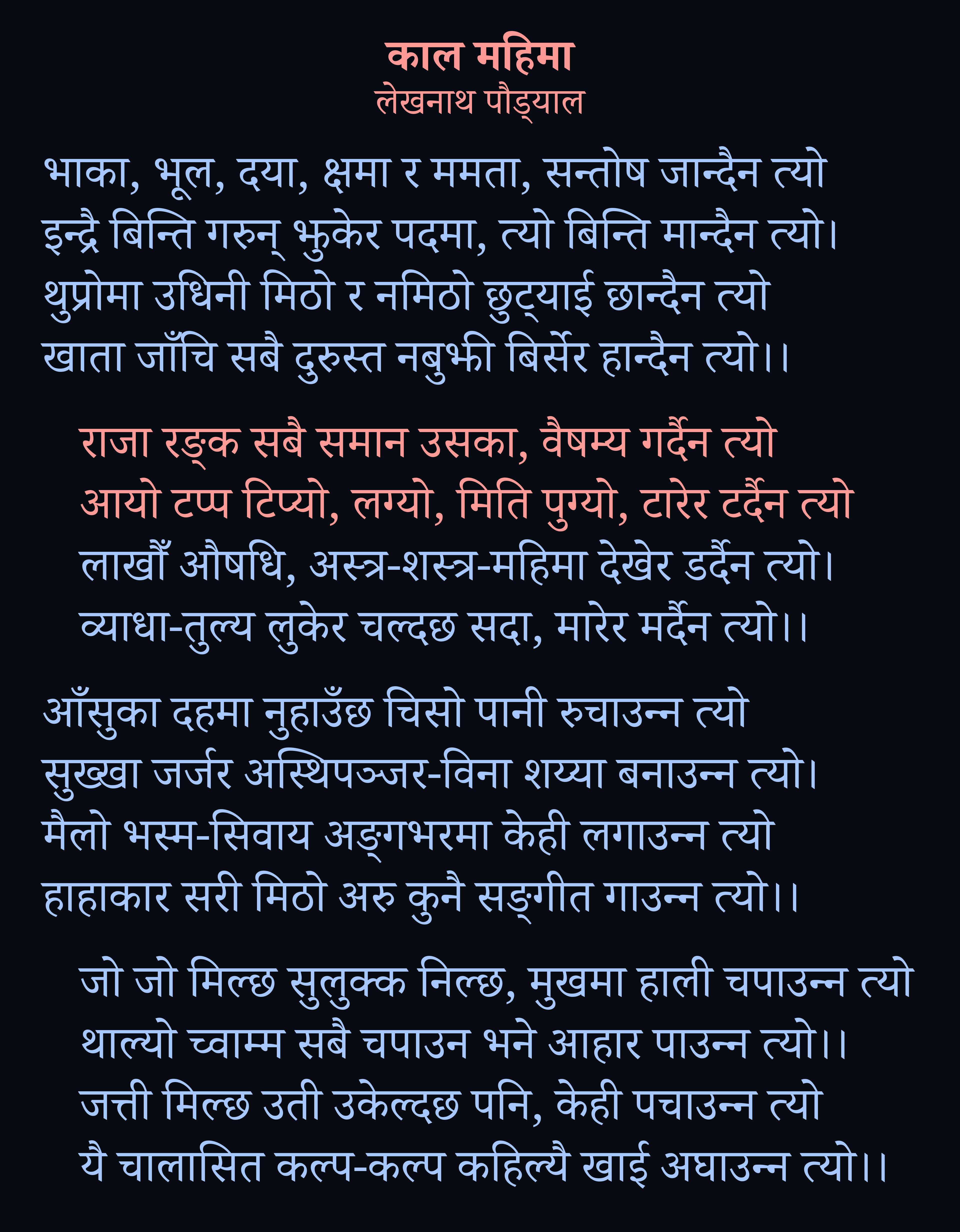
Kal Mahima is a poem centred on the power of time and the transience of human life.
It presents the idea that wealth, power, youth and worldly status are not permanent.
The poet expresses the philosophical view that nobody can escape the effects of time.
The poem combines classical metre, aphoristic language and reflection on the nature of life.
Jeevan Changa
In Jeevan Changa, human life is compared to a kite flying in the sky.
Through the symbolic use of the kite, string and wind, the poet reflects on human life, attachment, pride, happiness, suffering and the influence of circumstances.
The poem suggests that, like the flight of a kite, human life is shaped by different conditions and limitations.
This composition represents Lekhnath's poetic ability to express philosophical ideas through ordinary objects.
Major Characteristics of Lekhnath Paudyal's Poetry
The principal characteristics of Lekhnath Paudyal's poetic style include classical metres, linguistic refinement, descriptions of nature, moral consciousness and philosophical reflection.
1. Commitment to Classical Metres
Lekhnath placed considerable importance on the use of classical metres in Nepali poetry.
His compositions employ metres associated with the Sanskrit poetic tradition, including Anushtubh and Shikharini.
He paid particular attention to maintaining a balance between rhythm, word choice and poetic meaning.
2. Linguistic Refinement
Linguistic refinement is one of the defining characteristics of his poetry.
Lekhnath emphasised careful word selection, grammar, alliteration and meaningful expression.
His poems combine Sanskrit-derived vocabulary with words commonly used in Nepali.
Grammatical precision, rhythmic expression and discipline in language are central characteristics of the refinement-oriented literary tradition.
3. Descriptions of Nature
Nature occupies an important position in Lekhnath's literary works.
He used seasons, trees, flowers, rivers, birds and other natural features as subjects of his poetry.
Ritu Vichar provides detailed descriptions of seasonal changes, while Tarun Tapasi uses a tree as its central symbol.
In his compositions, nature is not merely an object of beauty but also a means of expressing human emotions and philosophical ideas.
4. Moral and Reform-Oriented Consciousness
Lekhnath's poetry emphasises ethical conduct, social responsibility, virtue and human values.
Satyakali Samvad criticises social problems and moral weaknesses.
Similarly, Tarun Tapasi presents ideas concerning compassion and altruism in opposition to violence, selfishness and exploitation.
5. Influence of Eastern Philosophy
Lekhnath's literature reflects the influence of Vedanta and other Eastern philosophical traditions.
His writings explore themes such as the impermanence of life, worldly attachment, self-reflection, moral duties and spiritual awareness.
Buddhi Vinod, Mero Ram and Tarun Tapasi are important works for understanding his philosophical outlook.
6. Symbolic and Aphoristic Style
Lekhnath used ordinary objects and natural phenomena as symbols to express deeper ideas.
The cage and parrot in Pinjarako Suga, the kite in Jeevan Changa, and the tree in Tarun Tapasi are examples of his symbolic expression.
Many of his poems present reflections on life and the world through brief but meaningful statements.
The Rana-Era Setting and Social Consciousness
A substantial part of Lekhnath Paudyal's literary career took place during Rana rule. The political and social conditions of that period appear to have influenced his literary expression.
Because he worked as a teacher and religious scholar for the Rana family, his professional life was associated with the ruling establishment.
Under these circumstances, some of his poems express symbolic criticism and reform-oriented ideas rather than direct political opposition.
Pinjarako Suga has been interpreted in relation to oppression and the desire for freedom. Satyakali Samvad comments on social problems and moral weaknesses.
Similarly, Tarun Tapasi addresses human selfishness, violence, inequality and exploitation through the experiences of a tree.
However, not all of Lekhnath's writings focus on social or political criticism.
He also composed works praising figures associated with the court. Tyag Ra Udayako Yugal Prakash is studied in this connection.
Therefore, an assessment of Lekhnath's literary personality should consider his social consciousness, spiritual outlook, classical poetic style and the historical circumstances of his time.
Institutional Involvement and Literary Contributions
Lekhnath Paudyal's contributions were not limited to his own literary creations. He also participated in activities associated with the institutional development of Nepali language and literature.
His literary career was connected with the development of magazines such as Sundari, Madhavi and Sharada.
These publications provided opportunities for contemporary Nepali writers to publish their literary works.
When the then Royal Nepal Academy was established in BS 2014, Lekhnath Paudyal became a member of its first Academic Council.
The official records of the Nepal Academy include his name among the members of the first Academic Council formed in BS 2014.
His literary contribution was particularly important in the development of the classical tradition, linguistic refinement and philosophical subject matter in Nepali poetry.
Honours and National Recognition
Lekhnath Paudyal received several honours during his lifetime in recognition of his contributions to Nepali literature. His literary achievements also received institutional recognition after his death.
Kavi Shiromani Title
On 29 Ashadh BS 2008, the then King Tribhuvan conferred the title Kavi Shiromani upon Lekhnath Paudyal.
The honour also included an arrangement for a lifelong monthly allowance of Rs. 200.
Public Felicitation and Ceremonial Chariot Procession
On 20 Poush BS 2011, a public felicitation ceremony and ceremonial chariot procession were organised in Kathmandu in honour of Lekhnath Paudyal.
The programme was organised by the Nepali Shiksha Parishad (Nepal Education Council).
Literary and public figures of the time participated in the procession. Writers including Balkrishna Sama and Laxmi Prasad Devkota also played roles in the event.
The procession is remembered as a historic occasion on which public respect was expressed for a literary figure.
Membership in the Nepal Academy
Lekhnath Paudyal was appointed as a member of the first Academic Council of the then Royal Nepal Academy, established in BS 2014.
Tribhuvan Pragya Puraskar
Lekhnath Paudyal was posthumously awarded the Tribhuvan Pragya Puraskar in BS 2026.
The official award records of the Nepal Academy identify him as a posthumous recipient of the literary award for BS 2026.
Personal and Family Life
Lekhnath Paudyal's personal life was shaped by financial difficulties, family bereavements, and his interest in religion and philosophy.
He married twice. After the death of his first wife, he married Satyawati Paudyal in BS 1972.
His wife, Satyawati Paudyal, was also involved in literary writing. A collection of her poems was published in BS 2030, after Lekhnath's death.
According to literary scholar Leela Luitel, some biographies identify his wife as Satyadevi. However, the name Satyawati Paudyal appears in her published poetry collection. For this reason, Satyawati is considered the more reliable form of her name.
Lekhnath's family experiences and religious studies can be examined in relation to his spiritual reflections.
Nevertheless, it would be inappropriate to regard all his philosophical writings solely as the result of personal experiences. Classical Sanskrit literature, Eastern philosophy and the social conditions of his time also contributed to the development of his literary outlook.
Later Life and Death
Lekhnath Paudyal experienced increasing health problems during the later years of his life.
According to biographical accounts, he began suffering from recurring illness after BS 2020.
In BS 2022, while travelling towards Varanasi, he became seriously ill after reaching Raxaul, India. He subsequently returned to Nepal.
Lekhnath Paudyal died in the Devghat area on 7 Falgun BS 2022, the day of Maha Shivaratri.
Following his death, his literary works have continued to be studied, republished and critically evaluated.
In 2018, Publication Nepalaya published Kavi Shiromani Rachanawali, a five-volume collection of his published and unpublished writings organised by literary genre.
The collection brought together his works from different literary genres in a single publication series.
Lekhnath Paudyal's Place and Contributions in Nepali Literature
In the history of Nepali literature, Lekhnath Paudyal is recognised as a major figure of the classical and refinement-oriented tradition associated with the early development of modern Nepali poetry.
His contributions include the development of poetic themes, language, metre, literary craftsmanship and philosophical expression.
Role in the Development of Modern Nepali Poetry
Lekhnath is regarded as one of the pioneers of modern Nepali poetry.
However, literary critics differ on the question of who initiated the modern period of Nepali poetry.
Some critics consider Lekhnath's poetic career the beginning of modern Nepali poetry. Others regard the works of Laxmi Prasad Devkota or Gopal Prasad Rimal as marking a clearer development of modernity in Nepali poetry.
Despite this debate, Lekhnath's contributions to the expansion of poetic subject matter and linguistic refinement are widely regarded as significant.
Literary Refinement of the Nepali Language
Lekhnath prioritised classical metres, word choice, rhythm, alliteration and linguistic discipline in Nepali poetry.
His writings demonstrated the capacity of the Nepali language to express complex philosophical and poetic ideas.
His sustained commitment to linguistic refinement through literary practice is an important characteristic of the refinement-oriented tradition of Nepali poetry.
Integration of Nature and Philosophy
Lekhnath connected natural themes with philosophical reflections on life and society.
Ritu Vichar explores the relationship between changes in nature and human life.
Tarun Tapasi uses the life story of a tree to reflect on society, morality, compassion and spiritual awareness.
These works contributed to the expansion of nature-related themes in Nepali poetry.
One of the Three Literary Figures Known as Trimurti
Lekhnath Paudyal, Balkrishna Sama and Laxmi Prasad Devkota are collectively known as the Trimurti of Nepali literature.
These three writers made contributions through different literary approaches and genres.
Lekhnath is known for classical and refinement-oriented poetry, Sama primarily for drama and intellectually oriented literary writing, and Devkota for Romantic poetry.
Trimurti Niketan was also established in honour of these three literary figures.
Critical Perspectives on the Limitations of His Literature
Alongside his contributions, scholars have also examined the ideological and stylistic limitations of Lekhnath's literary works.
Some of his poems strongly reflect didactic themes, religious ideals and traditional poetic conventions.
Similarly, his writings demonstrate greater emphasis on symbolic criticism and reform-oriented thought than on direct resistance to the political conditions of the Rana period.
Therefore, an evaluation of Lekhnath's literature should consider not only his linguistic and artistic contributions but also the historical circumstances and intellectual tendencies reflected in his work.
Conclusion
Lekhnath Paudyal was a major figure of the classical and refinement-oriented tradition of Nepali poetry. He emphasised the artistic use of classical metres, linguistic refinement, descriptions of nature, moral consciousness and Eastern philosophy.
Buddhi Vinod, Satyakali Samvad, Ritu Vichar, Tarun Tapasi and Mero Ram are important works for understanding his literary approach and contributions.
His literary personality combined a commitment to classical poetic traditions, philosophical reflection, linguistic discipline and sensitivity to social conditions.
Lekhnath Paudyal's contributions remain an important reference in the study of the development of Nepali poetry, the refinement-oriented literary tradition and classical poetic metres.
References
1. Publication Nepalaya. (2018). Kavi Shiromani Rachanawali. A five-volume collection of Lekhnath Paudyal's literary works, including published and unpublished writings, publication records and bibliographic details.
2. Hutt, Michael James. (1991). Himalayan Voices: An Introduction to Modern Nepali Literature. University of California Press. A study of the development of modern Nepali literature and the literary contributions of Lekhnath Paudyal.
3. Nepal Academy. Former Academic Councils. Official records identifying the members of the first Academic Council formed in BS 2014.
4. Nepal Academy. Pragya Puraskar. Official records of literary figures who received the Tribhuvan Pragya Puraskar.
5. Nepal, Devi. (BS 2074). Yugeen Chetanaka Samvahak. Nagarik. A study addressing Lekhnath Paudyal's date of birth, early literary career, refinement-oriented poetic tradition and literary contributions.
6. Gorkhapatra. Kavi Shiromani Lekhnath Paudyal. Biographical material covering his birth, family background, education, professional life, honours and death.
7. Gorkhapatra. Anekos Ham Ekah Syam Unmukha Tarun Tapasi (Literary Criticism). A critical study of the symbolic structure, narrative and philosophical themes of Tarun Tapasi.
8. Luitel, Leela. (2017). Shiromani Satyawati. A research article concerning Satyawati Paudyal's name, family details and literary contributions.
9. Trimurti Niketan. Introduction. Information about the three literary figures known as the Trimurti of Nepali literature and the establishment of the institution.
10. Sahitya Ras. Ritu Vichar and Mero Ram. Digital texts and materials concerning the structure and subject matter of Lekhnath Paudyal's literary works.







Comments 0
No comments yet. Be the first to start the conversation.