



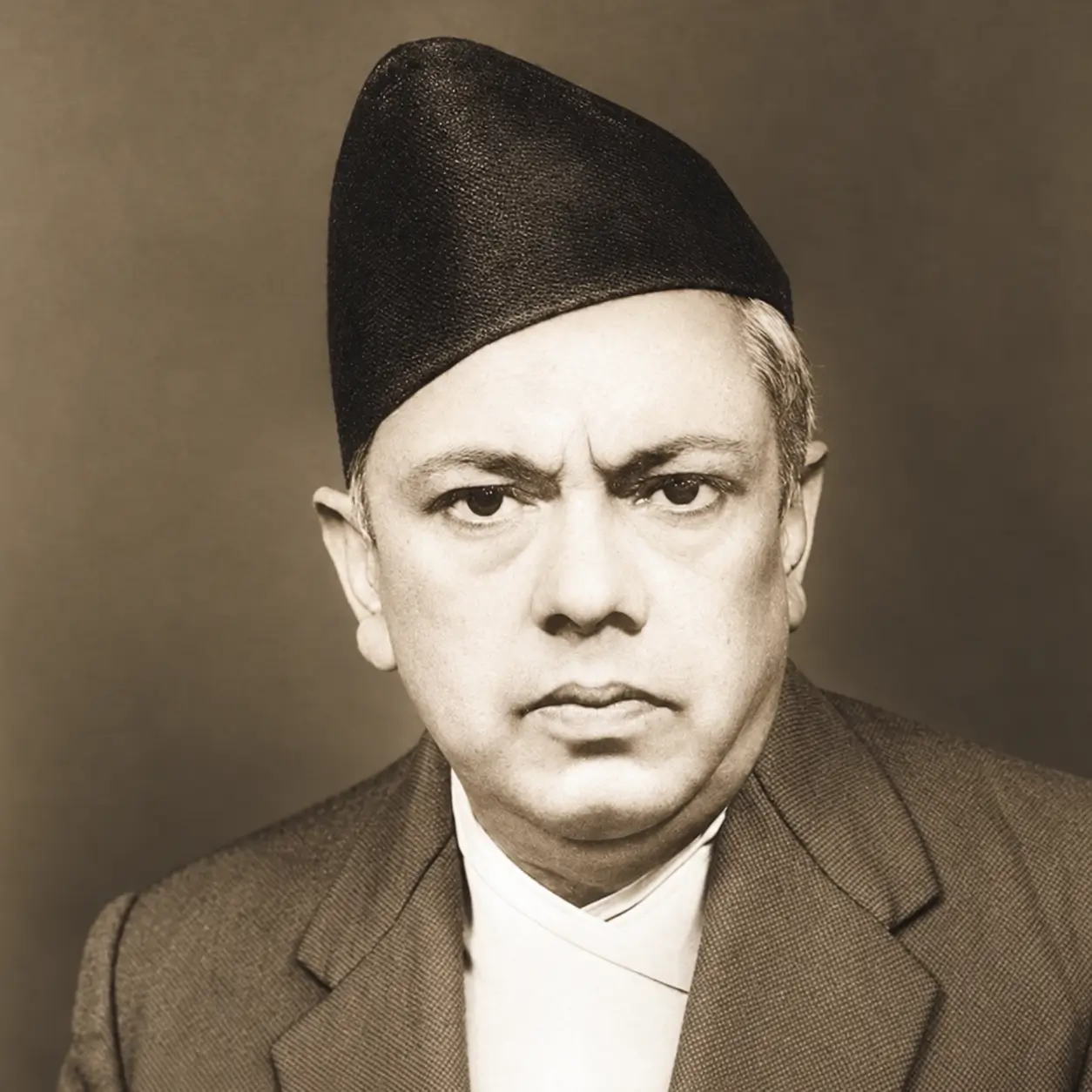
Gopal Prasad Rimal (1975–2030 BS) was a pioneer of modern Nepali prose poetry and a prominent playwright associated with social realism. He played an important role in moving Nepali poetry beyond the restrictions of traditional metrical verse and bringing family relationships, gender inequality, and contemporary social issues into Nepali drama.
Social injustice, political change, human freedom, women's dignity, and hope for the future are recurring themes in Rimal's literary works. He used literature not only as a form of artistic expression but also as a means of promoting social awareness and change.
His poetry collection Aamako Sapana (A Mother's Dream) and plays Masan and Yo Prem! are important works of modern Nepali literature. Beyond his literary career, he was actively involved in political activities opposing the Rana regime.
Rimal received the Madan Puraskar for the year 2019 BS for his poetry collection Aamako Sapana. He was also honored with the Tribhuvan Pragya Puraskar in 2030 BS in recognition of his contributions to Nepali literature.
Gopal Prasad Rimal: Quick Facts
|
Particular |
Information |
|---|---|
|
Full Name |
Gopal Prasad Rimal |
|
Date of Birth |
18 Jestha 1975 BS |
|
Place of Birth |
Lagan Tol, Kathmandu, Nepal |
|
Date of Death |
8 Kartik 2030 BS |
|
Place of Death |
Kathmandu, Nepal |
|
Nationality |
Nepali |
|
Father |
Umakanta Rimal |
|
Mother |
Adityakumari Rimal |
|
Education |
Studied at Durbar High School and Tri-Chandra College |
|
Main Literary Genres |
Poetry and drama |
|
Other Activities |
Teaching, literary editing, and political activism |
|
Major Works |
Aamako Sapana, Masan, Yo Prem!, and Maya |
|
Literary Recognition |
Pioneer of modern Nepali prose poetry and social realist playwright |
|
Political Involvement |
Anti-Rana movement and Nepal Praja Panchayat |
|
Major Awards |
Madan Puraskar (2019 BS) and Tribhuvan Pragya Puraskar (2030 BS) |
Some published biographies mention both 1974 BS and 1975 BS as Rimal's birth year. However, the official records of the Madan Puraskar Guthi state that he was born on 18 Jestha 1975 BS. This biography follows that official record.
Birth, Family and Childhood
Gopal Prasad Rimal was born on 18 Jestha 1975 BS in Lagan Tol, Kathmandu. According to the records of the Madan Puraskar Guthi, his father was Umakanta Rimal, and his mother was Adityakumari Rimal.
He spent his childhood in Kathmandu during the Rana regime. At that time, access to education was limited for ordinary citizens, while political activities and public expression were subject to restrictions.
Rimal grew up within the social and cultural conditions of contemporary Nepali society. His later literary works reveal a critical perspective on social inequality, traditional beliefs, and political restrictions.
However, available biographical sources provide limited information about his family background and specific childhood experiences. It would therefore be inappropriate to identify any single family event or personal experience as the decisive influence behind his literary development.
Education and Intellectual Development
Gopal Prasad Rimal received his school education at Durbar High School in Kathmandu. He later attended Tri-Chandra College for higher education.
He was recognized as a talented student during his school years. Published memoirs and accounts of his life describe his interest in reading, debating, and literary activities.
Various biographies state that he joined Tri-Chandra College after passing the school-leaving examination. However, he did not complete his higher education.
Alongside formal education, Rimal continued studying literature. His exposure to Nepali and foreign literary works appears to have contributed to his adoption of new writing styles, themes, and intellectual perspectives.
The influence of Norwegian playwright Henrik Ibsen's problem-oriented realist drama is particularly evident in Rimal's plays. Literary studies suggest that this influence encouraged him to explore family relationships, social conventions, and individual freedom through drama.
Early Literary Career
Gopal Prasad Rimal's literary activities began during the 1990s BS. Although he initially wrote metrical poetry, he later became particularly recognized for his role in developing Nepali prose poetry.
Literary scholar Michael Hutt discusses Rimal's early poems and the development of his prose poetry in his 1991 book Himalayan Voices: An Introduction to Modern Nepali Literature.
First Published Poem and the Beginning of Prose Poetry
According to Michael Hutt's study, Rimal's first published work was a metrical poem titled Prati, which appeared in Gorkhapatra in 1935 AD.
Hutt also identifies Kaviko Gan, published in Gorkhapatra during the same year, as an early and significant example of free-verse poetry in Nepali literature.
These publications indicate that Rimal's literary development was gradual. He initially experimented with traditional poetic meters before adopting new poetic structures that did not depend on fixed classical metrical patterns.
His significance is not limited to the publication of any single poem. His major literary achievement lies in helping develop independent poetic rhythms, idea-centered expression, and symbolic writing in Nepali poetry.
Association with Sharada Magazine
The monthly literary magazine Sharada played an important role in Gopal Prasad Rimal's literary career.
First published in 1991 BS, Sharada was an important publication in the development of modern Nepali literature. It published works by writers including Laxmi Prasad Devkota, Balkrishna Sama, Lekhnath Paudyal, Siddhicharan Shrestha, and Govinda Bahadur Malla 'Gothale'.
Rimal's poems also appeared in the magazine. For a period, he served in an editorial capacity at Sharada.
According to an account of the history of Nepali literary magazines published in Kantipur, Rimal's name appeared as editor in some issues of Sharada published in 2003 BS.
His editorial involvement did not continue for long. Michael Hutt's study states that Rimal was removed from his editorial position after a short period because he was considered politically controversial.
Alongside literary writing, Rimal was also involved in teaching and other professional activities.
Contributions to Nepali Prose Poetry
Gopal Prasad Rimal is regarded as a pioneer of modern Nepali prose poetry. Moving away from conventional metrical verse, he gave greater importance to ideas, emotions, symbolism, and internal rhythm.
Prose poetry is not simply ordinary prose divided into poetic lines. Although it does not require classical meter, its poetic effect comes from linguistic rhythm, imagery, symbolism, word choice, and the arrangement of meaning.
These characteristics are evident in Rimal's poetry.
Language and Style of His Prose Poetry
Rimal's poetic style is relatively simple, meaningful, and conversational. Rather than relying heavily on elaborate language and ornamental expressions, his poems emphasize clarity of thought and effective emotional expression.
He did not treat external meter and rhyme as essential requirements. Instead, he developed internal rhythms suited to the subject and emotional character of each poem.
Social and political messages appear in his poetry through both direct expression and symbolism. Images of mothers, children, darkness, light, and change occupy significant places in his works.
His poetic style helped expand the possibilities of structure and expression in modern Nepali poetry.
Central Theme of Aamako Sapana
Aamako Sapana (A Mother's Dream) is one of Gopal Prasad Rimal's representative prose poems. Through a conversation between a mother and her son, it expresses hope for future change.
In the poem, the mother awaits a person who will bring liberation from injustice and darkness. Her son asks about the arrival of this person, while the mother expresses her confidence in the future.
The poem is interpreted not only as a conversation within a family but also in relation to Nepal's political conditions at the time.
According to Michael Hutt's interpretation, the mother symbolizes Nepal, while the anticipated change represents hope for the end of Rana rule and the establishment of a new political order.
Motherhood and political consciousness are closely connected in the poem. The mother's dream is not limited to a personal desire; it represents a collective aspiration for justice, freedom, and social transformation.
Because of its symbolic structure and independent poetic style, Aamako Sapana is studied as an important work of modern Nepali prose poetry.
Political and Social Consciousness in Other Poems
Political change, national consciousness, and human freedom are also recurring themes in Rimal's other poems.
His work commonly identified by the title Ek Yugma Ek Din Ekchoti Aauchha portrays change as a significant event in the course of history.
Similarly, Rato Ra Chandra Surya is another well-known composition expressing national sentiment.
Composer Amber Gurung composed music for the song. According to the music archives of Paleti, it was performed in the voices of Fatteman and Amber Gurung.
According to a report published in Gorkhapatra, the Nepali Army has used the song based on this composition as its official military anthem since 2067 BS.
Other poems by Rimal, including Santwana, Aamako Vedana, Parivartan, and Timi Ko?, also express themes associated with social change, hope, and contemporary political circumstances.
However, interpreting his poetry merely as political slogans would be inadequate. Rimal combined political ideas with poetic symbolism, emotional expression, and carefully developed linguistic structures.
Contributions to Nepali Drama and Theatre
Gopal Prasad Rimal was a prominent writer of modern Nepali social realist drama. His plays address family relationships, women's identities, marriage, and the gender inequalities embedded in contemporary society.
While playwrights such as Balkrishna Sama had already contributed to the development of modern Nepali drama, Rimal placed social problems at the center of dramatic conflict.
His plays give considerable importance to the psychological experiences of characters and the conflicts between personal interests, family relationships, and established social conventions.
Problem Plays and Social Realism
A problem play presents a particular social issue through characters, relationships, and events. Such plays may explore family conflicts, social inequality, moral dilemmas, and questions of individual freedom.
Rimal gave particular attention to these themes in his dramatic writing.
Literary studies frequently discuss the influence of Henrik Ibsen on his plays. In particular, comparisons have been made between Ibsen's A Doll's House and Rimal's Masan concerning women's self-respect and resistance to restrictive family relationships.
However, the social settings and circumstances of the characters in these two plays are different. Rimal based his drama on the specific social problems and family structures of Nepali society.
Masan
Masan is a social realist play by Gopal Prasad Rimal, published in 2003 BS.
According to the bibliographic records of the Madan Puraskar Library, its first edition was published by the Nepali Bhasha Prakashini Samiti in 2003 BS.
The play explores the patriarchal family structure of contemporary Nepali society, social expectations surrounding children, women's freedom, and inequality within marriage.
Its principal characters include Krishna, Helen, and Dulahi.
Through Krishna's behavior and the conflicts that develop within the family, the play examines how patriarchal attitudes affect women's experiences of motherhood, personal desires, and individual identities.
Saraswati Pandey's research thesis, Gopal Prasad Rimalka Natakma Laingikata (Gender in the Plays of Gopal Prasad Rimal), submitted to Tribhuvan University, also examines gender-based power relations, oppression, and resistance in Masan.
The female characters express disagreement with and resistance to unequal treatment. Their responses raise important questions about women's dignity and their right to make personal decisions.
The central literary achievement of Masan lies in its treatment of family problems as expressions of broader structural inequalities rather than merely private disputes.
Yo Prem!
Yo Prem! is another full-length social play by Gopal Prasad Rimal, published in 2015 BS.
The play explores love, marriage, social morality, and unequal relationships between men and women.
It raises questions about love and personal freedom while criticizing the different expectations society places on men and women.
A gender-focused research thesis at Tribhuvan University examines power relations, gender identity, and resistance among the characters in Yo Prem!.
Women's self-respect and individual freedom are also important themes in this play.
In both Masan and Yo Prem!, Rimal presents marital and family relationships as inseparable from wider social structures. Through dramatic conflict, he examines the relationship between individuals and society.
Maya and Other Short Plays
In addition to his full-length plays, Rimal wrote a short play titled Maya.
Maya explores human relationships, family circumstances, and established social conventions.
Another short play, Nepali Sanskriti, is also mentioned in published literary studies of his works.
The use of conversational language and the presentation of social problems are important characteristics of Rimal's full-length and short plays.
These works contributed to the development of realist themes in Nepali drama and encouraged critical examination of problems within family relationships.
Political Activism and the Anti-Rana Movement
Gopal Prasad Rimal was not only a literary figure but also an individual involved in political activities against the Rana regime.
Through his literary works and public activities, he expressed support for political freedom and social change.
His political involvement became particularly visible during the final decade of Rana rule.
Political Awareness After the Events of 1997 BS
The execution of Shukraraj Shastri, Dharma Bhakta Mathema, Dasharath Chand, and Gangalal Shrestha by the Rana government in 1997 BS was an important event in the history of Nepal's democratic movement.
The event influenced politically conscious young people of the time.
Rimal also used literary and cultural activities to express his opposition to the Rana regime.
According to Michael Hutt's study, Rimal and his associates expressed political protest through devotional songs and hymns in the areas surrounding Pashupatinath Temple and Shobha Bhagawati.
These activities, which used religious and cultural gatherings to raise public awareness, reflected the restrictive political conditions of the period.
Involvement in Nepal Praja Panchayat
Rimal also attempted to organize anti-Rana political activities.
Biographical accounts indicate that he played an active role in establishing a political organization called Nepal Praja Panchayat.
Individuals associated with the organization included Vijay Malla and Gopal Das Shrestha, among others who were politically active at the time.
According to a biographical article by Rajkumar Baniya published in Nepal magazine, the organization conducted peaceful demonstrations and satyagraha activities in support of political rights and changes in government.
Rimal was also imprisoned because of his involvement in political activities.
However, published historical accounts differ regarding the organization's establishment date and the roles of certain individuals. It would therefore be inappropriate to present a single definitive date or leadership structure without accounting for those differences.
Political Views After 2007 BS
Following the end of Rana rule in 2007 BS, Nepal entered a new political period.
Rimal had expressed hope for political change, and this optimism was reflected in his poetry of the period.
However, subsequent political developments did not fulfill all his expectations.
Michael Hutt interprets Rimal's poem Parivartan as expressing hope for political transformation, while later works such as Timi Ko? reflect political dissatisfaction.
These interpretations demonstrate the relationship between Rimal's literature and the political circumstances of his time.
Nevertheless, it would be inappropriate to attribute the personal or health-related difficulties he experienced in later life directly to political disappointment without adequate evidence.
Major Literary Works of Gopal Prasad Rimal
Gopal Prasad Rimal wrote both poetry and drama. Although the number of his published books was relatively limited, his writings made significant contributions to the development of modern Nepali literature.
|
Literary Work |
Genre |
Details |
|---|---|---|
|
Aamako Sapana |
Poetry collection |
Received the Madan Puraskar for 2019 BS |
|
Masan |
Full-length play |
First edition published in 2003 BS |
|
Yo Prem! |
Full-length play |
Published in 2015 BS |
|
Maya |
Short play |
A work dealing with social themes |
|
Nepali Sanskriti |
Short play |
Mentioned in published literary studies |
Rimal's other poems appeared in various newspapers and literary magazines. Notable examples include Prati, Kaviko Gan, Santwana, Aamako Vedana, Parivartan, Timi Ko?, Ek Yugma Ek Din Ekchoti Aauchha, and Rato Ra Chandra Surya.
Some sources identify 2020 BS as the publication year of the poetry collection Aamako Sapana. However, the official records of the Madan Puraskar Guthi confirm that the award year was 2019 BS.
The year for which a literary award is granted should not automatically be treated as the publication year of the winning book.
Awards and Honors
Gopal Prasad Rimal's literary achievements received recognition through several awards and honors.
Madan Puraskar (2019 BS)
Rimal received the Madan Puraskar for the year 2019 BS for his poetry collection Aamako Sapana.
The official records of the Madan Puraskar Guthi identify his name, the award year, and the winning literary work.
This award represents one of the major formal recognitions of his contributions to Nepali prose poetry.
Tribhuvan Pragya Puraskar (2030 BS)
Gopal Prasad Rimal was awarded the Tribhuvan Pragya Puraskar in 2030 BS.
The official award records of the Nepal Academy list him among the recipients of the award in the field of literature for that year.
Other Honors
Various commemorative programs and honors have recognized Rimal's literary and national contributions.
The Nepali Army adopted the song based on his composition Rato Ra Chandra Surya as its official military anthem.
According to Gorkhapatra, the Nepali Army also posthumously honored Rimal with the honorary rank of colonel in 2068 BS.
This recognition connects his literary expression of national consciousness with the institutional traditions of the Nepali Army.
Personal Life, Health and Death
Gopal Prasad Rimal's life included literary achievements, political involvement, and personal challenges.
At different stages of his life, he was engaged in literary writing, teaching, editing, and political activities.
During his later years, Rimal experienced health-related difficulties. Literary studies and interviews with family members mention that he was taken to Ranchi, India, for treatment.
Published accounts of his health provide historical information about this period of his life. However, it would be inappropriate to draw definitive conclusions about the causes of his health problems without sufficient medical evidence.
His literary writing and public activities became increasingly limited during his later years.
Gopal Prasad Rimal died in Kathmandu on 8 Kartik 2030 BS at the age of 55.
Historical Contributions to Nepali Literature
Gopal Prasad Rimal's contributions to Nepali literature are primarily associated with the development of modern prose poetry, the expansion of social realist drama, and the expression of ideas concerning social and political change.
Development of Modern Prose Poetry
Rimal played an important role in moving Nepali poetry beyond the restrictions of fixed classical meters.
Through free rhythms, symbolic expression, and idea-centered poetic structures, he contributed to the development of prose poetry.
His writing opened new possibilities of literary expression for later generations of Nepali poets.
Development of Social Realist Drama
Through Masan and Yo Prem!, Rimal brought contemporary family problems and gender inequalities into the central themes of Nepali drama.
These works examine marriage, motherhood, personal freedom, patriarchal behavior, and women's self-respect.
They helped encourage a stronger focus on social realism and psychological conflict in Nepali dramatic writing.
Relationship Between Literature and Political Consciousness
Rimal's poems express themes of freedom, social change, and resistance to injustice.
Because he participated in political activities as well as literary writing, his life occupies a place in the histories of both Nepali literature and Nepal's democratic movement.
His works demonstrate how political consciousness can be expressed in literature through symbolic and artistic techniques rather than direct political slogans alone.
Literary Legacy of Gopal Prasad Rimal
Gopal Prasad Rimal's literary legacy rests less on the number of books he published than on their contributions to the development of Nepali literature.
His poem Aamako Sapana can be studied in relation to modern Nepali prose poetry, political symbolism, and hope for change.
Similarly, Masan and Yo Prem! provide material for examining gender inequality, power relations within families, and individual freedom.
Michael Hutt's study of modern Nepali literature and research theses submitted to Tribhuvan University have examined Rimal's works from different literary and social perspectives.
These studies demonstrate that his writings remain relevant not only to the history of Nepali literature but also to literary criticism and academic research.
Conclusion
Gopal Prasad Rimal was an important poet and playwright in modern Nepali literature. He contributed to the development of prose poetry and brought family relationships and gender inequality into the central themes of social realist drama.
His major works, including Aamako Sapana, Masan, and Yo Prem!, explore political change, human freedom, women's self-respect, and social inequality through different literary forms.
His involvement in political activities against the Rana regime further illustrates the relationship between his literary work and his commitment to social change.
Rimal is therefore remembered as a significant contributor to the development of modern Nepali prose poetry, social realist drama, and literature concerned with political and social transformation.
References
1. Madan Puraskar Guthi. Gopal Prasad Rimal: Official Biographical Record and Madan Puraskar 2019 BS.
2. Madan Puraskar Library. Masan: Bibliographic Record of the Play by Gopal Prasad Rimal. First edition, Nepali Bhasha Prakashini Samiti, 2003 BS.
3. Nepal Academy. Pragya Puraskar: Official List of Award Recipients.
4. Hutt, Michael James. (1991). Himalayan Voices: An Introduction to Modern Nepali Literature. University of California Press.
5. Pandey, Saraswati. (2025). Gopal Prasad Rimalka Natakma Laingikata (Gender in the Plays of Gopal Prasad Rimal). Research thesis, Tribhuvan University.
6. Baniya, Rajkumar. (2073 BS). Gopal Prasad Rimal Revisited. Nepal magazine.
7. Baniya, Rajkumar. (2079 BS). Sampadakka Susedhanda. Kantipur, Koseli.
8. Gorkhapatra. Sarvapratham Jai Nepalko Nara Lagaune Aadi Gadyakavi Rimal.
9. Paleti. Rato Ra Chandra Surya: Archival Record of the Song, Lyricist, and Musical Composition.







Comments 0
No comments yet. Be the first to start the conversation.