



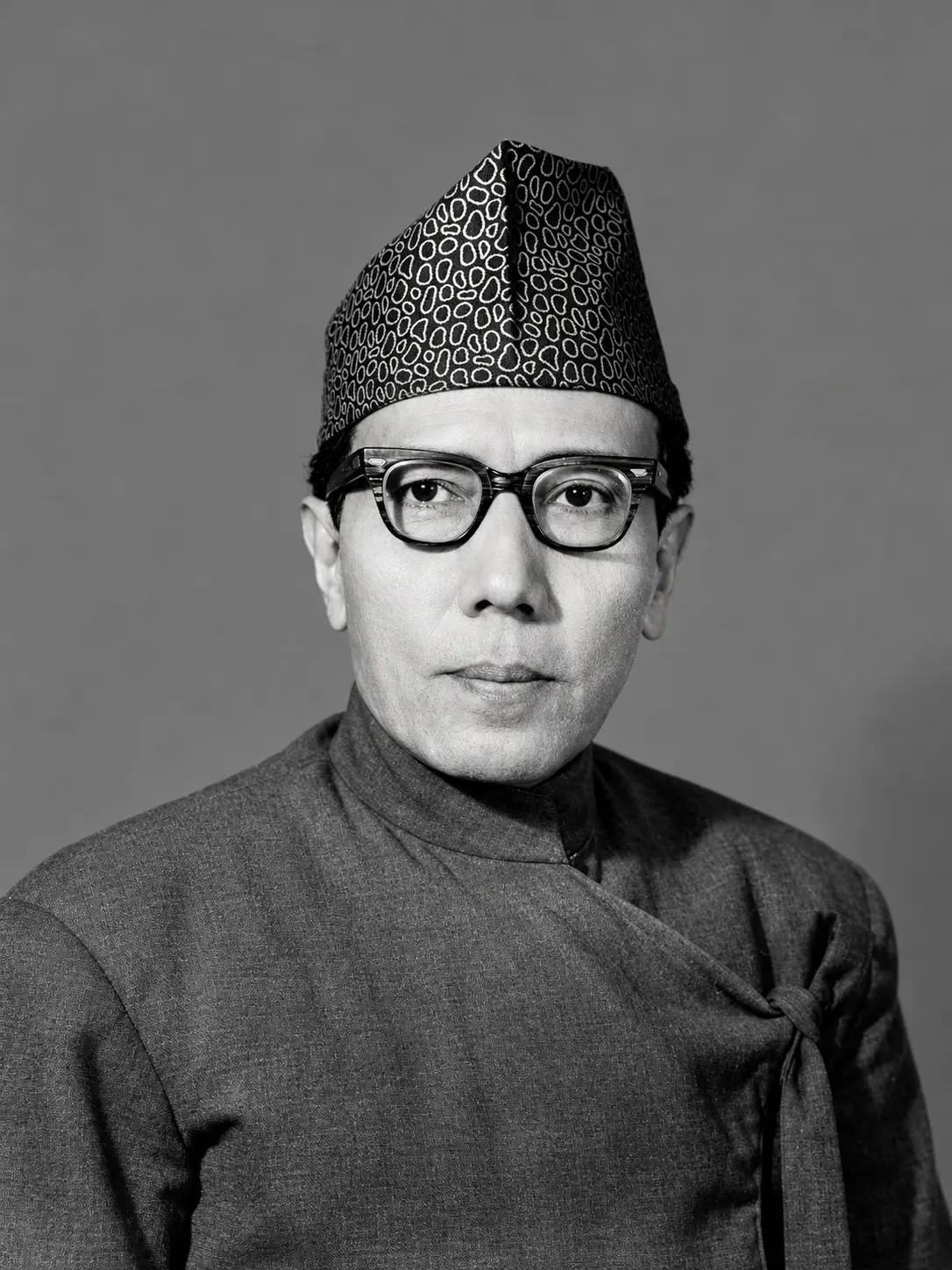
Balkrishna Sama (1959–2038 BS) was a prominent playwright, poet, essayist, philosophical thinker, and painter in modern Nepali literature. He was born on Magh 24, 1959 BS, in Gyaneshwar, Kathmandu. His birth name was Balkrishna Shamsher Jung Bahadur Rana, but he later became widely known as Balkrishna Sama.
He is honoured in Nepali literature with the titles Natyashiromani and Natyasamrat, recognising his contributions to drama. He played an important role in developing modern Nepali theatre through original playwriting, psychological characterisation, metrical dialogue, and theatrical presentation. His notable plays include Mutuko Byatha, Mukunda–Indira, Prahlad, Andhaveg, Prempinda, Amar Singh, and Bhimsenko Antya.
Sama's literary contributions extended beyond drama. He also wrote poetry, epics, philosophical essays, and autobiographical works, including Ago ra Pani, Chiso Chulho, Niyamit Akasmikata, and Mero Kavitako Aradhana. His writings explore humanism, social inequality, love, family relationships, history, patriotism, and questions concerning science and philosophy.
Alongside Kavi Shiromani Lekhnath Paudyal and Mahakavi Laxmi Prasad Devkota, Balkrishna Sama is recognised as one of the three literary figures collectively known as the Trimurti of modern Nepali literature.
In addition to his literary work, he held responsibilities at institutions such as the Nepali Bhasha Prakashini Samiti, Radio Nepal, Gorkhapatra, and the Royal Nepal Academy.
Balkrishna Sama: Quick Facts
|
Particulars |
Details |
|---|---|
|
Literary name |
Balkrishna Sama |
|
Birth name |
Balkrishna Shamsher Jung Bahadur Rana |
|
Date of birth |
Magh 24, 1959 BS |
|
Birthplace |
Gyaneshwar, Kathmandu |
|
Father |
Samar Shamsher Jung Bahadur Rana |
|
Mother |
Kirti Rajya Lakshmi Rana |
|
Elder brother |
Pushkar Shamsher Jung Bahadur Rana |
|
Spouse |
Mandakini Devi |
|
Education |
Schooling at Durbar High School, matriculation, and higher studies at Tri-Chandra College |
|
Main occupations |
Playwright, poet, essayist, philosophical thinker, and painter |
|
Major plays |
Mutuko Byatha, Dhruva, Mukunda–Indira, Prahlad, Andhaveg, Prempinda, Amar Singh, Bhimsenko Antya |
|
Major poetic works |
Ago ra Pani, Chiso Chulho |
|
Major prose works |
Niyamit Akasmikata, Mero Kavitako Aradhana |
|
Major awards |
Sajha Puraskar, Tribhuvan Pragya Puraskar, Prithvi Pragya Puraskar |
|
Date and place of death |
Shrawan 6, 2038 BS, Kathmandu |
Birth, Family Background and Childhood
Balkrishna Sama was born into Nepal's ruling Rana family. His father, Samar Shamsher Jung Bahadur Rana, held a senior position in military service, while his mother was Kirti Rajya Lakshmi Rana. His grandfather, Dambar Shamsher Jung Bahadur Rana, was also an influential member of the Rana family.
Sama's elder brother, Pushkar Shamsher Jung Bahadur Rana, was a recognised figure in Nepali language and literature.
Being born into the Rana family gave Sama access to educational and cultural opportunities that were unavailable to most people in Nepal at the time. He spent his childhood in the aristocratic surroundings of Gyaneshwar.
During that period, Rana palaces hosted music, dance, drama, painting, and other artistic activities. The residence of his grandfather, Dambar Shamsher, also organised theatrical and dance performances.
Growing up in this setting, Sama had opportunities to watch theatrical productions from an early age. Literary books, religious texts, and painting materials available within the family helped develop his artistic interests.
In his autobiographical work Mero Kavitako Aradhana, Sama described various aspects of his childhood, family relationships, education, and growing interest in literature.
Although his family background was closely associated with political power and social privilege, his later literary works frequently addressed the emotions of ordinary people, social discrimination, and human relationships.
Education and Early Literary Interests
Balkrishna Sama began his education at home. Following the educational practices of Rana families at the time, he received basic instruction in various subjects from private tutors during childhood.
In 1970 BS, he enrolled at Durbar High School in Kathmandu. While studying there, he developed a growing interest in Nepali and English literature.
After completing his school education, he passed the matriculation examination through Calcutta. He subsequently began higher studies in science at Tri-Chandra College in Kathmandu.
However, he could not complete his formal higher education. Under the prevailing practice of appointing Rana family members to military service, Sama entered the army.
Although his formal education was interrupted, he continued studying independently and practising literature. He read various works of Nepali, Sanskrit, and English literature.
The plays of William Shakespeare particularly influenced his literary development. His familiarity with Eastern dramatic traditions and Western theatrical techniques can be observed in the plots, dialogues, character development, and presentation styles of his plays.
Sama's literary interests initially centred on poetry. What began as an early interest in composing poems eventually expanded into drama, poetry, philosophy, and various forms of prose.
According to Dr. Devi Prasad Subedi's study, Balkrishna Samako Sahityik Yatrama Kavita ra Natak (Poetry and Drama in Balkrishna Sama's Literary Journey), Sama began composing poetry during childhood. His subsequent study of English literature, particularly Shakespeare, encouraged him to explore new forms of dramatic writing in Nepali.
How Did Balkrishna Shamsher Become Balkrishna Sama?
Balkrishna Sama's change of name is often examined in relation to his social and ideological views.
His birth name was Balkrishna Shamsher Jung Bahadur Rana. The names Shamsher and Jung Bahadur Rana identified his association with Nepal's ruling family.
During the final years of Rana rule, demands for political change and civil rights were growing in Nepal. Sama was also influenced by the political developments of that period.
Biographical accounts of his life mention that he was imprisoned because of activities opposing Rana rule. According to a biography published in Gorkhapatra, he began using the name Sama after abandoning his former family name following events associated with political activities.
The Nepali word Sama conveys the meaning of equality or being equal. His decision to change his name is therefore interpreted as an expression of his belief in equality among people.
Balkrishna Sama subsequently became his established literary and public identity.
Military Service, Teaching and Administrative Responsibilities
Balkrishna Sama began his professional career in military service. However, his interests in literature, art, and education eventually took his career in a different direction.
He subsequently became involved in teaching and institutional activities associated with the development of the Nepali language.
Teaching at Durbar High School and Tri-Chandra College
Sama taught at Durbar High School and Tri-Chandra College.
In 1987 BS, he became associated with teaching at Tri-Chandra College. His work in education provided opportunities to continue his literary activities and interact with younger generations.
The educational settings of schools and colleges also helped support the writing, rehearsal, and staging of Nepali plays.
Role in the Nepali Bhasha Prakashini Samiti
Sama was also associated with the leadership of the Nepali Bhasha Prakashini Samiti, a body responsible for publishing books and literary materials in the Nepali language.
During his association with the committee, writing and publication activities were expanding across different genres of Nepali literature.
Alongside his creative contributions, Sama held institutional responsibilities that supported the development of Nepali language and literature.
Radio Nepal and Gorkhapatra
Following Nepal's political changes in 2007 BS, Sama also worked in media institutions.
He served as a director of Radio Nepal. Later, in 2012 BS, he assumed editorial responsibilities at Gorkhapatra.
These positions connected his literary career with public communication and institutional administration.
Contributions to Nepal Academy
Balkrishna Sama was also involved in the institutional development of literature, art, and culture in Nepal.
He was a founding member of the Nepali Literature and Arts Academy, established on Ashadh 9, 2014 BS. The institution later became the Royal Nepal Academy and is now known as Nepal Academy.
Sama subsequently served as vice-chancellor of the academy.
His association with the academy provided opportunities to work institutionally in literature, drama, art, and cultural activities.
Sama's contribution to Nepali literature was therefore not limited to writing his own books. His involvement in institutions concerned with language, literature, and the arts further strengthened his connection with the literary activities of his time.
Balkrishna Sama's Journey as a Playwright
Balkrishna Sama is best known for his contributions to drama. His role in the development of modern Nepali dramatic literature is particularly significant.
Before Sama began writing plays, Nepali drama was influenced by Sanskrit theatrical traditions, translations, adaptations, and Indian Parsi theatre. However, efforts to write original plays in Nepali had already begun.
Acknowledging the contributions of earlier playwrights such as Pahalman Singh Swar, Sama is recognised as an important writer who introduced modern themes, psychological conflict, and developed dramatic techniques into Nepali theatre.
He wrote plays based on social life, mythology, and historical figures. His dramatic works include both prose and verse.
Sama placed particular emphasis on conflicts between characters, dialogue, the progression of events, and the resolution of dramatic plots.
Mutuko Byatha: A Modern Nepali Tragedy
Mutuko Byatha, published in 1986 BS, is one of Balkrishna Sama's early and important plays.
In the history of Nepali literature, the play is studied in connection with the development of modern Nepali drama.
Its storyline centres on love, family relationships, emotional conflict, and tragic circumstances.
The significance of Mutuko Byatha extends beyond its storyline. Sama used metrical dialogue to express the emotions and psychological conditions of his characters.
One notable feature of his dramatic style is the use of the Anushtubh metre without end rhyme.
This form of dialogue allowed him to maintain a poetic rhythm while portraying the emotions of characters and the circumstances of the drama.
Mutuko Byatha is regarded as an important contribution to the development of tragedy, psychological conflict, and original dramatic writing in Nepali literature.
Mukunda–Indira: Social Drama and Theatre
Mukunda–Indira is one of Sama's plays based on social themes. It was published in 1994 BS.
The central storyline concerns the marital relationship between Mukunda and Indira, their family responsibilities, and the consequences of personal behaviour.
The contrast between Mukunda's lifestyle and the circumstances of Indira, who remains at home, creates family and emotional conflicts within the story.
The play portrays contemporary social expectations concerning marriage, family relationships, and moral responsibilities.
The staging of Mukunda–Indira is also considered important in the development of Nepali theatre. The play contributed to the process of expanding Nepali theatrical performances beyond palace-centred activities to schools and other audiences.
Prahlad: Philosophical Thought Through Mythology
Prahlad is a mythological and philosophical play by Balkrishna Sama. Literary studies identify its publication year as 1995 BS.
The play is based on the conflict between the mythological characters Hiranyakashipu and Prahlad.
Through their story, Sama explores ideas concerning power, arrogance, truth, faith, knowledge, and science.
Rather than presenting mythological events solely as a religious narrative, Prahlad raises questions concerning human life and social organisation through the ideological conflict between its characters.
The play is therefore regarded as an important work for studying Sama's philosophical outlook.
Andhaveg: A Portrayal of Human Psychology
Andhaveg, published in 1996 BS, is a social and psychological play by Sama.
It portrays how human emotions, suspicion, impulsive behaviour, and personal decisions can affect family relationships.
The characters are influenced not only by external circumstances but also by their own emotions and internal psychological conflicts.
One of the play's main characteristics is its portrayal of love, trust, jealousy, and impulsiveness through dramatic events.
The work demonstrates Sama's ability to develop characters and examine human psychology.
Prempinda: Love, Class Relations and Social Inequality
Prempinda is a social tragedy written by Balkrishna Sama.
The play explores the atmosphere of Rana-era palaces, social power relations, love, and questions of individual freedom.
Its principal characters include Edwill, Sabita, and Nahakul. Their relationships create conflicts involving love, social status, authority, and individual desires.
In Prempinda, personal relationships are presented in connection with the social structures of the time.
The play's extensive character development, sequence of events, and theatrical structure also demonstrate Sama's willingness to experiment with dramatic techniques.
Literary criticism considers this work important for its examination of social relationships and human psychology.
Amar Singh and Bhimsenko Antya: Historical Plays
Balkrishna Sama also wrote plays based on historical figures and events in Nepal.
Amar Singh and Bhimsenko Antya are among his major historical works.
Published in 2010 BS, Amar Singh centres on Amar Singh Thapa, a historical figure associated with the Anglo-Nepalese War.
The play explores patriotism, self-respect, duty, and conflicts arising from historical circumstances.
Similarly, Bhimsenko Antya, published in 2012 BS, dramatises events associated with the life of Bhimsen Thapa, an influential figure in Nepal's political history.
The play addresses power, political rivalry, loyalty, and human circumstances.
Both works demonstrate Sama's approach to transforming historical events into dramatic narratives.
Major Characteristics of Balkrishna Sama's Plays
Balkrishna Sama's plays cover a wide range of subjects and dramatic styles. They can primarily be studied as works based on social, mythological, and historical themes.
|
Type of play |
Major works |
Main themes |
|---|---|---|
|
Social and psychological |
Mutuko Byatha, Mukunda–Indira, Andhaveg, Prempinda |
Love, family, social relationships, and psychological conflict |
|
Mythological and philosophical |
Dhruva, Prahlad |
Faith, knowledge, power, truth, and moral questions |
|
Historical |
Bhakta Bhanubhakta, Amar Singh, Bhimsenko Antya |
Historical figures, national identity, and political circumstances |
|
Experimental and intellectual |
Ma, Swasni Manchhe |
Identity, society, philosophy, and imaginative presentation |
Development of Original Storylines
Sama used Nepali society, family relationships, and historical circumstances as subjects for his plays.
Although his works reflect the influence of Eastern and Western literary traditions, he adapted their dramatic approaches to Nepali language and social settings.
Tragic Dramatic Style
Sama is recognised as one of the major figures in the Nepali tradition of tragic drama.
In works such as Mutuko Byatha, Andhaveg, Prempinda, and Bhimsenko Antya, the decisions of characters, social circumstances, and psychological conflicts contribute to tragic outcomes.
Use of Metrical Dialogue
In addition to prose, Sama wrote plays in verse.
Some of his plays employ the Anushtubh metre without end rhyme. This approach allowed him to combine poetic rhythm with the expression of ideas in dramatic dialogue.
Psychological and Philosophical Perspectives
Sama's plays give considerable attention to the internal psychological conditions of characters alongside external events.
Love, jealousy, arrogance, suspicion, duty, faith, and social pressure are frequently connected with the behaviour and decisions of his characters.
Theatrical Experimentation
Sama regarded drama not only as literature to be read but also as an art form involving acting and performance.
His theatrical activities included playwriting, directing, acting, and staging performances.
These activities contributed to strengthening the relationship between Nepali dramatic literature and theatre.
Contributions to One-Act Plays
Alongside full-length dramas, Balkrishna Sama also wrote one-act plays.
A one-act play is generally a dramatic form that presents a storyline within a single act, usually involving a limited number of characters and events.
Sama's one-act plays address social, historical, psychological, and intellectual themes.
Works such as Boksi, Bhater, Tapobhumi, Matoko Mamata, and Birami ra Kuruwa are associated with his contribution to one-act drama.
Char Ekanki is his collection of one-act plays.
Through this dramatic form, Sama further developed the practice of presenting characters, conflicts, and themes within a shorter theatrical structure.
Contributions to Poetry, Short Epics and Epic Poetry
Balkrishna Sama began his literary journey with poetry. Although he later became particularly well known as a playwright, poetry remained an important part of his creative life.
His poems address intellectual thought, nature, human life, society, philosophy, and human relationships.
His poetic expression often combines ideas with emotions. Some of his writings focus on philosophical questions, while others express human sensitivity and social awareness.
Ago ra Pani: A Philosophical Short Epic
Ago ra Pani, published in 2011 BS, is a short epic reflecting Balkrishna Sama's philosophical interests.
The work uses fire and water as symbols.
Through these symbols, Sama explores relationships between opposing tendencies in life, nature, human behaviour, and ideas.
Ago ra Pani demonstrates his tendency to examine the physical world and human thought from a philosophical perspective.
Chiso Chulho: A Socially Focused Epic
Chiso Chulho, published in 2015 BS, is one of Balkrishna Sama's major epic poems.
Its importance in the Nepali epic tradition is closely associated with its social themes and choice of central character.
Traditional epics often featured mythological figures, rulers, or individuals of high social standing. In contrast, Sama made Sante Damai the central protagonist of Chiso Chulho.
The epic follows the love between Sante and Gauri and the social circumstances surrounding their relationship.
It examines how caste discrimination, economic inequality, and social restrictions affect human relationships.
The title Chiso Chulho, meaning "Cold Hearth," symbolically represents a life made difficult by deprivation and social circumstances.
Through this epic, Sama brought the experiences of a socially marginalised character to the centre of literary expression.
In this respect, Chiso Chulho is regarded as a notable experiment in Nepali epic poetry, particularly in its choice of subject and protagonist.
Philosophy and Essay Writing
Balkrishna Sama's philosophical and prose writings are also important for understanding his intellectual interests.
Beyond literary creation, he explored ideas concerning human life, nature, science, and the organisation of the universe.
Niyamit Akasmikata
Niyamit Akasmikata, published in 2005 BS, is a work associated with Sama's philosophical thought.
In this work, he examines the relationship between regularity and unexpected events in nature and life.
The relationship between natural laws, change, and uncertainty forms a central theme of his thinking.
Sama attempts to explain philosophically how regularity and chance interact in events occurring throughout life and the world.
The work reflects an effort to establish connections between Eastern philosophical thought and modern scientific perspectives.
Niyamit Akasmikata is an important source for understanding Sama's intellectual contributions beyond creative literature. Library catalogues also contain records of its publication in 2005 BS.
Mero Kavitako Aradhana
Mero Kavitako Aradhana is an autobiographical work that also contains Balkrishna Sama's reflections on literature.
In it, he writes about his life, family surroundings, education, attraction to literature, and creative experiences.
The first part of the work, Upasana 1, was published in 2023 BS. Publication details are available in the records of Madan Puraskar Pustakalaya and other libraries.
Because it combines prose and verse, the work is also studied in connection with autobiographical writing and the Champu literary style.
Its significance extends beyond Sama's personal experiences. It also provides information about Rana-era society, contemporary literary activities, and the development of the author's creative interests.
Contributions to Short Stories and Biographical Writing
Balkrishna Sama also contributed to short stories and biographical prose.
His stories explore social relationships, human nature, psychological conditions, and various aspects of contemporary society.
Kaikeyi, Talatal, Paraighar, and Fukeko Bandhan are among his narrative works.
Similarly, Hamra Rashtriya Bibhutiharu is associated with his biographical writing.
These works demonstrate that Sama's literary interests were not confined to drama and poetry.
Contributions to Painting and Fine Arts
Balkrishna Sama was involved in painting as well as literature.
His interest in painting developed during childhood. Alongside his literary activities, he continued practising visual art.
His artistic career reflects connections between painting, drama, and theatrical presentation.
His interest in stage settings, the appearance of characters, dramatic scenes, and theatrical decoration also demonstrates the relationship between his literary and visual artistic activities.
Special programmes and documentary screenings concerning his work as a painter have been organised at the Nepal Academy of Fine Arts.
Although Sama is widely recognised for his literary achievements, his paintings represent another important aspect of his work that deserves attention in the history of Nepali art. The broader cultural background can also be explored through Art and Literature in Nepal.
Major Literary Works of Balkrishna Sama
Balkrishna Sama wrote in several literary genres, including drama, poetry, epic poetry, short epics, essays, philosophy, autobiography, and biography.
The following table presents selected works and their publication years as recorded in literary studies.
|
Literary work |
Genre |
Year (BS) |
|---|---|---|
|
Mutuko Byatha |
Social tragedy |
1986 |
|
Dhruva |
Mythological play |
1986 |
|
Mukunda–Indira |
Social drama |
1994 |
|
Prahlad |
Mythological and philosophical play |
1995 |
|
Andhaveg |
Social and psychological drama |
1996 |
|
Bhakta Bhanubhakta |
Biographical play |
2000 |
|
Ma |
Intellectual drama |
2002 |
|
Niyamit Akasmikata |
Philosophical essay |
2005 |
|
Amar Singh |
Historical play |
2010 |
|
Ago ra Pani |
Short epic |
2011 |
|
Bhimsenko Antya |
Historical play |
2012 |
|
Chiso Chulho |
Epic poem |
2015 |
|
Talamathi |
Play |
2023 |
|
Amit Basana |
Play |
2027 |
|
Motiram |
Biographical play |
2033 |
|
U Mareki Chhaina |
Play |
2035 |
Other notable works include Prempinda, Swasni Manchhe, Boksi, Tapobhumi, Char Ekanki, Matoko Mamata, Tansenko Jhari, Birami ra Kuruwa, Mero Kavitako Aradhana, and Balkrishna Samaka Kavita.
For some works, the dates of composition, first publication, and subsequent editions differ. Therefore, the publication years of all his works cannot be presented on a single consistent basis.
Where the exact year of publication is uncertain, the publication details of the relevant book should be consulted.
Awards and Honours
Balkrishna Sama received various awards and honours in recognition of his contributions to Nepali language, literature, drama, and the arts.
Sajha Puraskar
Balkrishna Sama was a recipient of the Sajha Puraskar.
The award represents one of the institutional recognitions of his literary contributions.
Tribhuvan Pragya Puraskar
Balkrishna Sama received the Tribhuvan Pragya Puraskar in 2029 BS.
Official award records maintained by Nepal Academy identify him among the individuals honoured in 2029 BS for their contributions to literature, art, and culture.
Prithvi Pragya Puraskar
Sama received the Prithvi Pragya Puraskar in 2035 BS.
According to Nepal Academy's official award records, he was the first recipient of this award.
Honorary Degree from Tribhuvan University
Tribhuvan University also conferred an honorary doctorate on Balkrishna Sama.
This recognition was associated with his literary and intellectual contributions.
In addition to these awards and honours, Sama received recognition from various literary and cultural institutions.
Personal Life and Final Years
Balkrishna Sama's wife was Mandakini Devi. His son, Janardan Sama, is also mentioned in accounts of his personal and literary life.
Sama devoted much of his life to literary creation, study, art, and institutional responsibilities.
Even after leaving active administrative positions, he remained involved in literary and cultural activities.
He continued his writing and artistic interests into the later years of his life.
Balkrishna Sama died on Shrawan 6, 2038 BS, in Kathmandu.
His contributions to Nepali literature and theatre have continued to receive scholarly attention and recognition since his death.
A postage stamp was issued in his honour. Literary and cultural organisations have also commemorated his life and contributions through various programmes.
Historical Significance of Balkrishna Sama in Nepali Literature
Balkrishna Sama's contributions can be evaluated through his role in developing Nepali drama, experimenting with literary forms, addressing social issues, and producing works across several genres.
Development of Modern Nepali Drama
Sama's most important contribution was to the development of modern Nepali drama.
Nepali-language playwriting existed before his time. However, Sama expanded that tradition through original storylines, psychological conflict, developed dialogue, and diverse dramatic techniques.
He presented social, mythological, and historical themes through modern dramatic structures.
Expansion of Nepali Theatre
Sama's contributions extended beyond writing plays.
He participated in theatrical directing, acting, and performance-related activities.
His role in expanding the practice of staging Nepali plays in schools and other theatrical settings is considered significant.
Social and Humanistic Thought
Sama's literary works address social inequality, human relationships, and questions of individual freedom.
His decision to make Sante Damai, a socially marginalised character, the protagonist of the epic Chiso Chulho is a notable example of his literary outlook.
Similarly, Prempinda examines class relations, while Mukunda–Indira portrays family relationships and prevailing social expectations.
Philosophical and Intellectual Interests
Sama's writings frequently combine emotions with intellectual inquiry.
In works such as Niyamit Akasmikata, Prahlad, and Ago ra Pani, he raises philosophical questions concerning nature, science, faith, and human life.
These concerns extend his literary works beyond the narration of events into the examination of ideas.
Critical Assessment of His Literary Limitations
Literary assessments of Sama's works have identified certain limitations alongside their strengths.
Some critics have observed that the philosophical ideas, lengthy dialogues, and complex linguistic structures found in certain plays can make them difficult for general readers or audiences to understand.
Narayan Marasini's study, Balkrishna Samaka Natyapravritti (The Dramatic Characteristics of Balkrishna Sama), examines his dramatic style, originality, psychological presentation, thematic diversity, and linguistic features.
Such critical assessments help readers understand both Sama's literary achievements and the stylistic characteristics and limitations of his works.
Balkrishna Sama's Place Among the Trimurti of Nepali Literature
The term Trimurti in Nepali literature refers to three major literary figures: Lekhnath Paudyal, Balkrishna Sama, and Laxmi Prasad Devkota.
These writers contributed to the development of modern Nepali literature through distinct literary approaches and styles.
Lekhnath Paudyal is particularly associated with refined poetic language and the classical tradition of poetry.
Laxmi Prasad Devkota is recognised for Romantic poetry, emotional expression, and experimentation across different literary genres.
Balkrishna Sama's major contributions lie in modern playwriting, intellectual inquiry, philosophical thought, and theatrical creation.
The individual characteristics of these three writers contributed to the diversity and development of modern Nepali literature.
Conclusion
Balkrishna Sama was a versatile figure in modern Nepali literature. His principal contribution was advancing Nepali drama through original storylines, psychological analysis, philosophical thought, and developed dramatic techniques.
Plays such as Mutuko Byatha, Mukunda–Indira, Prahlad, Andhaveg, Prempinda, Amar Singh, and Bhimsenko Antya hold important positions in the development of Nepali dramatic literature.
Similarly, Chiso Chulho, Ago ra Pani, Niyamit Akasmikata, and Mero Kavitako Aradhana demonstrate his contributions to poetry, philosophy, and autobiographical writing.
Understanding Sama's literary significance requires consideration not only of his creative achievements but also of the society, political structures, theatrical traditions, and literary experimentation of his time.
His works remain important resources for studying the historical development of Nepali language, literature, and theatre.
References
1. Nepal Academy. Official records of the Pragya Awards.
2. Nepal Academy. Institutional introduction and history.
3. Rijal, Nawaraj. "Natakkar Balkrishna Sama" (Playwright Balkrishna Sama). Gorkhapatra, Muna.
4. Subedi, Devi Prasad. "Balkrishna Samako Sahityik Yatrama Kavita ra Natak" (Poetry and Drama in Balkrishna Sama's Literary Journey). Janamat Literary Monthly, 2078 BS.
5. Marasini, Narayan. "Balkrishna Samaka Natyapravritti" (The Dramatic Characteristics of Balkrishna Sama). Samakalin Sahitya, 2023.
6. Hutt, Michael James. Himalayan Voices: An Introduction to Modern Nepali Literature. University of California Press, 1991.
7. Madan Puraskar Pustakalaya. Bibliographic record of Mero Kavitako Aradhana (1), 2023 BS.
8. DRKRM Library. Library catalogue records of Balkrishna Sama's works.
9. "Samale Chihayeko Sante Damaiko Chiso Chulho." Ratopati, 2080 BS.




Comments 0
No comments yet. Be the first to start the conversation.