



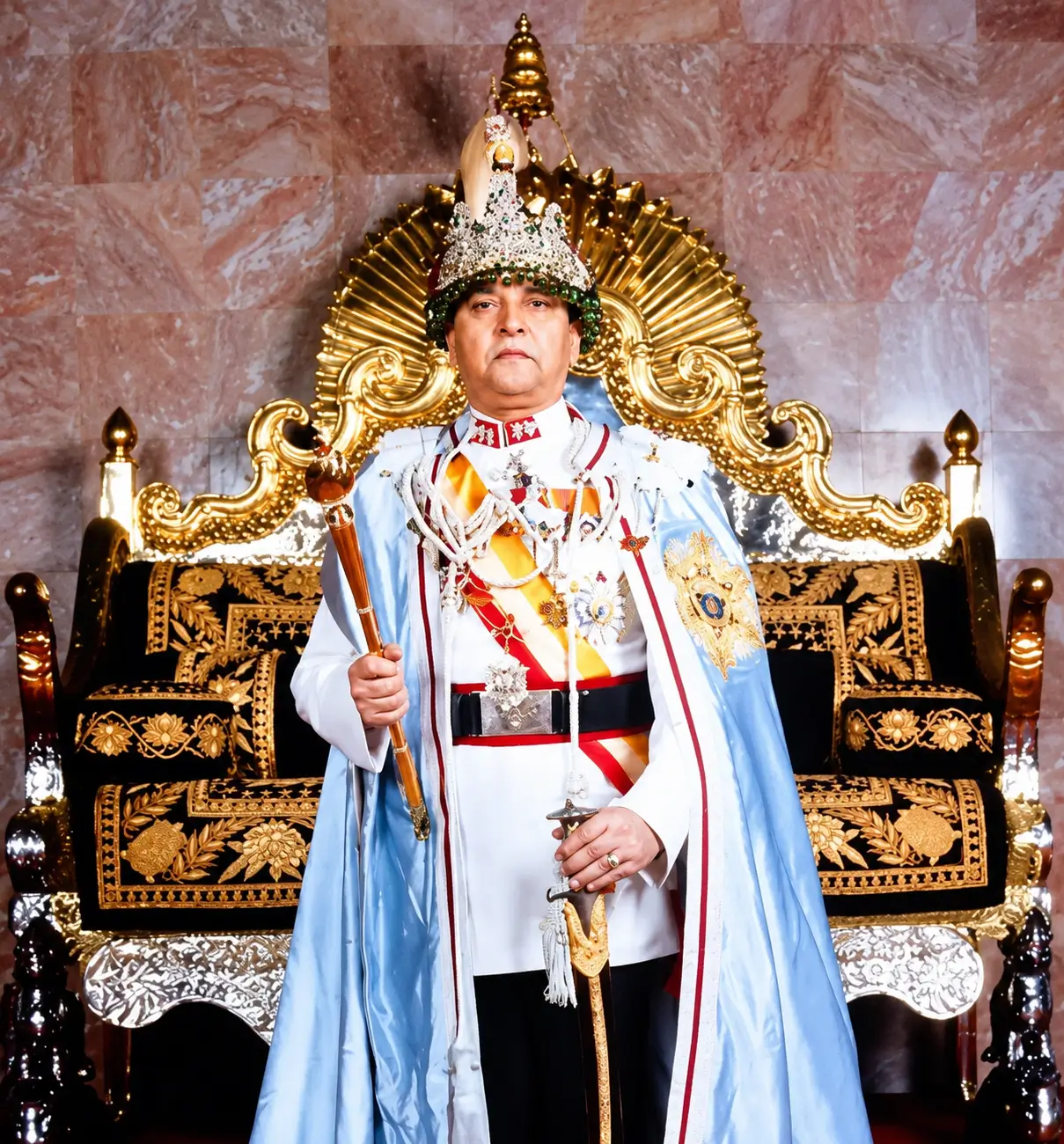
Gyanendra Bir Bikram Shah Dev was the last king of Nepal's Shah dynasty. He was declared king twice in Nepal's history. The first time was in 1950, when he was three years old. Approximately five decades later, he became king again in 2001 following the royal palace massacre at Narayanhiti Palace.
His reign from June 4, 2001, to May 28, 2008 (BS 2058 Jestha 22 to 2065 Jestha 15) was closely associated with Nepal's constitutional monarchy, multiparty political system, Maoist armed conflict and democratic movements. His royal interventions on October 4, 2002, and February 1, 2005, in particular, generated serious controversy over the constitutional role of the monarch and the exercise of executive authority.
Gyanendra Shah's direct rule ended following the Second People's Movement of 2006. The subsequent peace process and Constituent Assembly election moved Nepal toward a republican system. On May 28, 2008, the first meeting of the Constituent Assembly formally abolished the monarchy and declared Nepal a federal democratic republic.
Gyanendra Shah's public life was not limited to royal responsibilities. Before becoming king, he was involved in nature and wildlife conservation, Lumbini development, business and literary activities.
His biography provides an account of the changes in Nepal's political system and governance from the political transition of 1950–1951 to the abolition of the monarchy in 2008.
Gyanendra Shah: Quick Facts
|
Detail |
Information |
|---|---|
|
Full Name |
Gyanendra Bir Bikram Shah Dev |
|
Known For |
Last King of Nepal |
|
Date of Birth |
July 7, 1947 (BS 2004 Ashadh 23) |
|
Place of Birth |
Narayanhiti Royal Palace, Kathmandu, Nepal |
|
Father |
King Mahendra Bir Bikram Shah Dev |
|
Mother |
Indra Rajya Lakshmi Devi Shah |
|
Grandfather |
King Tribhuvan Bir Bikram Shah Dev |
|
Elder Brother |
King Birendra Bir Bikram Shah Dev |
|
Younger Brother |
Dhirendra Bir Bikram Shah |
|
Spouse |
Komal Rajya Lakshmi Devi Shah |
|
Children |
Paras Bir Bikram Shah and Prerana Rajya Lakshmi Devi Singh |
|
School Education |
St. Joseph's School and College, Darjeeling, India |
|
Higher Education |
Graduated from Tribhuvan University in 1969 |
|
First Proclamation as King |
November 7, 1950 (BS 2007 Kartik 22) |
|
Status of First Proclamation |
Declared by the Rana government; did not receive widespread international recognition |
|
Second Accession to the Throne |
June 4, 2001 (BS 2058 Jestha 22) |
|
Second Reign |
June 4, 2001, to May 28, 2008 |
|
Abolition of Monarchy |
May 28, 2008 (BS 2065 Jestha 15) |
|
Major Institutional Roles |
Chairman of the King Mahendra Trust for Nature Conservation (1982–2001) and Lumbini Development Trust (1986–1991) |
|
Literary Pen Name |
G. Shah |
Birth, Family Background and Childhood
Gyanendra Bir Bikram Shah Dev was born on July 7, 1947 (BS 2004 Ashadh 23), at Narayanhiti Royal Palace in Kathmandu. He was the second son of the then Crown Prince Mahendra Bir Bikram Shah and Crown Princess Indra Rajya Lakshmi Devi Shah.
His grandfather was King Tribhuvan Bir Bikram Shah Dev. His elder brother, Birendra, later became king of Nepal, while his younger brother, Dhirendra Shah, was also involved in public life as a member of the royal family. His sisters were Shanti, Sharada and Shobha.
Gyanendra was approximately three years old when his mother, Indra Rajya Lakshmi Devi, died. Crown Prince Mahendra subsequently married Indra's younger sister, Ratna Rajya Lakshmi Devi. Ratna played a parental role in raising Gyanendra and the other royal children.
Gyanendra's childhood coincided with a period of growing political resistance against Rana rule in Nepal. Although born into the royal family, he became involved in the political struggle for power at the age of three.
The Political Change of 1950–1951 and His First Accession
In 1950, during the movement against Rana rule, the Rana government declared three-year-old Gyanendra king of Nepal. However, the proclamation did not receive widespread international recognition.
In November 1950, King Tribhuvan, Crown Prince Mahendra and other members of the royal family sought refuge at the Indian Embassy in Kathmandu in opposition to Rana rule. They subsequently traveled to New Delhi, India.
Gyanendra did not accompany the other members of the royal family to India.
During King Tribhuvan's absence, Rana Prime Minister Mohan Shumsher Jung Bahadur Rana declared Gyanendra king of Nepal on November 7, 1950 (BS 2007 Kartik 22).
Gyanendra was three years old at the time. The Rana government attempted to conduct royal activities in his name. Coins bearing his name were also issued.
However, countries including India, Britain and the United States continued to recognize King Tribhuvan as Nepal's legitimate head of state.
Historical records of Indian Prime Minister Jawaharlal Nehru also refer to Gyanendra's proclamation as king on November 7, 1950, and the diplomatic recognition issues that followed.
Gyanendra's first accession is therefore understood as a political decision by the Rana government rather than a conventional constitutional succession.
Restoration of King Tribhuvan
As the anti-Rana movement expanded, a political understanding was reached among King Tribhuvan, the Rana government and the Nepali Congress.
Following a political agreement mediated by India, King Tribhuvan returned to Kathmandu on February 15, 1951 (BS 2007 Falgun 4).
The establishment of democracy was announced on February 18, 1951 (BS 2007 Falgun 7).
This political change restored King Tribhuvan's royal position and brought an end to the political justification for the Rana government's proclamation of Gyanendra as king.
Gyanendra's first proclamation as king was a short-lived episode. As a minor, he was not in a position to exercise governing authority personally.
King Tribhuvan's restoration connected Nepal's royal succession with the outcome of the political movement against Rana rule.
Education and Early Intellectual Development
Gyanendra Shah received his school education at St. Joseph's School in Darjeeling, India. He studied at the institution alongside his elder brother, Birendra.
In 1966, he completed the Senior Cambridge qualification at St. Joseph's College.
He subsequently returned to Kathmandu for higher education and graduated from Tribhuvan University in 1969.
As a member of the royal family, his education was not limited to traditional instruction within the palace. After studying at formal educational institutions, he began participating in royal, administrative and public activities.
Early Public Responsibilities
Gyanendra Shah held various royal, institutional and public responsibilities during the reign of his elder brother, King Birendra Bir Bikram Shah.
Following the death of King Mahendra in 1972, Birendra became king of Nepal. In the subsequent years, Gyanendra became involved in various royal committees.
Gyanendra chaired the advisory committee established for King Birendra's coronation ceremony, which took place in February 1975.
He also undertook responsibilities associated with the Raj Parishad (Royal Council). When King Birendra traveled abroad, Gyanendra performed various representative duties under the prevailing royal arrangements.
Apart from these responsibilities, his public activities included nature conservation, heritage development and business.
Involvement in Environmental and Wildlife Conservation
Nature and wildlife conservation formed an important part of Gyanendra Shah's public life before his accession to the throne in 2001. He was involved in leading the King Mahendra Trust for Nature Conservation for an extended period.
Leadership of the King Mahendra Trust for Nature Conservation
The King Mahendra Trust for Nature Conservation was established in 1982. It was later renamed the National Trust for Nature Conservation (NTNC).
Gyanendra Shah served as chairman of the trust from its establishment until he became king in 2001.
During this period, the trust implemented programs related to national parks, wildlife conservation, biodiversity, natural resource management and local community participation.
According to the institutional history of the National Trust for Nature Conservation, conservation management practices in Nepal developed to incorporate the needs and participation of local communities.
Annapurna Conservation Area Project
The Annapurna Conservation Area Project (ACAP), launched in 1986, was an important conservation initiative during this period.
The project sought to establish a relationship among nature conservation, local livelihoods and tourism management.
The approach of involving local communities in managing the Annapurna Conservation Area contributed to the development of new practices in conservation management in Nepal.
Although the project operated under an institution chaired by Gyanendra Shah, its development involved the collective contributions of government agencies, conservation specialists, technical personnel, local communities and partner organizations.
The achievements of the conservation area should therefore be understood as the result of institutional and community efforts rather than the contribution of any single individual.
Role in the Lumbini Development Trust
Gyanendra Shah served as chairman of the Lumbini Development Trust from 1986 to 1991.
During his leadership of the institution established to conserve, develop and manage Lumbini, the birthplace of Gautama Buddha, he was involved in activities related to Lumbini's development.
The master plan for Lumbini, prepared by Japanese architect Kenzo Tange, was completed in 1978.
The plan provided a basis for the organized development of areas including the Sacred Garden, the Monastic Zone and the New Lumbini Village.
Activities related to the implementation of the master plan continued during Gyanendra Shah's tenure as chairman.
However, the preparation and implementation of the master plan, along with the long-term conservation of the heritage site, involved government bodies, the Lumbini Development Trust, archaeologists and international organizations across different periods.
According to the United Nations Educational, Scientific and Cultural Organization (UNESCO), Lumbini was inscribed on the World Heritage List in 1997.
Business and Industrial Involvement
Before becoming king, Gyanendra Shah was also associated with private businesses and industrial enterprises.
News reports published in 2001 discussed investments connected with hotels, tea production, tourism, hydropower and other industrial sectors.
According to a report published in Nepali Times on June 15, 2001, the royal family had indirect investments in certain companies associated with the Soaltee Group.
The report mentioned business investments connected with Soaltee Hotel, Himalayan Goodrick and the then Surya Tobacco.
According to a company representative quoted in the report, the royal family's investments were managed through related companies. It would therefore be inaccurate to conclude that Gyanendra Shah personally held direct ownership of all those companies.
These accounts indicate his association with the private sector before becoming king. However, historical business involvement and present-day ownership are separate matters.
Literary and Musical Activities
Gyanendra Shah is known in Nepali literature and songwriting by the pen name G. Shah.
He has written Nepali songs and poems. His involvement in literature represents an aspect of his public identity distinct from his royal and institutional responsibilities.
His writings address subjects including national sentiment, nature and human relationships.
Gyanendra Shah's public life was therefore connected not only with royal affairs but also with conservation, heritage development, business and literary activities.
The Narayanhiti Royal Palace Massacre of 2001
The incident at Narayanhiti Royal Palace on June 1, 2001 (BS 2058 Jestha 19), brought a major change to Nepal's royal succession.
Ten people, including the then King Birendra, Queen Aishwarya and other members of the royal family, died following an incident during a family gathering at the palace.
Prince Gyanendra was outside Kathmandu at the time. His wife, Komal Shah, was injured in the incident.
Following King Birendra's death, Crown Prince Dipendra, who was unconscious and receiving medical treatment, was proclaimed king under the royal succession arrangements. Gyanendra was appointed regent.
After Dipendra died on June 4, 2001 (BS 2058 Jestha 22), Gyanendra Bir Bikram Shah became king of Nepal.
His accession ceremony took place at Nasal Chowk in the Hanuman Dhoka Palace complex in Kathmandu.
He thus returned to the throne approximately five decades after the Rana government had first proclaimed him king during his childhood.
Official Investigation into the Royal Palace Massacre
An investigation committee was established to examine the Narayanhiti Royal Palace massacre. It included the then Chief Justice Keshav Prasad Upadhyaya and Speaker of the House of Representatives Taranath Ranabhat.
The committee's report, released on June 14, 2001, identified the then Crown Prince Dipendra as responsible for the incident.
Even after the committee published its findings, public questions continued regarding the investigation process and the report's credibility.
Various theories and suspicions have been expressed publicly about the palace massacre. However, these claims cannot be presented as established facts equivalent to the findings of the official investigation.
In a public statement issued on June 11, 2008, after the abolition of the monarchy, Gyanendra Shah denied allegations that he or his family had been involved in the incident.
An account of this historical event must distinguish between the investigation committee's conclusions, public reactions and the formal statements of those concerned.
Second Reign and Nepal's Political Crisis
When Gyanendra Shah assumed the throne for the second time, Nepal was experiencing the Maoist armed conflict, political instability and challenges within its parliamentary system.
The armed conflict launched by the then Communist Party of Nepal (Maoist) in February 1996 (BS 2052 Falgun) had spread across different parts of the country.
At the same time, frequent changes of government, disagreements among political parties and election-related difficulties affected political stability under the multiparty system.
The Constitution of the Kingdom of Nepal, 1990, had established a constitutional monarchy and a multiparty parliamentary system.
However, during Gyanendra's reign, disputes over the monarch's constitutional role and the exercise of executive authority became increasingly serious.
Armed Conflict and the State of Emergency
In 2001, the government led by Prime Minister Sher Bahadur Deuba attempted peace negotiations with the Maoists.
After the talks failed, the conflict intensified. A nationwide state of emergency was declared in November that year, and the Royal Nepalese Army was deployed against the Maoists.
The emergency and security challenges further complicated Nepal's political situation.
Meanwhile, the dissolution of Parliament and the scheduling of elections became major political controversies.
In May 2002 (BS 2059 Jestha), the House of Representatives was dissolved on the recommendation of the then Prime Minister Deuba. The political crisis deepened when elections could not be held within the scheduled period.
Royal Intervention of October 4, 2002
On October 4, 2002 (BS 2059 Ashoj 18), King Gyanendra dismissed Prime Minister Sher Bahadur Deuba.
The king cited Deuba's failure to conduct the House of Representatives election within the prescribed period as the basis for his dismissal.
He stated that he had exercised the power to remove constitutional obstacles under Article 127 of the Constitution of the Kingdom of Nepal, 1990.
However, political parties and constitutional experts opposed the use of that provision to dismiss the prime minister and expand royal authority.
After October 4, King Gyanendra began appointing governments through his own decisions amid a lack of agreement among political parties.
During this period, Lokendra Bahadur Chand and Surya Bahadur Thapa were appointed prime ministers. Sher Bahadur Deuba was subsequently reappointed prime minister in May 2004 (BS 2061 Jestha).
The formation and replacement of these governments failed to establish political stability.
Royal Proclamation of February 1, 2005
On February 1, 2005 (BS 2061 Magh 19), King Gyanendra dissolved the Council of Ministers led by Prime Minister Sher Bahadur Deuba and began direct rule.
He argued that his leadership was necessary to maintain peace and security and resolve the country's political crisis.
Following the proclamation, he assumed the position of chairman of the Council of Ministers.
A state of emergency was declared as direct rule began. Strict restrictions were imposed on political activities, civil liberties and the media.
Leaders of major political parties, human rights activists and civil society members were arrested or placed under detention. Communication services were temporarily disrupted, and restrictions on the media increased.
International human rights organizations expressed serious concerns about these measures.
The king's direct rule intensified the conflict between Nepal's constitutional monarchy and multiparty democracy.
Royal Commission for Corruption Control and the Supreme Court's Ruling
The Royal Commission for Corruption Control (RCCC), established during King Gyanendra's direct rule, became the subject of a constitutional controversy.
The commission was granted extensive powers to investigate corruption and take action in corruption-related cases.
It took action against political figures, including former Prime Minister Sher Bahadur Deuba.
However, petitions challenging the commission's establishment and jurisdiction were filed in the Supreme Court.
On February 13, 2006 (BS 2062 Falgun 1), the Supreme Court ruled that the royal orders concerning the commission's establishment and continuation were unconstitutional.
Following the court's decision, the commission ceased to exist.
The ruling clarified constitutional questions concerning the establishment of a parallel institution exercising investigative and judicial authority beyond the limits prescribed by the Constitution.
The Supreme Court of Nepal's judgment in Rajeev Parajuli v. Royal Commission on Corruption Control and Others provides a detailed examination of the constitutional validity of the commission's establishment, continuation and powers.
Second People's Movement and the End of Direct Royal Rule
The Second People's Movement of 2006 (BS 2062/63) created the political conditions that brought Gyanendra Shah's direct rule to an end.
Major parliamentary parties, civil society organizations, human rights activists and various professional groups participated in the movement against royal rule.
The 12-Point Understanding Between the Seven Parties and the Maoists
On November 22, 2005 (BS 2062 Mangsir 7), seven political parties and the then Communist Party of Nepal (Maoist) reached a 12-point understanding.
The understanding established a basis for opposing direct royal rule, pursuing a democratic political process and seeking a political settlement through a Constituent Assembly.
Cooperation between the parliamentary parties and the Maoists, who had previously followed different political paths, became an important political foundation for the Second People's Movement.
People's Movement of 2006
Nationwide protests and general strikes intensified in the final week of Chaitra 2062 BS (early April 2006).
Large numbers of ordinary citizens participated in the movement organized by the alliance of seven political parties with the involvement of civil society.
Curfews, prohibitory orders and security operations were imposed during the movement. Civilians were also killed and injured during demonstrations.
A report prepared by the Office of the United Nations High Commissioner for Human Rights (OHCHR) on the April 2006 protests documented the excessive use of force by security agencies and restrictions on civil rights.
Following sustained protests, King Gyanendra called on political parties to recommend a candidate for prime minister on April 21, 2006 (BS 2063 Baisakh 8).
However, the protesting parties continued to demand the restoration of the House of Representatives.
Finally, on April 24, 2006 (BS 2063 Baisakh 11), King Gyanendra announced the reinstatement of the dissolved House of Representatives.
This announcement ended direct royal rule and allowed the parliamentary political process to resume.
Restoration of the House of Representatives and Reduction of Royal Powers
Following the announcement of April 24, 2006, the reinstated House of Representatives introduced important changes to Nepal's system of government.
A government was formed under the leadership of Girija Prasad Koirala.
On May 18, 2006 (BS 2063 Jestha 4), the House of Representatives issued a historic proclamation.
The proclamation curtailed various constitutional and royal powers of the king.
The official designation Government of Nepal replaced His Majesty's Government. The Royal Nepalese Army was renamed the Nepal Army.
Measures were introduced to end royal control over the military and expand the authority of the elected government.
Nepal was declared a secular state.
The proclamation advanced the process of limiting the monarch's traditional powers and transferring state authority to elected representatives and the government.
Comprehensive Peace Agreement and Interim Constitution
Following the Second People's Movement, Nepal's political transition moved toward the peace process and constitution-making.
On November 21, 2006 (BS 2063 Mangsir 5), the Government of Nepal and the Communist Party of Nepal (Maoist) signed the Comprehensive Peace Agreement.
The agreement established a path toward ending the armed conflict, seeking a political settlement and drafting a new constitution through a Constituent Assembly election.
It included provisions removing the king's governing authority and a political understanding that the future of the monarchy would be determined by the Constituent Assembly.
Subsequently, the Interim Constitution of Nepal was promulgated on January 15, 2007 (BS 2063 Magh 1).
The Interim Constitution established the constitutional principle that sovereignty and state authority were vested in the Nepali people.
It provided the constitutional basis for the Interim Legislature-Parliament, the interim government and the Constituent Assembly election.
The provisions of the Interim Constitution separated the king from the exercise of governing authority. Consequently, Nepal's monarchy had already been deprived of direct governing powers before the formal decision to abolish it.
Formal Abolition of the Monarchy by the Constituent Assembly
On May 28, 2008 (BS 2065 Jestha 15), the first meeting of Nepal's Constituent Assembly abolished the monarchy and declared Nepal a federal democratic republic.
The Constituent Assembly election had previously been held on April 10, 2008 (BS 2064 Chaitra 28).
The first meeting of the Constituent Assembly, formed after the election, took place at the International Convention Centre in Kathmandu.
A proposal to declare Nepal a republic was presented at the meeting.
The proposal received 560 votes in favor and four votes against.
This decision ended approximately 240 years of Shah dynastic monarchy in Nepal.
Gyanendra Bir Bikram Shah became the country's last king.
Nepal's political system changed from a monarchy to a federal democratic republic. The transition separated the position of head of state from hereditary royal succession.
Departure from Narayanhiti Royal Palace
Following the decision to abolish the monarchy, Gyanendra Shah left Narayanhiti Royal Palace.
Approximately two weeks after the Constituent Assembly declared Nepal a republic, he held a press conference at Narayanhiti Palace on June 11, 2008 (BS 2065 Jestha 29).
During the press conference, he stated that he accepted the Constituent Assembly's decision and had no plans to leave Nepal and live abroad.
He also denied allegations concerning his involvement in the royal palace massacre.
He subsequently handed over the royal crown and sceptre to the Government of Nepal.
On the same day, he left Narayanhiti Royal Palace and moved to a residence in Nagarjun.
This event marked the beginning of a new phase in the former king's public and personal life following the abolition of the monarchy.
Narayanhiti Palace was later converted into a museum.
Political Controversies and Questions of Historical Assessment
Gyanendra Shah's reign was at the center of controversies concerning constitutional authority, democracy, human rights and the future of the monarchy in Nepal.
An assessment of his reign requires distinguishing among the political crisis of the period, the powers exercised by the king and the constitutional consequences of his decisions.
Exercise of Constitutional Authority
The royal interventions of October 4, 2002, and February 1, 2005, remain major subjects of controversy concerning the exercise of the monarch's constitutional powers.
King Gyanendra argued that these measures were necessary to address the country's political instability and security challenges.
However, parliamentary political parties opposed the interventions, arguing that they exceeded the limits of constitutional monarchy.
The central issue concerned who could exercise executive authority under the multiparty system established by the 1990 Constitution and within what constitutional limits.
The political movement and agreements that developed after the king's direct rule brought changes to Nepal's constitutional system.
Human Rights and Political Freedoms
Restrictions imposed on political rights and civil liberties during the state of emergency following February 1, 2005, drew criticism from international human rights organizations.
Various reports documented the arrests of political leaders and activists, restrictions on the media and the use of force during demonstrations.
United Nations human rights records identified serious concerns regarding civil liberties and the safety of protesters, particularly during 2005–2006.
These records are important documents for understanding the political and human rights developments during Gyanendra Shah's period of direct rule.
Personal Life and Family
Gyanendra Shah married Komal Rajya Lakshmi Devi Shah in 1970.
Komal Shah came from a family associated with the Rana dynasty.
Gyanendra and Komal have two children: a son, Paras Bir Bikram Shah, and a daughter, Prerana Rajya Lakshmi Devi Singh.
During King Gyanendra's reign, Paras Shah held the position of crown prince.
Following the abolition of the monarchy in 2008, the Shah family lost its constitutional royal status.
Gyanendra Shah and members of his family have subsequently appeared in public life as members of Nepal's former royal family.
Public Life After the Establishment of the Republic
Gyanendra Shah has remained in Nepal since the abolition of the monarchy.
He has participated in religious, cultural and social events on various occasions.
As the former king, he has also publicly expressed his views on national circumstances, political developments and social issues.
His statements and public appearances have periodically renewed discussions about the institution of monarchy in Nepal.
Nepal's political debate includes differing perspectives between groups supporting the restoration of the monarchy and political parties and citizens supporting the existing republican system.
Groups favoring restoration generally hold positive views of the historical role of the monarchy. Supporters of the republic emphasize popular sovereignty, democratic accountability and governance through elected state institutions.
Amid these differing political perspectives, Gyanendra Shah has remained a subject of public discussion as Nepal's former king.
Historical Significance of Gyanendra Shah
Gyanendra Shah's role in Nepal's modern political history can be understood through three major aspects.
Monarchy and Political Succession
His first accession was associated with the political movement against Rana rule in 1950–1951.
The Rana government's proclamation of the three-year-old Gyanendra as king formed part of the political struggle for power at the time.
His second accession, by contrast, resulted from the royal succession arrangements that followed the 2001 palace massacre.
His royal life was therefore connected with two different periods in Nepal's political history.
Institutional Leadership and Conservation
Before becoming king, Gyanendra Shah was involved in nature conservation, Lumbini development and various public institutional activities.
His leadership of the King Mahendra Trust for Nature Conservation and the Lumbini Development Trust represents documented responsibilities from his public life.
Assessing the contributions of these institutions also requires consideration of institutional policies and the roles played by employees, experts, communities and the governments concerned.
Democratic Transition and the End of Monarchy
Gyanendra Shah's second reign marked the final phase of the Nepali monarchy.
He became king under the constitutional system established in 1990 but later made decisions that expanded the exercise of executive authority by the monarch.
Those decisions led to serious disputes with democratic political parties.
The political changes resulting from the Second People's Movement, the peace process and the Constituent Assembly election ultimately ended the monarchy.
An assessment of this political transition must consider not only the king's decisions but also the Maoist armed conflict, the role of parliamentary parties, civic movements, the peace process and the Constituent Assembly's decision.
Gyanendra Shah's acceptance of the Constituent Assembly's decision in 2008 and his departure from Narayanhiti Palace marked the final major event of his royal life.
Conclusion
The biography of Gyanendra Bir Bikram Shah is closely connected with Nepal's monarchy and modern political transition.
The Rana government's first proclamation of him as king in 1950, his second accession in 2001, the royal interventions of 2002 and 2005, and the abolition of the monarchy in 2008 were major historical events in his public life.
Before becoming king, he was associated with institutions involved in nature conservation and heritage development. During his second reign, however, the exercise of executive authority, restrictions on civil liberties and the constitutional system became subjects of widespread controversy.
The peace process that followed the Second People's Movement and the Constituent Assembly's decision changed Nepal's system of government.
Gyanendra Shah's biography therefore represents not only an account of an individual monarch's life but also an important chapter in Nepal's political transition from hereditary monarchy to a federal democratic republic.
References and Sources
1. Jawaharlal Nehru Archive. To Rajendra Prasad (7 November 1950). Selected Works of Jawaharlal Nehru, Second Series, Volume 15.
2. Jawaharlal Nehru Archive. Relations with Nepal (28 February 1952). Selected Works of Jawaharlal Nehru, Second Series, Volume 17.
3. RAOnline. The Former Royal Family: King Gyanendra – A Profile. Historical biographical archive.
4. National Trust for Nature Conservation. About Us: Institutional History. Nepal.
5. UNESCO World Heritage Centre. Lumbini, the Birthplace of the Lord Buddha. World Heritage records.
6. Binod Bhattarai. All the King's Businesses. Nepali Times, June 15, 2001.
7. Nepali Times. Very Sharp, and a Good Listener. June 2001.
8. The Guardian. Nepal Inquiry Blames Crown Prince for Royal Massacre. June 14, 2001.
9. U.S. Department of State. Nepal: Background Note, August 2005. Historical political records.
10. Supreme Court of Nepal. Rajeev Parajuli v. Royal Commission on Corruption Control and Others. NJA Law Journal, 2007.
11. United Nations Peacemaker. 12-Point Understanding between the Seven Political Parties and Nepal Communist Party (Maoists). November 22, 2005.
12. South Asia Terrorism Portal. King Gyanendra's Proclamation, 24 April 2006. Original royal proclamation.
13. Office of the United Nations High Commissioner for Human Rights (OHCHR). The April Protests: Democratic Rights and the Excessive Use of Force. September 2006.
14. United Nations Nepal Digital Library. Proclamation of the House of Representatives, 2006. May 18, 2006.
15. United Nations Security Council. Security Council Welcomes 21 November Peace Agreement in Nepal. December 1, 2006.
16. WIPO Lex. The Interim Constitution of Nepal, 2007 (2063). Constitutional document.
17. United Nations Nepal Digital Library. Report of the Secretary-General on United Nations Assistance in Support of Nepal's Peace Process. July 10, 2008.
18. Alliance for Social Dialogue. Review of the Constituent Assembly Meetings. Records relating to the Constituent Assembly process.
19. Associated Press, CBS News. Nepal's Controversial King Leaves Palace. June 11, 2008.






Comments 0
No comments yet. Be the first to start the conversation.