



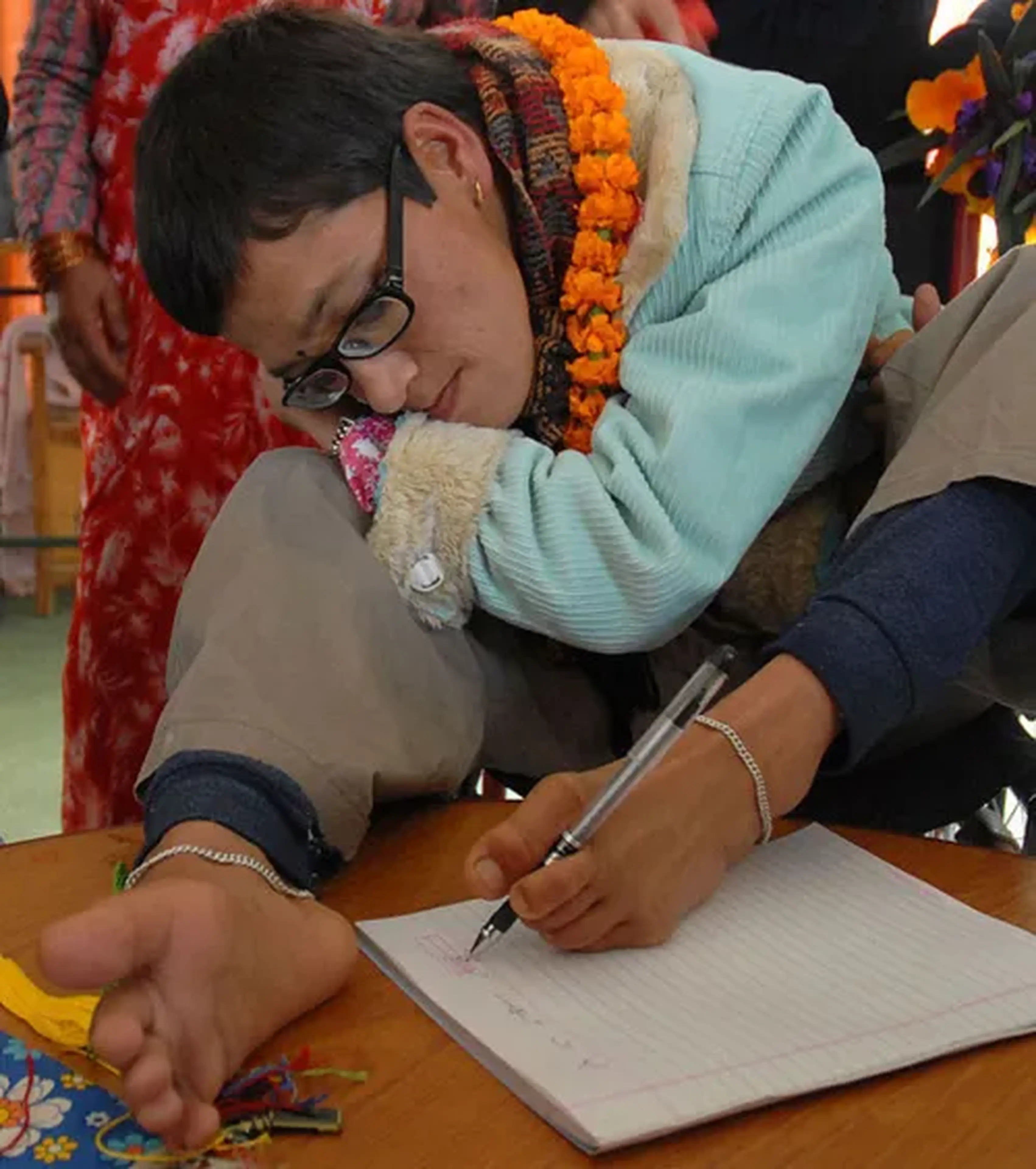
Jhamak Kumari Ghimire is a Nepali poet, short-story writer, essayist, autobiographer, and columnist. She is widely known in literary circles as Jhamak Ghimire. Having received no formal school education, she acquired knowledge of language and literature through self-study. Born with cerebral palsy, which affects her physical movements and speech, she has contributed to Nepali literature by writing with the toes of her left foot.
Her autobiographical work, Jeevan Kada Ki Phool, received the Madan Puraskar for 2067 BS. She became the second woman writer to receive the award, after Parijat.
Ghimire's writings explore personal experiences alongside rural life, social attitudes toward disability, gender discrimination, human relationships, social inequality, and self-respect. Through poetry, short stories, essays, and autobiography, she connects her experiences with broader social and literary discussions.
Jhamak Kumari Ghimire: Quick Facts
|
Details |
Information |
|---|---|
|
Full Name |
Jhamak Kumari Ghimire |
|
Literary Name |
Jhamak Ghimire |
|
Date of Birth (BS) |
21 Asar 2037 BS, Friday |
|
Date of Birth (AD) |
July 4, 1980 |
|
Birthplace |
Kachide, Dhankuta Municipality–3, Dhankuta, Nepal |
|
Nationality |
Nepali |
|
Father's Name |
Krishna Bahadur Ghimire |
|
Mother's Name |
Asha Devi Ghimire |
|
Literary Genres |
Poetry, short stories, essays, autobiography, and columns |
|
Education |
No formal schooling; self-educated |
|
First Published Book |
Sankalpa (poetry collection, 2055 BS) |
|
Major Work |
Jeevan Kada Ki Phool |
|
Madan Puraskar |
2067 BS, for Jeevan Kada Ki Phool |
|
Other Academic Recognition |
Honorary doctorate, Mid-Western University, 2016 |
Birth, Family Background and Childhood
Jhamak Kumari Ghimire was born on Friday, 21 Asar 2037 BS (July 4, 1980), in Kachide, Dhankuta district, Nepal. She is the daughter of Krishna Bahadur Ghimire and Asha Devi Ghimire. The official records of the Madan Puraskar Guthi identify her birthplace as Kachide, Ward No. 3 of Dhankuta Municipality.
Born into a rural family, Ghimire spent her childhood facing physical difficulties, limited educational opportunities, and social neglect. Her autobiography, Jeevan Kada Ki Phool, describes her childhood family relationships, rural lifestyle, and experiences associated with disability.
Physical Condition and Childhood Challenges
Jhamak Ghimire has had cerebral palsy since birth. Cerebral palsy is a condition associated with early brain development that can affect physical movement, muscle control, and coordination.
Because of this condition, Ghimire experienced difficulties using her hands, moving around, and communicating through speech. She nevertheless developed the ability to express her thoughts, feelings, and experiences through writing.
Her autobiography discusses misconceptions and prejudices surrounding disability during her childhood. It also describes experiences in which some people incorrectly associated her physical condition with her intellectual abilities.
Ghimire's life raises an important point: a person's intellectual abilities should not be judged on the basis of their physical condition.
Family and Social Environment
Family members played an important role in Ghimire's childhood. Her autobiography describes how household responsibilities and the demands of earning a livelihood affected her daily care and learning opportunities.
Her grandmother's affection and care held a particularly important place in her early life. The autobiography also describes the sense of loss and loneliness she experienced after her grandmother's death.
Conversations within the family and her younger sister's studies became sources of knowledge for Ghimire. In particular, observing her sister's education provided a foundation for learning to recognize letters and develop writing skills.
Her early experiences therefore also provide an account of the barriers that children with disabilities faced in accessing education and participating in rural society at that time.
Learning to Read, Self-Education and Intellectual Development
Jhamak Ghimire did not have the opportunity to enroll in school and receive formal education. Instead, she learned to recognize letters and developed her writing skills through materials she heard, observed, and read at home.
A defining feature of her educational journey was not simply the absence of formal schooling but her continued effort to acquire knowledge using the limited resources available to her.
Early Attempts to Recognize Letters
Ghimire began recognizing letters by listening to lessons taught to her younger sister and observing her sister's writing. Through her own efforts, she learned about letter shapes, sounds, and word formation.
Because holding a pen with her hands was difficult, she practiced writing with the toes of her left foot. She initially traced letters in the dust of the courtyard and on other available surfaces, gradually learning to use paper and a pen.
Her experience of learning to recognize letters and write is one of the central episodes in her autobiography. She presents the difficulties she encountered, her interest in learning, and her experience of expressing her thoughts in written form for the first time through a personal narrative.
From Self-Study to Literature
After learning to recognize letters, Ghimire gradually expanded her reading. She began studying textbooks, newspapers, magazines, and literary works available at home.
Self-study gave her opportunities to develop ideas about language, literature, and social issues. Her reading, surroundings, and personal experiences formed the basis of her early creative writing.
As her access to literary books and periodicals increased, her writing began to address a wider range of social and intellectual subjects.
Ghimire's educational experience illustrates both the effects of exclusion from formal education and the effort involved in acquiring knowledge through available resources.
Beginning of Her Literary Career
Jhamak Ghimire began writing literature during her teenage years. Her first published book, the poetry collection Sankalpa, appeared in Baisakh 2055 BS. According to the Madan Puraskar Pustakalaya records, it was published by the Postal Employees Welfare Committee in Biratnagar.
Her early writings explored personal feelings, perspectives on life, social relationships, and human emotions. Over time, she expanded beyond poetry to write essays, short stories, memoirs, and articles on contemporary issues.
In 2057 BS, several of her works were published, including Aafnai Chita Agnishikhatira, Manchhebhitraka Yoddhaharu, Awasan Pachhiko Aagaman, and Samjhanaka Bachhitaharu. She continued writing across different literary genres in subsequent years.
Poetry
Ghimire first became known as a literary writer through her poetry. Her poems address personal experiences alongside social inequality, freedom, self-respect, and human relationships.
Her notable poetry collections include Sankalpa, Aafnai Chita Agnishikhatira, Manchhebhitraka Yoddhaharu, Naulo Pratibimba, and Jhamak Ghimireka Kavitaharu.
Her poetry combines emotional expression with a critical perspective on society. One characteristic of her writing is the connection she establishes between personal experiences and wider human concerns.
Essays and Column Writing
Alongside poetry, Ghimire has contributed to essay writing and social commentary.
Her essays address personal experiences, social behavior, gender inequality, human rights, and social awareness.
Samjhanaka Bachhitaharu and Bemausamka Aasthaharu are among her major collections of articles and essays.
In addition to publishing literary books, she has written articles and columns for newspapers and periodicals, including Kantipur. Through these publications, she has expressed her views on contemporary social issues as well as literary subjects.
Short Stories and Other Literary Genres
Jhamak Ghimire has also written short stories and works in various other literary genres.
Parda, Samaya Ra Manchheharu is her short-story collection. It explores social relationships, rural life, human emotions, and inequality.
Awasan Pachhiko Aagaman is a collection containing writings from different literary genres. It demonstrates that her literary work is not confined to poetry or any single form of writing.
Her other writings include diaries, memoirs, and articles on contemporary subjects.
Jeevan Kada Ki Phool: Jhamak Ghimire's Autobiography
Jeevan Kada Ki Phool is an autobiographical work by Jhamak Ghimire. According to the Madan Puraskar Pustakalaya records, its first edition was published in Baisakh 2067 BS.
In this work, Ghimire explores various aspects of her childhood, family, attempts to acquire education, social experiences, emotional life, and literary journey.
Although based on personal experiences, the book also addresses disability, gender discrimination, social prejudice, and human rights.
Structure and Major Themes
Jeevan Kada Ki Phool contains 47 autobiographical essays or episodes.
The opening sections depict the family and social conditions of Ghimire's childhood. Subsequent sections describe her efforts to recognize letters, her interest in reading, the development of her writing skills, and her experiences with society.
Drawing on her personal experiences, she questions social behavior, human relationships, and prevailing attitudes toward life.
The book's title also suggests a relationship between life's difficulties and the creative and human experiences that emerge amid them.
Disability and Social Attitudes
One of the autobiography's central themes is society's treatment of people with disabilities.
Ghimire describes the prejudice and neglect she experienced because of her physical condition.
The book questions the tendency to view people with disabilities only through pity or dependence. An important aspect of the work is its emphasis on recognizing individuals' thoughts, abilities, self-respect, and participation in society.
It encourages readers to understand disability not as a person's entire identity but also in relation to social opportunities and accessibility.
Women's Experiences and Gender Discrimination
Jeevan Kada Ki Phool also addresses experiences associated with women's lives.
Ghimire describes the treatment she encountered as a woman, changes during adolescence, personal freedom, and social restrictions.
These accounts reveal connections between women's private experiences and broader social structures.
Because the autobiography is written from the perspective of a woman with a disability, it also provides relevant material for gender studies and disability studies.
Social Beliefs and Critical Awareness
Ghimire's autobiographical accounts include criticism of religious superstition, fatalism, and social prejudice.
Through her experiences, she questions explanations that associate a person's physical condition with sin, curses, or fate.
The book critically examines social beliefs, family behavior, and unequal attitudes prevalent in society.
For these reasons, Jeevan Kada Ki Phool can be read both as a personal life narrative and as an autobiographical work concerned with social awareness.
Language and Writing Style
The writing style of Jeevan Kada Ki Phool is personal, descriptive, and reflective.
Ghimire does not simply narrate events from her life. She also examines the feelings, thoughts, and social questions arising from those experiences.
The combination of rural experiences, personal memories, and social criticism gives the book its autobiographical literary character.
The connection between personal experience and social issues is evident throughout the work. This allows readers to understand not only the author's life but also the society and circumstances in which she grew up.
English Translation of Jeevan Kada Ki Phool
Jhamak Ghimire's autobiography, Jeevan Kada Ki Phool, has been published in English under the title A Flower in the Midst of Thorns.
The book was translated by Nagendra Sharma and Safal Sharma. According to bibliographic records, the English edition was published by Oriental Publication in 2012, with Govinda Raj Bhattarai serving in an editorial capacity.
The English translation has made Ghimire's autobiography accessible to readers who do not read Nepali.
The book and its translation have also been subjects of university-level research. Records maintained by Tribhuvan University include academic studies examining the English translation of the autobiography, the representation of disability, and the translation of culturally specific terms.
Major Literary Works of Jhamak Ghimire
Jhamak Ghimire has published books in poetry, short fiction, essays, autobiography, and collections combining different literary forms.
Her major published works include the following:
|
Book Title |
Genre |
Publication Year (BS) |
|---|---|---|
|
Sankalpa |
Poetry collection |
2055 |
|
Aafnai Chita Agnishikhatira |
Poetry collection |
2057 |
|
Manchhebhitraka Yoddhaharu |
Poetry collection |
2057 |
|
Awasan Pachhiko Aagaman |
Collection of writings in different genres |
2057 |
|
Samjhanaka Bachhitaharu |
Collection of articles |
2057 |
|
Naulo Pratibimba |
Poetry collection |
2060 |
|
Parda, Samaya Ra Manchheharu |
Short-story collection |
2062 |
|
Bemausamka Aasthaharu |
Essay collection |
2063 |
|
Jhamak Ghimireka Kavitaharu |
Poetry collection |
2065 |
|
Jeevan Kada Ki Phool |
Autobiography |
2067 |
These publications illustrate the development of Ghimire's literary career across poetry, short stories, essays, and autobiographical writing.
Her later writings also include diaries and memoirs. This list covers her major works rather than every book she has published.
Madan Puraskar and Literary Recognition
Jhamak Ghimire has received literary and academic honors in recognition of her contribution to Nepali literature. Among the most notable are the Madan Puraskar and an honorary doctorate awarded by Mid-Western University.
Madan Puraskar 2067
Jhamak Ghimire received the Madan Puraskar for 2067 BS for her autobiographical work Jeevan Kada Ki Phool.
According to the official records of the Madan Puraskar Guthi, she was presented with the Madan Puraskar 2067 at a ceremony held on 12 Ashoj 2068 BS.
With this award, she became the second woman writer to receive the Madan Puraskar.
Before her, Parijat had received the Madan Puraskar for 2022 BS for her novel Shirishko Phool.
Because the award year and presentation year differ, references to Ghimire's award sometimes mention both 2067 BS and 2011 AD. The official award designation is Madan Puraskar 2067.
Honorary Doctorate
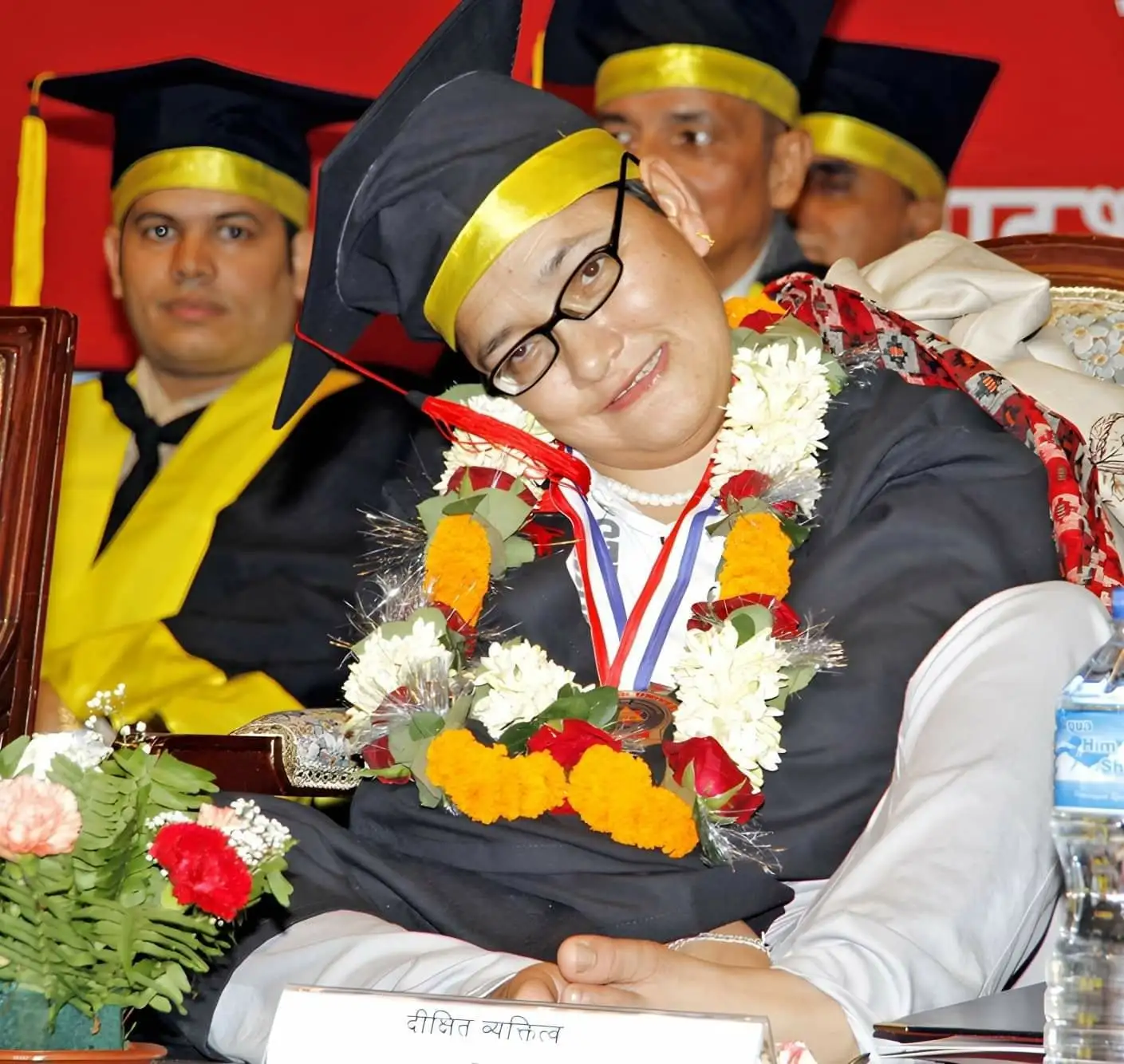
In 2016 (2073 BS), Mid-Western University awarded Jhamak Ghimire an honorary doctorate.
The university conferred the degree in recognition of her contribution to Nepali literature.
Although Ghimire did not receive formal school education, she developed her intellectual abilities through literary writing and self-study. The honorary doctorate provided institutional recognition of that contribution.
Other Literary Awards
Apart from the Madan Puraskar, Jeevan Kada Ki Phool has received other literary awards.
According to the book information published by BookHill, the autobiography received the Padmashree Sahitya Puraskar for 2067 BS and the Uttam Shanti Puraskar for 2068 BS.
In addition, literary and social organizations have honored Jhamak Ghimire on various occasions.
Film Based on Jhamak Ghimire's Life
A Nepali film titled Jeevan Kada Ki Phool was produced based on Jhamak Ghimire's autobiography of the same name.
Produced and directed by Binod Bista, the film was released on 22 Kartik 2076 BS (November 8, 2019).
The film portrays episodes from Ghimire's childhood through her literary journey.
It presents her autobiographical narrative through a different medium. However, because cinema and literature are distinct forms of expression, the original book remains the primary material for studying Ghimire's autobiographical writing.
Literary Contributions and Social Significance
Jhamak Ghimire's literary contribution extends beyond her autobiography. Through poetry, short stories, essays, and columns, she has presented diverse aspects of personal and social experience in Nepali literature.
Her major contributions can be examined in relation to literary expression, awareness of disability, women's experiences, and access to education.
Contribution to Nepali Autobiographical Literature
Ghimire's autobiography gives literary expression to the experiences of a woman who grew up in a rural setting while facing physical disability and social prejudice.
Jeevan Kada Ki Phool combines personal memories with a critical portrayal of social behavior and beliefs.
The book explores the relationship between personal life and social issues in autobiographical writing. Ghimire does not restrict her narrative to private events but also addresses the wider social questions arising from those experiences.
Social Awareness of Disability
Ghimire's life and writings provide a basis for discussing the abilities, self-respect, and social participation of people with disabilities.
Her works describe not only personal difficulties associated with disability but also barriers created by society.
They emphasize the importance of providing people with disabilities access to education, communication, social participation, and opportunities for creative expression.
Ghimire's literary achievements should therefore be understood not only as the result of personal determination but also in the broader social context of disability rights, accessibility, and dignity.
Literary Representation of Women's Experiences
Women's experiences are clearly represented in Ghimire's autobiographical and reflective writings.
She addresses social attitudes toward women, gender-related behavior, personal freedom, and self-respect.
Her works also help readers understand how the experiences of women and people with disabilities can intersect.
Education and Self-Study
Ghimire's educational journey raises important questions about learning opportunities and accessibility.
Although she did not have the opportunity to receive formal school education, she developed her literary abilities through self-study and independent learning. However, her personal achievement should not be interpreted as evidence that self-study can replace formal education.
Instead, her experience helps explain the need for inclusive education, accessible learning materials, and supportive conditions for children with disabilities.
Academic Studies of Jhamak Ghimire's Works
Jhamak Ghimire's literary works have also become subjects of university-level academic research.
The digital library of Tribhuvan University contains research examining social assumptions about disability, ability, and beauty in A Flower in the Midst of Thorns.
Another study examines the translation of culturally specific terms in the English version of Jeevan Kada Ki Phool and the challenges associated with that process.
These studies indicate that her autobiography can be examined not only through literary criticism but also through gender studies, disability studies, and translation studies.
Conclusion
Jhamak Kumari Ghimire is a Nepali literary figure who has contributed to poetry, short stories, essays, and autobiographical writing.
Without receiving formal school education, she developed her literary knowledge and writing abilities through self-study. Her publishing career began with Sankalpa and expanded to include various works, most notably Jeevan Kada Ki Phool.
Her autobiography, which received the Madan Puraskar for 2067 BS, is her major literary achievement. In the book, she connects personal experiences with questions of social prejudice, gender discrimination, disability, education, and human dignity.
The significance of her literary contribution lies not only in her account of overcoming personal difficulties but also in her expression of diverse social experiences and questions through Nepali literature.
References
1. Madan Puraskar Guthi. Jhamak Ghimire: Official Biography and Madan Puraskar Records. Official records of her date of birth, family details, birthplace, award year, and award presentation date.
2. Madan Puraskar Guthi. Parijat: Madan Puraskar Recipient. Information about Parijat's Madan Puraskar for 2022 BS and her novel Shirishko Phool.
3. Madan Puraskar Pustakalaya. Sankalpa: Bibliographic Record. Details of Ghimire's first poetry collection, its publisher, and its publication in Baisakh 2055 BS.
4. Madan Puraskar Pustakalaya. Jeevan Kada Ki Phool: Bibliographic Record. Details of the first edition, publication year, literary genre, and publication information.
5. Nepal Samaya. Maun Aawaj Ra Abhivyaktibhitraki Mridubhashi Jhamak. Yagyaraj Joshi, 2023. Coverage of Ghimire's literary journey, writings, published works, and a conversation with the author.
6. Samakalin Sahitya. Jeevan Kada Ki Phool Sar-sarti Padhda. Sadananda Abhagi. A review of Ghimire's literary works and autobiography.
7. Samakalin Sahitya. Jeevan Kada Ki Phoolma Dekhine Jeevanpratiko Prabal Aastha. Dr. Bishnu Prasad Poudel, 2012. An examination of the autobiography's structure, themes, and literary characteristics.
8. The Kathmandu Post. Jhamak Ghimire Honored. June 16, 2016. Report on the honorary doctorate awarded by Mid-Western University.
9. CiNii Books. Jhamak Kumari Ghimire: Bibliographic Records. Bibliographic information about the English edition of A Flower in the Midst of Thorns, its translators, and publication details.
10. Tribhuvan University Digital Library. Deconstructing the Ideology of Ability and Beauty in A Flower in the Midst of Thorns. Chhitup Dorji Lama, 2017. Academic research on disability and social beliefs represented in the autobiography.
11. Tribhuvan University Digital Library. Translation Techniques Used and Gaps Found in Translating Cultural Terms of Jeevan Kada Ki Phool. Ritu Limbu, 2021. Research examining the English translation of the autobiography.
12. Onlinekhabar. Release Date Announced for Jeevan Kada Ki Phool. 3 Kartik 2076 BS. Information about the film's release date and production.
13. BookHill. Jeevan Kada Ki Phool. Publisher's information about the book and its literary awards.
14. EnglishToNepali. BS 2037 Asar 21 to AD Date Conversion. Calendar conversion reference for the author's date of birth.






Comments 0
No comments yet. Be the first to start the conversation.