



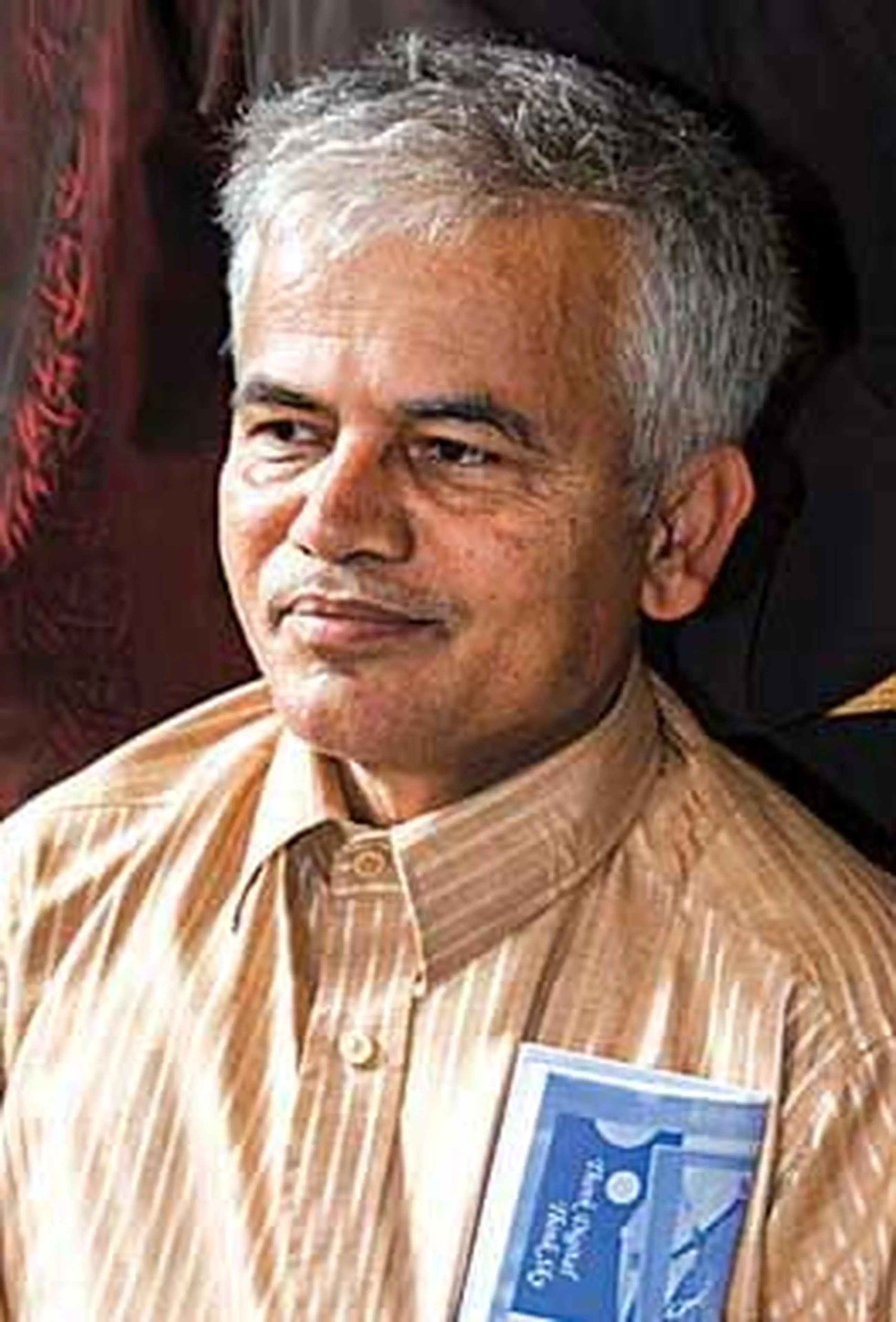
Krishna Dharabasi is a Nepali novelist, short-story writer, essayist, poet, and literary critic. His real name is Krishna Prasad Bhattarai. Born on 2 Shrawan 2017 BS (17 July 1960) in Amarpur, Panchthar district, he is associated with the study, interpretation, and creative application of Leelalekhan, a literary approach in Nepali literature.
He received the Madan Puraskar for his novel Radha for the year 2062 BS. According to the Madan Puraskar Guthi, the award was presented to him at a ceremony held on 8 Ashwin 2063 BS.
His major works include Sharanarthi, Aadha Bato, Radha, Jhola, Tapain, Tundal, Pandulipi, Gestapo, and Tallo Bato. In addition to novels and short stories, he has published essays, memoirs, and works of literary criticism.
Dharabasi's writing explores social realities, personal experiences, historical events, reinterpretations of mythological narratives, and literary experimentation. Works such as Radha, Sharanarthi, and Jhola represent different aspects of his literary career.
Krishna Dharabasi: Quick Facts
|
Details |
Information |
|---|---|
|
Real Name |
Krishna Prasad Bhattarai |
|
Literary Name |
Krishna Dharabasi |
|
Date of Birth |
2 Shrawan 2017 BS (17 July 1960) |
|
Birthplace |
Amarpur, Panchthar, Nepal |
|
Father |
Tikaram Bhattarai |
|
Mother |
Ambika Bhattarai |
|
Nationality |
Nepali |
|
Former Profession |
Employee at Agricultural Development Bank |
|
Literary Genres |
Novels, short stories, essays, poetry, memoirs, and literary criticism |
|
Literary Approach |
Leelalekhan, experimental fiction, and social realism |
|
Major Works |
Radha, Sharanarthi, Aadha Bato, Jhola, Tundal, Gestapo |
|
Major Awards |
Madan Puraskar, Yuwa Barsha Moti Puraskar, Uttam Shanti Puraskar |
Birth, Family Background and Childhood
Krishna Dharabasi was born on 2 Shrawan 2017 BS in Amarpur village, Panchthar district, eastern Nepal. According to the official records of the Madan Puraskar Guthi, he is the eldest son of Tikaram Bhattarai and Ambika Bhattarai.
He spent his early childhood in Panchthar before his family moved to Jhapa. According to an interview with the writer, his family relocated from Panchthar to Jhapa in 2024 BS.
He attended school in Shanishchare, Jhapa, and later went to Ilam for his initial higher education studies.
Dharabasi experienced family and financial difficulties from childhood. These experiences are connected to the autobiographical elements of his literary writing.
In works such as Aadha Bato, he presents his childhood, family circumstances, struggles, and various life experiences through a fictional narrative.
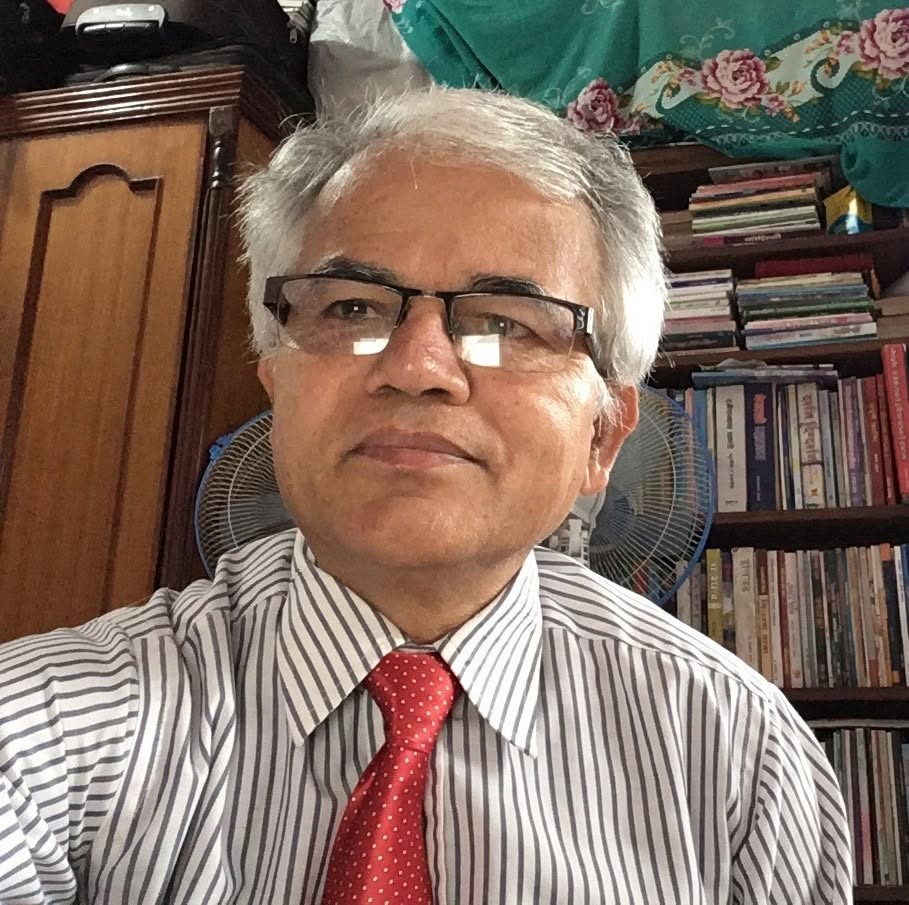
How Did Krishna Dharabasi Get His Literary Name?
Krishna Dharabasi's real name is Krishna Prasad Bhattarai. He began using Krishna Dharabasi as his literary name during his writing career.
His pen name is associated with the idea of being an inhabitant of the Earth. The Sanskrit word dhara means Earth. Dharabasi has connected this name with his belief in viewing human beings from a broader human perspective, beyond divisions of caste, religion, geography, and political boundaries.
Available accounts indicate that around 2035 BS, he used the name Krishna Prasad Dharabasi in literary activities. Krishna Dharabasi later became his established literary name.
Education and Development of Literary Interests
Krishna Dharabasi developed an interest in literature during his school years. As a student, he began writing poetry and other literary compositions.
Alongside literature, he was interested in books on philosophy and spirituality. This interest in literary and philosophical studies appears to have influenced his later writing.
While living in Jhapa and Ilam, he became increasingly involved with local writers and literary activities.
Debates surrounding the Third Dimension (Tesro Ayam) movement and Leelalekhan, which developed within the literary circles of eastern Nepal and Darjeeling, also contributed to his intellectual development.
First Published Literary Works
Dharabasi began his literary career by writing poetry.
His early poems were published in the Suryodaya Weekly during the 2030s BS. In the initial phase of his writing career, he used the name Krishna Prasad Bhattarai.
He subsequently expanded his literary activities beyond poetry to essays, short stories, novels, and literary criticism.
Banking Career and Literary Life
Alongside his literary work, Krishna Dharabasi served for many years at Agricultural Development Bank. He worked in the banking sector for approximately 25 years.
He remained active in writing, literary journalism, and literary activities throughout his professional career.
After retiring from Agricultural Development Bank, he began devoting more time to literary creation and study.
His professional life, family experiences, and social surroundings are reflected in his literary work. However, not all his writings can be regarded as based solely on personal experiences. He has also used history, mythology, and contemporary social issues as the basis for his fiction.
Krishna Dharabasi's Literary Career
Krishna Dharabasi's literary career began with poetry and essays before expanding into short stories, novels, and literary criticism.
Among his early published books were the 2048 BS essay collection Balak Harayeko Suchana and the critical work Bishweshwar Prasad Koiralaka Upanyasharu.
His poetry collection Unmuktika Awajharu was published in 2050 BS.
He subsequently became more active in studying Leelalekhan, writing essays, and creating fiction.
His first novel, Sharanarthi, was published in 2056 BS. Later novels, including Aadha Bato and Radha, further expanded his work as a novelist.
Receiving the Madan Puraskar for Radha marked another significant achievement in his literary career.
In subsequent years, he continued exploring various subjects through works such as Pandulipi, Gestapo, and Tallo Bato.
Krishna Dharabasi's Contribution to the Leelalekhan Movement
Leelalekhan is a literary philosophy and writing approach in Nepali literature that emphasizes presenting events, characters, and experiences from multiple perspectives and reinterpreting established meanings.
Its theoretical beginnings are associated with literary figure Indra Bahadur Rai.
In 2034 BS, Rai's article titled Bhrantiharu Ra Leelalekhan Matra was published in the 200th issue of the literary magazine Ruprekha. This publication is regarded as the formal introduction of Leelalekhan in Nepali literature.
Krishna Dharabasi later contributed to the study, criticism, and creative application of this literary approach.
What Is Leelalekhan?
Leelalekhan emphasizes the idea that the meaning of an event or experience in literature should not be confined to a single, fixed perspective.
According to this approach, the meaning and interpretation of an event may change depending on the person, time, or circumstances from which it is viewed.
In literature, this perspective creates opportunities to consider the viewpoints of characters, authors, narrators, and readers.
Eastern philosophical thought has influenced the philosophical foundations of Leelalekhan. Its relationship with modern literary theories has also been examined.
However, it would be inappropriate to understand Leelalekhan merely as a synonym for postmodernism. It has its own literary and philosophical background.
Dharabasi's Works on Leelalekhan
Krishna Dharabasi published a critical work titled Leelalekhan in 2053 BS.
Through this book, he presented his study of the ideas and literary practices associated with Leelalekhan.
Another of his works, Leelabodh, also addresses this subject.
Dharabasi's engagement with Leelalekhan extends beyond literary criticism. He has also applied various techniques associated with the approach in novels such as Sharanarthi, Radha, and Tundal.
Major Novels by Krishna Dharabasi
Krishna Dharabasi's novels are diverse in both subject matter and narrative style. Some explore social realities and autobiographical experiences, while others draw on mythology, historical events, and experimental literary techniques.
1. Sharanarthi
Sharanarthi is Krishna Dharabasi's first published novel. It was released in Chaitra 2056 BS.
The Madan Puraskar Pustakalaya's bibliographic records document the publication year and literary genre of its first edition.
The novel explores the displacement, identity, and social circumstances of Nepali-speaking Bhutanese refugees.
By presenting refugee experiences through fiction, Dharabasi examines the circumstances of people who have been separated from their homeland, identity, and established social existence.
The novel also employs experimental narrative techniques.
2. Aadha Bato
Aadha Bato, published in 2059 BS, is an autobiographical novel.
It presents the author's childhood, family circumstances, financial difficulties, and personal experiences in literary form.
The novel uses autobiographical narration. Alongside events from the author's personal life, it also incorporates various aspects of the social conditions of the period.
Because real-life experiences are presented within a fictional structure, the book should not be understood solely as a complete factual record of the author's life.
3. Radha
Radha, published in 2062 BS, is Krishna Dharabasi's Madan Puraskar-winning novel.
The novel retells mythological narratives associated with Radha and Krishna from a different perspective.
While traditional narratives frequently present Radha through her relationship with Krishna, Dharabasi portrays her as a character with independent thoughts and an identity of her own.
Radha's experiences, decisions, questions, and concerns about women's identity occupy a central place in the novel.
One of the book's significant features is its reinterpretation of mythology. By presenting a familiar character from a different perspective, the author questions established interpretations of traditional narratives.
The novel also demonstrates experimental techniques associated with Leelalekhan.
Radha received the Madan Puraskar for 2062 BS.
4. Tapain
Tapain is an experimental novel by Krishna Dharabasi.
The novel is particularly notable for its use of second-person narration.
While first-person and third-person narration are more commonly used in novels, Tapain presents direct address and narrative technique differently.
This experiment places particular emphasis on the relationship between the author, characters, and readers.
5. Tundal
Tundal is another novel by Krishna Dharabasi.
The novel explores Nepal's cultural setting, traditional artworks, and the social and psychological perspectives associated with them.
Tundal presents the relationship between the cultural meanings of artworks and the beliefs that have developed around them in society.
The novel incorporates themes related to history, culture, and psychology.
6. Pandulipi
Pandulipi is an autobiographical novel by Krishna Dharabasi.
It presents experiences from personal life, marital relationships, family memories, and separation.
The novel transforms the author's private experiences into literary narratives.
Alongside Aadha Bato, Pandulipi can be considered a relevant work for studying Dharabasi's autobiographical writing.
7. Gestapo
Gestapo is a novel by Krishna Dharabasi set against the historical background of Germany during the Second World War.
It draws on historical events associated with Nazi rule, Adolf Hitler's political rise, and the Second World War.
The author combines historical material, imagination, and literary narration to construct the novel.
The work presents a literary reinterpretation of history and the political circumstances of wartime.
Although the novel deals with historical events, it should not be regarded as a substitute for independent historical research.
8. Tallo Bato
Tallo Bato, published in 2074 BS, is a novel by Krishna Dharabasi.
The novel explores the experiences of Nepalis attempting to reach the United States through irregular and dangerous migration routes.
Dharabasi has stated that he interviewed people who had experienced such journeys while preparing the novel.
The work presents aspirations for foreign migration, dangerous journeys, and the social circumstances associated with migration.
Jhola: The Short Story and Its Historical Background
Jhola is one of Krishna Dharabasi's representative short stories. It is included in the short-story collection Jhola, published in 2060 BS.
The story is set against the historical background of Nepal during a period when the Sati system was practiced.
Main Themes of Jhola
Jhola portrays the social pressures faced by women and the beliefs associated with the Sati system during that period.
The relationship between a female character and her son is central to the story.
Against the background of the Sati system, Dharabasi explores motherhood, family relationships, social behavior, and the position of women through fiction.
The story offers an opportunity to understand an aspect of social history through human experiences.
Abolition of the Sati System in Nepal
The Sati system was legally abolished in Nepal on 25 Ashadh 1977 BS during the administration of then Prime Minister Chandra Shumsher.
The story Jhola is connected to the historical period in which this practice existed.
However, the characters and events presented in the story are elements of literary fiction. Therefore, the work should be studied as literature influenced by history rather than as a historical document.
Nepali Film Based on Jhola
The Nepali film Jhola, adapted from Krishna Dharabasi's short story of the same name, was directed by Yadav Kumar Bhattarai.
Garima Panta played the principal female character in the film. Other cast members include Sujal Nepal, Laxmi Giri, Desh Bhakta Khanal, and Deepak Chhetri.
The film presents the historical setting and social themes of the original story through a visual medium.
International Participation and Achievements
The film Jhola participated in international film festivals.
In 2014, Garima Panta received the Best Actress Award at the SAARC Film Festival held in Sri Lanka for her performance in Jhola.
Also in 2014, Jhola was selected as Nepal's official entry for consideration in the Foreign Language Film category at the 87th Academy Awards.
However, the film did not receive a final nomination in that category.
The film adaptation of Jhola provides an example of how a Nepali literary story can be presented through cinema.
Krishna Dharabasi's Essays and Critical Works
In addition to novels and short stories, Krishna Dharabasi has written essays and literary criticism.
His essays explore everyday experiences, family relationships, social behavior, and aspects of human psychology.
Balak Harayeko Suchana
Balak Harayeko Suchana, published in 2048 BS, is an essay collection by Dharabasi.
The collection presents individual experiences and aspects of social life through essays.
Personal reflection and diversity of subject matter are among the characteristics associated with this work.
Nari Bhitra Tyasto Ke Chha Hajur
Nari Bhitra Tyasto Ke Chha Hajur, published in 2053 BS, is another of his essay collections.
The work includes subjects related to women, men, human relationships, and social behavior.
Uttam Jung Sijapatiko Aalu
Uttam Jung Sijapatiko Aalu, published in 2055 BS, is another essay collection by Dharabasi.
It explores various aspects of life and society through essays.
Aandhi Naaune Ghar
Aandhi Naaune Ghar, published in 2067 BS, is an essay collection by Dharabasi.
The work presents subjects related to life experiences, human emotions, and social relationships.
Literary Criticism
Dharabasi's major works of literary criticism include Bishweshwar Prasad Koiralaka Upanyasharu, Leelalekhan, Tesro Ayam Ra Bairagi Kainla, and Leelabodh.
These works represent his studies of Nepali literary figures, literary movements, and writing approaches.
His works on Leelalekhan particularly demonstrate his involvement in theoretical literary study alongside creative writing.
List of Major Published Works by Krishna Dharabasi
The following is a selected list of Krishna Dharabasi's representative publications.
|
Book Title |
Literary Genre |
Publication Year (BS) |
|---|---|---|
|
Balak Harayeko Suchana |
Essay collection |
2048 |
|
Bishweshwar Prasad Koiralaka Upanyasharu |
Literary criticism |
2048 |
|
Unmuktika Awajharu |
Poetry collection |
2050 |
|
Nari Bhitra Tyasto Ke Chha Hajur |
Essay collection |
2053 |
|
Leelalekhan |
Literary criticism |
2053 |
|
Uttam Jung Sijapatiko Aalu |
Essay collection |
2055 |
|
Sharanarthi |
Novel |
2056 |
|
Aadha Bato |
Novel |
2059 |
|
Jhola |
Short-story collection |
2060 |
|
Radha |
Novel |
2062 |
|
Kanchhi Radha |
Poetry |
2062 |
|
Tesro Ayam Ra Bairagi Kainla |
Literary criticism |
2063 |
|
Aandhi Naaune Ghar |
Essay collection |
2067 |
|
Tallo Bato |
Novel |
2074 |
His other published works include Tapain, Tundal, Pandulipi, Gestapo, Aama, Leelabodh, Great Falls, Red Square, and Kagajko Manchhe.
This is a selected list rather than a complete bibliography. Publication years have not been included for works where available sources provide differing information.
Awards and Honors Received by Krishna Dharabasi
Krishna Dharabasi has received various literary awards and honors for his contributions to Nepali literature.
Madan Puraskar
Krishna Dharabasi received the Madan Puraskar for 2062 BS for his novel Radha.
The records of the Madan Puraskar Guthi contain his name, birth details, award-winning work, and the date on which the award was presented.
Yuwa Barsha Moti Puraskar
Krishna Dharabasi has also received the Yuwa Barsha Moti Puraskar.
This award is associated with recognizing the contributions of young literary creators to Nepali literature.
Uttam Shanti Puraskar
He has also received the Uttam Shanti Puraskar.
Literary profiles additionally mention honors such as the Mahananda Puraskar and Rashtriya Pratibha Puraskar among the awards he has received.
Krishna Dharabasi's Literary Style and Characteristics
Krishna Dharabasi's literature incorporates a variety of themes and narrative techniques.
His major literary characteristics include:
-
Creative application of literary ideas associated with Leelalekhan.
-
Reinterpretation of mythological and historical narratives.
-
Presentation of personal experiences through autobiographical fiction.
-
Exploration of social realities, displacement, and identity.
-
Attention to the experiences, questions, and identities of female characters.
-
Experimentation with narrative structures and perspectives that differ from conventional storytelling.
These characteristics do not appear in the same way across all his works.
Sharanarthi addresses displacement and identity. Personal experience plays an important role in Aadha Bato, while Radha reinterprets a mythological narrative.
The short story Jhola explores a historical social practice and the circumstances of women.
Gestapo fictionalizes historical events, while Tallo Bato explores migration-related experiences.
These differences in subject matter demonstrate the diversity of Dharabasi's fiction.
Krishna Dharabasi's Contributions to Nepali Literature
Krishna Dharabasi's literary contributions span fiction, essays, literary criticism, and experimental writing.
Through his study and creative application of Leelalekhan, he has connected his writing with a distinct approach in Nepali literature.
In Radha, he reexamines an established mythological narrative by presenting a familiar character from a different perspective. In Sharanarthi, he addresses displacement and identity.
Similarly, works such as Aadha Bato and Pandulipi transform autobiographical experiences into literary narratives.
The short story Jhola portrays the circumstances of women against the background of a historical social practice. Its film adaptation demonstrates how a literary work can be presented in a visual form.
Through Leelalekhan, Leelabodh, and other critical works, Dharabasi has also contributed to literary thought and study alongside his creative writing.
His contributions are therefore not limited to novels and short stories. His writing across different genres and subjects has shaped his identity as a literary figure.
Conclusion
Krishna Dharabasi is a Nepali novelist, short-story writer, essayist, poet, and literary critic. His literary career began with poetry and essays before expanding into novels, short stories, memoirs, and literary criticism.
Receiving the Madan Puraskar for his novel Radha in 2062 BS was a notable achievement in his literary career.
Works such as Sharanarthi, Aadha Bato, Radha, Jhola, Gestapo, and Tallo Bato demonstrate the diversity of subjects explored in his writing.
His major literary contributions include the study and application of Leelalekhan, reinterpretation of mythological narratives, fictionalization of social experiences, and autobiographical writing.
His works remain relevant to the study of experimental fiction, social realism, and literary reinterpretation in Nepali literature.
References and Sources
1. Madan Puraskar Guthi. Official profile of Krishna Dharabasi, including his birth details and Madan Puraskar records.
2. Madan Puraskar Pustakalaya. Bibliographic records relating to the first edition of the novel Sharanarthi.
3. Durga Paudel. "Jindagi Euta Leela Ho: Dharabasi." Samachar Dainik, 18 Ashwin 2076 BS.
4. Mohan Duwal. "Vyaktivritta, Sirjanaka Sundar Bimba Krishna Dharabasi." News of Nepal, 16 Mangsir 2074 BS.
5. Sahitya Post. "Krishna Dharabasiko Aupanyasik Yatra: Aaroh Awaroh." 24 Ashadh 2077 BS.
6. Thuprai. Author profile of Krishna Dharabasi and list of published books.
7. Onlinekhabar. "Donkey Is a Novel Based on the Story of Those Who Entered America Illegally." 15 Ashadh 2083 BS. Includes the author's comments on Tallo Bato.
8. Himal Press. "103 Barsha Aghi Yasari Antya Bhayo Sati Pratha." Historical account of the abolition of the Sati system in Nepal.
9. Himal Press. "These Are Nepal's Official Submissions to Oscars." Information on Jhola as Nepal's official entry for the Academy Awards.







Comments 0
No comments yet. Be the first to start the conversation.