



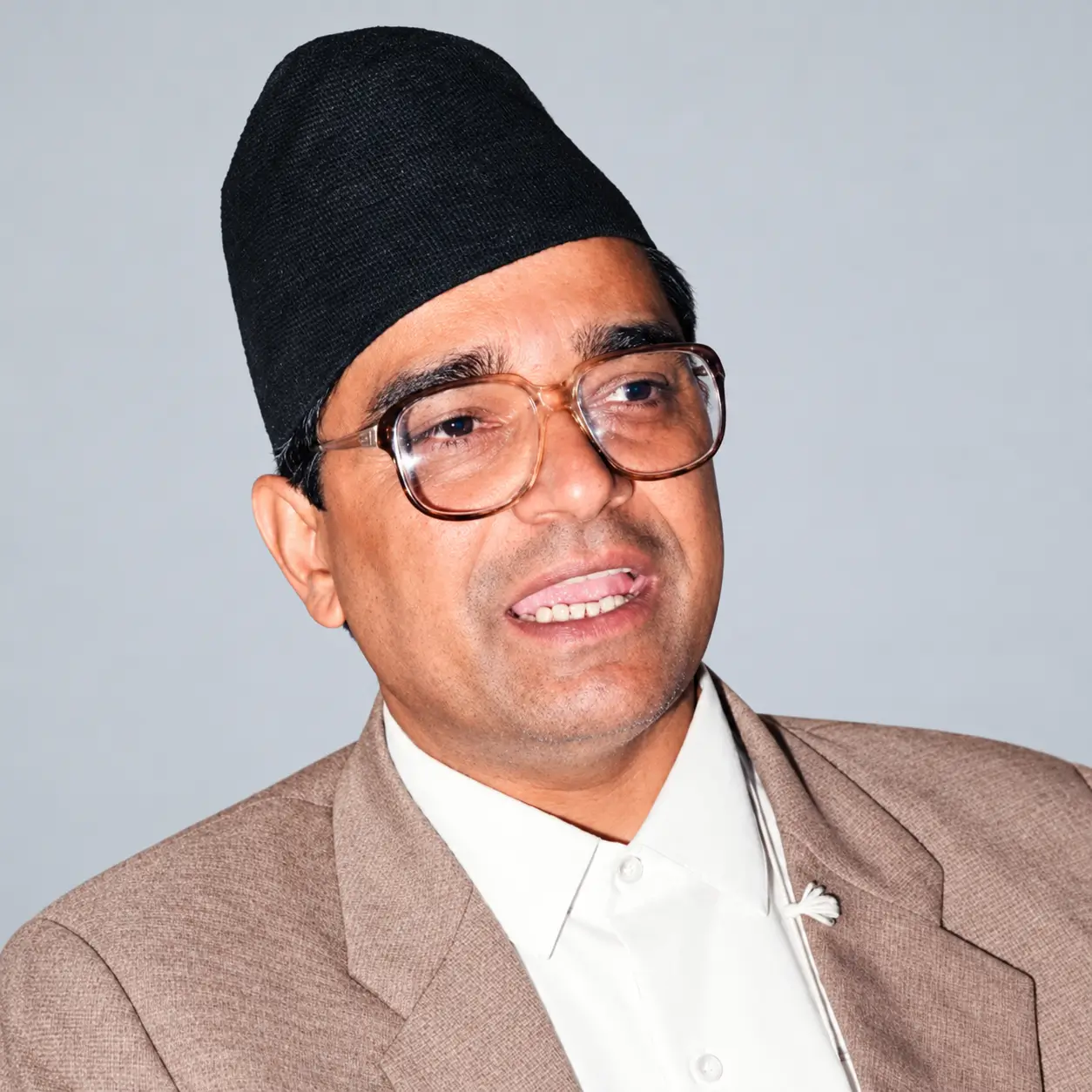
Madan Kumar Bhandari (14 Ashadh 2009 BS – 3 Jestha 2050 BS) was a Nepali communist politician, political thinker, and former General Secretary of the Communist Party of Nepal (Unified Marxist–Leninist), commonly known as CPN-UML. He was among the leaders who promoted multiparty competition and democratic processes as part of the political program of Nepal's communist movement.
Bhandari played an important role in underground political activities against the Panchayat system, the mobilization of left-wing forces during the People's Movement of 2046 BS (1990), the formation of the CPN-UML, and the development of People's Multiparty Democracy (PMD).
He interpreted Marxist political thought in relation to Nepal's circumstances, placing constitutional supremacy, an open and pluralistic society, human rights, periodic elections, and multiparty competition among the principal foundations of his political program.
In the House of Representatives election of 2048 BS (1991), Bhandari was elected from two constituencies in Kathmandu. His victory over Krishna Prasad Bhattarai, the then interim Prime Minister, in Kathmandu Constituency No. 1 brought his political role to national and international attention.
On 3 Jestha 2050 BS (16 May 1993), Bhandari and Jeevaraj Ashrit, the Organization Department chief of the CPN-UML, died in a jeep accident at Dasdhunga in Chitwan. Investigations into the cause of the incident and the political debates surrounding it remain notable subjects in Nepal's political history.
Madan Bhandari: Brief Profile
|
Particulars |
Details |
|---|---|
|
Full Name |
Madan Kumar Bhandari |
|
Commonly Known As |
Madan Bhandari |
|
Date of Birth |
14 Ashadh 2009 BS |
|
Place of Birth |
Dhungesanghu, Taplejung, Nepal |
|
Date of Death |
3 Jestha 2050 BS (16 May 1993) |
|
Place of Death |
Dasdhunga, Chitwan |
|
Nationality |
Nepali |
|
Spouse |
Bidya Devi Bhandari |
|
Children |
Two daughters |
|
Education |
Studies in Sanskrit and literature in Nepal and India |
|
Political Affiliation |
CPN-ML and CPN-UML |
|
Major Political Positions |
General Secretary of CPN-ML and CPN-UML |
|
Parliamentary Role |
Member of the House of Representatives, 2048–2050 BS |
|
Major Ideological Contribution |
People's Multiparty Democracy (PMD) |
|
Major Honor |
Nepal Ratna (posthumously) |
Birth, Family Background and Childhood
Madan Bhandari was born on 14 Ashadh 2009 BS in Dhungesanghu, Taplejung district, eastern Nepal. He was born into a rural farming family.
He spent his childhood in the social and cultural setting of the Taplejung hills. Because his family had a tradition of Sanskrit education, he became familiar with language and literature from an early age.
At that time, opportunities for formal education in rural Nepal were limited. Students often had to leave their birthplace to continue their studies beyond the elementary level.
Bhandari's family later migrated from Taplejung to Morang district. This move expanded his exposure to the social and political conditions of Nepal's eastern Terai.
Available biographical materials about his early life mention Sanskrit education, an interest in literature, and the educational traditions of his family.
Education and Intellectual Development
Madan Bhandari began his education in Nepal and continued his studies in India. After receiving his early education in Taplejung, he pursued further studies in Sanskrit language and literature.
During his education in Nepal, he was also associated with the tradition of Sanskrit learning in Dingla, Bhojpur. He subsequently traveled to India for higher studies.
While in India, he studied Sanskrit, language, literature, and political philosophy. Varanasi was a major center of his higher education and the development of his political awareness.
During that period, Varanasi was associated with the activities of Nepali students, political activists, and leaders living in exile. Nepali students discussed opposition to the Panchayat system, the establishment of democracy, and social change.
In this setting, Bhandari's interests expanded from traditional Sanskrit literature to political philosophy, history, and Marxist thought.
He sought to understand political ideas through his literary studies. The influence of ideological reasoning and literary expression can be seen in his later political writings and speeches.
His educational experiences and political connections in India therefore contributed to the development of his intellectual and political identity.
Early Political Career and Cultural Activities
Madan Bhandari began his organized political career while studying in India. He was influenced by the political ideas of Pushpa Lal Shrestha, the founding General Secretary of the Communist Party of Nepal.
Around 2029 BS, he became active in people's democratic cultural activities associated with Pushpa Lal.
At that time, cultural programs, literature, poetry, and songs were used to communicate political ideas. Cultural activities had political significance because political parties were prohibited from operating openly under the Panchayat system.
Through cultural campaigns, Bhandari developed contacts with political activists and students. These activities gave him experience in organizational development and the communication of political ideas.
After completing his studies and participating in political activities in India, he returned to Nepal and became involved in expanding communist organizations in different parts of eastern Nepal.
Separation from the Pushpa Lal Group
During the 2030s BS, Nepal's communist movement was divided into several groups. Political leaders differed over strategies for political change, organizational operations, and the course of revolution.
Bhandari participated in these ideological debates.
As disagreements over political strategy with the group led by Pushpa Lal increased, Madan Bhandari, Jeevaraj Ashrit, and other leaders became involved in establishing a separate political organization.
Around 2033 BS, they became associated with the Mukti Morcha group.
Mukti Morcha emphasized underground organizational development, expanded public contact, and coordinated activities for political change.
The group later participated in a merger process with other communist factions.
Underground Politics and the Formation of CPN-ML
A substantial part of Madan Bhandari's political career was spent in underground activities against the Panchayat system.
On 11 Poush 2035 BS, the Communist Party of Nepal (Marxist–Leninist), or CPN-ML, was formed through the unification of several communist groups.
The merger process involved political groups associated with the Jhapa Movement, Mukti Morcha, and other left-wing factions.
C.P. Mainali became the General Secretary of the newly formed party. Madan Bhandari joined its central leadership.
Following the party's establishment, Bhandari played an active role in organizational development, political training, and debates over political strategy.
Expansion of Underground Organizations
Because political parties were prohibited from operating openly under the Panchayat system, communist leaders had to conduct organizational activities underground.
Bhandari also worked for the party for many years while keeping his public identity relatively limited.
He was involved in expanding communist organizations in eastern Nepal, developing contacts among party workers, and providing political training.
During his underground political activities, he was also known by the name Sagar.
Throughout this period, the party continued debating strategies for political change. The political direction of the then CPN-ML gradually shifted toward public mobilization and broader political movements.
Rise to the Leadership of CPN-ML
After Jhalanath Khanal became General Secretary of the CPN-ML in 2039 BS, a review of the party's political strategy began.
Madan Bhandari's role also gradually expanded.
Discussions within the party increasingly focused on cooperation with other political forces against the Panchayat system, building the foundations for a people's movement, and connecting the communist movement with broader public participation.
Against this background, Bhandari eventually reached the party's highest leadership position.
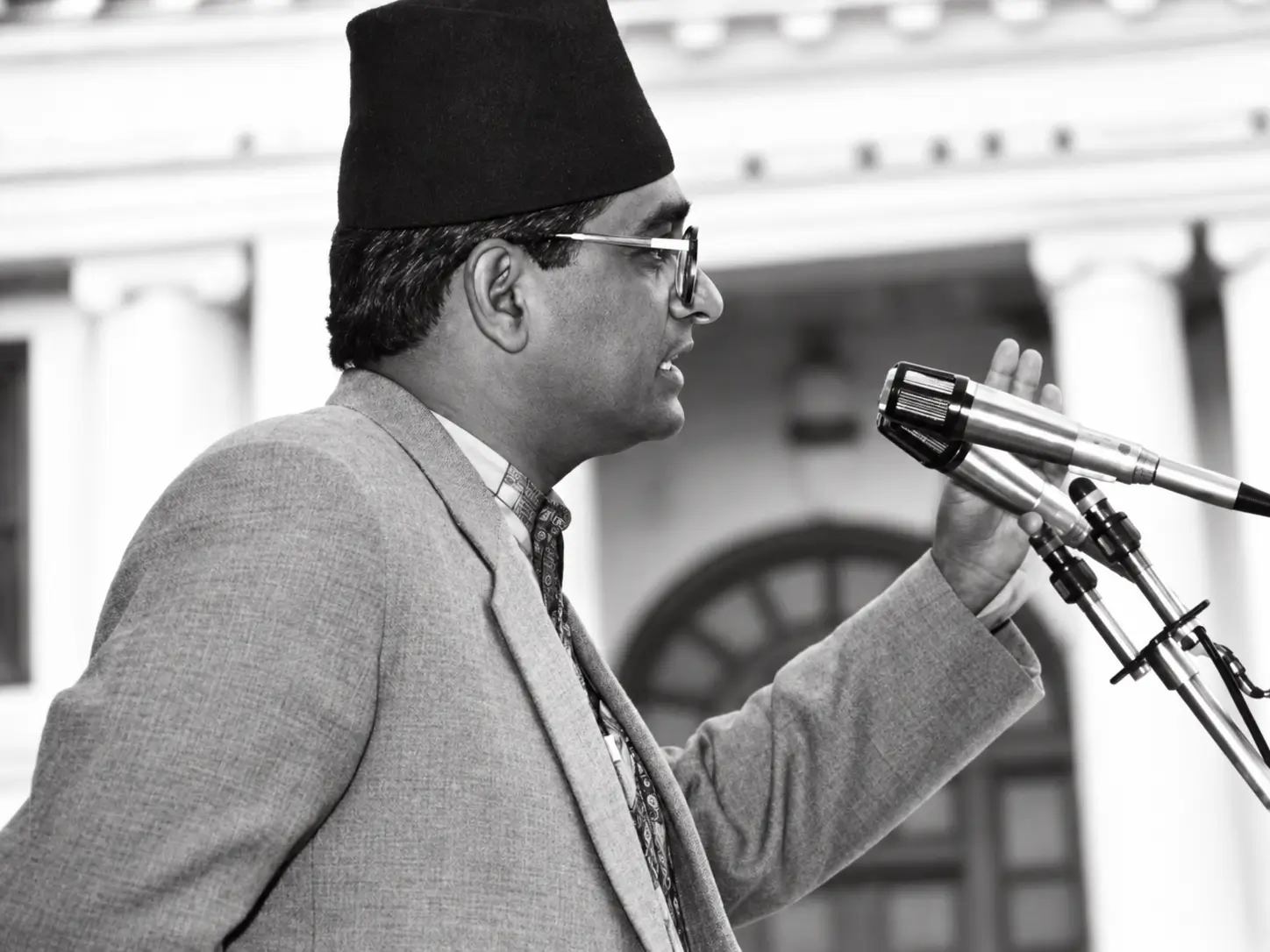
Fourth National Congress of CPN-ML and Appointment as General Secretary
The Fourth National Congress of the CPN-ML was held from 9 to 14 Bhadra 2046 BS at Sarre Ambas, Bishnupurkatti, Siraha district.
Madan Bhandari was elected General Secretary of the party at the congress.
The congress adopted a political strategy calling for a united people's movement against the Panchayat system. It also decided to incorporate the principle of multiparty competition into the political program of New Democracy.
This decision represented an important change in the political approach of the CPN-ML.
After becoming General Secretary, Bhandari played a leading role in mobilizing the party against the Panchayat system and promoting cooperation with other democratic political forces.
The political direction adopted by the Fourth Congress later provided an ideological foundation for the development of People's Multiparty Democracy.
Madan Bhandari's Role in the People's Movement of 2046 BS
Madan Bhandari's role in the People's Movement of 2046 BS was associated with cooperation among left-wing parties, mobilization of underground organizations, and preparations for a united movement against the Panchayat system.
In 2046 BS, the United Left Front was formed with the participation of various left-wing parties. Sahana Pradhan led the front.
The United Left Front and the Nepali Congress agreed to launch a movement against the Panchayat system.
As General Secretary of the CPN-ML, Madan Bhandari played a political role in this cooperation.
The People's Movement began on 7 Falgun 2046 BS, with demonstrations, protest gatherings, and political activities taking place across the country.
Following the movement, King Birendra announced the restoration of multiparty democracy on 26 Chaitra 2046 BS.
This marked the end of the partyless Panchayat system and created conditions for political parties to operate openly.
Transition from Underground Politics to Public Political Life
Following the restoration of multiparty democracy, Madan Bhandari entered public political life.
Having worked in underground organizations for many years, he began participating in open political activities, public meetings, and political debates.
During this period, he presented his views on democracy, national identity, citizens' rights, and the political direction of the communist movement.
His political role was no longer limited to underground organizational work. He became an active figure in national political discussions.
Madan Bhandari's Position on the Constitution of 2047 BS
Madan Bhandari offered critical support to the Constitution of 2047 BS.
The process of drafting a new constitution began after the People's Movement of 2046 BS. The Constitution of the Kingdom of Nepal was promulgated on 23 Kartik 2047 BS.
The constitution established a constitutional monarchy and a multiparty democratic system.
Although Bhandari accepted the democratic rights established through the constitution, he disagreed with some of its provisions.
He presented a 27-point statement of disagreement concerning issues such as popular sovereignty, the powers of the king, religious equality, linguistic rights, and civil liberties.
In his view, the constitution needed to guarantee the rights of the people clearly.
However, rather than rejecting the constitution entirely because of these disagreements, he advocated protecting the democratic achievements already secured and participating in the political process.
This approach demonstrated the place of constitutional procedures and democratic competition in Bhandari's political strategy.
Formation of CPN-UML and Madan Bhandari's Leadership
On 22 Poush 2047 BS, the Communist Party of Nepal (Unified Marxist–Leninist), or CPN-UML, was formed through the merger of the CPN-ML and the Communist Party of Nepal (Marxist).
Man Mohan Adhikari was elected Chairman of the unified party, while Madan Bhandari became its General Secretary.
The merger created a new organizational foundation for left-wing politics in Nepal.
The CPN-UML adopted a policy of participating in multiparty political competition. As General Secretary, Bhandari contributed to developing the party's political strategy, expanding its organization, and preparing for elections.
During this period, he promoted the principle that a communist party could contest elections under a constitutional system and form a government based on public support.
Following the merger, Bhandari's leadership became increasingly associated with parliamentary politics and the development of People's Multiparty Democracy.
General Election of 2048 BS and Parliamentary Role
The House of Representatives election held on 29 Baisakh 2048 BS was a significant event in Madan Bhandari's political career.
It was the first general election following the restoration of multiparty democracy. The election determined the 205 members of the House of Representatives.
Madan Bhandari contested the election as a CPN-UML candidate from Kathmandu Constituencies No. 1 and No. 5.
In Kathmandu Constituency No. 1, he competed against Krishna Prasad Bhattarai, who was serving as the interim Prime Minister.
Bhandari defeated Bhattarai in the election. He was also elected from Kathmandu Constituency No. 5.
After winning both constituencies, Bhandari retained Kathmandu Constituency No. 1.
In that election, the CPN-UML won 69 seats in the House of Representatives and became the principal opposition party.
The result established the CPN-UML as a major political force in Nepal's parliamentary system.
Madan Bhandari's Role in Parliament
After becoming a member of the House of Representatives, Bhandari presented his party's positions on national interests, constitutional procedures, government policies and programs, and democratic rights.
As General Secretary of the principal opposition party, he actively questioned government decisions and presented alternative political perspectives.
At the time, parliamentary practices were still developing following the restoration of multiparty democracy.
Bhandari participated in debates concerning relations between the government and the opposition, constitutional implementation, and national policymaking.
Tanakpur Dispute
The Tanakpur dispute was another important issue associated with Madan Bhandari's parliamentary role.
In 2048 BS, Nepal and India reached an understanding concerning the Tanakpur project.
A dispute arose over the legal status of the understanding, the use of national resources, and whether parliamentary approval was required.
The CPN-UML questioned the constitutional procedures surrounding the understanding. Bhandari also presented his party's position on national interests and the authority of Parliament.
The Supreme Court later determined that the Tanakpur understanding had the character of a treaty and required parliamentary approval in accordance with constitutional procedures.
The Tanakpur dispute generated extensive political, parliamentary, and judicial debate in Nepal over national resources and constitutional processes.
Development of People's Multiparty Democracy (PMD)
People's Multiparty Democracy is Madan Bhandari's principal political and ideological contribution.
The program sought to connect Marxist political thought with multiparty competition, constitutional supremacy, human rights, and democratic processes.
Political changes in the Soviet Union and Eastern Europe between the late 1980s and early 1990s generated debates within the international communist movement.
Different communist parties developed varying views on one-party political systems, the role of the state, democracy, and the political path toward socialism.
Against this background, Bhandari argued that Nepal's communist movement should accept multiparty competition in accordance with the country's social and political circumstances.
He emphasized public support, political organization, elections, and democratic rights as important components of political change.
Adoption of PMD at the Fifth National Congress
The Fifth National Congress of the CPN-UML was held in Kathmandu from 14 to 20 Magh 2049 BS.
Several proposals concerning the party's political direction were presented at the congress.
The political program titled People's Multiparty Democracy, presented by Madan Bhandari as a program for the Nepali revolution, was adopted by a majority vote.
Bhandari was re-elected General Secretary of the CPN-UML.
The Fifth Congress established PMD as the party's official political program.
Subsequent CPN-UML congresses further interpreted and developed its ideological and theoretical position.
Fourteen Characteristics of People's Multiparty Democracy
The program of People's Multiparty Democracy identifies 14 major characteristics. These relate to the political system, citizens' rights, governance, economic policy, and international relations.
The following sections summarize the characteristics described in Madan Bhandari's political documents.
1. Supremacy of the Constitution
All organs of the state, political parties, institutions, and individuals must remain subject to the constitution.
The central principle is that no individual or institution can stand above the constitution.
2. Pluralistic Open Society
Society must provide space for different ideas, perspectives, and political beliefs.
Citizens must have the right to express their views within constitutional and legal limits.
3. Principle of Separation of Powers
State power should not be excessively concentrated in a single individual or institution.
Authority and responsibilities must be divided among the executive, legislature, and judiciary.
4. Protection of Human Rights
The protection of fundamental rights, civil liberties, and human rights is regarded as an essential foundation of the political system.
5. System of Multiparty Competition
Different political parties must be allowed to compete politically in accordance with the constitution.
A central aspect of this principle is that no single party should hold a permanent monopoly over state power.
6. Periodic Elections
Citizens must have opportunities to elect their representatives at regular intervals.
Elections should provide a system of competition among the ideas, policies, and programs of different political parties.
7. Majority Government and Minority Opposition
The party securing a majority in an election should form the government, while parties that do not obtain a majority should perform their constitutional role as the opposition.
8. Rule of Law
All decisions of the state must comply with the law.
A system that allows individuals or institutions to be punished arbitrarily is unacceptable.
9. Consolidation of the People's Democratic System
This characteristic includes the gradual development of a people's democratic system.
It concerns removing the exploitative remnants of the previous system, advancing changes in production relations and social development, and preparing for a transition toward socialism.
10. Utilization of Foreign Capital and Technology
The program proposes that foreign capital and technology may be utilized in accordance with national interests, the constitution, and applicable laws.
11. Compensation
The program includes a policy of providing compensation to certain landowners when changes in land ownership occur during land reform.
It proposes compensation for landowners who support social change, middle and wealthy farmers, and small landholders.
However, it proposes different arrangements for feudal landlords who engage in violent opposition to the transformation.
12. Foreign Policy
The program proposes conducting international relations on the basis of national independence, sovereignty, mutual respect, and the principles of Panchsheel.
13. Leadership and Dictatorship
This characteristic maintains that political leadership should not be obtained solely through ideological claims or the exercise of state power.
It emphasizes gaining leadership through public service, initiative, and competition.
It also prioritizes the concept of "people's democratic state power" over "people's democratic dictatorship."
14. People's Multiparty Democracy
This characteristic connects the political program of the Nepali revolution with multiparty competition and people's democratic objectives.
Bhandari presented it as a new democratic program developed in accordance with Nepal's circumstances.
A more detailed explanation of these characteristics is included in Madan Bhandari on People's Multiparty Democracy, published by the CPN-UML.
Relationship Between PMD and Multiparty Democracy
People's Multiparty Democracy accepts multiparty competition as an essential component of the political system.
Under this concept, political parties must have opportunities to form governments based on public support and election results.
It also includes provisions for parties that do not secure a majority to perform the role of constitutional opposition.
However, PMD does not focus exclusively on political competition. It also presents ideas concerning socioeconomic change, class relations, the role of the state, and the political direction toward socialism.
Therefore, an examination of PMD must consider both its multiparty political principles and its economic and social objectives.
Criticism and Debate Surrounding Madan Bhandari's Political Thought
People's Multiparty Democracy, as proposed by Madan Bhandari, became a subject of both support and criticism within Nepal's communist movement.
Its supporters argued that accepting multiparty competition was an attempt to connect the communist movement with democratic political processes.
From their perspective, incorporating constitutional principles, elections, and citizens' rights into the political program created a foundation for communist parties to participate in open political competition.
However, some communist groups that supported more traditional revolutionary strategies criticized PMD as a departure from the objectives of Marxist revolution.
They argued that prioritizing parliamentary competition could weaken the objective of bringing fundamental changes to social and economic structures.
Some critics from non-communist political traditions also questioned how consistently communist parties would maintain their commitment to multiparty democracy in practice.
Through his political writings and speeches, Bhandari argued that multiparty competition was a necessary political arrangement suited to Nepal's circumstances.
These debates brought different perspectives on the relationship between democracy, socialism, state power, and political competition into public discussion within Nepal's communist movement.
Literary Writings and Ideological Works
In addition to politics, Madan Bhandari was involved in literary and ideological writing.
He developed an interest in language, literature, and political thought during his student years.
His involvement in cultural campaigns during his early political activities connected his writing with social and political issues.
His political articles, speeches, and documents contain views on Nepal's communist movement, national identity, political change, and People's Multiparty Democracy.
His major ideological writings and materials address the following subjects:
-
The Program of the Nepali Revolution: People's Multiparty Democracy
-
Theoretical explanations of People's Multiparty Democracy
-
The relationship between New Democracy and People's Multiparty Democracy
-
The international communist movement and Nepal's political circumstances
-
National identity, democracy, and political competition
-
Various political speeches and interviews
In 2024, the CPN-UML published Madan Bhandari on People's Multiparty Democracy, a collection of his political writings and documents concerning PMD.
The publication provides material for examining the development of his political program and theoretical perspectives.
Madan Bhandari in the International Media
Following the general election of 2048 BS, Madan Bhandari's political activities also attracted attention from international media.
At that time, debates were taking place in different parts of the world about communist political systems and the future of socialism.
In Nepal, however, a communist party had participated in multiparty elections and secured the position of principal opposition party.
The American magazine Newsweek published an interview with Madan Bhandari in 1991.
The interview became widely discussed in connection with the idea that Karl Marx was still alive in Nepal.
This reflected international interest in Nepal's communist movement and its participation in multiparty political competition.
Personal and Family Life
Madan Bhandari married Bidya Pandey in 2039 BS. She later became known in Nepal's national politics as Bidya Devi Bhandari.
Bidya Devi Bhandari had also been involved in left-wing political activities since her student years.
Madan Bhandari and Bidya Devi Bhandari have two daughters.
Because Bhandari spent many years working in underground politics, his family life was influenced by his political responsibilities and the circumstances of that period.
Bidya Devi Bhandari's Political Career
Following Madan Bhandari's death, Bidya Devi Bhandari's parliamentary and national political roles expanded.
In 2050 BS, she contested the by-election held in Kathmandu Constituency No. 1 as a CPN-UML candidate.
She defeated Nepali Congress leader Krishna Prasad Bhattarai in that election.
She subsequently served as a member of the House of Representatives, a minister, and a leader within the CPN-UML.
On 11 Kartik 2072 BS, she was elected Nepal's first female President. She served two terms as President until Falgun 2079 BS.
Dasdhunga Incident and the Death of Madan Bhandari
On 3 Jestha 2050 BS (16 May 1993), Madan Bhandari and Jeevaraj Ashrit, the Organization Department chief of the CPN-UML, died in a jeep accident at Dasdhunga, Chitwan.
They were traveling in connection with party-related programs.
The jeep carrying them plunged into the Trishuli River at Dasdhunga along the Narayangadh–Mugling road.
The driver, Amar Lama, survived the accident. Bhandari and Ashrit died.
Ashrit's body was recovered after the accident, while Bhandari's body was found several days later farther downstream.
Their deaths created a major leadership vacuum within the CPN-UML's political and organizational structure.
Investigation into the Dasdhunga Incident
Disputes concerning the cause of the Dasdhunga incident arose immediately after the accident.
Different views emerged over whether the crash resulted from the driver's negligence or whether it involved a planned act.
Various governmental and non-governmental investigations were undertaken following the incident.
The government at the time formed an inquiry commission led by former judge Prachanda Raj Anil.
The commission identified the driver's negligence as the cause of the accident.
The CPN-UML disagreed with the findings of the government investigation and formed a separate investigation committee under the leadership of K.P. Sharma Oli.
The party's committee expressed suspicion that the incident involved a conspiracy.
An investigation was also undertaken at the citizens' level under the leadership of Padma Ratna Tuladhar.
Later, a judicial inquiry commission was formed under the chairmanship of Supreme Court Justice Trilok Pratap Rana.
According to a 2012 report by the International Commission of Jurists (ICJ), the Trilok Pratap Rana Commission concluded that it had found no evidence of a premeditated conspiracy by the driver to cause the deaths of the two leaders.
Thus, different investigations and political interpretations have emerged concerning the Dasdhunga incident.
It is necessary to distinguish between suspicions expressed in political discussions and conclusions established through investigations.
Death of Driver Amar Lama
Amar Lama, the driver who survived the Dasdhunga accident, was an important individual in investigations concerning the incident.
Following the accident, he became subject to legal proceedings.
He was killed in Kirtipur, Kathmandu, on 27 July 2003.
The International Commission of Jurists' 2012 report also mentions that a separate commission was established to investigate Amar Lama's killing.
Independent evidence is necessary to substantiate any claim directly linking Amar Lama's killing to the Dasdhunga incident.
When studying the history of the Dasdhunga incident, the judicial investigations into the accident, political allegations, and investigations into Amar Lama's killing should be examined as separate matters.
Nepal Ratna Honor and Memorial Institutions
Following Madan Bhandari's death, various institutions and programs were established or operated in connection with his political ideas, public life, and memory.
Nepal Ratna Decoration
The Government of Nepal honored Madan Bhandari posthumously with the Nepal Ratna decoration.
The decision to confer the honor was announced in 2073 BS.
Later, his daughters received the posthumous decoration at an award ceremony.
Nepal Ratna is a high civilian honor conferred by the Government of Nepal.
Institutions Established in Madan Bhandari's Name
Various institutions and projects related to education, research, health, and public infrastructure have been named after Madan Bhandari.
Major examples include:
-
Madan Bhandari Foundation: An institution involved in activities related to his political thought, social contributions, research, and publications.
-
Madan Bhandari Memorial College: An educational institution operating in Kathmandu.
-
Madan Bhandari University of Science and Technology: A university established under the Madan Bhandari University of Science and Technology Act, 2079 BS.
-
Madan Bhandari Academy of Health Science: An institution of health sciences established in Bagmati Province.
-
Madan Bhandari Highway: A national road project named after him.
These institutions and projects differ in their establishment, legal structures, and operational objectives.
Madan Bhandari's Contributions to Nepal's Political History
Madan Bhandari's political contributions can be examined in relation to Nepal's communist movement, democratic movement, and the development of political thought.
His contributions have three major dimensions.
1. Political Movement Against the Panchayat System
Bhandari played a role in developing underground organizations and mobilizing the public against the Panchayat system.
After becoming General Secretary of the CPN-ML, he promoted the political strategy of a united people's movement.
During the People's Movement of 2046 BS, he participated in efforts to develop cooperation among left-wing parties and organize a joint movement with the Nepali Congress.
2. Recognition of Multiparty Competition in the Communist Movement
Bhandari promoted a political strategy that involved communist parties participating in multiparty elections and parliamentary competition.
This approach expanded debates within Nepal's communist movement about the role of elections, public support, and constitutional processes in achieving political change.
3. Development of People's Multiparty Democracy
People's Multiparty Democracy, developed by Bhandari, is closely associated with the political and ideological development of the CPN-UML.
The program brought together constitutional supremacy, a pluralistic society, periodic elections, citizens' rights, and socioeconomic change within a common political approach.
However, different political groups do not share the same assessment of Bhandari's political thought.
The CPN-UML considers PMD a major foundation of its ideological development, while critics from other political traditions have expressed different views on its socioeconomic objectives and practical implementation.
Therefore, an assessment of his historical role should be based on available documents, contemporary events, and verified facts, rather than political support or criticism alone.
Conclusion
Madan Kumar Bhandari was among the leaders who interpreted the relationship between Nepal's communist movement and multiparty democratic processes in a new way.
His political journey began with cultural activities and progressed through underground organizations, the leadership of the CPN-ML, the People's Movement of 2046 BS, the General Secretary position of the CPN-UML, and parliamentary politics.
People's Multiparty Democracy, which he developed, gave a new direction to debates within Nepal's communist movement concerning elections, political competition, constitutional supremacy, and citizens' rights.
Following his death in the Dasdhunga accident on 3 Jestha 2050 BS, he was unable to directly lead the long-term implementation of the political programs he had introduced.
Nevertheless, his political ideas, writings, and historical role remain important subjects in the study of Nepal's democratic movement and communist politics.
References
1. Madan Bhandari Foundation. Biography of Madan Bhandari. Institutional material concerning his birth, political leadership, views on the constitution, and ideological contributions.
2. Communist Party of Nepal (Unified Marxist–Leninist). Fourth National Congress. Details concerning the Fourth National Congress of 2046 BS, leadership selection, and political strategy.
3. Communist Party of Nepal (Unified Marxist–Leninist). Madan Bhandari on People's Multiparty Democracy. A collection of Bhandari's political writings and documents published in 2024.
4. Thapa, Surya. (2078 BS). A 72-Year Overview of Nepal's Communist Movement. Kantipur. Historical background concerning the CPN-ML, CPN-UML, party congresses, and elections.
5. Nepal Law Journal. Constitutional and Judicial Dispute Concerning Tanakpur. Records of constitutional questions and judicial proceedings before the Supreme Court.
6. International Commission of Jurists. (2012). Commissions of Inquiry in Nepal: Denying Remedies, Entrenching Impunity. Details concerning inquiry commissions related to the Dasdhunga incident and the killing of Amar Lama.
7. Office of the President, Nepal. Brief Biography of Bidya Devi Bhandari. Official records concerning her political career, by-election, and presidential terms.
8. Madan Bhandari Foundation. About Madan Bhandari Foundation. Information concerning the foundation's establishment, objectives, and institutional activities.
9. Nepal Law Commission. Madan Bhandari University of Science and Technology Act, 2079 BS. Legal basis for the university's establishment.
10. Public Service Broadcasting, Radio Nepal. (2026). UML Marks 33rd Madan–Ashrit Memorial Day. Information concerning the date of death of Madan Bhandari and Jeevaraj Ashrit and the Dasdhunga incident.





Comments 0
No comments yet. Be the first to start the conversation.