



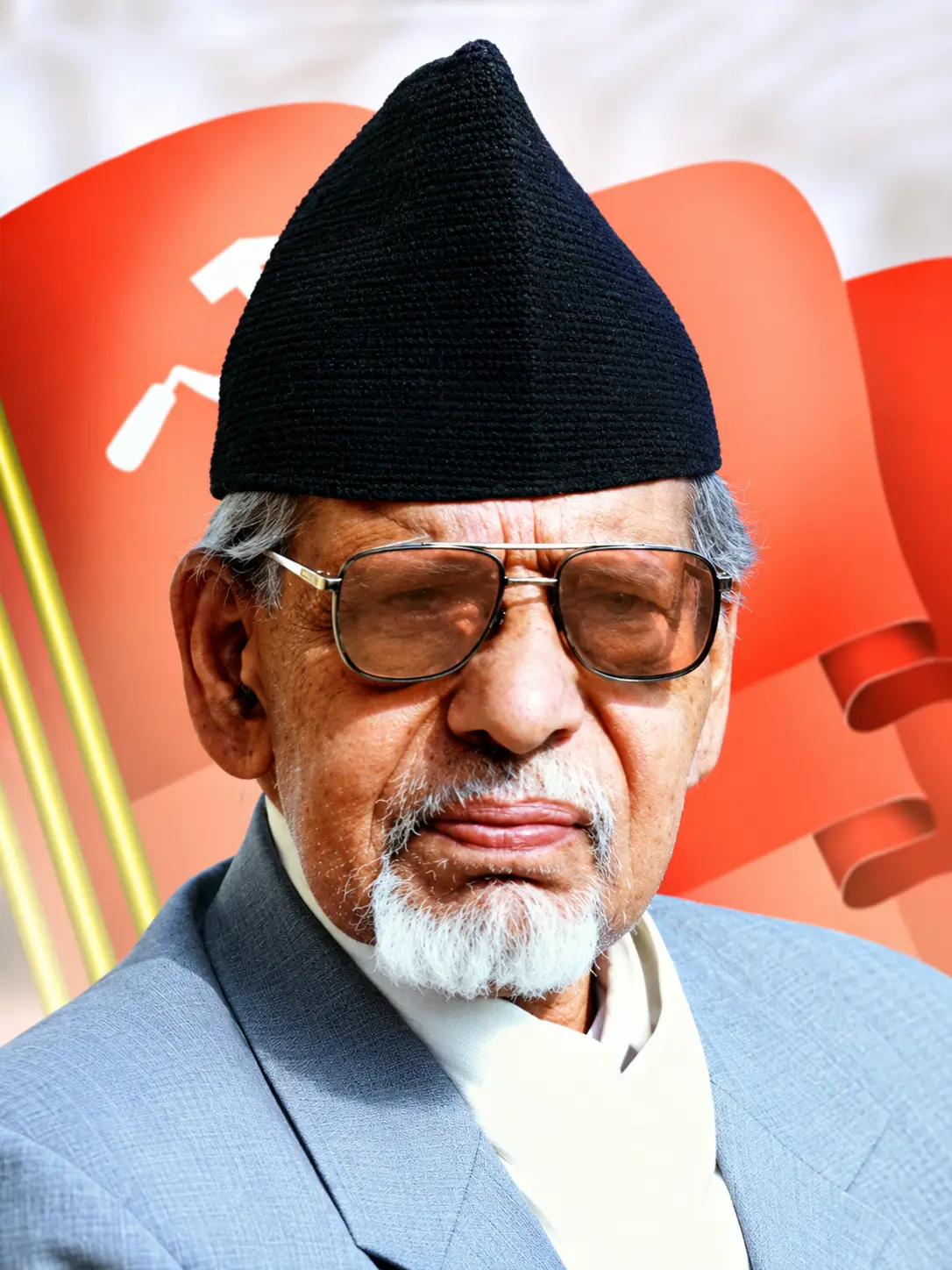
Manmohan Adhikari (1920–1999) was a former Prime Minister of Nepal, an influential communist leader, and a politician who supported multiparty democracy. He became Nepal's first communist Prime Minister to lead a government formed following a parliamentary election. He assumed office after the Communist Party of Nepal (Unified Marxist–Leninist), commonly known as CPN (UML), emerged as the largest party in the House of Representatives in the 1994 midterm election.
Adhikari served as Prime Minister from Mangsir 14, 2051 BS, to Bhadra 27, 2052 BS (November 30, 1994, to September 12, 1995). His minority government remained in office for approximately nine months. Two major initiatives introduced during this period—the senior citizen allowance and the Build Your Village Yourself program (Afno Gaun Afai Banau)—hold a significant place in the history of Nepal's social security and local development policies.
His political career began with his participation in India's Quit India Movement in 1942. He subsequently became involved in the Biratnagar workers' movement, the leadership of the Communist Party of Nepal, the struggle against the Panchayat system, the 1990 People's Movement, and multiparty parliamentary politics.
Adhikari's contributions extended beyond his tenure as Prime Minister. His involvement in the early leadership of the Communist Party of Nepal and his role as the founding chairman of CPN (UML) established him as an important figure in Nepal's leftist movement and parliamentary history.
Manmohan Adhikari: Quick Facts
|
Particulars |
Details |
|---|---|
|
Full name |
Manmohan Adhikari |
|
Date of birth |
Jestha 28, 1977 BS (1920 AD) |
|
Birthplace |
Lazimpat, Kathmandu, Nepal |
|
Date of death |
Baisakh 13, 2056 BS (April 26, 1999) |
|
Age at death |
78 years |
|
Place of death |
Tribhuvan University Teaching Hospital, Maharajgunj, Kathmandu |
|
Nationality |
Nepali |
|
Father |
Ram Chandra Adhikari |
|
Mother |
Purna Kumari Adhikari |
|
Spouse |
Sadhana Adhikari (Pradhan) |
|
Brother |
Bharat Mohan Adhikari |
|
Education |
Early education in Biratnagar and higher studies in Varanasi, India |
|
Major political parties |
Communist Party of Nepal, CPN (Marxist), CPN (UML) |
|
Major political positions |
General Secretary of the Communist Party of Nepal; founding Chairman of CPN (UML) |
|
Term as Prime Minister |
Mangsir 14, 2051 BS, to Bhadra 27, 2052 BS |
|
Type of government |
CPN (UML)-led minority government |
|
Major policy initiatives |
Senior citizen allowance; Build Your Village Yourself program |
Birth, Family Background, and Early Life
Birth in Kathmandu and Childhood in Biratnagar
Manmohan Adhikari was born on Jestha 28, 1977 BS, in Lazimpat, Kathmandu. His father was Ram Chandra Adhikari, and his mother was Purna Kumari Adhikari.
He spent his childhood in Biratnagar, Morang district. At the time, Biratnagar was developing as an important industrial center in Nepal's eastern Terai region. The city's labor movement later became closely associated with his political career.
His younger brother, Bharat Mohan Adhikari, also became active in Nepal's leftist politics. Bharat Mohan subsequently served as Finance Minister in the government led by Manmohan Adhikari.
Marriage and Family Life
Manmohan Adhikari's wife, Sadhana Pradhan, was also associated with Nepal's political movements. After their marriage, she became known as Sadhana Adhikari.
The couple had one son and one daughter.
An obituary published in The Guardian in 1999 described Adhikari's modest lifestyle and his tendency to keep his family separate from public political competition.
The account suggests that, despite his long political struggle, imprisonment, and party leadership responsibilities, Adhikari maintained a relatively private family life.
Education of Manmohan Adhikari
Early Education and Studies in Varanasi
Manmohan Adhikari received his early education in Biratnagar. Around 1938, he traveled to Varanasi, India, for higher studies.
Higher education opportunities in Nepal were limited at that time. Nepali students frequently traveled to Indian educational centers such as Banaras, Patna, and Calcutta to continue their studies.
Adhikari studied science in Varanasi. Some published biographical accounts associate his education with Banaras Hindu University.
Political Involvement During His Studies
In 1942, while studying science, Adhikari participated in India's Quit India Movement against British colonial rule.
He was arrested for his involvement in the movement, which disrupted his formal education.
Published accounts of his education differ regarding whether he completed his undergraduate studies and obtained a degree. Therefore, the available information does not provide a sufficient basis to identify a specific academic qualification.
Nevertheless, his years in Varanasi were an important stage in his intellectual and political development. During this period, he became increasingly involved with the Indian independence movement and communist political ideas.
Beginning of His Political Career
Participation in the Quit India Movement in 1942
Manmohan Adhikari's political activism began during India's struggle for independence.
In August 1942, the Quit India Movement was launched under Mahatma Gandhi's leadership against British colonial rule. Adhikari, then studying in Varanasi, participated in the movement.
The British Indian administration arrested him for his involvement. His experience of imprisonment brought him closer to political activism, organizational work, and leftist ideology.
Association with the Indian Communist Movement
During his stay in India, Adhikari came into contact with the Indian communist movement. He developed an interest in workers' rights, social inequality, and political change.
After returning to Nepal, he continued to prioritize labor organization and political activities.
His early political career reflected the historical connection between India's independence movement and Nepal's struggle against the Rana regime.
Role in the Biratnagar Workers' Movement
The Biratnagar workers' movement of 2003 BS (1947 AD) was a significant event in Manmohan Adhikari's political life.
After returning from India, Adhikari began working in Biratnagar's industrial sector. He played an active role in organizing workers and supporting activities related to their rights.
The Biratnagar Jute Mill Strike
On Falgun 21, 2003 BS (March 4, 1947), workers at Biratnagar Jute Mill launched a strike demanding better wages, improved working conditions, and labor rights.
Political and labor leaders, including Manmohan Adhikari, Girija Prasad Koirala, and Tarini Prasad Koirala, participated in the movement.
Initially, the workers focused on employment-related demands. As the movement expanded, it also developed into a political struggle against the Rana administration.
Arrest and Imprisonment
The Rana administration intervened in the Biratnagar workers' movement and arrested several leaders associated with it.
Manmohan Adhikari was among those detained. He and other political prisoners were taken from Biratnagar to Kathmandu and imprisoned.
Following this incident, his political activities increasingly combined the struggle for workers' rights with opposition to Rana rule.
The Biratnagar workers' movement is regarded as an important event in the history of Nepal's organized labor movement and democratic struggle.
Communist Party of Nepal: Formation and Early Leadership
Formation of the Communist Party of Nepal
The Communist Party of Nepal was established in Calcutta, India, under the leadership of Pushpa Lal Shrestha.
According to the official history published by CPN (UML), the party was founded on Baisakh 10, 2006 BS (April 22, 1949).
The five individuals identified as members of its initial founding group were Pushpa Lal Shrestha, Niranjan Govinda Vaidya, Nar Bahadur Karmacharya, Narayan Bilas Joshi, and Moti Devi Shrestha.
However, historical sources differ on the party's formal founding date. Some historians associate its formal establishment with September 15, 1949, when the party's central committee and manifesto were made public.
Manmohan Adhikari was not among the five members of the initial founding group. He subsequently became active in the party's early central leadership and later served as General Secretary.
Leadership Changes in 2008 BS
After Nepal's political change in 2007 BS, discussions emerged within the Communist Party of Nepal regarding organizational expansion and political direction.
The party held its first conference in Calcutta in 2008 BS. Some historical accounts indicate that the conference continued Pushpa Lal Shrestha's leadership.
However, disagreements over leadership developed after the conference. Following changes in the central leadership later that year, Manmohan Adhikari became General Secretary.
Different political historians and communist groups have offered varying assessments of the decisions and procedures associated with this leadership change.
First General Convention in 2010 BS
The Communist Party of Nepal's first general convention opened underground in Patan, Lalitpur, on Magh 10, 2010 BS.
According to historical records published by CPN (UML), the convention continued for approximately ten days.
The convention elected Manmohan Adhikari as General Secretary, establishing him as a central figure in Nepal's early communist movement.
Debate Over Constitutional Monarchy and Political Strategy
Around 2013 BS, disagreements emerged within the Communist Party of Nepal over legal political activities and the acceptance of constitutional monarchy.
The faction led by Manmohan Adhikari advocated peaceful political activities and operating the party within a constitutional system.
Another faction criticized this position as a political and ideological compromise.
The dispute reflected wider disagreements within Nepal's early communist movement regarding republicanism, constitutional monarchy, and political strategy.
Political Struggles During the Panchayat Era
Opposition to King Mahendra's Political Takeover
On Poush 1, 2017 BS, King Mahendra dismissed the elected government of Prime Minister Bishweshwar Prasad Koirala, dissolved Parliament, and banned political parties.
Nepal subsequently entered a period of partyless Panchayat rule.
Manmohan Adhikari opposed the King's decision. He was arrested during the Panchayat period and spent considerable time in prison.
From the anti-Rana movement to the Panchayat era, his involvement in political activities resulted in repeated imprisonment.
Attempts to Reorganize the Communist Movement
During the Panchayat period, the Communist Party of Nepal split into several ideological and organizational groups.
After his release from prison, Adhikari worked to reorganize the communist movement. He participated in political dialogue and organizational development among different groups.
The movement faced serious disagreements over leadership, ideology, and political strategy.
Although Adhikari participated in efforts to reunify communist groups, lasting unity among all factions could not be achieved.
Support for Multiparty Democracy During the Referendum
Following the student movement of 2036 BS, King Birendra announced a referendum on whether Nepal should retain the Panchayat system or adopt multiparty democracy.
The referendum, held in 2037 BS, produced a result in favor of a reformed Panchayat system.
Manmohan Adhikari supported multiparty democracy and continued raising issues concerning democratic rights and communist political organization throughout the Panchayat period.
Formation of CPN (Marxist) and the 1990 People's Movement
Establishment of CPN (Marxist)
In 2043 BS, the communist group led by Manmohan Adhikari merged with a communist faction associated with Sahana Pradhan.
The merger resulted in the formation of the Communist Party of Nepal (Marxist).
Adhikari and Pradhan became prominent leaders of the new party.
The unification also helped establish a basis for cooperation among communist groups participating in the movement against Panchayat rule.
United Left Front and the People's Movement
During the People's Movement of 2046 BS (1990 AD), the Nepali Congress and several leftist parties joined the struggle against the Panchayat system.
The United Left Front, led by Sahana Pradhan, was a major participant in the movement. Manmohan Adhikari was also involved as a leader of CPN (Marxist).
The movement began on Falgun 7, 2046 BS. On Chaitra 26, the ban on political parties was lifted, and multiparty democracy was restored.
This political change allowed communist leaders, including Adhikari, to participate openly in parliamentary politics.
Formation of CPN (UML) and Adhikari's Leadership
Merger of CPN (Marxist) and CPN (Marxist–Leninist)
On Poush 22, 2047 BS, CPN (Marxist), led by Manmohan Adhikari, merged with CPN (Marxist–Leninist), whose General Secretary was Madan Bhandari.
The merger established the Communist Party of Nepal (Unified Marxist–Leninist), or CPN (UML).
Manmohan Adhikari became the party's Chairman, while Madan Bhandari became General Secretary.
Adhikari brought his long political experience to the chairmanship, while Bhandari led the party's organizational activities and political direction.
The merger was an important development in the emergence of CPN (UML) as a major force in Nepal's multiparty parliamentary politics.
The 2048 BS General Election
Nepal held its first House of Representatives election following the restoration of multiparty democracy in 2048 BS (1991 AD).
The Nepali Congress secured a majority, while CPN (UML) emerged as the principal opposition party.
Manmohan Adhikari was elected to the House of Representatives from Sunsari Constituency No. 1.
As leader of the CPN (UML) parliamentary party, he assumed the responsibilities of the principal opposition leader.
During this period, he led the opposition in Parliament and questioned government policies and decisions.
Fifth General Convention and People's Multiparty Democracy
CPN (UML) held its fifth national general convention in Magh 2049 BS.
The convention adopted the political program known as People's Multiparty Democracy (Janata Ko Bahudaliya Janabad), presented by Madan Bhandari.
The program addressed multiparty political competition and the political direction of the communist party.
Following the convention, Manmohan Adhikari continued as Chairman, while Madan Bhandari remained General Secretary.
Party Leadership After Madan Bhandari's Death
On Jestha 3, 2050 BS, Madan Bhandari and Jibaraj Ashrit died in a jeep accident at Dasdhunga, Chitwan.
Madhav Kumar Nepal subsequently became General Secretary of CPN (UML).
Manmohan Adhikari continued serving as the party's Chairman.
How Did Manmohan Adhikari Become Prime Minister?
Manmohan Adhikari became Nepal's first communist Prime Minister following the midterm parliamentary election of 2051 BS (1994 AD).
The House of Representatives had been dissolved following political disagreements within the Nepali Congress. A midterm election was subsequently held on Kartik 29, 2051 BS (November 15, 1994).
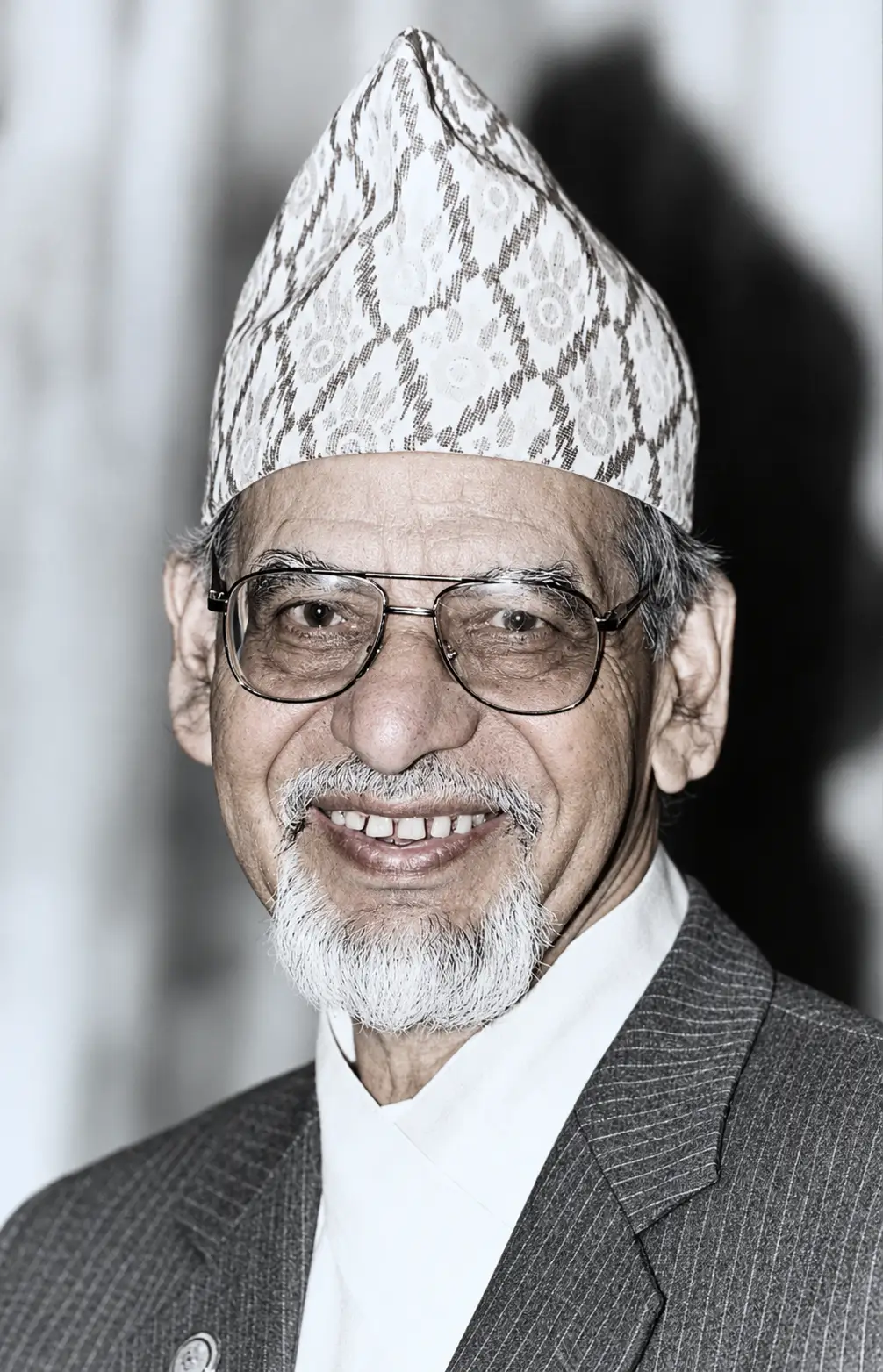
Results of the 1994 Midterm Election
According to the election records of the Inter-Parliamentary Union (IPU), the 205 seats in the House of Representatives were distributed as follows:
|
Political Party |
Seats Won |
|---|---|
|
Communist Party of Nepal (UML) |
88 |
|
Nepali Congress |
83 |
|
Rastriya Prajatantra Party |
20 |
|
Nepal Workers and Peasants Party |
4 |
|
Nepal Sadbhavana Party |
3 |
|
Independent candidates |
7 |
|
Total |
205 |
No party secured an outright majority. CPN (UML) became the largest party in the House of Representatives.
Under Article 42(2) of the Constitution of the Kingdom of Nepal, 2047 BS, Manmohan Adhikari was appointed Prime Minister as the parliamentary leader of the largest party.
He assumed office on Mangsir 14, 2051 BS (November 30, 1994).
Nepal's First Communist-Led Government
Manmohan Adhikari headed a minority government led by CPN (UML).
With only 88 seats in the 205-member House of Representatives, the party depended on parliamentary support from other parties to maintain its government.
As the Prime Minister of a minority government, Adhikari had the constitutional and political responsibility of maintaining Parliament's confidence.
Major Members of His Cabinet
Several CPN (UML) leaders served as ministers in Manmohan Adhikari's government.
Madhav Kumar Nepal served as Deputy Prime Minister, Bharat Mohan Adhikari as Finance Minister, and KP Sharma Oli as Home Minister.
Other cabinet members included Chandra Prakash Mainali, Radha Krishna Mainali, Modnath Prashrit, Pradeep Nepal, and Padma Ratna Tuladhar, who held various ministerial responsibilities.
Major Policies and Programs of the Manmohan Adhikari Government
During Manmohan Adhikari's tenure as Prime Minister, his government introduced several initiatives related to social security, local development, and land management.
Among these, the senior citizen allowance and the Build Your Village Yourself program are particularly notable.
Build Your Village Yourself Program
The Build Your Village Yourself program (Afno Gaun Afai Banau) was one of the major local development initiatives introduced by the Manmohan Adhikari government.
On Poush 11, 2051 BS, Finance Minister Bharat Mohan Adhikari presented a supplementary budget emphasizing rural development.
The program aimed to provide Village Development Committees (VDCs) with financial resources to implement development projects based on local needs.
Under the initiative, each Village Development Committee was allocated NPR 300,000 for development activities.
The program promoted the use of these funds for local roads, drinking water, irrigation, and other small-scale infrastructure projects.
It represented an effort to make public resources available at the local level and encourage community participation in development planning.
However, determining whether the program produced similar results across all villages would require a separate assessment of its implementation.
Introduction of the Senior Citizen Allowance
The senior citizen allowance is among the most widely recognized social security initiatives associated with Manmohan Adhikari's government.
On December 26, 1994, the government announced a policy to provide a monthly allowance of NPR 100 to Nepali citizens aged 75 years and above.
It was a non-contributory social security program, meaning beneficiaries were not required to make prior financial contributions to a social security fund.
During its initial phase, the program was implemented on a pilot basis in five districts representing Nepal's five development regions.
According to S. Irudaya Rajan's 2003 study, Old Age Allowance Program in Nepal, the first payment was made on July 2, 1995. It covered the period from January to June 1995.
The study is available through the United Kingdom government's development research archive.
The initiative established a system through which the government provided regular financial assistance to citizens within a specified older age group.
Successive governments subsequently changed and expanded the allowance amounts, age requirements, and categories of beneficiaries.
Therefore, the original senior citizen allowance should not be treated as identical to Nepal's present-day social security system.
The Nine 'Sa' Development Program
In its budget for fiscal year 2052/53 BS, the Manmohan Adhikari government introduced a rural development initiative known as the Nine 'Sa' Program (Nau 'Sa' Karyakram).
The program prioritized local roads, small irrigation projects, drinking water, healthcare, education, skills development, and rural infrastructure.
Its purpose was to expand access to basic services and support local economic activities in rural areas.
However, policy announcements and actual achievements are different matters. Evidence of implementation would be necessary to establish whether all the proposed activities were completed.
Initiatives to Address Landlessness and Squatter Settlements
The Manmohan Adhikari government also introduced initiatives to address the problems faced by landless families and informal settlers, commonly referred to in Nepal as sukumbasi.
In 2051 BS, the government formed a Landless People's Problem Resolution Commission under the leadership of Rishi Raj Lumsali.
According to a Kantipur report citing information from the Ministry of Land Management and Poverty Alleviation, the commission distributed 21,974 bighas of land to 58,340 families.
A high-level commission was also established to study land reform issues and provide recommendations.
Despite these initiatives, landlessness and unplanned settlements remained long-term problems in Nepal.
The formation of commissions and distribution of land should therefore not be presented as a complete solution to the country's landlessness problem.
Foreign Policy During Manmohan Adhikari's Government
As Prime Minister, Manmohan Adhikari attached importance to Nepal's bilateral relationships with India and China.
He visited both neighboring countries in 1995.
Visit to India and Discussion of the 1950 Treaty
Manmohan Adhikari undertook an official goodwill visit to India from April 10 to 14, 1995.
During the visit, he held discussions with Indian Prime Minister P. V. Narasimha Rao on bilateral relations.
Details of the visit are included in a compilation of joint statements published by Nepal's Institute of Foreign Affairs.
The discussions covered Nepal–India relations, economic cooperation, regional issues, and matters concerning a review of the 1950 Treaty of Peace and Friendship.
However, the treaty was not amended during Adhikari's tenure.
Relations with China
Manmohan Adhikari also visited China in April 1995.
The visit included discussions on bilateral relations, economic cooperation, and regional political issues.
His government maintained diplomatic engagement with both neighboring countries while pursuing matters of mutual cooperation.
Dissolution of the House of Representatives and the Supreme Court Ruling
One of the most significant constitutional controversies during Manmohan Adhikari's tenure concerned the dissolution of the House of Representatives in 2052 BS.
Opposition parties had begun the process of bringing a motion of no confidence against his minority government.
Recommendation to Dissolve Parliament
On Jestha 26, 2052 BS, Prime Minister Adhikari recommended the dissolution of the House of Representatives to the King under Article 53(4) of the Constitution of the Kingdom of Nepal, 2047 BS.
King Birendra subsequently dissolved the House of Representatives on Jestha 30, 2052 BS.
Adhikari argued that a fresh election was necessary to obtain a new public mandate.
Opposition parties challenged the dissolution, arguing that an alternative government could be formed within the existing House of Representatives.
Petitions were filed in the Supreme Court against the dissolution.
Supreme Court Decision
On Bhadra 12, 2052 BS (August 28, 1995), the Supreme Court annulled the dissolution and ordered the restoration of the House of Representatives.
A special bench that included Chief Justice Bishwanath Upadhyaya heard the constitutional dispute.
The principal issues involved the process of convening a special parliamentary session, the motion of no confidence, and the possibility of forming an alternative government.
The ruling established that the Prime Minister's authority to dissolve the House of Representatives could not be considered separately from parliamentary accountability and the overall constitutional structure.
The decision is regarded as an important judicial precedent in Nepal's parliamentary and constitutional history.
Manmohan Adhikari's No-Confidence Vote From Hospital
On Shrawan 29, 2052 BS, Manmohan Adhikari was injured in a helicopter accident.
Following the accident, he received treatment at Tribhuvan University Teaching Hospital in Maharajgunj, Kathmandu.
After the Supreme Court restored the House of Representatives, his government faced a motion of no confidence in Parliament.
Parliamentary Address From Hospital
Due to his health condition, Adhikari was unable to attend the parliamentary session in person.
On Bhadra 25, 2052 BS, he responded to the issues raised in the no-confidence motion through a recorded television address from the hospital.
According to an account based on Kantipur's historical archives, a television screen was installed at the parliamentary meeting venue so that lawmakers could hear his address.
Adhikari read the opening portion of his statement. Deputy Prime Minister Madhav Kumar Nepal subsequently read the remaining portion.
The address was broadcast by Radio Nepal and Nepal Television.
The incident is remembered as an unusual episode in Nepal's parliamentary history, in which a sitting Prime Minister addressed a no-confidence motion while receiving hospital treatment.
Passage of the No-Confidence Motion
The House of Representatives voted on the motion of no confidence on Bhadra 25, 2052 BS.
The motion received 107 votes in favor and 88 against.
After the motion passed, Manmohan Adhikari resigned as Prime Minister.
On Bhadra 27, 2052 BS, a new government was formed under Sher Bahadur Deuba.
This brought Adhikari's approximately nine-month minority government to an end.
Assessment of the Manmohan Adhikari Government
An assessment of Manmohan Adhikari's government requires consideration of both its social security initiatives and its parliamentary controversies.
His administration introduced the senior citizen allowance and local development grant programs. These initiatives became part of the subsequent development of Nepal's social security and local development policies.
However, opposition parties questioned the government's economic management, administrative appointments, civil service practices, and constitutional procedures.
The motion of no confidence against his government included allegations concerning economic policy, administrative management, foreign policy, and parliamentary conduct.
These were political allegations made by opposition parties at the time and should not be presented as independently established facts.
The Supreme Court's annulment of the government's decision to dissolve the House of Representatives, however, is confirmed by judicial records.
Adhikari's administration therefore remains significant in Nepal's parliamentary history for both its social security initiatives and the constitutional disputes associated with its tenure.
Political Career After Leaving the Prime Minister's Office
Role as Opposition Leader
After resigning as Prime Minister, Manmohan Adhikari remained active as Chairman of CPN (UML) and a parliamentary leader.
He continued participating in opposition politics while maintaining responsibilities in party organization and political activities.
During this period, disagreements within CPN (UML) increased over the Mahakali Treaty, political strategy, and leadership.
Mahakali Treaty Dispute and Party Split
The Nepal–India Mahakali Treaty, ratified by Parliament in 2053 BS, became a major source of disagreement within CPN (UML).
Party leaders differed in their assessment of the treaty and the party's broader political direction.
In 2054 BS, a faction including Bam Dev Gautam, Sahana Pradhan, and Chandra Prakash Mainali separated from CPN (UML).
The group subsequently formed CPN (Marxist–Leninist).
Despite the split, Manmohan Adhikari remained Chairman of CPN (UML) until his death.
Personality and Public Image
Manmohan Adhikari is remembered in Nepalese political history as a leader associated with a modest lifestyle and a willingness to engage in political dialogue.
Such assessments of his personality are based on the experiences of political contemporaries, journalists, and published accounts.
A 1999 obituary in The Guardian discussed his simple way of life, his decision not to promote family members as political successors, and his approach to public life.
Another notable aspect of his political career was his participation in competitive multiparty parliamentary politics after decades of political struggle.
Final Years and Death
The 2056 BS Election Campaign
During preparations for the House of Representatives election of 2056 BS (1999 AD), Manmohan Adhikari remained active in CPN (UML)'s election campaign.
He was 78 years old at the time.
His political role was particularly important to the party as it prepared for an election following its organizational split.
Illness in Gothatar
On Baisakh 6, 2056 BS (April 19, 1999), Adhikari became seriously ill during an election program in Gothatar, Kathmandu.
Following a heart attack, he was admitted to Tribhuvan University Teaching Hospital in Maharajgunj.
Despite receiving treatment, his condition did not improve.
Manmohan Adhikari died on Baisakh 13, 2056 BS (April 26, 1999), at the age of 78.
His death marked the end of a political career that had extended from Nepal's early communist movement to the era of multiparty parliamentary democracy.
Historical Contributions and Political Legacy
Manmohan Adhikari's contributions can be assessed through his involvement in the labor movement, communist party organization, multiparty parliamentary politics, and social security policy.
Contribution to the Labor Movement
Adhikari played an active role in the Biratnagar workers' movement of 2003 BS.
The movement was connected to the history of organized labor rights and political resistance against the Rana administration.
His involvement helped link workers' organizational activities with the broader struggle for political change.
Development of Nepal's Communist Movement
Adhikari participated in the early leadership of the Communist Party of Nepal, efforts to reorganize the movement during the Panchayat period, and the leadership of CPN (Marxist).
Following the merger of CPN (Marxist) and CPN (Marxist–Leninist) in 2047 BS, he became the founding Chairman of CPN (UML).
These roles connected him with several important phases in the organizational history of Nepal's communist movement.
Contribution to Multiparty Parliamentary Politics
Following the People's Movement of 2046 BS, Adhikari participated actively in multiparty elections and parliamentary proceedings.
He led the principal opposition party after the 2048 BS election and became Prime Minister in 2051 BS.
His appointment marked the first formation of a communist-led parliamentary government in Nepal.
His tenure provided experience in government formation and administration by a communist party within a parliamentary system, while also highlighting the roles of opposition parties and constitutional accountability.
Contribution to Social Security Policy
The senior citizen allowance remains one of the principal social security programs associated with Adhikari's government.
Initially, citizens aged 75 years and above were eligible for a monthly allowance of NPR 100.
The initiative established a practice of providing regular state-funded financial assistance to older citizens.
Social security allowances were subsequently expanded to additional groups.
However, not all programs that later became part of Nepal's social security system originated during Adhikari's administration.
Contribution to Local Development Policy
The Build Your Village Yourself initiative represented an important effort to direct development funds to Village Development Committees.
It encouraged the implementation of small development projects according to local priorities.
The program is considered to have contributed to discussions about fiscal decentralization and the use of public resources at the local level.
Institutions Named in Memory of Manmohan Adhikari
Several educational, technical, and healthcare institutions in Nepal have been established or named in memory of Manmohan Adhikari.
Manmohan Memorial Foundation
The Manmohan Memorial Foundation is an organization associated with preserving the memory of Adhikari's life and political contributions.
The foundation has organized commemorative programs and social activities.
Manmohan Technical University
Manmohan Technical University is a university located in Morang district, Koshi Province, Nepal.
It was established under the Manmohan Technical University Act, 2076 BS.
The university's development is associated with Manmohan Memorial Polytechnic.
It offers technical and vocational higher education programs.
Further institutional information is available in the Manmohan Technical University profile.
Other Healthcare and Educational Institutions
Institutions associated with cardiac treatment and health sciences education also operate in Kathmandu under Manmohan Adhikari's name.
Their naming reflects the association of his memory with healthcare and education, in addition to politics.
Conclusion
Manmohan Adhikari was a political leader whose career extended across several major phases of Nepal's modern political history, including the labor movement, communist party organization, the struggle against the Panchayat system, and multiparty parliamentary democracy.
His involvement in India's independence movement, the Biratnagar workers' struggle, the 1990 People's Movement, and the formation of CPN (UML) reflected his long engagement in political organization and democratic activities.
His approximately nine-month tenure as Prime Minister from 1994 to 1995 is particularly remembered for the introduction of the senior citizen allowance and local development grants.
At the same time, the controversy surrounding the dissolution of the House of Representatives resulted in an important Supreme Court ruling concerning parliamentary accountability and constitutional limits.
Manmohan Adhikari's political life is therefore best understood by considering his policy initiatives, party leadership, participation in democratic politics, and the achievements and limitations of his government.
References and Sources
1. Government of Nepal, Office of the Prime Minister and Council of Ministers. List of Former Prime Ministers of Nepal.
2. Inter-Parliamentary Union (IPU). Nepal: Parliamentary Elections, 1994. Election results and records relating to government formation.
3. Communist Party of Nepal (UML). Establishment of the Communist Party of Nepal. Official account of the party's founding date and founding members.
4. Communist Party of Nepal (UML). First General Convention of the Communist Party of Nepal. Historical account of the first general convention and the election of the General Secretary.
5. Communist Party of Nepal (UML). Fourth General Convention and Early Leadership of CPN (UML). Historical information concerning the party's unification in 2047 BS.
6. Supreme Court of Nepal, Nepal Law Journal. Judgment Concerning the Dissolution of the House of Representatives, 2052 BS. Judicial record relating to the dissolution and restoration of Parliament.
7. Rajan, S. Irudaya (2003). Old Age Allowance Program in Nepal. Research published in the United Kingdom government's development research archive.
8. Institute of Foreign Affairs, Nepal. A Compilation of Joint Communiqués and Press Statements Issued by Governments of Nepal and India During Prime Ministers' Official Visits. Includes the joint statement relating to Manmohan Adhikari's official visit to India in April 1995.
9. Kantipur (2025). The Budget Presented in Parliament by a Communist Government 32 Years Ago. Historical budget records concerning local development grants and senior citizen allowances.
10. Karobar Daily. A Pioneer of Fiscal Decentralization. Information concerning Bharat Mohan Adhikari's budget, the Build Your Village Yourself program, and the Nine 'Sa' initiative.
11. Kantipur (2022). Thirteen Commissions Formed in 30 Years in the Name of Landless Settlers. Information about landless settlement commissions and land distribution.
12. Kantipur Archives (2025). The No-Confidence Motion Manmohan Adhikari Faced From His Hospital Bed. Historical account of the parliamentary proceedings in 2052 BS.
13. Goldenberg, Suzanne (1999). Man Mohan Adhikari. The Guardian, May 4, 1999. Contemporary obituary discussing his lifestyle, political contributions, and death.
14. Rastriya Samachar Samiti, The Rising Nepal (2024). Man Mohan Adhikari: A Tireless Warrior of Left-Democratic Movement. Account of his political struggles, social security initiatives, and death.
15. Manmohan Technical University. Introduction to Manmohan Technical University. Official university information concerning its establishment, institutional background, and academic activities.



Comments 0
No comments yet. Be the first to start the conversation.