



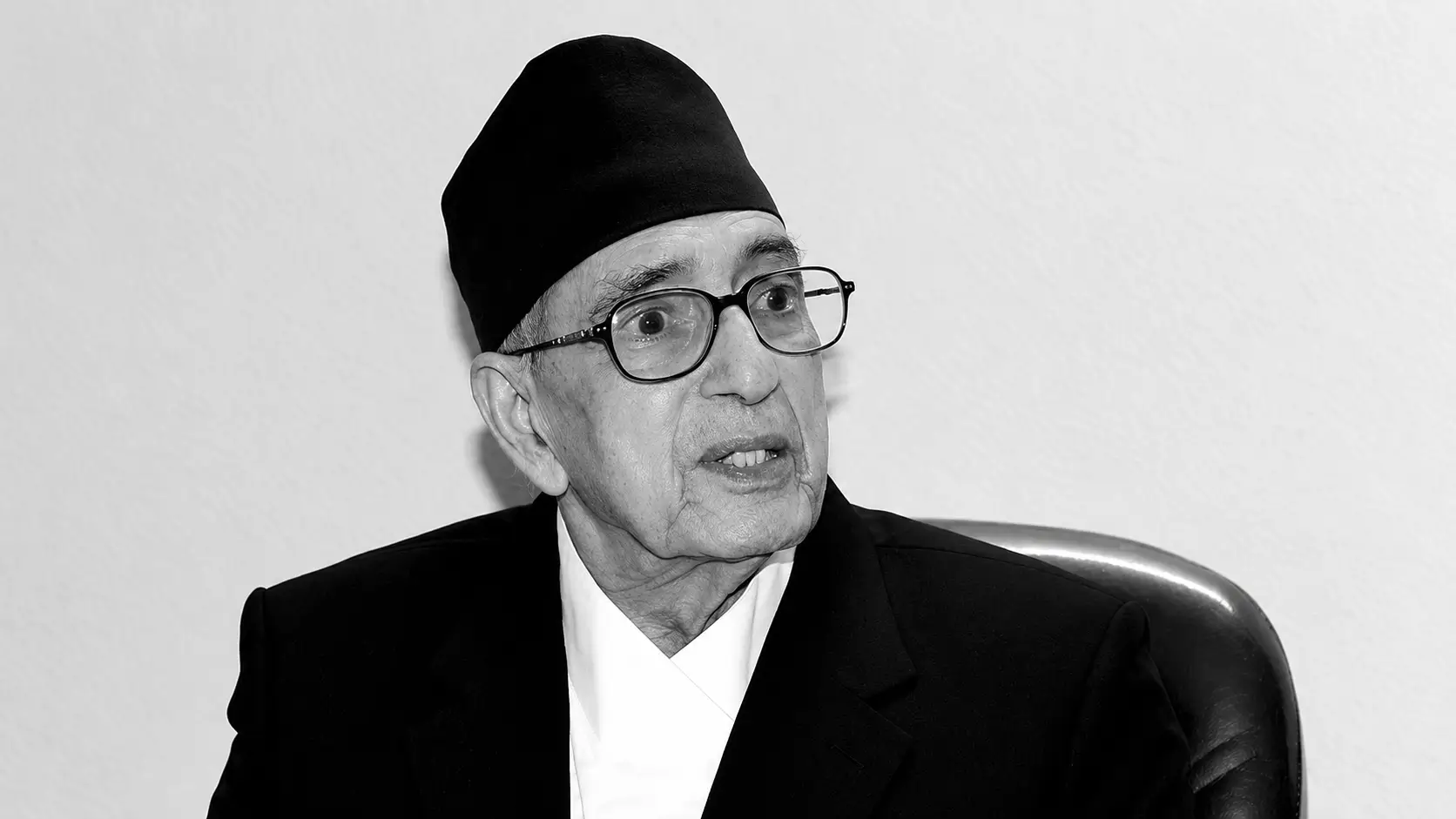
Girija Prasad Koirala was a former Prime Minister of Nepal, former President of the Nepali Congress, and a prominent leader of Nepal's democratic movements. Beginning his political career in the workers' movement, he remained active in the struggle against Rana rule, opposition to the Panchayat system, restoration of multiparty democracy, and Nepal's peace process.
He served as Nepal's Prime Minister during four major periods between 1991 and 2008. He was President of the Nepali Congress from 1996 until his death in 2010. During Nepal's political transition from 2007 to 2008, he also performed the functions of interim head of state while serving as Prime Minister.
His political career extended from the Biratnagar workers' movement of BS 2003 to the People's Movement of 2006, the Comprehensive Peace Agreement, the Constituent Assembly election, and the establishment of a republic.
One of his most significant contributions was his role as Prime Minister in signing the Comprehensive Peace Agreement between the Government of Nepal and the then Communist Party of Nepal (Maoist) on 21 November 2006. The agreement formally ended the armed conflict that had continued since 1996 and laid the groundwork for Nepal's political transition.
Koirala's political career is remembered for his contributions to democratic movements and the peace process. However, it was also marked by internal party leadership struggles, parliamentary instability, controversies over economic policies, and criticism of security measures adopted during the armed conflict. A balanced historical assessment must consider both his achievements and these controversies.
Girija Prasad Koirala: Quick Facts
|
Details |
Information |
|---|---|
|
Full Name |
Girija Prasad Koirala |
|
Popular Names |
Girijababu, GP Koirala |
|
Date of Birth |
4 July 1924, according to the G.P. Koirala Foundation |
|
Place of Birth |
Tedi, Saharsa, Bihar, then British India |
|
Date of Death |
20 March 2010 (BS 2066 Chaitra 7) |
|
Place of Death |
Kathmandu, Nepal |
|
Father |
Krishna Prasad Koirala |
|
Mother |
Divya Koirala |
|
Spouse |
Sushma Koirala |
|
Daughter |
Sujata Koirala |
|
Political Party |
Nepali Congress |
|
Prime Ministerial Periods |
1991–1994, 1998–1999, 2000–2001, and 2006–2008 |
|
President of Nepali Congress |
1996–2010 |
|
Major Political Involvement |
Workers' movement, democratic movements, parliamentary politics, peace process, and transition to a republic |
Historical records differ regarding Koirala's exact date of birth. The G.P. Koirala Foundation records his birth as 4 July 1924. Nepali news sources mention BS 1981 Ashadh 18, while historian John Whelpton, writing in The Guardian, gave 20 February 1925 in his obituary. Because these dates do not fully correspond, they should not be treated as equivalent calendar conversions of the same date.
Birth, Family, and Early Life
Girija Prasad Koirala was born in Tedi, in the Saharsa district of Bihar, then part of British India. At the time, his father, Krishna Prasad Koirala, and other family members were living in exile in India because of their opposition to Nepal's Rana regime.
Krishna Prasad Koirala was involved in business, social reform, and anti-Rana activities. He was an outspoken critic of Rana rule. Because of his family's political involvement, Girija Prasad spent his childhood amid changing political circumstances in India and Nepal.
His mother, Divya Koirala, was also associated with the family's political struggle.
Two of Girija Prasad's elder brothers, Matrika Prasad Koirala and Bishweshwar Prasad (BP) Koirala, also served as Prime Ministers of Nepal. Matrika Prasad Koirala became Prime Minister following the political change of BS 2007, while BP Koirala became Nepal's first democratically elected Prime Minister after the general election of BS 2015.
Thus, three sons of Krishna Prasad Koirala became Prime Ministers of Nepal.
Following the death of Chandra Shumsher in 1929, conditions became more favorable for the Koirala family's return to Nepal. The family subsequently settled in Biratnagar.
Available accounts of Girija Prasad Koirala's early education refer to both India and Biratnagar. He also studied in India. However, biographical sources do not provide consistent details about his higher education, duration of study, or formal academic qualifications.
His youth coincided with India's independence movement and the expansion of political activities against Rana rule in Nepal. The political involvement of his family members also drew him toward organizational activities and political movements.
Beginning of His Political Career: The Biratnagar Workers' Movement
Girija Prasad Koirala's organized political career is generally considered to have begun with the Biratnagar Jute Mill workers' movement in 1947.
On 4 March 1947, workers at Biratnagar Jute Mill began a strike demanding higher wages, better working conditions, housing, and other labor rights.
Among the principal figures involved in initiating the movement were Girija Prasad Koirala, Tarini Prasad Koirala, Manmohan Adhikari, Yuvraj Adhikari, and Gehendra Hari Sharma.
Initially focused on workers' rights, the strike subsequently became connected to the broader political struggle against Rana rule.
The involvement of BP Koirala and other democratic leaders expanded the movement.
The Rana government deployed soldiers to suppress the protests. Girija Prasad Koirala and other movement leaders were arrested, taken from Biratnagar to Kathmandu, and imprisoned.
The movement became an important event in the history of organized labor rights and anti-Rana political activities in Nepal.
Nepal Workers' Congress and the Trade Union Movement
Following the Biratnagar movement, Koirala remained active in organizing workers.
He contributed to the establishment and organizational expansion of the Nepal Workers' Congress, which later developed into the Nepal Trade Union Congress.
At that time, Nepal had not yet developed a modern legal system governing labor rights. Workers were struggling for the right to establish organizations, present collective demands, and improve their working conditions.
Koirala initially established his political identity as a labor leader. He later became active in the district and central leadership of the Nepali Congress.
The BS 2007 Revolution and Expansion of the Nepali Congress
Girija Prasad Koirala was an active organizer for the Nepali Congress during the democratic revolution of BS 2007.
He played a role in political mobilization and organizational activities in eastern Nepal during the Congress-led movement to end Rana rule.
The political change of BS 2007 ended hereditary Rana rule and initiated a new political process aimed at developing democratic governance in Nepal.
During this period, Koirala concentrated on expanding the party organization rather than seeking a position in the national government.
In the early 1950s, he became President of the Nepali Congress Morang District Committee. He was active in developing the party's local organizations and network of workers in Biratnagar and surrounding areas.
According to the biography published by the G.P. Koirala Foundation, he became a member of the Nepali Congress Central Working Committee in 1959.
The Royal Takeover of BS 2017, Imprisonment, and Exile in India
On BS 2017 Poush 1 (15 December 1960), King Mahendra dismissed the elected government led by BP Koirala and dissolved Parliament. Political parties were banned, and the partyless Panchayat system was introduced.
Girija Prasad Koirala was arrested along with other Nepali Congress leaders who opposed the royal takeover.
He spent approximately seven years in prison. After his release, he went into exile in India and continued his political involvement with the Nepali Congress.
During their exile in India, Congress leaders and party workers continued organizational activities and preparations for movements against the Panchayat system.
The Nepali Congress adopted various political strategies against the Panchayat administration during this period. Koirala was also involved in the party's phase of armed struggle.
The Aircraft Hijacking of BS 2030
The aircraft hijacking of BS 2030 remains a controversial historical event associated with Koirala's political career.
On 10 June 1973, individuals associated with the Nepali Congress hijacked a Royal Nepal Airlines Corporation aircraft flying from Biratnagar to Kathmandu.
Durga Subedi, Nagendra Dhungel, and Basanta Bhattarai were directly involved in the incident. The objective was to obtain government money being transported on the aircraft for use in the political struggle.
Durga Subedi's memoirs and subsequently published historical accounts describe Girija Prasad Koirala's involvement in planning the incident.
The passengers and aircraft were later returned safely.
The incident was connected to the armed-struggle strategy adopted by the Nepali Congress against the Panchayat system. However, the hijacking of a passenger aircraft for political purposes has remained a subject of criticism and historical debate.
General Secretary of the Nepali Congress and the Anti-Panchayat Movement
Koirala became General Secretary of the Nepali Congress in the 1970s. In this position, he played an active role in managing the party organization and movements against the Panchayat system.
Following BP Koirala's return to Nepal in BS 2033 under the policy of national reconciliation, the Nepali Congress changed its political strategy.
Koirala continued to serve in the party's leadership during the referendum of BS 2036 and the Satyagraha movement of BS 2042.
He remained politically active in favor of restoring multiparty democracy.
The People's Movement of BS 2046 and Restoration of Multiparty Democracy
Girija Prasad Koirala was among the principal Nepali Congress leaders during the People's Movement of BS 2046.
The Nepali Congress and left-wing political forces jointly organized the movement against the Panchayat system.
Political parties, students, professional organizations, and members of the general public participated in the protests.
Under pressure from the movement, King Birendra announced the restoration of multiparty democracy.
A new constitution was subsequently promulgated, and preparations began for parliamentary elections.
Following the People's Movement, Koirala emerged as a parliamentary leader of the Nepali Congress and eventually became head of government.
Girija Prasad Koirala's Terms as Prime Minister
Girija Prasad Koirala served as Nepal's Prime Minister during four distinct political periods between 1991 and 2008.
However, the official list of former Prime Ministers published by Nepal's Office of the Prime Minister and Council of Ministers records five terms under his name. The difference arises from changes in the composition of the government and coalition arrangements during 1998–1999, which are counted as separate cabinet terms.
General biographies usually present his time as Prime Minister in the following four major periods.
|
Period |
Major Political Developments |
|---|---|
|
1991–1994 |
First elected government after the restoration of multiparty democracy and economic liberalization |
|
1998–1999 |
Coalition politics, Maoist conflict, and the general election of BS 2056 |
|
2000–2001 |
Maoist conflict, royal palace massacre, and political controversies |
|
2006–2008 |
Government following the People's Movement, peace agreement, Constituent Assembly election, and establishment of a republic |
First Term as Prime Minister: BS 2048–2051
Girija Prasad Koirala became Prime Minister for the first time after the Nepali Congress secured a majority in the House of Representatives in the general election of BS 2048.
He assumed leadership of the government in May 1991.
This was the first parliamentary general election held after the political change of BS 2046. The Nepali Congress formed a majority government following the election.
During Koirala's first term, Nepal introduced changes related to economic liberalization, private-sector participation, and industrial policy.
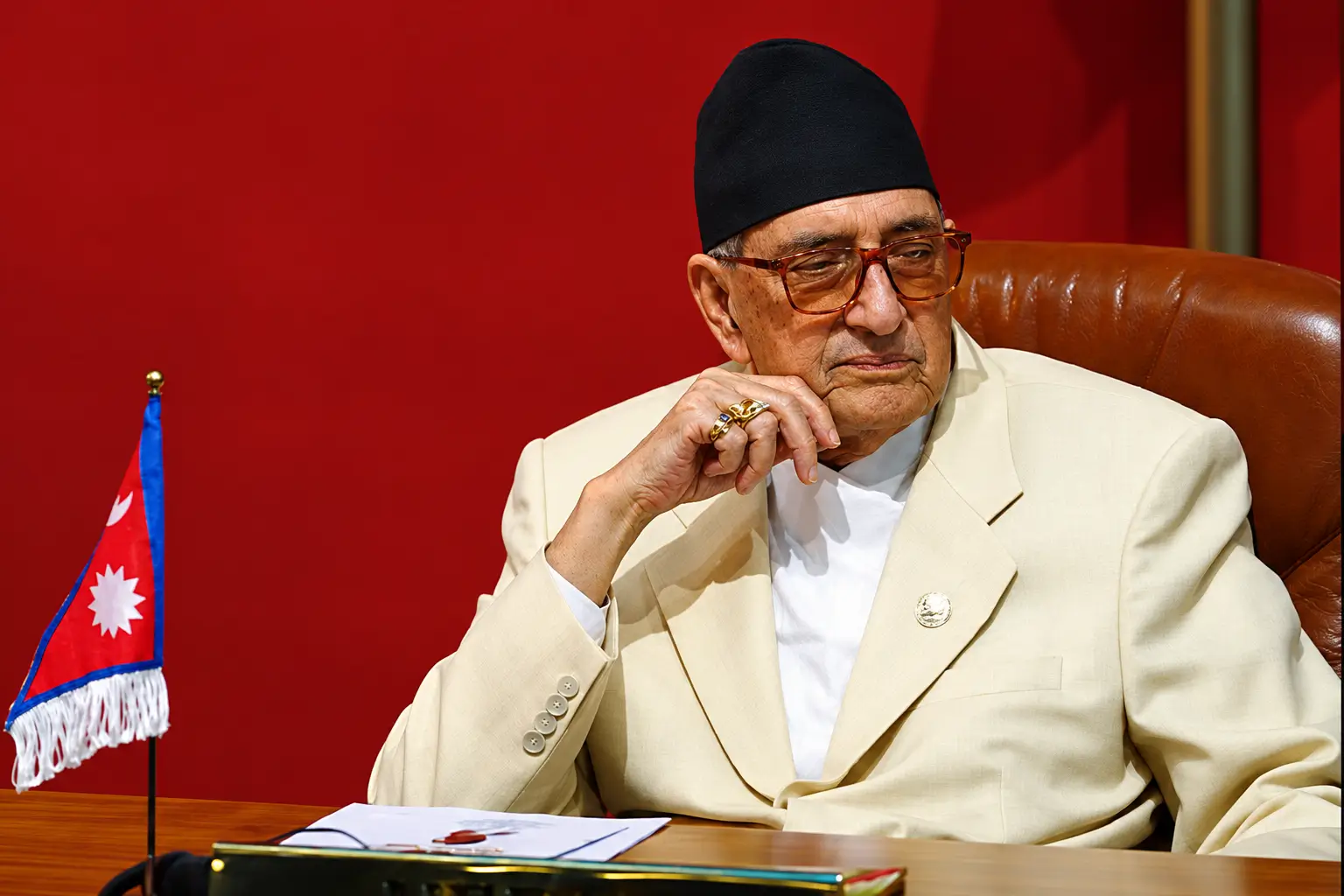
Economic Liberalization and Legal Reforms
In the early 1990s, Nepal began shifting from a controlled economic system toward policies encouraging greater private-sector participation.
During Koirala's administration, legislation such as the Industrial Enterprises Act, 2049, and the Foreign Investment and Technology Transfer Act, 2049, was enacted.
These laws provided a policy foundation for industrial investment, private-sector participation, and foreign investment.
However, assessments of economic liberalization differ. Its effects on private-sector expansion, public enterprise management, and the distribution of economic opportunities require separate evaluation.
Controversy Over the Tanakpur Understanding
The Tanakpur understanding with India became a political and constitutional controversy during Koirala's first term.
Questions arose regarding the legal nature of the understanding and whether parliamentary ratification was necessary.
In 1992, the Supreme Court interpreted the Tanakpur understanding as having the nature of a treaty and ruled that parliamentary ratification was required.
The controversy intensified debates about international treaties, executive authority, and Parliament's constitutional role.
Internal Congress Disputes and the Midterm Election
During his first term, disagreements within the Nepali Congress increased over party leadership and government administration.
Koirala's political differences with Ganesh Man Singh and Krishna Prasad Bhattarai became public.
In BS 2051, a parliamentary proposal related to the government's policies and programs failed to secure approval. A decision was subsequently made to dissolve the House of Representatives and hold a midterm election.
In the election that followed, the Nepali Congress lost its majority, and the Communist Party of Nepal (Unified Marxist–Leninist), or CPN-UML, became the largest party.
This episode is considered an important example of parliamentary instability following the restoration of multiparty democracy.
Second Term as Prime Minister: BS 2055–2056
After the midterm election of 1994, no political party held a clear majority, leading to a series of coalition governments in Nepal.
Against this political background, Koirala returned as Prime Minister on 15 April 1998.
He initially headed a minority government. The government's composition subsequently changed with the support and participation of other political parties.
Maoist Conflict and Operation Kilo Sera Two
The Maoist armed conflict was expanding during Koirala's second term.
The government conducted security operations in conflict-affected areas. These included the police operation known as Kilo Sera Two, launched in 1998.
The United Nations Office of the High Commissioner for Human Rights, in its Nepal Conflict Report 2012, recorded allegations of serious human rights violations by the police during the operation.
The government's security policies and the protection of civil rights became subjects of criticism during this period.
General Election of BS 2056
In the general election of BS 2056, the Nepali Congress won 111 of the 205 seats in the House of Representatives.
The result gave the party a clear parliamentary majority.
Krishna Prasad Bhattarai became Prime Minister following the election, bringing Koirala's second term to an end.
The election records of the Inter-Parliamentary Union confirm that the Nepali Congress won 111 seats and the CPN-UML secured 71 seats.
Third Term as Prime Minister: BS 2056–2058
Koirala became Prime Minister again in March 2000 after Krishna Prasad Bhattarai resigned.
The Maoist conflict, deployment of security forces, allegations of financial irregularities, and the royal palace massacre were among the major political developments of this period.
Establishment of the Armed Police Force
As the Maoist conflict expanded, the government initiated the establishment of the Armed Police Force to strengthen internal security.
The establishment of the Armed Police Force in 2001 represented an important institutional change in Nepal's internal security structure.
At the time, differences also emerged among the elected government, the royal palace, and military leadership over the deployment of the army to control the Maoist conflict.
Royal Palace Massacre
On BS 2058 Jestha 19 (1 June 2001), King Birendra, Queen Aishwarya, and other members of the royal family died in the Narayanhiti Royal Palace massacre.
Girija Prasad Koirala was serving as Prime Minister when the incident occurred.
The massacre was followed by a change in Nepal's monarchy, with Gyanendra Shah ascending the throne after King Birendra.
The incident was among the most serious national political events of Koirala's third term.
Lauda Affair and Criticism of the Government
During Koirala's third term, the Lauda affair, involving aircraft leasing by Royal Nepal Airlines Corporation, became a major controversy.
Allegations of financial irregularities in the aircraft leasing decision and procurement process prompted criticism from opposition parties.
The matter also led to parliamentary protests and demands for the Prime Minister's resignation.
However, political allegations associated with the Lauda affair should not be equated with Koirala's personal legal responsibility. The existence of a public controversy does not establish that an individual's guilt was judicially proven.
Holeri Incident and Resignation
In BS 2058, disagreements increased between the government and military leadership over the deployment of security forces following a Maoist attack in Holeri, Rolpa.
The dispute raised questions about the elected government's authority to implement security decisions and its relationship with the military structure operating under the monarchy.
Koirala resigned as Prime Minister in July 2001. Sher Bahadur Deuba subsequently assumed leadership of the government.
Fourth Term as Prime Minister: BS 2063–2065
Girija Prasad Koirala returned as Prime Minister following the People's Movement of BS 2062/63.
His final term was closely associated with Nepal's peace process, the Interim Constitution, the Constituent Assembly election, and the abolition of the monarchy.
The major developments of this period provided the foundation for Nepal's political transformation.
Leadership of the Nepali Congress
Girija Prasad Koirala became President of the Nepali Congress in 1996.
He led the party until his death in 2010.
During this period, the Nepali Congress faced several phases of political change, including parliamentary politics, the Maoist conflict, direct royal rule, democratic movements, and the peace process.
Under Koirala's presidency, his influence remained significant in party organization and national political decision-making.
However, the party also experienced leadership centralization, factional competition, and disagreements over government administration.
His political differences with Krishna Prasad Bhattarai and Sher Bahadur Deuba were particularly significant in the party's internal struggles.
In 2002, a faction led by Sher Bahadur Deuba separated from the Nepali Congress, resulting in a party split. The two factions reunited in 2007.
Koirala's leadership period is therefore assessed in terms of both organizational continuity and internal political disputes.
Movement Against Royal Rule and the Twelve-Point Understanding
Nepal's parliamentary political crisis deepened after 2002.
Following the dissolution of the House of Representatives on the recommendation of Prime Minister Sher Bahadur Deuba, elections and government administration became subjects of political controversy.
In October 2002, King Gyanendra dismissed the Deuba government. Subsequent governments were formed through the King's active intervention.
On 1 February 2005, King Gyanendra assumed direct rule.
The Nepali Congress and other political parties intensified their democratic movement against this decision.
Seven-Party Alliance and Dialogue with the Maoists
Koirala became one of the principal leaders of the seven-party alliance formed in opposition to royal rule.
During this period, political dialogue progressed between the seven-party alliance and the then Communist Party of Nepal (Maoist).
On 22 November 2005, the seven political parties and the Maoists reached the Twelve-Point Understanding.
The understanding provided a basis for a joint movement against autocratic monarchy and for advancing democratic processes to resolve the country's political problems.
It included commitments related to political transition, Constituent Assembly elections, and the establishment of peace.
People's Movement of BS 2062/63
The seven-party alliance provided political leadership during the People's Movement that continued from BS 2062 Chaitra to BS 2063 Baisakh.
Civil society groups, students, professional organizations, political activists, and members of the general public participated in the movement.
Under pressure from the protests, King Gyanendra announced the restoration of the House of Representatives on 24 April 2006.
The restored House of Representatives held its first meeting on 28 April 2006.
The process of forming a government under Koirala's leadership subsequently moved forward.
Comprehensive Peace Agreement and Formal End of the Armed Conflict
On BS 2063 Mangsir 5 (21 November 2006), the Government of Nepal and the then Communist Party of Nepal (Maoist) signed the Comprehensive Peace Agreement.
Prime Minister Girija Prasad Koirala signed the agreement on behalf of the government, while Maoist Chairman Pushpa Kamal Dahal signed on behalf of the Maoists.
The agreement formally ended the armed conflict that had continued since 1996 and became a central document in Nepal's peace process.
It addressed the establishment of lasting peace, management of arms and armed personnel, protection of human rights, political transformation, and Constituent Assembly elections.
Following the agreement, a path opened for the Maoists to participate in competitive politics and for Nepal to move toward constitution-making through transitional political arrangements.
The United Nations also provided assistance in monitoring the management of arms and armed personnel and supporting the electoral process.
However, although the Comprehensive Peace Agreement formally ended the conflict, not all commitments contained in it were immediately fulfilled.
Justice for conflict victims, transitional justice, and certain issues concerning implementation of the peace agreement remained challenges for subsequent governments.
The peace process was not the result of Koirala's efforts alone. It progressed through the involvement of the seven-party alliance, Maoist leadership, civil society movements, various communities, and national and international stakeholders.
Interim Constitution and Responsibilities as Interim Head of State
Nepal's Interim Constitution was promulgated on BS 2063 Magh 1 (15 January 2007).
It provided the legal foundation for transitional governance and Constituent Assembly elections following the peace agreement.
The interim constitutional arrangements removed the King's governing powers while expanding the roles of elected and interim political institutions.
During this transitional period, Prime Minister Girija Prasad Koirala also performed the functions of head of state.
He exercised these responsibilities from January 2007 until July 2008.
After the presidency was established and Nepal's first President assumed office, the responsibilities of head of state were transferred to the President.
Maoist Participation in the Interim Government
An interim Council of Ministers that included the Maoists was formed in April 2007.
This brought a political force that had previously engaged in armed struggle into the process of government administration.
However, disagreements persisted among the parties participating in the interim government over the electoral system, the republic, and state restructuring.
These differences affected the timetable for Constituent Assembly elections.
Madhes Movement and the Question of Federalism
Following the promulgation of the Interim Constitution, dissatisfaction increased over state restructuring, representation, and inclusion.
The Madhes Movement began in BS 2063.
The movement raised demands concerning federalism, proportional representation, inclusive state structures, and political rights.
Negotiations and political agreements followed between the government and the protesting groups.
Subsequent constitutional amendments advanced the principles of federal governance and inclusive representation.
These changes were not the result of unilateral government decisions. Pressure, dialogue, and agreements involving protesting communities, political parties, and the government played important roles.
Constituent Assembly Election and Establishment of the Republic
Nepal held its first Constituent Assembly election on BS 2064 Chaitra 28 (10 April 2008).
The then Communist Party of Nepal (Maoist) emerged as the largest party in the election.
According to the Inter-Parliamentary Union's election records, among the seats filled through direct and proportional electoral systems, the Maoists secured 220 seats, the Nepali Congress won 110, and the CPN-UML obtained 103.
The Constituent Assembly election institutionalized the process of drafting a new constitution through elected representatives.
Abolition of the Monarchy
On BS 2065 Jestha 15 (28 May 2008), the first meeting of the Constituent Assembly declared Nepal a federal democratic republic.
The decision formally ended the Shah monarchy in Nepal.
Girija Prasad Koirala was serving as Prime Minister and interim head of state when the republic was declared.
The declaration was a collective constitutional decision of the Constituent Assembly. Earlier democratic movements, the peace agreement, and political understandings had established the basis for this decision.
First President and Change of Government
Dr. Ram Baran Yadav of the Nepali Congress was elected President in July 2008.
On 23 July 2008, Yadav assumed office as Nepal's first President.
In August 2008, the Constituent Assembly elected Pushpa Kamal Dahal as Prime Minister. Koirala's term ended when Dahal assumed office on 18 August.
Policy Changes in Education, Health, and Labor
Several legal and institutional changes concerning education, health, industry, and labor were introduced during Girija Prasad Koirala's first term as Prime Minister.
These developments should be understood as the combined results of initiatives by the government, Parliament, relevant ministries, and institutions rather than the achievements of one individual.
Establishment of Kathmandu University
The Kathmandu University Act was enacted in BS 2048.
The Act provided the legal foundation for establishing and operating Kathmandu University.
The university's establishment was associated with the development of a new institutional structure in Nepal's higher education sector.
The preamble to the Kathmandu University Act, 2048, refers to the objective of establishing a university in the non-governmental sector.
BP Koirala Institute of Health Sciences
The BP Koirala Institute of Health Sciences Act was enacted in BS 2049.
The Act established the legal framework for the establishment and operation of the BP Koirala Institute of Health Sciences in Dharan, covering healthcare services, medical education, and research.
The institution's development was also associated with cooperation between Nepal and India in the health sector.
Legislation Concerning Labor Rights
Following the restoration of multiparty democracy, Nepal introduced changes to its labor legislation.
The Labor Act, 2048, and Trade Union Act, 2049, established legal provisions concerning workers' rights, labor relations, and the registration and operation of trade unions.
These laws are important documents in the development of Nepal's labor rights legislation and the broader history of Nepali trade unions.
Although Koirala began his political career in the workers' movement, these laws cannot be presented as his individual achievements alone. Parliament, labor organizations, the government, and other stakeholders also contributed to their development.
Political Controversies and Criticism
Girija Prasad Koirala's political career was associated with various controversies alongside his achievements in democratic movements and the peace process.
These controversies primarily concerned party leadership, government administration, economic policies, and security arrangements during the armed conflict.
Internal Power Struggles within the Nepali Congress
During Koirala's leadership, the Nepali Congress repeatedly experienced disagreements over party leadership and government administration.
His political differences with Ganesh Man Singh, Krishna Prasad Bhattarai, and Sher Bahadur Deuba were among the notable episodes of internal party conflict.
Events such as the 1994 midterm election and the split in the Nepali Congress in 2002 are assessed in connection with leadership struggles within the party.
Critics of Koirala's leadership style argued that he tended to centralize power.
Allegations of Financial Irregularities
During Koirala's terms as Prime Minister, the Dhamija and Lauda affairs involving Royal Nepal Airlines Corporation became subjects of political controversy.
Allegations of financial irregularities were raised in these cases, and questions emerged regarding government decision-making processes.
The controversies generated debate about government transparency and the management of public enterprises.
However, political allegations, administrative responsibility, and personal guilt established by a court are separate matters. It would therefore be inappropriate to conclude solely from these allegations that Koirala was personally found guilty of corruption.
Disagreements Over the Effects of Economic Liberalization
Economic liberalization introduced during the 1990s is generally understood as a policy shift intended to expand private-sector participation and investment.
However, questions were also raised about the condition of public enterprises, the effects of privatization, the distribution of economic opportunities, and access to government services.
An assessment of the economic policies introduced under Koirala's administration therefore requires separating their stated objectives from their long-term economic and social consequences.
Human Rights Issues During the Armed Conflict
During Koirala's second and third terms as Prime Minister, the government adopted various security measures to control the Maoist conflict.
In particular, allegations of serious human rights violations by police personnel emerged during Operation Kilo Sera Two.
Human rights reports documented violations committed by both government security forces and the insurgent side during the conflict.
These incidents remain important in assessing the security policies and civilian protection measures of successive governments during Nepal's armed conflict.
Personal and Family Life
Girija Prasad Koirala married Sushma Koirala in 1952.
Sushma Koirala was associated with the teaching profession. Their daughter is Sujata Koirala.
Koirala also accepted Suresh, Sushma's son from an earlier marriage, as his son and assumed parental responsibility for him. Details of this relationship were published in the archives of the Nepali newspaper Nagarik.
Sushma Koirala died in 1967.
Their daughter, Sujata Koirala, later became active in Nepali Congress politics. She served as Nepal's Foreign Minister and Deputy Prime Minister.
Koirala's family background was closely connected to Nepal's democratic movement. In addition to his elder brothers, Matrika Prasad and BP Koirala, several other family members were active in politics and public life.
Final Political Years and Death
After leaving the office of Prime Minister in 2008, Koirala remained active as President of the Nepali Congress and continued to participate in national politics.
At the time, political parties disagreed over constitution-making, the management of Maoist combatants, and unresolved issues associated with the peace agreement.
Koirala continued his efforts to promote dialogue and agreement among leaders of different political parties.
During the final years of his life, he experienced respiratory health problems.
He died on 20 March 2010 (BS 2066 Chaitra 7) at the residence of his daughter, Sujata Koirala, in Mandikhatar, Kathmandu.
His funeral was held with state honors at Pashupati Aryaghat on 21 March 2010.
Political leaders, government representatives, members of the diplomatic community, and the general public attended the funeral.
Girija Prasad Koirala's Contributions to Nepal's Political History
Girija Prasad Koirala's political contributions are closely associated with Nepal's democratic movements, party organization, parliamentary governance, and peace process.
Continued Involvement in Democratic Movements
Koirala remained politically active from the struggle against Rana rule through opposition to the Panchayat system and the restoration of multiparty democracy.
He continued working for the Nepali Congress during periods of political prohibition, imprisonment, and exile in India.
He played an important political role in the People's Movements of 1990 and 2006.
Organizational Leadership
Beginning with local workers' movements and district-level organization, Koirala spent decades managing the Nepali Congress before reaching national leadership.
During his presidency from 1996 to 2010, he led the party through various stages of political transition.
However, this period also included internal leadership struggles and a party split.
Parliamentary Governance and Economic Policy
After becoming Prime Minister in 1991, Koirala led an elected government under Nepal's restored multiparty parliamentary system.
His first term saw policy changes concerning economic liberalization and private-sector participation.
Assessments of these economic reforms include both favorable and critical perspectives.
Leadership in the Peace Process
One of Koirala's most significant contributions in the later years of his political career was his leadership role in the peace process with the Maoists.
In 2006, the government under his leadership signed the Comprehensive Peace Agreement with the then Communist Party of Nepal (Maoist).
The agreement formally ended the armed conflict and established a foundation for Constituent Assembly elections and competitive political processes.
Role During the Transition to a Republic
During Koirala's final term as Prime Minister, the process of removing the monarchy's governing powers moved forward.
He headed the government during the introduction of the Interim Constitution, the Constituent Assembly election, and the declaration of the republic.
However, the establishment of the republic resulted from democratic movements, agreements among political parties, and the collective decision of the elected Constituent Assembly.
Koirala served as head of government and a principal political negotiator during this transition.
Conclusion
Girija Prasad Koirala was a prominent historical figure associated with Nepal's democratic movements, parliamentary politics, and peace process.
His political career, which began with the Biratnagar workers' movement, extended through the struggle against Rana rule, opposition to the Panchayat system, restoration of multiparty democracy, his responsibilities as Prime Minister, and the establishment of a republic.
His political achievements included party organization, economic policy changes, and peace negotiations. At the same time, parliamentary instability, internal party leadership struggles, controversies over government administration, and questions concerning security policies during the armed conflict remain important subjects of historical evaluation.
His role in the Comprehensive Peace Agreement of 2006 and Nepal's transition to a republic in 2008 represents a significant chapter in the country's modern political history.
References
1. G.P. Koirala Foundation — G.P. Koirala: Life and Political Contributions
2. Office of the Prime Minister and Council of Ministers, Government of Nepal — Former Prime Ministers
3. United Nations — Comprehensive Peace Agreement between the Government of Nepal and the Communist Party of Nepal (Maoist), 2006
4. United Nations — Twelve-Point Understanding between the Seven Political Parties and Nepal Communist Party (Maoists), 2005
5. Inter-Parliamentary Union — Nepal Parliamentary Elections, 1999
6. Inter-Parliamentary Union — Nepal Constituent Assembly Elections, 2008
7. Office of the President of Nepal — History and Background
8. United Nations Office of the High Commissioner for Human Rights — Nepal Conflict Report, 2012
9. Nepal Law Commission — Kathmandu University Act, 2048
10. Nepal Law Commission — BP Koirala Institute of Health Sciences Act, 2049
11. Nepal Law Commission — Trade Union Act, 2049
12. John Whelpton — Girija Koirala Obituary, The Guardian, 21 March 2010
13. The Kathmandu Post — Tell-all Account of 1973 Hijacking Hits Shelves, 12 August 2018
14. Nagarik — Death of Girija Prasad Koirala's Son Suresh, 2071 BS
15. RSS/Setopati — 100th Birth Anniversary of Girija Prasad Koirala, 2080 BS






Comments 0
No comments yet. Be the first to start the conversation.