



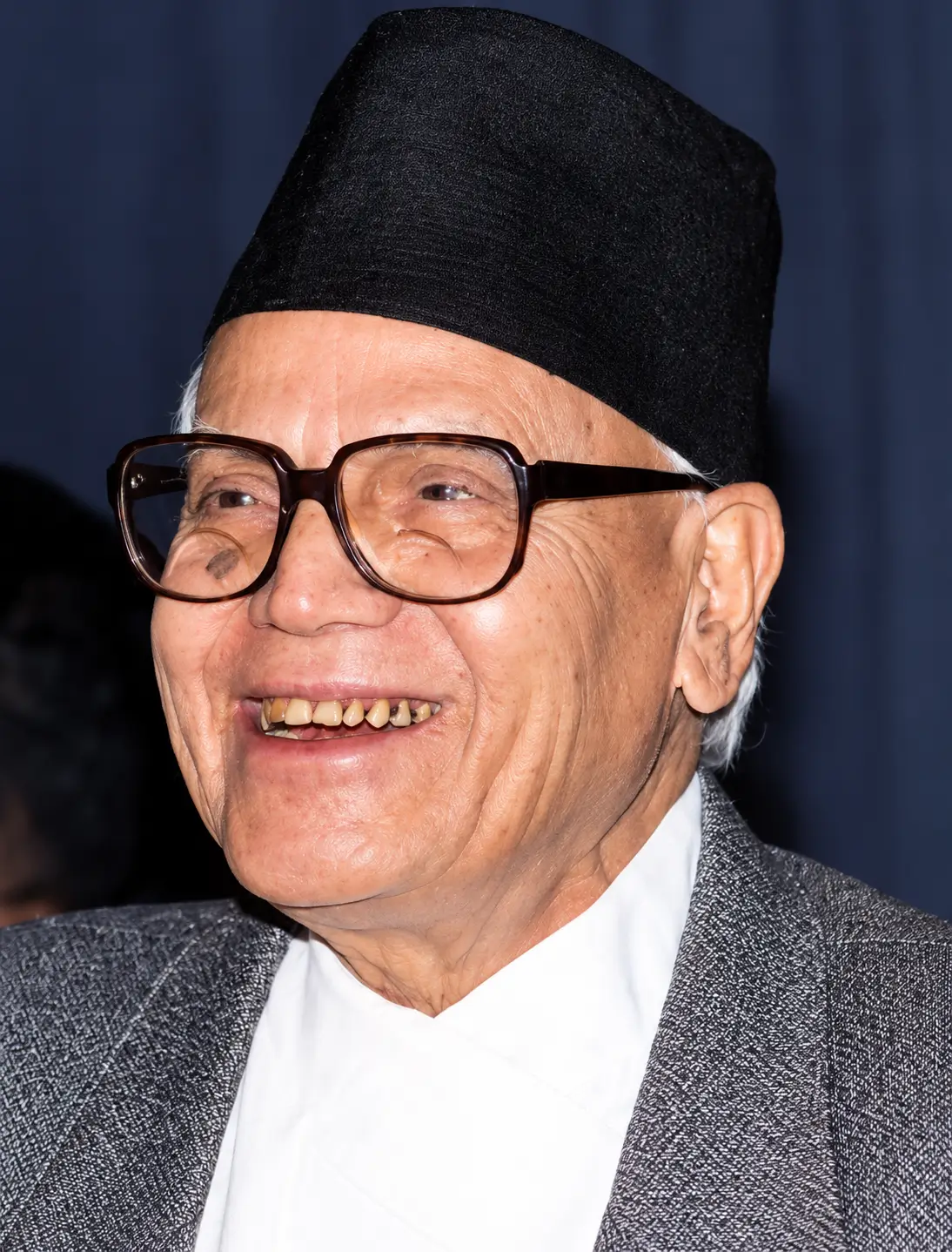
Krishna Prasad Bhattarai (1924–2011 AD / 1981–2067 BS) was a former Prime Minister of Nepal, the first Speaker of the House of Representatives, a founding leader of the Nepali Congress, and a prominent figure in Nepal's democratic movements. Popularly known as "Kishunji" in Nepali political circles, he played an active role in the struggle against Rana rule and the movement to restore multiparty democracy.
Bhattarai was involved in the early organizational activities of the Nepali National Congress in Banaras, India, and participated in Nepal's democratic movement of 1951 (2007 BS). In 1959 (2016 BS), he became the Speaker of Nepal's first elected House of Representatives. After King Mahendra dismissed the elected government on Poush 1, 2017 BS, he spent many years in prison.
Following the People's Movement of 1990 (2046 BS), Bhattarai became Prime Minister of the interim government. He led the process that resulted in the promulgation of the Constitution of the Kingdom of Nepal, 1990 (2047 BS), and the general election of 1991 (2048 BS). He was appointed Prime Minister for a second time in 1999 (2056 BS).
Bhattarai was also known as a "Saint Leader" because of his simple lifestyle, commitment to democratic values, and conduct while holding public office. However, toward the end of his political career, his support for constitutional monarchy conflicted with the Nepali Congress's decision to adopt a republican political position.
Krishna Prasad Bhattarai: Quick Facts
|
Details |
Information |
|---|---|
|
Full Name |
Krishna Prasad Bhattarai |
|
Popular Names |
Kishunji, Saint Leader |
|
Birth |
1981 BS (1924 AD) |
|
Birthplace |
Varanasi (Banaras), India |
|
Death |
Falgun 20, 2067 BS (March 4, 2011) |
|
Place of Death |
Norvic International Hospital, Kathmandu |
|
Nationality |
Nepali |
|
Father |
Sankata Prasad Bhattarai |
|
Mother |
Lalita Devi Bhattarai |
|
Marital Status |
Unmarried |
|
Education |
Higher education associated with Banaras Hindu University |
|
Political Party |
Nepali Congress |
|
First Term as Prime Minister |
2047–2048 BS (1990–1991 AD) |
|
Second Term as Prime Minister |
2056 BS (1999–2000 AD) |
|
Speaker of the House of Representatives |
Ashadh 19, 2016 BS to Poush 1, 2017 BS |
|
Chairman of the Advisory Assembly |
2009 BS |
|
Nepali Congress Leadership |
Acting President and elected President |
|
Contribution to Journalism |
President of the Nepal Journalists Association formed in 2012 BS |
|
Published Work |
Mero Ma (Autobiography) |
Birth, Family Background, and Childhood
Krishna Prasad Bhattarai was born in 1924 in Varanasi, Uttar Pradesh, India. His family's ancestral roots were in Gorkha, Nepal.
His father was Sankata Prasad Bhattarai, and his mother was Lalita Devi Bhattarai. He was the youngest of four brothers. His elder brothers were Batuk Prasad, Narayan Prasad, and Gopal Prasad Bhattarai.
Gopal Prasad Bhattarai was also associated with journalism and political activities. Krishna Prasad spent his early years in Banaras at a time when organizational activities among Nepali political activists in India were increasing.
Banaras was an important center of religious studies, Sanskrit education, and political activity. Its educational and social setting influenced Bhattarai's intellectual development and political awareness.
Differences in Historical Records About His Birth Date
Although Krishna Prasad Bhattarai's birth year is generally recorded as 1981 BS (1924 AD), published sources differ on his exact date of birth.
Some biographies mention December 13, 1924, while others record December 22 or 23. Accounts of his traditional lunar birth date are also inconsistent.
Therefore, rather than presenting any of these conflicting dates as an undisputed fact, this biography retains only his birth year.
Education and Intellectual Development
Krishna Prasad Bhattarai received his early education in Banaras. He later pursued higher education at Banaras Hindu University.
Various biographies indicate that he studied Sanskrit and other modern subjects. However, published sources differ regarding his formal university qualifications. Some state that he obtained a bachelor's degree, while others suggest that he did not complete his formal studies.
During his student years, Bhattarai became involved in organizational activities among Nepali students in Banaras. He also held a leadership position in an organization of Nepali students studying at Banaras Hindu University.
The Indian independence movement, democratic ideas, and political organizational activities helped shape the direction of his public life.
Participation in the Indian Independence Movement
Krishna Prasad Bhattarai's early political career was connected with the Indian independence movement.
In 1942, he participated in the Quit India Movement launched under the leadership of Mahatma Gandhi. He was arrested and detained for some time because of his involvement in political activities against British rule.
According to accounts based on Bhattarai's autobiography, he worked with his elder brother Gopal Prasad Bhattarai and other associates to publish and distribute pamphlets opposing British rule.
His arrest and detention during this period became an important experience in his early political journey.
Participation in the Indian independence movement introduced Bhattarai to political organization, public mobilization, and different methods of protest. He later applied this experience in Nepal's democratic movement.
Establishment of the Nepali National Congress and His Early Role
Krishna Prasad Bhattarai was among the leaders involved in the early organization of the Nepali National Congress.
According to the official history of the Nepali Congress, on Ashwin 18, 2003 BS, Bishweshwar Prasad Koirala issued an appeal through The Searchlight, a newspaper published in Patna, India, calling for the establishment of a democratic political organization in Nepal.
Subsequently, on Kartik 15, 2003 BS, a gathering at Narendra Regmi's residence in Dugdhabinayak, Banaras, formed a preparatory committee to establish the All India Nepali National Congress.
The committee was headed by Subba Devi Prasad Sapkota as President, with Bishweshwar Prasad Koirala as Convener, Bal Chandra Sharma as Vice President, and Krishna Prasad Upadhyaya Bhattarai as General Secretary.
Gopal Prasad Bhattarai served as Publicity Secretary on the same committee.
A convention held at Khalsa School in Bhawanipur, Calcutta, on Magh 12 and 13, 2003 BS, adopted the name "Nepali National Congress."
Following the convention, Tanka Prasad Acharya was appointed Honorary President, while Bishweshwar Prasad Koirala became Acting President. Krishna Prasad Bhattarai was assigned responsibility as Organization Secretary.
Bhattarai contributed to expanding the organization, conducting publicity activities, and mobilizing Nepalis for the movement against Rana rule.
Formation of the Nepali Congress
The Nepali Congress was formed on Chaitra 27, 2006 BS (April 9, 1950), following the merger of the Nepali National Congress and the Nepal Democratic Congress.
Leaders including Subarna Shumsher Rana and Mahendra Bikram Shah had played important roles in establishing the Nepal Democratic Congress.
Following the merger, the movement against Rana rule in Nepal proceeded under the leadership of a unified political party.
Krishna Prasad Bhattarai was one of the founding leaders of the Nepali Congress.
Role in the Democratic Movement of 1951 (2007 BS)
Krishna Prasad Bhattarai held political and organizational responsibilities during the movement against Rana rule in 2007 BS.
Following a conference in Bairgania, India, the Nepali Congress decided to pursue an armed struggle to end Rana rule.
During this period, the party's Liberation Army conducted operations in different parts of Nepal. Bhattarai was associated with the leadership of Liberation Army activities in certain areas of eastern and central Nepal.
Contemporary memoirs and biographies describe a group under his leadership conducting activities in Udayapur and surrounding areas.
After Rana rule ended and democracy was established on Falgun 7, 2007 BS, Bhattarai became active in building political organizations and developing representative governance under the new political system.
Contribution as Chairman of the Advisory Assembly
Following the political change of 2007 BS, efforts began to develop a representative system of government in Nepal.
As part of this process, King Tribhuvan established a 35-member Advisory Assembly on Ashwin 16, 2008 BS.
The assembly was assigned responsibilities that included discussing matters of public importance, examining the budget, advising the government, and making recommendations concerning legislation.
Its first meeting took place on Ashadh 16, 2009 BS.
According to a historical study based on Gorkhapatra archives, Krishna Prasad Bhattarai was elected Chairman of the Assembly on that day. Poet Laxmi Prasad Devkota was also a candidate in the election.
As Chairman, Bhattarai gained experience in conducting assembly proceedings and parliamentary procedures.
This experience proved useful when he assumed responsibility as Speaker of the House of Representatives in 2016 BS.
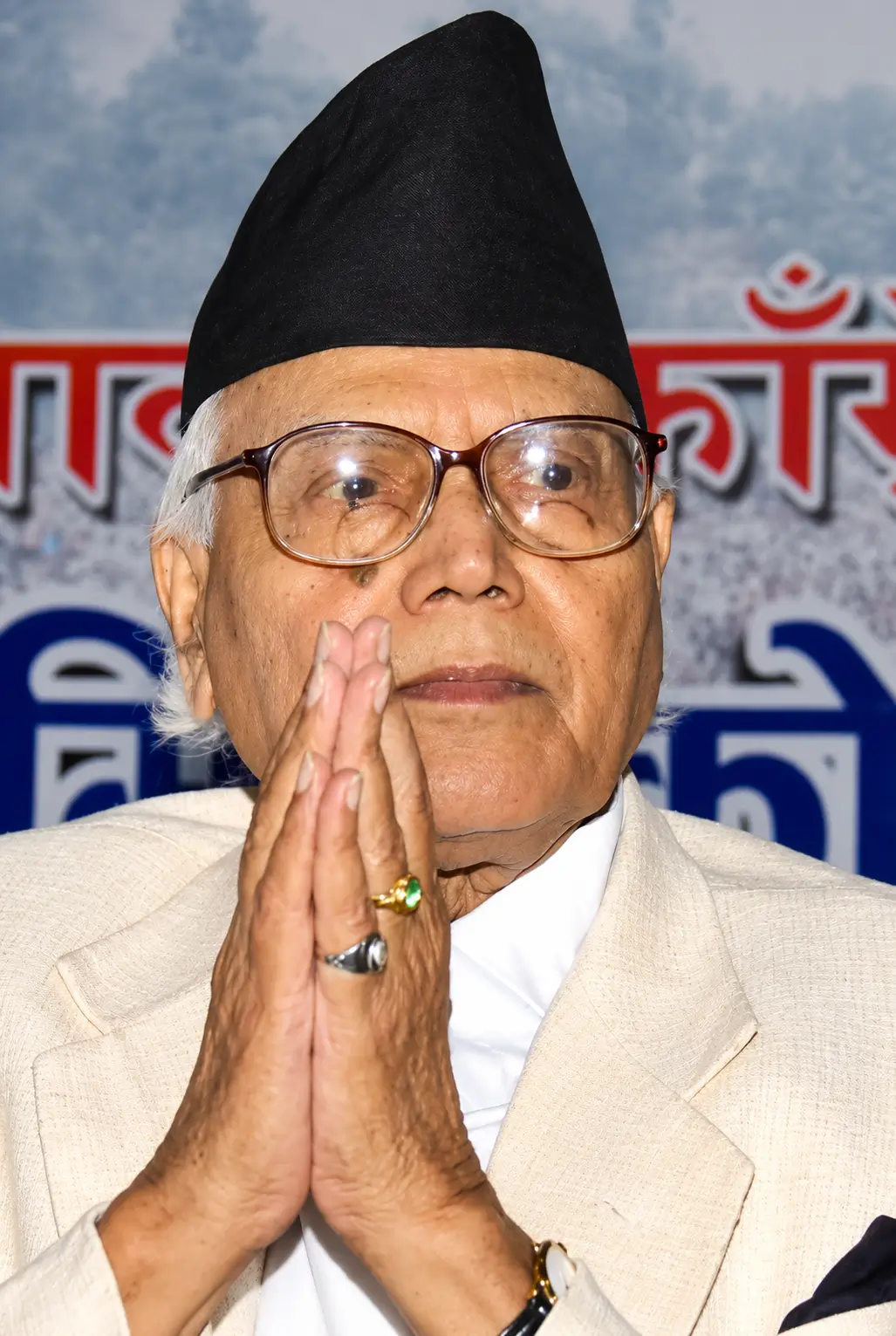
Contributions to Journalism and the Nepal Journalists Association
Krishna Prasad Bhattarai's contributions were not limited to politics. He was also involved in journalism and the organization of media professionals.
He worked in the editorial activities of publications such as Yugvani and Nepal Pukar. In the political circumstances of that period, these publications served as platforms for disseminating democratic ideas and reporting political activities.
Bhattarai served as President of the Nepal Journalists Association, established on Chaitra 16, 2012 BS.
According to the official institutional history of the Federation of Nepali Journalists, the present federation developed from the association established in 2012 BS. The association was transformed into a federation on Jestha 29, 2053 BS.
Early History of the Nepal Journalists Association
There is an important historical difference in accounts of the early development of the Nepal Journalists Association.
Some studies of Nepal's journalism history state that a Nepal Journalists Association had already been established in 2008 BS under the leadership of Satya Narayan Bahadur Shrestha.
However, the Federation of Nepali Journalists recognizes the association established on Chaitra 16, 2012 BS as the basis of its institutional history.
Therefore, the establishment of Nepal's earliest journalists' organization and the founding date recognized by the present federation should be understood within their different historical contexts.
It is established that Krishna Prasad Bhattarai was President of the Nepal Journalists Association formed in 2012 BS.
First Speaker of Nepal's House of Representatives
Krishna Prasad Bhattarai became the Speaker of Nepal's first elected House of Representatives in 2016 BS.
In Nepal's first general election, which began on Falgun 7, 2015 BS, the Nepali Congress won 74 of the 109 seats.
Following the election, Nepal's first elected government was formed under the leadership of Bishweshwar Prasad Koirala.
Bhattarai also contested the election as a Nepali Congress candidate but lost the House of Representatives election from Gorkha.
How Did He Become Speaker Despite Losing the Election?
Article 29 of the Constitution of the Kingdom of Nepal, 2015 BS, contained provisions relating to the Speaker and Deputy Speaker of the House of Representatives.
Under those provisions, a person who was not a member of the House of Representatives could also be elected Speaker.
Bhattarai was elected Speaker under this constitutional provision.
According to the official records of the Federal Parliament Secretariat, Krishna Prasad Bhattarai served as Speaker from Ashadh 19, 2016 BS to Poush 1, 2017 BS.
As Speaker, he contributed to the early functioning of Nepal's new parliamentary system, the conduct of parliamentary meetings, and the development of parliamentary procedures.
Political Events of 1960 (2017 BS) and Imprisonment
On Poush 1, 2017 BS (December 15, 1960), King Mahendra dismissed the elected government and dissolved Parliament.
Political parties were subsequently banned.
Several leaders, including then-Prime Minister Bishweshwar Prasad Koirala, Ganesh Man Singh, and Krishna Prasad Bhattarai, were arrested.
Bhattarai was detained at the Sundarijal prison, where he spent a considerable period alongside other political prisoners.
He remained continuously imprisoned for approximately a decade, from 2017 BS to 2026 BS. Biographical accounts indicate that his total time in prison reached approximately 14 years because he was arrested on several other occasions during political movements.
Even after his release, Bhattarai continued political activities against the Panchayat system.
His prolonged imprisonment and involvement in political organization under restrictions became important parts of his contribution to Nepal's democratic movement.
Leadership of the Nepali Congress During the Panchayat Period
Krishna Prasad Bhattarai led the Nepali Congress for many years as its Acting President during the Panchayat period.
According to the Nepali Congress's official convention history, he was serving as Acting President of the party in 2034 BS.
He contributed to maintaining the organization's activities while political parties were banned, coordinating with leaders including Bishweshwar Prasad Koirala, Ganesh Man Singh, and Subarna Shumsher Rana.
After Bishweshwar Prasad Koirala and Ganesh Man Singh returned to Nepal on Poush 16, 2033 BS, with a policy of national unity and reconciliation, Bhattarai remained active in organizational activities within the country.
During the referendum of 2036 BS, he participated in campaigning and public mobilization in support of a multiparty political system.
Following the death of Bishweshwar Prasad Koirala in 2039 BS, Ganesh Man Singh, Krishna Prasad Bhattarai, and Girija Prasad Koirala played important roles in the leadership of the Nepali Congress.
Bhattarai also participated in the Satyagraha movement launched by the Nepali Congress in 2042 BS.
Elected President of the Nepali Congress
After the restoration of multiparty democracy in 2046 BS, the Nepali Congress reorganized itself and held a party convention.
Krishna Prasad Bhattarai was elected President at the party's eighth general convention, held in Jhapa from Falgun 1 to 3, 2048 BS.
His tenure as elected President ended when Girija Prasad Koirala was elected to the position at the ninth general convention, held in Kathmandu from Baisakh 26 to 28, 2053 BS.
Contribution to the People's Movement of 1990 (2046 BS)
The People's Movement of 2046 BS was a political movement aimed at restoring multiparty democracy in Nepal.
The movement involved cooperation between the Nepali Congress and the United Left Front.
Ganesh Man Singh was the Supreme Commander of the movement, while Krishna Prasad Bhattarai was among the principal leaders of the Nepali Congress.
The movement began on Falgun 7, 2046 BS, with the participation of various political parties, students, and civil society groups.
Following sustained public pressure, King Birendra lifted the ban on political parties on Chaitra 26, 2046 BS, restoring the multiparty system.
The process of forming an interim government under the new political arrangement then began.
First Term as Prime Minister: 1990–1991 (2047–2048 BS)
Krishna Prasad Bhattarai became Prime Minister of Nepal's interim government on Baisakh 6, 2047 BS (April 19, 1990).
After Ganesh Man Singh, the Supreme Commander of the People's Movement, declined to accept the position of Prime Minister, Bhattarai was given the responsibility of leading the interim government.
A coalition government was formed under his leadership, comprising representatives of the Nepali Congress, left-wing groups, and other political representatives.
The interim government's main responsibilities were managing the political transition, preparing a new constitution, and conducting multiparty general elections.
Promulgation of the Constitution of the Kingdom of Nepal, 1990
During Bhattarai's tenure as Prime Minister, the Constitution of the Kingdom of Nepal, 2047 BS, was promulgated on Kartik 23, 2047 BS (November 9, 1990).
A Constitution Recommendation Commission chaired by Bishwanath Upadhyaya had been formed to prepare the new constitution.
The constitution incorporated provisions for constitutional monarchy, a multiparty parliamentary system, sovereignty vested in the people, fundamental rights, and an independent judiciary.
It retained the monarchy while establishing a system in which governments would be formed and operated through elected representatives.
Providing a constitutional foundation for the multiparty system restored after the People's Movement of 2046 BS was a major achievement of Bhattarai's government.
Improvement of Relations with India
Efforts were also made to improve Nepal's relations with India during Bhattarai's first term as Prime Minister.
Disruptions in trade and transit arrangements beginning in 2045 BS had created economic difficulties in Nepal.
Prime Minister Bhattarai visited India from Jestha 25 to 27, 2047 BS.
During the visit, he held discussions with Indian Prime Minister Vishwanath Pratap Singh on Nepal–India relations and bilateral cooperation.
Following the visit, efforts proceeded to facilitate trade and transit relations between the two countries.
General Election of 1991 (2048 BS)
The interim government led by Bhattarai conducted the general election for the House of Representatives on Baisakh 29, 2048 BS (May 12, 1991).
The Nepali Congress secured a majority by winning 110 seats in the 205-member House of Representatives.
However, Prime Minister Bhattarai himself lost the election in Kathmandu Constituency No. 1 to Madan Kumar Bhandari of the Communist Party of Nepal (Unified Marxist–Leninist), or CPN-UML.
Madan Bhandari received 27,372 votes, while Krishna Prasad Bhattarai secured 26,621 votes. The difference between the two candidates was 751 votes.
Following the election, Bhattarai resigned as Prime Minister. A new government was subsequently formed under the leadership of Girija Prasad Koirala.
Thus, overseeing the promulgation of a new constitution and conducting general elections became the principal historical achievements of Bhattarai's first term as Prime Minister.
By-Election of 2050 BS and Internal Disagreements in the Nepali Congress
Following the death of Madan Kumar Bhandari, then General Secretary of the CPN-UML, in the Dasdhunga accident on Jestha 3, 2050 BS, the House of Representatives seat for Kathmandu Constituency No. 1 became vacant.
A by-election was held in the constituency on Magh 25, 2050 BS.
Krishna Prasad Bhattarai contested the election as the Nepali Congress candidate, while Bidhya Devi Bhandari represented the CPN-UML.
Bidhya Devi Bhandari won the election, and Krishna Prasad Bhattarai was defeated again.
Following the by-election result, disagreements within the Nepali Congress intensified over party leadership and organizational discipline.
Some party leaders and workers alleged internal sabotage during the election. The role of then-Prime Minister Girija Prasad Koirala also became a subject of controversy within the party.
However, these political allegations should not be treated as independently established conclusions.
The political rivalry between Bhattarai and Koirala became a major factor influencing the internal politics of the Nepali Congress during that period.
Second Term as Prime Minister: 1999–2000 (2056 BS)
Krishna Prasad Bhattarai was appointed Prime Minister for the second time on Jestha 17, 2056 BS (May 31, 1999).
Before the general election of 2056 BS, the Nepali Congress had presented him as its prospective Prime Minister.
Bhattarai was elected to the House of Representatives from Parsa Constituency No. 1 in that election.
According to election records, the Nepali Congress won a majority with 111 of the 205 seats.
A Nepali Congress government was subsequently formed under Bhattarai's leadership.
Challenges During His Second Term
During Bhattarai's second term as Prime Minister, Nepal was experiencing the Maoist armed conflict.
Maintaining law and order, ensuring political stability, managing the conflict, and running the government administration were among the major challenges of the period.
The government also formed a study committee under the leadership of Sher Bahadur Deuba to explore possible solutions to the Maoist conflict.
Meanwhile, disagreements within the Nepali Congress intensified over government leadership and its functioning.
Political differences between Prime Minister Bhattarai and party President Girija Prasad Koirala became a matter of public controversy.
As internal party pressure increased, Bhattarai announced his resignation as Prime Minister on March 16, 2000.
His second term ended when a new government was formed under the leadership of Girija Prasad Koirala on March 22, 2000.
While Bhattarai's first term had involved successfully overseeing the promulgation of a constitution and the conduct of general elections, his second term was shortened by internal leadership disputes within the party.
Krishna Prasad Bhattarai's Role in the Melamchi Water Supply Project
The proposal to bring water from Melamchi to the Kathmandu Valley became closely associated with Krishna Prasad Bhattarai's public political commitments.
Before the general election of 2048 BS, he publicly committed to bringing Melamchi water to the Kathmandu Valley during a political gathering in Kathmandu.
At the time, Kathmandu was facing increasing drinking water shortages. Bhattarai presented the proposal to bring water from Melamchi as a public political priority.
However, studies and discussions concerning the feasibility and concept of the Melamchi Water Supply Project had already taken place before his announcement.
Therefore, rather than claiming that Bhattarai was the first person to conceive the project, it is more accurate to state that he helped bring the proposal into public political focus.
He also remained active in efforts to advance the Melamchi project during his second term as Prime Minister.
Since various governments, agencies, and development partners contributed to the project's lengthy implementation process, its overall achievements cannot be attributed exclusively to any single individual or administration.
Writing, Journalism, and Autobiography
Krishna Prasad Bhattarai was involved in writing and journalism alongside his political activities.
During the early organizational development of the Nepali National Congress, he contributed to newspaper editing and the communication of political ideas.
His autobiography, Mero Ma, was published as a collection of his personal experiences and recollections.
The book covers his childhood, life in Banaras, participation in the Indian independence movement, the early history of the Nepali Congress, and his personal and political experiences.
CiNii Books, a Japanese academic library catalog system, contains a bibliographic record of the 2011 edition of Mero Ma: Autobiography.
The autobiography is a useful source for understanding Bhattarai's life and Nepal's political history from his own perspective. However, personal recollections presented in autobiographies should also be examined alongside other historical records.
Personal Life and the Identity of a "Saint Leader"
Krishna Prasad Bhattarai remained unmarried throughout his life.
His personal life was widely associated with simple living, limited personal needs, and dedication to public service.
One frequently recalled account describes him leaving his official residence after stepping down as Prime Minister with a few personal belongings, an umbrella, and a traditional water vessel known as a surahi.
His simple lifestyle and reported lack of interest in accumulating personal wealth led supporters and media outlets to refer to him as a "Saint Leader."
Bhattarai was also known for using humor and satire in conversation. Contemporary memoirs describe his ability to express his views in straightforward language, even when discussing serious political matters.
However, "Saint Leader" was a popular public nickname rather than an official title. It should not be understood as a comprehensive assessment of his entire political career.
Views on Constitutional Monarchy and Decision to Leave the Nepali Congress
Toward the end of his political career, Krishna Prasad Bhattarai continued to support multiparty democracy under a constitutional monarchy.
Following the People's Movement of 2062/63 BS, the future of Nepal's monarchy and the establishment of a republic became major subjects of political debate.
In 2064 BS, the Nepali Congress decided to support a federal democratic republic. Bhattarai expressed his disagreement with the decision.
On September 26, 2007, he announced that he was severing his ties with the Nepali Congress.
The relationship between constitutional monarchy and multiparty democracy remained important to Bhattarai's political outlook.
However, the Nepali Congress leadership at the time accepted republicanism as a necessary direction for political change.
This disagreement illustrates the distinction between Bhattarai's historical role in Nepal's democratic movements and the political position he maintained toward the end of his career.
Later Years and Death
As his political activities declined, Krishna Prasad Bhattarai spent the later years of his life at his residence in Bandegaun, Lalitpur.
His health gradually deteriorated with advancing age.
When his health problems became more serious, he was admitted to Norvic International Hospital in Kathmandu for treatment.
He died while undergoing treatment on Falgun 20, 2067 BS (March 4, 2011), at the age of 86.
His funeral was conducted with state honors at Pashupati Aryaghat in Kathmandu.
His death marked the passing of a veteran political leader who had directly participated in the early organization of the Nepali Congress, the struggle against Rana rule, and the movement against the Panchayat system.
Historical Contributions of Krishna Prasad Bhattarai
Krishna Prasad Bhattarai's contributions to Nepal's modern political history are closely associated with the democratic movement, the development of parliamentary institutions, and the leadership of a transitional government.
1. Development of Democratic Political Organizations
Bhattarai was active from the formation of the initial preparatory committee of the Nepali National Congress through the establishment of the Nepali Congress.
He contributed to building political organizations, mobilizing party workers, and conducting the movement against Rana rule.
2. Development of Parliamentary Practices
As Chairman of the Advisory Assembly in 2009 BS and the first Speaker of the House of Representatives in 2016 BS, Bhattarai played a role in Nepal's early parliamentary practices.
His leadership was significant during a period when procedures for parliamentary meetings and the functioning of representative institutions were still developing.
3. Democratic Struggle Against the Panchayat System
Despite spending many years in prison following the political events of 2017 BS, Bhattarai remained involved in democratic movements.
During the Panchayat period, he contributed to maintaining the Nepali Congress organization and mobilizing public support for the restoration of a multiparty political system.
4. Constitutional Development and General Elections
During Bhattarai's first term as Prime Minister, the Constitution of the Kingdom of Nepal, 2047 BS, was promulgated, and multiparty general elections were held in 2048 BS.
Both events provided an institutional foundation for the multiparty system restored following the People's Movement of 2046 BS.
5. Development of Journalists' Organizations
As President of the Nepal Journalists Association established in 2012 BS, Bhattarai contributed to the organizational development of journalists in Nepal.
Although historical accounts differ regarding the earliest journalists' organization, his leadership of the association established in 2012 BS is an established historical fact.
Political Challenges and Limitations
Krishna Prasad Bhattarai's political career was marked by important challenges as well as achievements.
He was unable to complete his second term as Prime Minister because of leadership disputes within the Nepali Congress.
Similarly, his position on republicanism toward the end of his political career differed from the new political direction adopted by the party.
These developments should be assessed within the historical circumstances of his political journey. His contribution to democratic movements and the political positions he supported throughout his career do not necessarily require identical assessments.
Conclusion
Krishna Prasad Bhattarai was an important leader in Nepal's democratic political history. He played notable roles in the early organization of the Nepali Congress, the democratic movement of 2007 BS, the office of the first Speaker of the House of Representatives, and the struggle against the Panchayat system.
His principal achievement in public office was leading the interim government after the People's Movement of 2046 BS, overseeing the promulgation of the Constitution of 2047 BS, and conducting the general election of 2048 BS.
Having served twice as Prime Minister and led the Nepali Congress for many years, Bhattarai experienced achievements, disagreements, and challenges throughout his political career.
His life provides an important perspective on Nepal's political history, from the movement against Rana rule to the restoration of multiparty democracy under a constitutional monarchy and the subsequent transition toward a republic.
References
1. Nepali Congress — Official History. Historical information about the establishment of the Nepali National Congress, the formation of the Nepali Congress, party conventions, and democratic movements.
2. Government of Nepal, Office of the Prime Minister and Council of Ministers — Former Prime Ministers. Official information concerning Krishna Prasad Bhattarai's terms as Prime Minister.
3. Federal Parliament Secretariat — Former Office Bearers of the House of Representatives. Official records concerning the Speaker of Nepal's first House of Representatives and the duration of his tenure.
4. Nepal Law Commission — Constitution of the Kingdom of Nepal, 2015 BS. Constitutional provisions concerning the Speaker and Deputy Speaker of the House of Representatives.
5. Gorkhapatra — Beginning of Parliamentary Practices. A historical study of Nepal's early Advisory Assembly and Krishna Prasad Bhattarai's election as its Chairman.
6. Federation of Nepali Journalists — Institutional Introduction. Official information on the establishment of the Nepal Journalists Association and its transformation into the federation.
7. Martin Chautari — Study of the Institutional History of Journalists' Associations. A study examining the early history of journalists' organizations in Nepal.
8. Amrit Kumar Shrestha — Position of Nepali Congress in the Electoral Politics of Nepal. Researcher, Vol. 4, No. 2, July 2020. A study of the Nepali Congress's electoral history and the results of the general elections of 2048 BS and 2056 BS.
9. Inter-Parliamentary Union (IPU) — Nepal Parliamentary Elections, 1999. Records concerning Nepal's 1999 House of Representatives election and the formation of the government.
10. Hom Raj Dahal — Remembering KP Bhattarai, The Kathmandu Post. A 2014 personal recollection covering Krishna Prasad Bhattarai's family background, education, and early political life.
11. Kantipur — Former Prime Ministers Who Lost Parliamentary Elections. Information concerning Krishna Prasad Bhattarai's election result in 2048 BS.
12. Kantipur Archive — Bidhya's Political Career That Began by Defeating Krishna Prasad. Historical information concerning the by-election of 2050 BS.
13. CiNii Books — Mero Ma: Autobiography. Library catalog record and publication details of Krishna Prasad Bhattarai's autobiography.
14. Gorkhapatra — Melamchi Water Reaches the Taps. Historical background concerning Krishna Prasad Bhattarai's public commitment to the Melamchi Water Supply Project.
15. Reuters — Nepal's Biggest Party to Ditch Monarchy in Polls. A September 2007 report concerning the Nepali Congress's republican position and Krishna Prasad Bhattarai's disagreement.
16. Republica — Krishna Prasad Bhattarai Passes Away. A news report published on March 4, 2011, concerning the death of Krishna Prasad Bhattarai.





Comments 0
No comments yet. Be the first to start the conversation.