



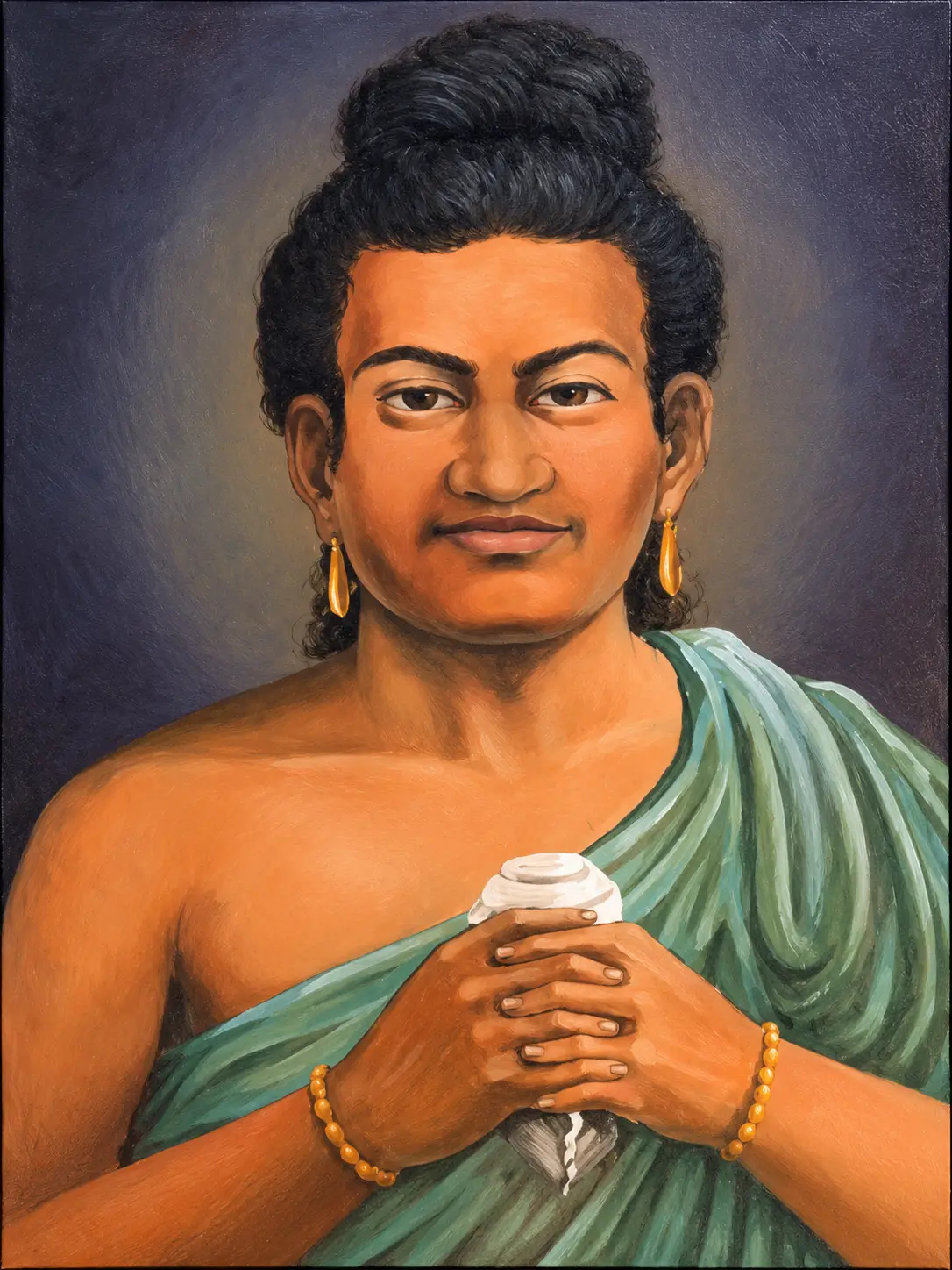
Sankhadhar Sakhwa is remembered in Nepal's history and cultural traditions as the founder of Nepal Sambat and a figure associated with public welfare. According to traditional chronicles and folklore, he paid off the debts of people in Nepal at the time and contributed to the introduction of a new calendar era to commemorate the event. In recognition of his contribution, the Government of Nepal declared him a National Luminary (Rastriya Bibhuti) on Mangsir 2, 2056 BS (November 18, 1999).
Nepal Sambat is generally considered to have begun in 879 AD, during the reign of King Raghavadeva. However, most accounts of Sankhadhar Sakhwa's birth, family, occupation, and debt-relief activities come from later chronicles and oral traditions.
The historical existence of Nepal Sambat and the events associated with Sankhadhar Sakhwa's personal life are not supported by the same level of evidence. Understanding his biography therefore requires distinguishing between historical records, accounts preserved in chronicles, and cultural beliefs.
Brief Introduction to Sankhadhar Sakhwa
|
Details |
Information |
|---|---|
|
Full Name |
Sankhadhar Sakhwa |
|
Other Spellings |
Shankhadhar Sakhwa, Sankhadhar Sakhva |
|
Historical Period |
Traditionally associated with the late ninth century |
|
Residence |
Kantipur (present-day Kathmandu), according to chronicles |
|
Known For |
Traditionally described as a merchant and public benefactor |
|
Major Contribution |
Traditionally associated with debt relief and the introduction of Nepal Sambat |
|
Beginning of Nepal Sambat |
879 AD (Kartik 936 BS) |
|
Ruler at the Time |
King Raghavadeva |
|
Birth and Death Dates |
Exact dates are unknown |
|
National Recognition |
National Luminary of Nepal |
|
Declaration as National Luminary |
Mangsir 2, 2056 BS (November 18, 1999) |
Historical Background: Nepal in the Ninth Century
Sankhadhar Sakhwa's contribution is associated with the beginning of Nepal Sambat. Understanding this development requires examining Nepal's political situation and calendar traditions during the late ninth century.
Historical inscriptions show that different calendar eras were used in Nepal during the Licchavi period and afterward. Historians have offered different interpretations of the names, chronological calculations, and relationships among these calendar systems.
In particular, scholars disagree about whether the era used during the Licchavi period should be identified with the Shaka Era, Manadeva Sambat, or Licchavi Sambat.
Historical studies establish that a new era of year reckoning began in 879 AD and later became known as Nepal Sambat. Sources including the Gopalrajavamsavali associate its early chronology with the reign of King Raghavadeva.
However, historians have not reached a consensus on the actual purpose of introducing the new era, the role of the political circumstances at the time, or the identities of the individuals directly involved in its establishment.
It is within this historical setting that Sankhadhar Sakhwa's name and the tradition of debt relief are placed.
Birth, Family, and Personal Life of Sankhadhar Sakhwa
Reliable information about Sankhadhar Sakhwa's date and place of birth, parents, spouse, children, and death is unavailable.
Traditional accounts associate his life with the late ninth century. However, sufficient contemporary records have not been found to establish his exact year of birth or death.
Later chronicles describe him as a merchant from Kantipur. Kathmandu's Maru area and places near the Bishnumati River are traditionally associated with his story.
Because these details of his personal life are based on cultural memory and chronicles, they cannot all be treated as directly verified historical facts.
Name and Identity
Sankhadhar Sakhwa's name appears in different forms across historical and cultural sources.
Spellings such as Shankhadhar Sakhwa, Sankhadhar Sakhwa, and Sankhadhar Sakhva are found in Nepali and Nepal Bhasa usage.
The chronicle included in History of Nepāl, edited by Daniel Wright and published in 1877, identifies the merchant associated with the debt-relief story as "Sakhwal."
These variations indicate differences in the spelling and identification of the individual across sources. In modern Nepali writing, the name Sankhadhar Sakhwa is widely used.
Education and Occupation
No reliable information is available about Sankhadhar Sakhwa's formal education, place of study, or academic qualifications.
Chronicles portray him as a financially prosperous individual associated with trade. However, there is no definite information about the goods he traded, the scale of his business, or how he accumulated his wealth.
It would therefore be inappropriate to draw conclusions about his education, occupation, or financial circumstances beyond what the available evidence supports.
Sankhadhar Sakhwa and the Legend of Sand Turning into Gold at Lakhatirtha
One of the best-known traditional stories associated with Sankhadhar Sakhwa concerns sand collected from Lakhatirtha on the Bishnumati River, which is said to have turned into gold.
A published version of this story appears in Chapter Four of History of Nepāl, edited by Daniel Wright in 1877.
According to the chronicle, an astrologer serving King Ananda Malla of Bhaktapur predicted that sand collected from Lakhatirtha at a particularly auspicious time would turn into gold.
Following the astrologer's advice, the king sent several porters to collect sand at the specified time and bring it to the palace.
The story states that while the porters were returning to Bhaktapur with the sand, they encountered a merchant from Kantipur named Sakhwal.
Sakhwal asked them to leave the sand they were carrying at his house and collect another load for the king. The porters agreed.
According to the story, the first load of sand turned into gold, while the second load remained ordinary sand.
The chronicle describes how Sakhwal used the wealth obtained in this manner to repay the debts of the people and, with the king's permission, introduced a new calendar era.
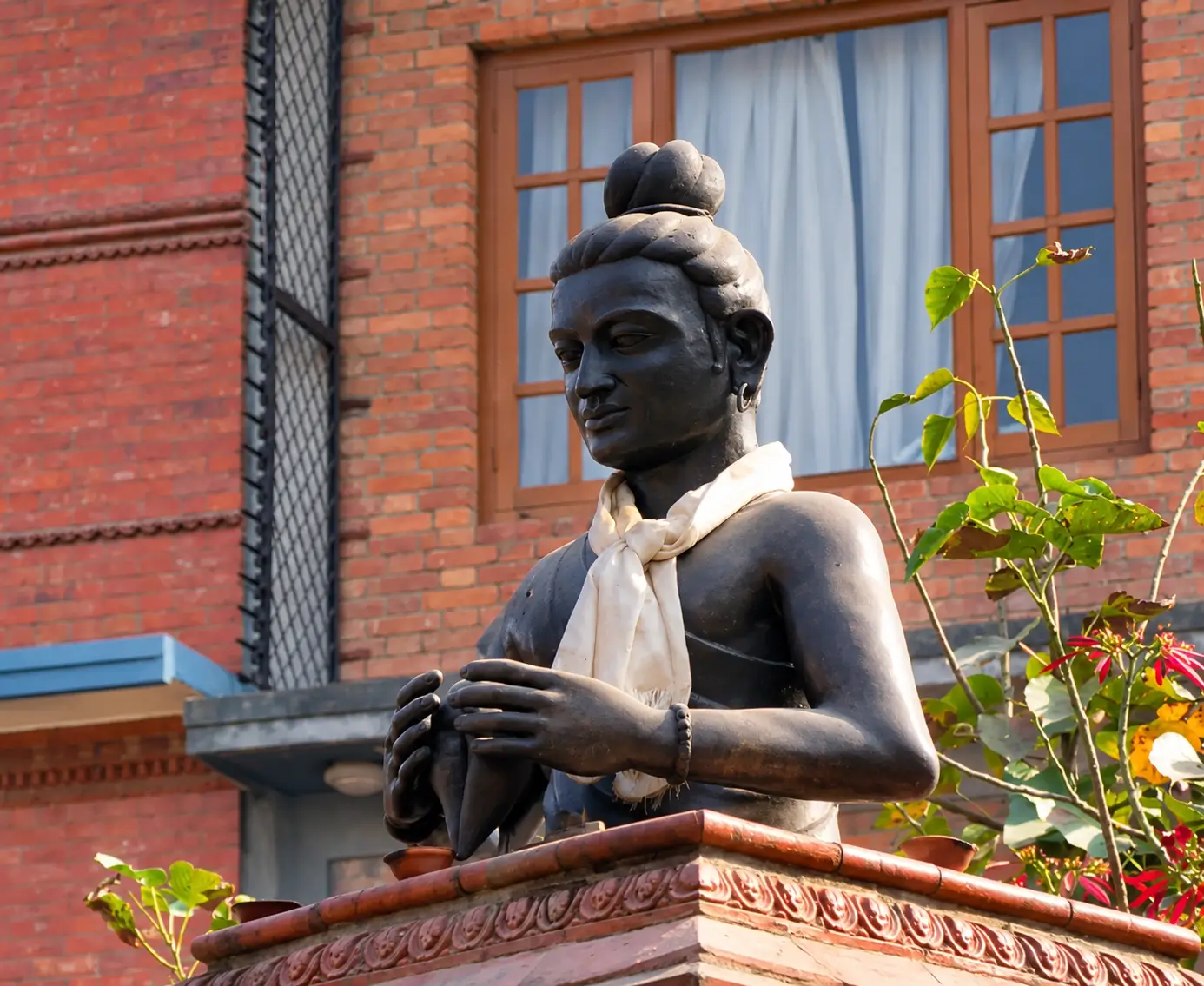
The same account also mentions that he established a chaitya near his house and placed a stone statue of himself at the southern entrance of the Pashupatinath Temple.
All these episodes form part of a traditional narrative preserved in the chronicle. They should not be presented as events confirmed by contemporary historical evidence.
Is the Story of Sand Turning into Gold Historically True?
No direct historical evidence is available to confirm that sand collected from Lakhatirtha turned into gold.
The chronicle describes this as a supernatural event. In the story, the transformation of sand into gold is directly connected with the repayment of people's debts using the wealth obtained.
From a historical perspective, such narratives should be understood in relation to the beliefs, collective memories, and moral ideals of the society in which they circulated.
The cultural significance of the story lies less in the extraordinary acquisition of wealth than in the traditional belief that the wealth was used for public welfare.
Debt Relief and the Introduction of Nepal Sambat
The principal basis for honoring Sankhadhar Sakhwa as the founder of Nepal Sambat is the traditional belief that he paid off the debts of the people.
According to the chronicles, he used his wealth to settle the financial obligations of those who were in debt. A new calendar era is said to have been introduced to commemorate this act.
Debt relief refers to freeing individuals from outstanding debts or financial obligations.
In Sankhadhar Sakhwa's story, this action is presented as an example of using personal wealth for the collective benefit of society.
However, contemporary records documenting the actual debt-relief event, the number of debtors, the amount of debt involved, or the repayment process are unavailable.
A distinction must therefore be made between the historical beginning of Nepal Sambat and the account of Sankhadhar Sakhwa repaying the debts of the people.
The chronology of Nepal Sambat can be studied through historical sources. By contrast, the account of Sankhadhar Sakhwa providing debt relief and initiating a new era comes from later chronicles and oral traditions.
When Did Nepal Sambat Begin?
Nepal Sambat is generally considered to have begun on Kartik Shukla Pratipada in 879 AD. This corresponds to the month of Kartik in 936 BS.
October 20, 879 AD is a commonly cited date in studies of Nepal Sambat's early chronology. However, older publications and some research works present differences in the calculation of the corresponding Gregorian date.
Epigraphist Shyam Sundar Rajbanshi has also presented an alternative interpretation of the commonly accepted calculation of Nepal Sambat's initial date.
It is therefore important to distinguish between the historical beginning of the era and the calculation of its exact corresponding date in the Western calendar.
Historical sources associate the beginning of Nepal Sambat with the reign of King Raghavadeva.
However, the purpose of introducing the era and the identity of the person directly responsible for establishing it remain subjects of historical study and debate.
Historical Sources and Evidence of Nepal Sambat
Nepal Sambat is a calendar system used in Nepal's historical inscriptions and manuscripts.
The Gopalrajavamsavali, later chronicles written in local languages, and epigraphic research are important sources for studying its origins and its association with Sankhadhar Sakhwa.
Gopalrajavamsavali and King Raghavadeva
The Gopalrajavamsavali is an important chronicle for studying Nepal's medieval history.
Believed to have been compiled in the fourteenth century, this source associates the beginning of a new calendar era with the reign of King Raghavadeva.
It mentions the introduction of the era in a passage connected with Pashupatinath.
However, historians interpret this account differently. Some regard it as evidence that King Raghavadeva himself initiated the new era, while others argue that it merely records the beginning of the era during his reign.
The Gopalrajavamsavali therefore provides an important basis for studying the early history of Nepal Sambat, but it does not establish the entire debt-relief story associated with Sankhadhar Sakhwa.
Daniel Wright's Chronicle
History of Nepāl, edited by Daniel Wright and published in 1877, is one of the sources used to study the traditional account associated with Sankhadhar Sakhwa.
Chapter Four describes sand being collected from Lakhatirtha, its transformation into gold, the repayment of people's debts by a merchant named Sakhwal, and the beginning of a new calendar era.
However, the chronicle also associates the names of King Ananda Malla and Jayadeva Malla with these events.
The traditional chronology associated with these names does not correspond to the beginning of Nepal Sambat in 879 AD. This suggests that events from different historical periods may have become mixed in later chronicles.
Wright's publication is therefore valuable for understanding history preserved through chronicles and oral traditions, but it cannot be treated as direct evidence from the ninth century.
Differences of Opinion Among Historians
Historians have offered different interpretations of the origins of Nepal Sambat and the role of Sankhadhar Sakhwa.
One interpretation regards the debt-relief story associated with Sankhadhar Sakhwa as a form of historical memory connected with the beginning of Nepal Sambat.
Another interpretation emphasizes the absence of sufficient contemporary evidence to establish his personal role.
In an interview published on June 12, 2026, epigraphist Shyam Sundar Rajbanshi expressed the view that no evidence is available to confirm that Sankhadhar Sakhwa himself introduced Nepal Sambat.
The interview, conducted by Govinda Neupane and published by Martin Chautari, discusses the chronology of Nepal Sambat, calendar eras used during the Licchavi period, and evidence relating to traditional beliefs about Sankhadhar Sakhwa.
Such studies demonstrate that cultural recognition of Sankhadhar Sakhwa and documentary confirmation of events in his personal life are separate matters.
Nepal Sambat Calendar System and Its Cultural Significance
Nepal Sambat is an indigenous lunar calendar system of Nepal. Its new year begins on Kartik Shukla Pratipada, the first day of the bright fortnight of Kartik.
In the traditional calendar, dates are calculated according to the phases of the Moon. Because the system also includes provisions for intercalary months, its dates do not fall on the same Gregorian dates every year.
The twelve traditional months of Nepal Sambat are known in Nepal Bhasa as Kachhala, Thinla, Pwanhela, Silla, Chilla, Chaula, Bachhala, Tachhala, Dilla, Gunla, Yanla, and Kaula.
The Nepal Sambat New Year is particularly associated with the cultural life of the Kathmandu Valley and the Newar community.
The occasion is marked by the exchange of New Year greetings, cultural programs, and public ceremonies. In Nepal Bhasa, the traditional New Year greeting is Nhudanya Bhintuna.
The observance of Mha Puja is also associated with this occasion. Mha Puja is a cultural ritual among the Newar community involving the worship of one's own body or self.
In a message issued on the occasion of Nepal Sambat 1144, the Office of the President described Nepal Sambat as Nepal's indigenous national calendar era.
Historical Use of Nepal Sambat
Nepal Sambat was used in inscriptions, manuscripts, and various historical documents during medieval Nepal.
Its use demonstrates that an organized system of time reckoning existed for recording information, conducting religious activities, and maintaining written records.
Although the calendar eras used for government purposes changed across different political periods, Nepal Sambat continued to survive through cultural practices.
Communities and organizations associated with Nepal Bhasa, literature, culture, and traditions have continued to use and preserve the calendar.
Nepal Sambat Movement and National Recognition
In modern times, various cultural campaigns have sought to expand the use of Nepal Sambat and secure national recognition for Sankhadhar Sakhwa's contribution.
The principal objectives of these campaigns included publicly celebrating the Nepal Sambat New Year, conducting research into its history, and increasing its use in government administration.
Cultural organizations, including Nepal Bhasa Manka Khala, have played a role in maintaining the identity and public use of Nepal Sambat.
Alongside these efforts, demands were also raised for Sankhadhar Sakhwa to be declared a National Luminary.
Sankhadhar Sakhwa's Declaration as a National Luminary
The Government of Nepal declared Sankhadhar Sakhwa a National Luminary on Mangsir 2, 2056 BS (November 18, 1999).
The decision was made by the Council of Ministers led by the then Prime Minister Krishna Prasad Bhattarai.
The Rastriya Bibhuti Sankhadhar Sakhwa Foundation clearly mentions the date of this declaration in information published on its official website about the organization and its activities.
The declaration formally recognized his traditional contribution to public welfare and the cultural identity associated with Nepal Sambat.
However, recognition as a National Luminary is a decision concerning national honor. It should not be interpreted as independent documentary confirmation of every event associated with Sankhadhar Sakhwa's personal life.
Government Recognition and Use of Nepal Sambat
The Government of Nepal has made decisions to grant national recognition to Nepal Sambat and expand its use in official documents.
On October 23, 2008, the government led by then Prime Minister Pushpa Kamal Dahal granted national recognition to Nepal Sambat.
Subsequently, at a Cabinet meeting held on Kartik 27, 2080 BS (November 13, 2023), the government decided that Nepal Sambat dates should also be included in government documents that mention Bikram Sambat dates, beginning with Nepal Sambat 1144.
The government decided that this provision would take effect from Kartik 28, 2080 BS, when Nepal Sambat 1144 began.
To implement the decision, the relevant government ministry also issued circulars to government agencies.
These decisions established a policy basis for expanding the official recognition and administrative use of Nepal Sambat alongside its existing cultural use.
Memorials and Cultural Remembrance of Sankhadhar Sakhwa
Statues and memorials have been established in different parts of Nepal to commemorate Sankhadhar Sakhwa's contribution.
Sankhadhar Chowk in Madhyapur Thimi is a public place associated with his name. It is customary to pay tribute at the statue located there and organize cultural programs on occasions including the Nepal Sambat New Year.
The Rastriya Bibhuti Sankhadhar Sakhwa Foundation is also active in studying, researching, and preserving materials relating to his contribution.
The foundation includes the study and preservation of historical and cultural materials concerning Sankhadhar Sakhwa and Nepal Sambat within its areas of work.
These activities have helped maintain public awareness of Sankhadhar Sakhwa and the cultural memory associated with Nepal Sambat.
Sankhadhar Sakhwa's Contributions and Social Significance
Sankhadhar Sakhwa's social significance is primarily based on the traditional account of debt relief and his association with Nepal Sambat.
His story describes the use of private wealth for public welfare. For this reason, he is honored as a symbol of philanthropy and social assistance.
His association with Nepal Sambat also connects his name with Nepal's historical calendar system and cultural identity.
His contributions can be understood from three perspectives.
First, the debt-relief story presents a traditional ideal of helping people facing financial difficulties.
Second, his association with Nepal Sambat connects his name with the preservation of Nepal's indigenous calendar system and cultural history.
Third, his recognition as a National Luminary and the establishment of public memorials in his honor demonstrate the national recognition of his cultural identity.
However, discussions of these contributions must maintain a clear distinction between traditional beliefs and the limits of historical evidence. This does not diminish his cultural significance. Rather, it helps readers develop a more evidence-based understanding of history.
Conclusion
Sankhadhar Sakhwa is a National Luminary associated with the history of Nepal Sambat and Nepal's cultural traditions. Traditional chronicles and folklore describe him as a person who helped introduce a new calendar era after paying off the debts of the people.
Historical studies associate the beginning of Nepal Sambat in 879 AD with the reign of King Raghavadeva. However, most accounts concerning Sankhadhar Sakhwa's personal life, acquisition of wealth, and debt-relief activities are based on later chronicles and oral traditions.
The Government of Nepal's declaration of Sankhadhar Sakhwa as a National Luminary in 1999, the national recognition granted to Nepal Sambat in 2008, and the 2023 decision concerning its use in government documents are important developments in the cultural history associated with his name.
Sankhadhar Sakhwa's biography provides a basis for understanding not only the history of Nepal's calendar systems but also traditional beliefs concerning philanthropy, public welfare, and cultural identity.
References
- Wright, Daniel (Editor). History of Nepāl. 1877, Chapter 4, pp. 163–164. Relevant section of the book.
- Rastriya Bibhuti Sankhadhar Sakhwa Foundation. Introduction and Historical Activities. Official website of the foundation.
- Neupane, Govinda, and Shyam Sundar Rajbanshi. There Is No Evidence That Sankhadhar Sakhwa Himself Introduced Nepal Sambat. Martin Chautari, June 12, 2026. Interview.
- Tribhuvan University Central Library. Calendar Eras Used in Inscriptions from the Licchavi Period. Research material.
- Office of the President, Nepal. President's Message on the Occasion of Nepal Sambat 1144. Kartik 28, 2080 BS.
- Government of Nepal, Ministry of Culture, Tourism and Civil Aviation. Official Correspondence Regarding the Implementation of the Cabinet Decision on the Use of Nepal Sambat, 2080 BS. Government document.
- Cultural Corporation, Government of Nepal. Information on Nepal Sambat and Mha Puja. Official material.
- The Kathmandu Post. “Nepal Sambat 1139 Being Marked with Fanfare.” November 8, 2018. News report.






Comments 0
No comments yet. Be the first to start the conversation.